HR Trends 2026: 63 Tips I Wish I’d Known
The first time I had to explain a “compensation adjustment” to a high performer, I used the kind of vague language that sounds safe… until you see the trust drain out of someone’s face. That moment sent me down a rabbit hole of HR tips—some classic, some painfully modern. This post is my stitched-together, real-world map of what I’d do differently today, using the spirit of “63 HR Tips Every Professional Should Know,” but updated for HR Trends 2026: employee mental health, skills-based hiring, AI integration, and the pay transparency move that’s changing how we talk about money at work.
1) Mental Health Support Isn’t a Perk—It’s Plumbing
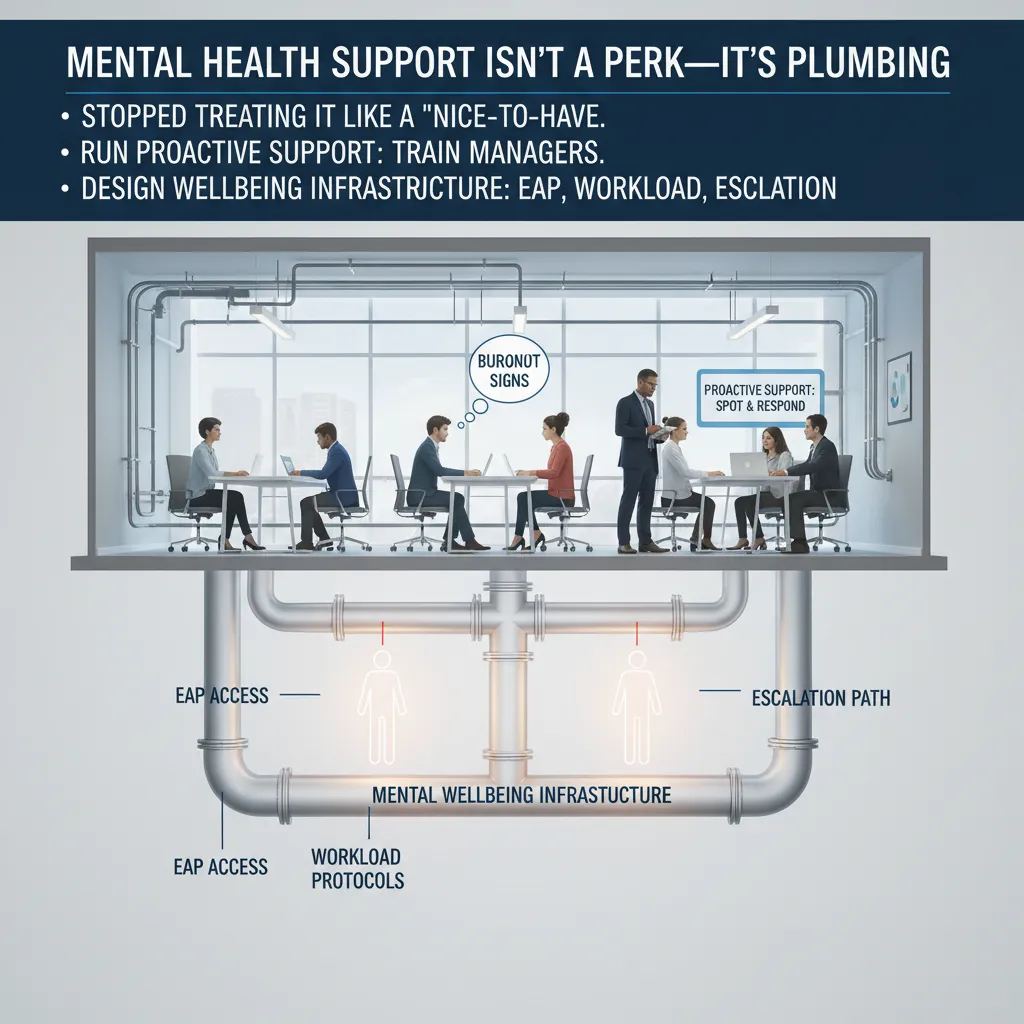
I used to treat employee mental health like a “nice-to-have.” Then I watched burnout quietly tank a whole team’s output. No big blow-up. No dramatic resignations at first. Just slower decisions, more mistakes, short tempers, and a steady drop in energy. That’s when I realized mental health support at work isn’t a perk like free snacks—it’s plumbing. If it’s broken, everything backs up.
Run proactive support (not reactive damage control)
In 2026, one of the biggest HR trends is moving from “we’ll help if you ask” to “we notice early and respond well.” That starts with manager training. Managers don’t need to be therapists, but they do need to spot burnout signs and know what not to say.
- Signs to watch: sudden quietness, missed deadlines, more sick days, sharp tone changes, “always on” behavior.
- What not to say: “Everyone’s stressed,” “Just manage your time,” “You seem fine,” “We all have to push through.”
- What to say instead: “I’ve noticed you’ve been carrying a lot. What’s making work hardest right now?”
Design wellbeing infrastructure like incident response
Good intentions don’t scale. Infrastructure does. I now think of wellbeing like IT reliability: you need clear access, clear rules, and a clear escalation path.
- EAP access that people can actually use: simple links, short instructions, private entry points, reminders during high-stress periods.
- Workload rules: limits on after-hours messaging, realistic staffing, and a process to pause low-value work.
- Escalation path: when someone is at risk, managers should know exactly who to contact and what happens next.
“Like IT incident response, but for people: detect early, respond fast, document, and prevent repeat issues.”
Flexible scheduling as burnout prevention
Flexibility isn’t only about location. It’s about recovery and focus. I’ve seen real gains from:
- Protected deep-work blocks (no meetings)
- Meeting caps (per day or per week)
- Recovery time after peak weeks (lighter load, delayed deadlines, or a true comp day)
A quick gut-check ritual that actually changes something
My favorite weekly prompt is simple:
“What’s the smallest change that would make Monday 10% easier?”
Then I make sure we actually do it—even if it’s small, like moving one recurring meeting, clarifying one priority, or removing one report no one reads.
2) Flexible Work Model: Stop Arguing About ‘Where’ and Start Measuring ‘When’
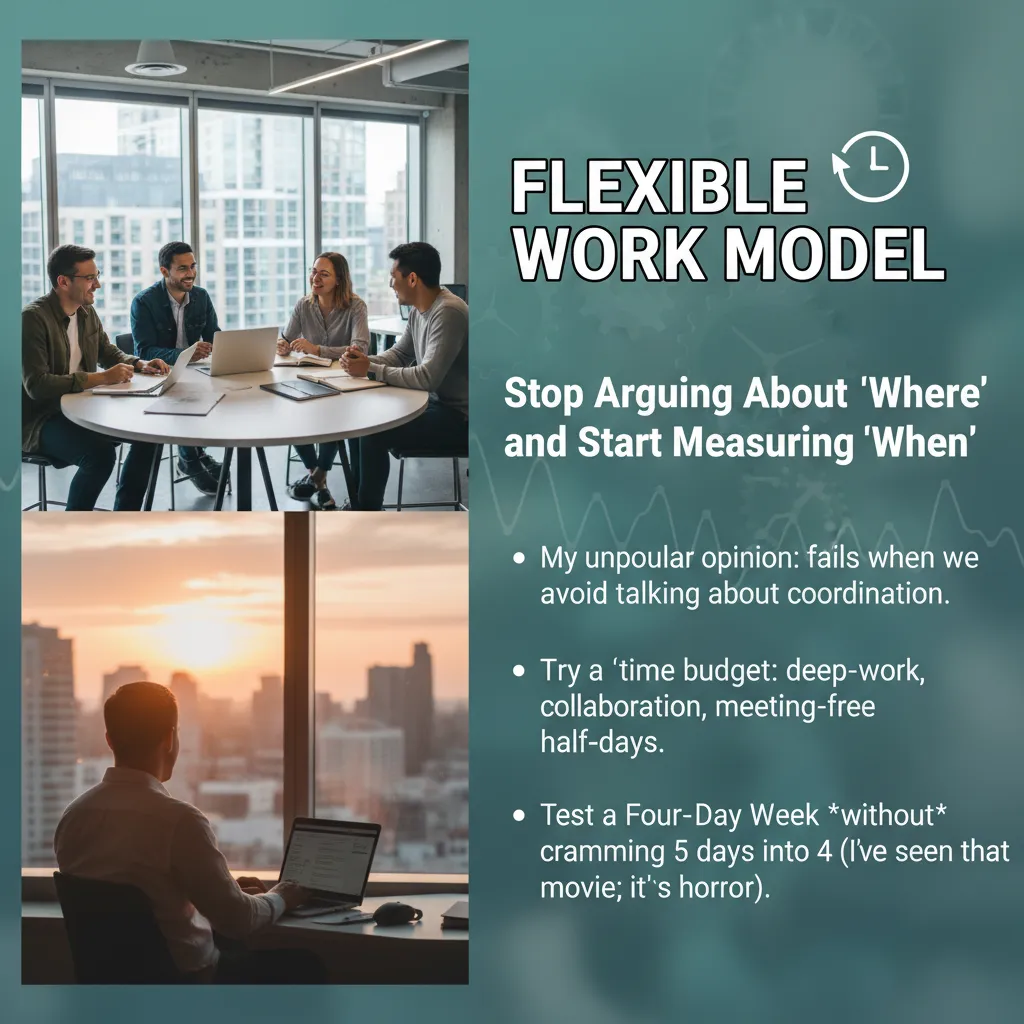
My unpopular opinion: the flexible work model fails when we use it to avoid talking about coordination. I’ve watched teams debate remote vs. office for months, while the real issue was simpler: nobody agreed on when work happens together. Flexibility without shared timing turns into slow decisions, duplicated work, and “always-on” stress.
Use a “time budget,” not a location fight
Instead of asking, “Which days are we in?” I ask, “How do we spend our time?” A practical approach is to set a weekly time budget that protects focus and makes collaboration predictable.
- Deep-work windows: 2–3 blocks per week where meetings are discouraged.
- Collaboration hours: a daily 2–4 hour overlap for decisions, pairing, and quick reviews.
- Meeting-free half-days: one or two per week to reduce context switching.
When I’ve done this, performance conversations get easier because we can measure what matters: cycle time, response time, and decision speed—not who sat where.
Pilot a four-day week (without the “horror movie” version)
Testing a four-day week can work, but only if you don’t cram five days of meetings into four. I’ve seen that movie; it’s a horror. The pilot has to include real subtraction: fewer meetings, shorter agendas, and clearer owners.
“If nothing is removed, the schedule change is just pressure in a new container.”
One simple rule I use: if a meeting has no decision to make, it becomes an update in writing.
Write RTO policies like product requirements
Return-to-office policies fail when they read like slogans. I write them like product requirements so people understand the “why” and the trade-offs.
| Requirement | What to define |
|---|---|
| Purpose | What outcomes improve (onboarding, customer work, innovation) |
| Constraints | Core hours, team days, travel limits |
| Exceptions | Caregiving, disability needs, distance, role type |
| Feedback loops | Review dates, metrics, and a way to request changes |
Wild-card test: extreme heat shuts down commuting
Here’s my stress test: What if extreme heat shuts down commuting for a week—does your plan hold? If your model collapses, it’s not flexible. Build for continuity: documented decisions, async updates, and a clear “minimum viable coordination” plan.
3) Skills-Based Approach: The Resume Is a Trailer, Not the Movie
Skills-based hiring changed my interviewing style in a big way. I used to start with the resume: schools, titles, and brand-name companies. In 2026, I treat the resume like a trailer—a quick preview, not the full story. The “movie” is what someone can actually do, under real conditions, with real constraints.
Ask for proof before pedigree
Now I ask for proof-of-skill artifacts before I ask about education. That can be a work sample, a short simulation, or a portfolio review. It keeps the process fair and focused, and it helps me avoid “credential bias.”
- Work samples: a one-page plan, a draft email, a spreadsheet model
- Simulations: a 20-minute role play, a mock customer call, a debugging task
- Artifacts: SOPs they wrote, dashboards they built, before/after process notes
Build internal mobility like a marketplace
One of the strongest HR trends I’m seeing is internal mobility that works like a marketplace. Instead of waiting for a promotion cycle, people can pick up small gigs and stretch projects that build skills fast. The key is transparency: clear skill requirements, clear time expectations, and a simple way to apply.
When we list projects with skill tags (like “stakeholder management” or “SQL basics”), employees can self-select into growth. Managers also get a safer way to test potential without making a full role change.
Scorecards: less vibe, more signal
I rely on recruiting scorecards that define “good” in observable behaviors. This reduces “gut feel” hiring and makes interviews more consistent.
| Skill | Observable behavior |
|---|---|
| Prioritization | Explains trade-offs and chooses a clear next step |
| Communication | Uses a simple structure and confirms understanding |
| Ownership | Names what they did, what changed, and what they learned |
A tangent I can’t resist
Some of the best operators I’ve hired had “weird” backgrounds—career switchers, self-taught builders, people with non-linear resumes. It wasn’t luck. The skills-based approach made their strengths visible when a traditional resume screen would have filtered them out.
Candidate experience: say why (briefly, kindly, specifically)
If someone doesn’t pass, I tell them why in plain language. Not a long critique—just one or two specific gaps tied to the scorecard. For example:
“We moved forward with candidates who showed stronger stakeholder alignment in the simulation. Your plan was solid, but it didn’t include how you’d get buy-in from Finance and Sales.”
4) Pay Transparency Move: The Conversation You Can’t Outsource
I used to fear pay transparency because I thought it meant “publish everyone’s salary.” That idea felt risky, messy, and honestly impossible. What I learned is that transparency is more nuanced (and more doable). It’s about being clear on how pay works, what the ranges are, and what someone can expect—without turning HR into a public spreadsheet.
Start with Total Rewards Design (Before You Talk)
If I could go back, I’d start with Total Rewards design and treat it like the foundation. If the foundation is weak, every pay conversation becomes a debate.
- Pay philosophy: Are we market-leading, market-matching, or cost-focused—and why?
- Pay ranges: Clear compensation bands for each role family.
- Leveling: What “Level 2” vs “Level 3” truly means in skills and scope.
- Progression: What it takes to move up (results, skills, time, impact).
Practice the Script (So You Don’t Sound Like Legal)
I learned to practice a simple script that explains comp bands, equity, and timing in plain language. The goal is calm clarity, not a policy recital.
“This role sits in a range based on level and experience. We place offers using skills, scope, and internal fairness. Equity is available for some roles and depends on level. Reviews happen on a set cycle, and increases are tied to performance and market movement.”
Labor Cost Control = Planned, Not Stingy
Labor cost control doesn’t mean underpaying. It means planning: workforce planning + compensation strategy + retention math. I started asking: What will turnover cost us? What’s the cost of a long vacancy? What’s the cost of losing a top performer because we avoided a fair adjustment?
Mini Role-Play: Range on the First Call
Candidate: “What’s the salary range?”
Me: “Yes—happy to share. The range for this role is $X to $Y, depending on experience and level. Most offers land in the middle of the band. We also offer bonus/equity where applicable and full benefits. If you share your expectations, I can tell you if we’re aligned before we go further.”
5) AI Integration + Predictive Analytics: Use Robots for Paperwork, Not People
In 2026, I’m finally clear on where AI in HR helps most: it removes friction. When I use AI for scheduling interviews, summarizing notes, or drafting job posts, my team moves faster and candidates get a smoother experience. But when AI tries to “judge” humans—like predicting performance from vague signals—I slow down and add human review. People are not spreadsheets.
Use AI to reduce admin work (not replace judgment)
These are the areas where AI integration has paid off for me:
- Scheduling: fewer emails, fewer delays, better candidate experience.
- Summaries: meeting notes, interview debriefs, policy updates.
- Sourcing support: building lists and outreach drafts (with recruiter edits).
Where I’m cautious: automated “fit scores,” emotion detection, or tools that claim to read intent. If a system can’t explain why it made a recommendation, I don’t let it drive decisions.
Data-driven decisions start with data literacy
Before buying any HR tech, I define the metrics we actually need. Otherwise, dashboards become expensive wallpaper. I start with a small set and make sure leaders agree on definitions:
- Time-to-fill: days from approved req to accepted offer.
- Internal mobility rate: % of roles filled by internal moves.
- Regretted attrition: high-impact exits we wish we’d prevented.
Then I ask: do we have clean data, clear owners, and a plan to act on what we learn?
Predictive analytics: treat it like weather forecasting
Predictive analytics should give probabilities, not prophecies.
I use predictive analytics in HR as an early warning system—like “teams with X pattern have a higher risk of turnover.” That’s useful if it triggers support (manager coaching, workload review, growth paths). It’s harmful if it becomes a label on an employee. I also check for bias, document assumptions, and keep humans accountable for final calls.
Change management: say the “why” twice, then show one win
My best change management move is simple: I announce the why of the tool twice (time back, fewer errors, better service), then deliver one small win fast—like cutting scheduling time by 30% in one department.
Quick note on AI layoffs and retraining
If automation is coming, I build retraining into workforce strategy early: skills mapping, internal pathways, and time to learn. If we wait until roles are at risk, we’ve waited too long.

6) Leadership Development: The Manager Is the Product (Sorry)
If I could go back and fix one leadership pattern early, it would be this: the most expensive HR mistake I’ve seen is promoting a great individual contributor into people leadership with zero training. We treat the promotion like a reward, then act surprised when performance drops, turnover rises, and “culture issues” appear. In 2026, leadership development has to be a core HR trend because managers shape the daily employee experience more than any policy ever will.
Why this mistake costs so much
A strong IC often wins by being fast, independent, and right. A strong manager wins by being clear, fair, and consistent. Those are different skills. When we skip training, we don’t just risk one bad manager—we risk a chain reaction: unclear priorities, uneven feedback, and quiet resentment that spreads across a team.
Personalized learning beats one-size-fits-all
I’ve learned that generic “manager training” rarely sticks. What works is short practice loops: a manager lab on one skill (like running a 1:1), then shadowing a great leader, then trying it for two weeks, then getting feedback. Repeat. This is how leadership development becomes real, not theoretical. It also respects that new managers struggle in different places: some avoid conflict, some over-control, some disappear when things get hard.
Engagement is the daily experience
Employee engagement isn’t a survey; it’s what happens on a normal Tuesday. Do people have clarity on what “good” looks like? Do they feel decisions are fair? Do they see a path to growth? When managers deliver those three things—clarity, fairness, growth—engagement scores usually follow without begging people to fill out another form.
Culture compliance matters most in messy times
When budgets tighten or performance dips, culture gets tested. This is where culture compliance matters: consistent consequences, documented decisions, and values you can point to when emotions run high. If two employees do the same thing and get different outcomes, your culture becomes a rumor instead of a system.
Wrap-up: the one-page manager checklist
To close this section (and this post), I’d do one exercise: write a “manager checklist” for your org that fits on one page and survives a bad quarter. If your managers can’t follow it when they’re stressed, it’s too complex. Keep it simple, teach it often, and remember: in HR trends 2026, the manager really is the product—whether we admit it or not.
TL;DR: If I had to compress 63 HR tips into one page: build mental health support like infrastructure, hire for skills not pedigree, make pay transparency a strategy (not a memo), use AI integration for boring work not people judgment, and treat workforce planning as your cost-control lever.


Comments
Post a Comment