
I still remember bombing a first “big” call because I tried to impress a VP with features. Halfway through, he cut me off and said, “So… what problem are you trying to solve for me?” I wrote that sentence on a sticky note and kept it on my laptop for months. This post is basically that sticky note expanded into 15 tips—some classic, some slightly weird, all meant to hold up in real-life conversations (the kind where your dog barks mid-demo and you keep going anyway).
1) Prospecting like a grown-up (not a spam cannon) — Sales Prospecting Tips
When I hear “prospecting,” I don’t think “blast 200 people and hope.” I think earn attention. The best sales techniques I actually use start with being clear on who I can help, then showing up like a real person across a few channels. That’s how I keep my pipeline healthy without burning my reputation.
Write a one-page “who I can help” note (my ICP + personas)
Before I send a single message, I write a simple one-page note that defines my ideal customer profile (ICP) and the personas inside it. I keep it practical:
- Industry: where I win most often
- Trigger events: funding, new leader, tool change, hiring spike, compliance deadline
- Pain patterns: slow process, missed revenue, messy handoffs, unclear reporting
This keeps my outreach focused and makes my sales prospecting tips feel grounded in reality, not guesswork.
Build my target list in batches (so Monday isn’t “start from zero”)
I batch my list-building so I’m never staring at an empty CRM. I’ll block time to add accounts and contacts in chunks, then tag them by trigger and persona. That way, I always have “ready-to-work” prospects.
“If I don’t prepare the list, I’m not prospecting—I’m panicking.”
Make contact with a multi-touch approach that sounds human
I use a simple multi-touch approach: email + call + social. The key is that it can’t read like a sequence. I reference something real, keep it short, and ask an easy question.
Example opener:Noticed you’re hiring SDRs—usually that’s when teams tighten lead routing. Worth a quick chat to compare notes?
Prospecting earns the right to ask tougher questions later
Good prospecting is also preparation. When I show I understand their world, I can ask better questions on the first call—about priorities, budget, and what’s not working—without sounding pushy. That’s the difference between “another sales email” and a professional conversation.

2) Qualification without the awkward interrogation — Sales Qualification Frameworks
I still qualify every deal, but I refuse to make it feel like an interview. The best sales techniques I use are simple: I treat frameworks like BANT and CHAMP as a map, not a checklist. That means I don’t open with, “So… do you have budget?” in minute one. I start with the problem, because real qualification shows up naturally when the buyer talks about what’s not working.
Use BANT/CHAMP as a guide, not a script
When I’m listening, I’m quietly mapping what I hear to the framework:
- BANT: Budget, Authority, Need, Timeline
- CHAMP: Challenges, Authority, Money, Prioritization
I’m not trying to “collect answers.” I’m trying to understand whether this is a real project or just curiosity.
Qualify while you sell (without grilling)
I qualify by exploring the pain and the impact. Instead of firing questions, I use prompts like:
- “Walk me through what’s happening today.”
- “Where does this break down the most?”
- “What does this cost you in time, revenue, or stress?”
These questions do double duty: they build value and reveal need, ownership, and urgency.
Ask timeline questions in a softer way
Timeline can feel pushy if you ask it bluntly. I prefer a consequence-based question:
“What happens if you do nothing for 90 days?”
If the answer is “nothing,” that tells me a lot. If the answer is “we lose deals” or “the team burns out,” now we’re talking about a real priority.
Keep a simple red-flag list (and respect it)
I keep three red flags on a sticky note, and I try not to negotiate with myself—even when I like the prospect:
- No pain: they can’t name a real problem
- No owner: nobody is responsible for fixing it
- No urgency: no cost to waiting
Frameworks help me stay honest, protect my pipeline, and keep the conversation human.
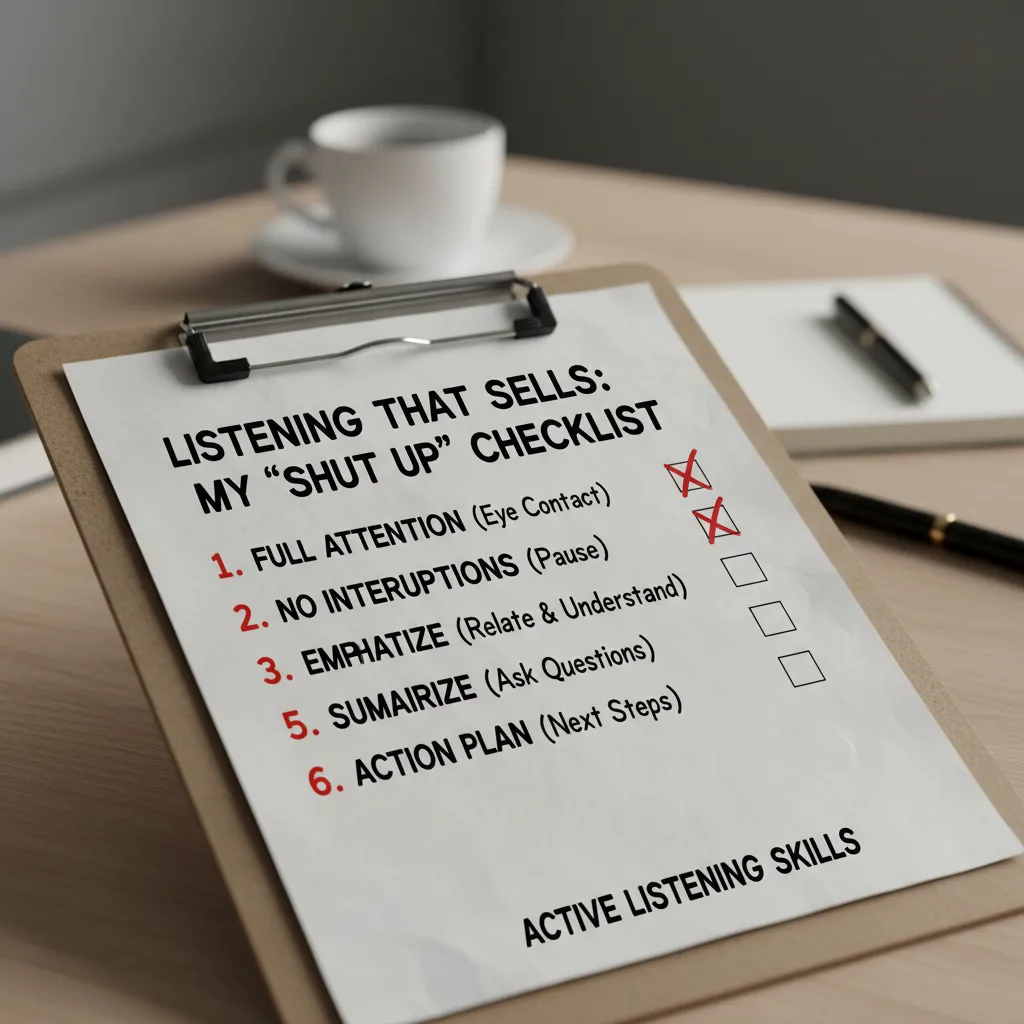
3) Listening that sells: my ‘shut up’ checklist — Active Listening Skills
One of the best sales techniques I actually use is simple: I talk less. When I’m tempted to pitch, I switch to my “shut up” checklist. It keeps me focused on active listening skills that move the deal forward without pressure.
My SPIN arc (so questions feel natural)
I use the SPIN Selling Technique to guide the conversation in a clean flow: Situation → Problem → Implication → Need-payoff. I don’t read a script, but I do follow the arc so I don’t jump to solutions too early.
- Situation: “What tools are you using today?”
- Problem: “Where does it slow you down?”
- Implication: “What happens when that delay hits your team or customers?”
- Need-payoff: “If we fixed that, what would improve first?”
What I watch on video calls (body language + pacing)
On Zoom, listening isn’t just words. I watch for small signals and adjust my pace:
- Leans in: I stay quiet and let them expand.
- Speeds up: I slow down and ask one clear follow-up.
- Goes quiet: I don’t fill the space; I ask, “What’s on your mind?”
Mirror their pain points (in their words)
After they explain a challenge, I repeat it back using their exact language. Then I check my understanding:
“So the real issue is that approvals take two weeks, and that’s causing missed launch dates. Did I get that right?”
This builds trust fast because they feel heard, not handled.
The 3-second pause (my secret weapon)
After a key question, I pause for three full seconds. It feels eternal. It works. People often share the real problem in that space. If I need a reminder, I literally note:
Ask → stop talking → count: 1…2…3
4) Solution Selling Approach: sell the ‘after,’ not the app
When I’m selling software, I try hard not to “demo first.” A shiny feature tour is tempting, but it often skips the real reason someone is shopping. Instead, I use a problem-focused selling lens. I start with the messy workflow: the spreadsheets, the handoffs, the missed follow-ups, the “we’ll fix it later” process that quietly drains time and money. Once we name the pain in plain language, the product becomes a tool—not the story.
Start with the mess, then earn the right to show features
I ask questions like: Where does work get stuck? What breaks when volume spikes? What do you dread doing every week? This keeps the conversation grounded in reality. Then, when I do show the app, I only show what connects to that pain.
Write a one-sentence value proposition
I build a simple customer value proposition that I can say out loud and they can repeat internally:
We help X achieve Y without Z.
Example: “We help sales teams close deals faster without chasing updates across five tools.” If I can’t fill in X, Y, and Z clearly, I’m not ready to pitch.
Work backward from the “after”
I also ask what success looks like in six months. Not “using the platform,” but outcomes: fewer errors, faster onboarding, cleaner reporting, higher conversion. Then I work backward and map the steps needed to get there. I’ll often capture it as a quick checklist in my notes:
- Today: what’s broken and what it costs
- 6 months: what “good” looks like
- Path: the smallest changes that create momentum
Offer packages by segment (without the bait-and-switch)
I create options that match where they are: starter for quick wins, expansion for growing teams, and enterprise for complex needs. I’m transparent about what’s included and why, so it feels like a fit—not an upsell trap.
5) Social proof that doesn’t sound like bragging — case studies & credibility
I use social proof as a tool for reducing doubt, not as a trophy. The timing matters more than the volume. Instead of dumping logos on a slide, I place a case study at the exact moment a concern shows up—usually around security, adoption, or ROI. If a buyer asks, “Will this pass our review?” that’s when I share proof about compliance. If they worry, “Will my team actually use it?” that’s when I share adoption proof.
Use proof in the moment (not just on the website)
In my sales materials, I keep it simple: one short testimonial plus one concrete before/after story. That combo feels helpful, not braggy, because it answers a question instead of trying to impress.
“We cut handoffs between Sales and Ops from 6 steps to 2, and nothing fell through the cracks.”
Then I add a quick before/after story:
- Before: Leads were passed through email threads, and reps had to re-enter data. Handoffs were slow and messy.
- After: We set up a shared workflow, automated the data capture, and created a clear owner for each step. Handoffs became predictable.
- Result: Faster follow-up and fewer “Where is this deal?” check-ins.
Borrow the buyer’s language
I never translate their words into my jargon. If they say “handoffs,” my proof talks about “handoffs.” If they say “security review,” I say “security review.” This makes the case study feel like it was made for them, which builds credibility fast.
Build a proof library you can grab in seconds
I keep a small “proof library” so I’m not hunting for the right story mid-call. Mine is organized by industry and pain point:
| Industry | Pain point | Best proof asset |
|---|---|---|
| SaaS | Adoption | Before/after onboarding story |
| Healthcare | Security | Compliance + review timeline |
| Manufacturing | ROI | Cost/time saved snapshot |
6) Pipeline sanity: metrics, momentum, and the calendar fight
When my pipeline feels messy, I don’t “work harder.” I get specific. I track a few sales performance metrics I can actually influence: touches (emails/calls/DMs), conversations (two-way replies), and meetings (booked and held). Revenue is the goal, but these are the levers I can pull every day. This keeps my sales pipeline management simple and honest.
Track what I can control
I use a tiny weekly scoreboard. If the numbers are low, I don’t panic—I just know what to fix.
- Touches: Did I create enough chances?
- Conversations: Is my message getting replies?
- Meetings: Am I earning real time on calendars?
Defend weekly activity like a workout
My calendar is always under attack—internal meetings, “quick questions,” random fires. So I block prospecting time like it’s the gym. If I skip it, I feel it next week. I commit to measurable weekly activities, such as:
- Prospecting blocks (2–4 per week)
- Follow-up blocks (daily, even 20 minutes)
- Pipeline cleanup (one short session)
If someone asks for that time, I offer another slot. I don’t give it away by default.
Short feedback loops: review, tweak, repeat
Every week I review wins and losses. I look for patterns: which subject lines got replies, which opening lines fell flat, which objections showed up. Then I tweak one thing and run it again. Small changes beat big “rebrands.”
Simple follow up strategies (no “circle back” purgatory)
I end every call with a clear next step. Not “I’ll follow up.” A real date and time.
“Let’s book it now: Tuesday at 10:30 or Wednesday at 2:00?”
If there’s no next meeting, I set a specific check-in: Follow up on 2026-02-01 at 9:00 AM. My rule: every conversation earns a calendar decision.
7) Closing without being ‘that person’ — Sales Closing Techniques I trust
Closing doesn’t have to feel pushy. The best sales techniques I actually use are simple: make the next step clear, reduce stress, and help the buyer feel confident. When I’m ready to close, I don’t “pressure.” I guide—and I do it in a way that respects how people really make decisions.
Good/Better/Best options to make choosing easier
One of my most reliable sales closing techniques is offering multiple options. If I only present one package, the buyer often freezes and starts hunting for reasons to say no. Instead, I share a good/better/best set of choices. The goal isn’t to trick anyone—it’s to reduce decision paralysis and let them pick what fits their budget and risk level. I keep the differences clear (scope, support, timeline), so it feels like a helpful menu, not a maze.
The visualization close that lowers resistance
When the conversation is positive but still stuck, I use a question that shifts the focus from “Should we buy?” to “What will success look like?” I’ll say:
Imagine it’s 60 days from now and this is working—what’s different?
This works because it invites them to describe outcomes in their own words. Then I can connect the plan to what they just told me matters. It also surfaces hidden concerns early, before they become last-minute objections.
Urgency, but only when it’s real
I’m careful with urgency. “Now-or-never” offers only belong in the deal when they’re true—like a real price change, a limited onboarding slot, or a contract deadline. Fake urgency breaks trust fast, and trust is the foundation of every strong close.
A clean recap that makes internal approval easier
Finally, I end with a short written recap: what we agreed on, the option they prefer, timeline, pricing, and next steps. I write it so stakeholders can forward it internally without rewriting anything. That recap often becomes the document that gets the deal approved—without me needing to chase or push.
TL;DR: Prospect consistently, qualify ruthlessly (BANT/CHAMP), listen like it’s your job (it is), sell outcomes not features, use social proof, measure weekly activity, and close with clear next steps and options.

Comments
Post a Comment