The first time I watched a bot reconcile a messy vendor statement, I didn’t feel futuristic—I felt relieved. It was 9:47 p.m., quarter-end, and my spreadsheet had turned into a confetti cannon of tabs. That small win kicked off a bigger shift: AI in Finance stopped being a slide deck topic and started showing up as shorter cycle times, cleaner audit trails, and fewer “who touched this?” emails. In this post, I’m sharing the real operational results I’ve seen (and the ones the industry is now measuring), including where Agentic AI actually helps—and where it can quietly create new headaches if you skip governance.
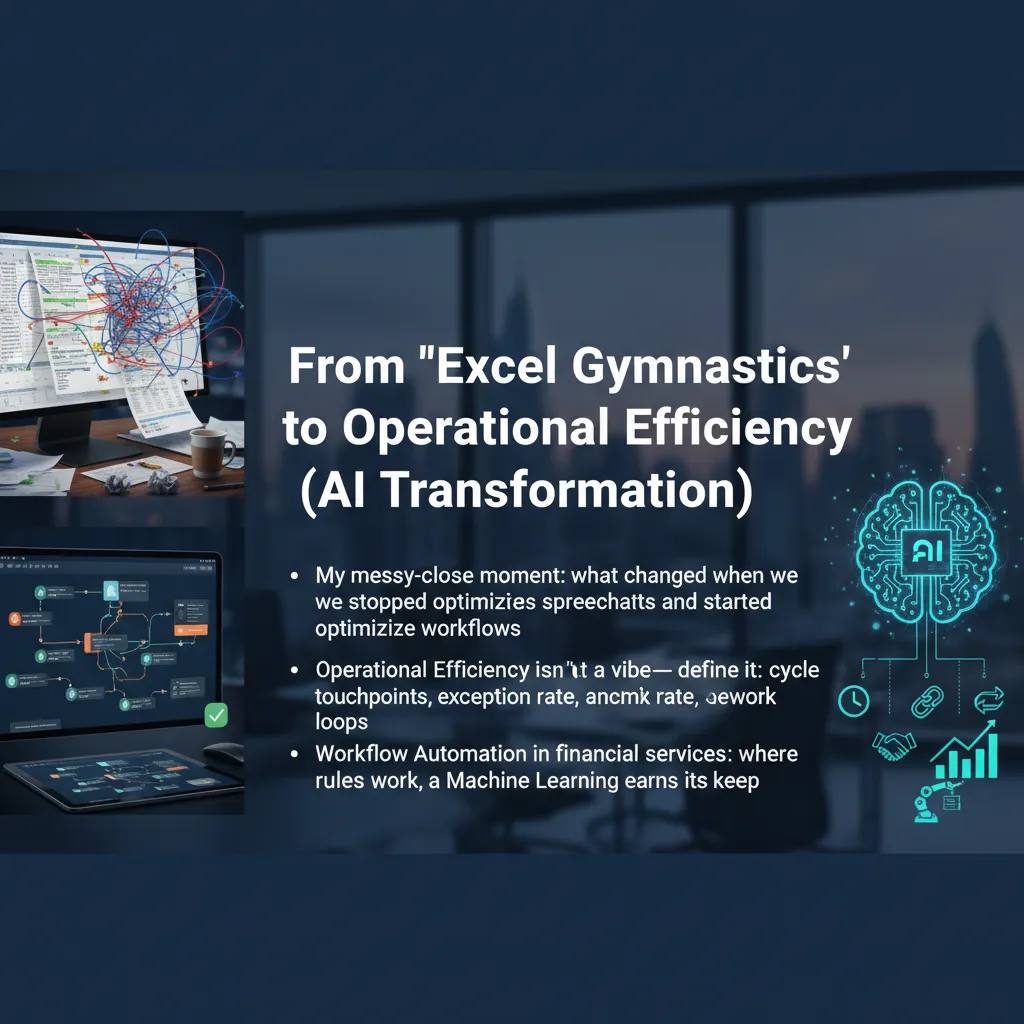
From “Excel gymnastics” to Operational Efficiency (AI Transformation)
My messy-close moment: stop optimizing spreadsheets, start optimizing workflows
I still remember a month-end close where we “won” by building a smarter spreadsheet. It had more tabs than I want to admit, and it worked—until one late journal entry broke three downstream reconciliations. That was the moment I realized we weren’t improving finance operations. We were just getting better at Excel gymnastics. When we shifted to AI-enabled workflow automation, the real change wasn’t speed alone—it was fewer handoffs, fewer surprises, and fewer late-night fixes.
Operational Efficiency isn’t a vibe—here’s how I define it
In finance, “efficient” can’t mean “everyone is busy.” I track it with simple measures that show whether the process is getting cleaner:
Cycle time: How long close, AP, or reconciliations take end-to-end.
Touchpoints: How many human edits, approvals, and re-keys happen per transaction.
Exception rate: What percentage falls out of the happy path and needs help.
Rework loops: How often we fix the same issue twice (or three times) because upstream data was wrong.
When AI transformed our finance operations, the biggest win was reducing exceptions and rework loops—not just shaving hours off the calendar.
Workflow Automation in financial services: where rules work, where Machine Learning earns its keep
I learned to be honest about what should be automated with rules versus ML:
Rules-based automation works best for stable policies: invoice routing by threshold, three-way match checks, approval chains, posting logic, and standard reconciliations.
Machine Learning earns its keep where patterns are messy: predicting coding for invoices, spotting unusual spend, identifying duplicate payments, and prioritizing exceptions by risk.
The goal isn’t “AI everywhere.” It’s the right automation at the right step, so humans focus on judgment calls instead of copy-paste.
Wild-card analogy: finance ops as an airport
I think of finance operations like an airport. The transactions are the planes. The teams are the ground crew. AI isn’t the airplane—it’s air-traffic control. It doesn’t fly the plane for you, but it sequences work, flags conflicts, routes exceptions, and keeps the whole system moving with fewer near-misses.
Quick gut-check: ready for zero-touch, or just tired?
Before chasing “zero-touch,” I ask:
Do we trust our master data, or are we automating bad inputs?
Are exceptions clearly defined, owned, and measured?
Can we explain decisions for audit and compliance?
Do we have a process owner, not just spreadsheet heroes?
Financial Close, AP Automation, and the oddly satisfying audit trail
The close pain points I used to accept
For years, I treated month-end close like a weather event: it was coming, it would be messy, and I just had to endure it. The worst parts were always the same—reconciliations that didn’t tie, accruals built from half-complete data, and the familiar last-minute JE parade where everyone “remembers” something at the final hour. In the source material, the big shift is simple: AI doesn’t just speed up tasks, it reduces the number of surprises by watching transactions as they happen.
Reconciliations: AI matches bank, subledger, and GL activity earlier, so breaks show up before day 5.
Accruals: Models suggest accruals based on patterns (and show the inputs), instead of relying on memory.
Journal entries: Suggested JEs come with context and supporting links, not mystery numbers.
AP automation + spend management (without the nagging)
What changed my mind was agentic AI in AP and spend management. Instead of sending generic reminders, it can chase approvals with context: “This invoice is due in 3 days, it matches the PO, and it’s within policy—approve?” If the approver is out, it can route to a delegate based on rules. That’s the difference between automation that annoys people and automation that quietly clears the runway.
“Automation works best when it removes friction, not when it adds noise.”
PwC’s “up to 80%” cycle time claim (and what “up to” means)
PwC has reported purchase order cycle time reductions up to 80% in tested environments. I read “up to” as a range, not a promise. It usually means the best-case process—clean vendor data, clear approval paths, and strong adoption. If your workflows are inconsistent, the first win may be smaller, but still real: fewer handoffs, fewer follow-ups, fewer stuck approvals.
Audit trails as a product feature
The oddly satisfying part is the audit trail. When AI logs who approved what, when, and why—with links to PO, receipt, invoice, and policy checks—compliance becomes easier instead of louder. The trail isn’t a scramble at audit time; it’s built-in evidence.
Mini-scenario: duplicate invoice at 4:58 p.m.
The bot flags a duplicate invoice right before close. Next steps are clear:
Hold payment automatically and notify AP owner.
Show the match: same vendor, amount, invoice number, and prior payment reference.
Route for decision: reject as duplicate or confirm it’s a valid split shipment.
Log the outcome in the audit trail with supporting documents.
Autonomous Forecasting and AI Predictions (without pretending we can see the future)
In 2026, I treat AI forecasting like a very fast analyst: useful, consistent, and sometimes wrong in ways that are hard to spot. The best results I’ve seen come when we use it to reduce noise in finance operations, not to “predict the future.” AI helps me move from monthly guesswork to tighter, more frequent updates—while keeping humans responsible for the final call.
What I trust AI-driven forecasting with (and what I still sanity-check)
I trust autonomous forecasting most when it’s doing repeatable work at scale: pulling data, cleaning it, and updating projections as new signals arrive. I still sanity-check anything that can swing decisions fast—especially when the business is changing.
I trust: baseline revenue and expense forecasts, seasonality patterns, variance explanations, and rolling re-forecasts.
I sanity-check: one-time events, pricing changes, new product launches, and “too perfect” trend lines.
Scenario modeling is my favorite stress test ritual
Forecasts feel honest when they come with scenarios. I run scenario modeling like a routine drill, not a panic button. My go-to stress tests include:
Rate hikes: higher borrowing costs and slower demand
Supply shocks: delayed inventory, higher COGS, missed revenue timing
Surprise churn spike: retention drops, CAC payback stretches, support costs rise
AI makes this faster by generating consistent assumptions and showing how each lever changes cash, margin, and runway.
Predictive analytics vs wishful thinking
Prettier charts don’t equal better decisions. What I look for are leading indicators that move before the financials do—pipeline quality, renewal intent, usage drops, payment delays, and support ticket volume. If the model can’t explain why the forecast changed, I treat it as a warning sign.
By 2026, “real-time” should mean something specific
Real-time forecasting isn’t about refreshing a dashboard every minute. For my team, “real-time” means:
Data updates within the same business day
Clear data lineage (where each number came from)
Alerts when drivers shift, not just when totals change
Informal aside: I once overrode the model because my gut said churn “couldn’t” jump that fast. It did. The humbling part wasn’t being wrong—it was realizing the model saw the early signals I ignored.

Risk Management that actually moves faster: Anomaly Detection, Fraud Detection, Credit Risk
The moment I realized risk management was a speed problem, not just a policy problem, was during a routine review where the “bad” event wasn’t missed because we lacked rules—it was missed because the signal arrived faster than our process. In modern finance operations, risk doesn’t wait for a weekly committee. It shows up in minutes, sometimes seconds, and it hides inside normal-looking volume.
Anomaly Detection: separating “weird but fine” from “weird and urgent”
AI anomaly detection changed my day-to-day because it doesn’t just flag “unusual.” It learns patterns across accounts, merchants, devices, and timing, then ranks what needs attention. The real win is reducing noise: I want fewer alerts, but better ones.
Weird but fine: a customer traveling, a seasonal spike, a one-off large invoice.
Weird and urgent: new device + new payee + odd hour + rapid retries.
In practice, I’ve seen teams move from reactive reviews to continuous monitoring, where analysts spend time investigating, not sorting.
Real-time Fraud Detection: what agentic AI can do at 2 a.m. when humans can’t
Fraud doesn’t keep office hours. Agentic AI helps by taking action when humans are offline—triaging cases, pulling context, and triggering safe controls. At 2 a.m., it can:
Correlate signals across channels (card, ACH, login, call center notes).
Open a case with evidence attached, not just an alert.
Recommend a step: step-up verification, temporary hold, or allow-with-monitoring.
“The goal isn’t to automate trust. It’s to automate the first response so humans can focus on the hardest calls.”
Credit Risk memos: AI agents drafting, humans deciding
Credit risk is still a human decision, but drafting is where time disappears. AI agents can assemble a first-pass memo: financial spreads, covenant checks, industry notes, and comparable deals. When I’ve seen this done well, productivity rises 20%–60% and turnaround is ~30% faster, because analysts start from a structured draft instead of a blank page.
Portfolio management tangent: exciting—and slightly terrifying
Autonomous portfolio rebalancing is powerful: it can watch exposures, drift, and liquidity in real time. It’s also slightly terrifying because small model errors can compound quickly. My rule: automate the recommendation, tightly govern the execution, and log everything like an audit is guaranteed.
Compliance checks, Client Onboarding, and AML: the unglamorous wins
Client Onboarding: the paperwork marathon where NLP quietly saves the day
In 2026, the biggest “AI win” I see in finance isn’t flashy trading bots. It’s client onboarding. The old process was a paperwork marathon: IDs, proof of address, corporate registries, beneficial ownership forms, tax docs, and endless back-and-forth emails. Using Natural Language Processing (NLP), we now extract key fields from messy PDFs, emails, and scanned documents, then route exceptions to the right queue. The result is simple: fewer manual re-keys, fewer missed fields, and faster time-to-open without lowering standards.
What changed most is consistency. NLP doesn’t get tired at 6 p.m. It flags missing signatures, mismatched names, and expired documents the same way every time, and it leaves a clear trail of what it read and what it couldn’t.
Anti-Money Laundering: agentic AI that gives analysts their lives back
AML investigations used to be a lot of tab-switching: alerts, transaction history, customer profile, adverse media, prior cases. With agentic AI (task-based assistants that follow a controlled workflow), we can cut investigation time per case by ~50% by automating the “gather and summarize” steps. Analysts still decide. The AI just does the legwork: pulls relevant transactions, groups them into patterns, and highlights why an alert fired.
Faster triage for low-risk, repetitive alerts
Better focus on complex networks and high-risk typologies
More consistent documentation across investigators
Regulatory compliance as a design constraint, not a final review step
From the “How AI Transformed Finance Operations: Real Results” playbook, the lesson is clear: compliance can’t be a last-minute checkbox. I treat it like a product requirement. That means defined data sources, model boundaries, audit logs, and clear ownership before anything goes live.
Generative AI for narrative work (with strict human review)
Generative AI is most useful for the boring but necessary writing: drafting SAR-style case summaries, timelines, and rationale statements. We keep it tight: the model drafts, a human reviews, and nothing is filed without sign-off. I also require citations back to internal case artifacts so the narrative is traceable.
If a regulator asks “why did the model decide?”
I don’t answer with hype. I answer with evidence:
“The model didn’t make the decision. It ranked risk based on defined features, and the investigator made the final determination. Here are the inputs used, the rules and thresholds, the top contributing factors, and the full audit log of actions taken.”

Agentic AI playbook for Finance 2026: data, people, governance (and my blunt checklist)
If I’m setting CFO priorities for 2026, I keep it simple: data infrastructure first, then AI agents, then new dashboards. The source lesson is clear: the teams getting “real results” didn’t start with shiny visuals. They fixed the pipes—clean master data, consistent definitions, and reliable feeds—so automation didn’t just move bad numbers faster.
1) Data infrastructure before anything “agentic”
Agentic AI in finance only works when the agent can trust what it reads and when humans can trace what it did. That means one chart of accounts logic, one customer and vendor truth, and clear ownership for every key field. If your close process still depends on spreadsheet handoffs, an AI agent will just learn your chaos.
2) Governance that assumes things will go wrong
I treat AI governance like financial controls: boring on purpose, strict by design. In practice, I want permissions (who can trigger postings, payments, or journal entries), audit trails (what the agent saw, decided, and changed), model monitoring (drift, error rates, and unusual behavior), and kill switches—yes, really. If an agent starts looping, pulling the wrong data, or escalating costs, I need a fast, documented way to stop it without debate.
3) People: retrain analysts into exception-handlers
The best outcome isn’t replacing analysts; it’s upgrading them. As automation takes routine reconciliations and report refreshes, I’d retrain analysts into exception-handlers (spot what’s off, fix root causes) and scenario storytellers (turn variance into decisions). That’s where finance earns trust: not in producing numbers, but in explaining them.
What to borrow (and ignore) from Tesco, Logitech, and Barclays
From Tesco, I’d borrow the discipline of standard processes and shared data definitions—agents need consistency. From Logitech, I’d borrow the focus on faster planning cycles and fewer manual touchpoints, but I’d ignore any temptation to over-customize early. From Barclays, I’d borrow the control mindset: strong access rules, traceability, and risk reviews; I’d ignore “AI theater” that looks impressive but can’t be audited.
My blunt checklist is this: fix the data, control the agent, train the people, then earn the right to build prettier dashboards. The goal isn’t fewer people—it’s fewer pointless loops: fewer rework cycles, fewer email chains, fewer late-night reconciliations, and more time spent on decisions that actually move the business.
TL;DR: AI in Finance is moving from pilots to operational muscle: agentic AI can cut manual workload 30%–50%, speed PO cycles up to 80%, halve AML case time, and boost credit-risk memo productivity 20%–60%—but only if data infrastructure and AI governance show up early.


Comments
Post a Comment