Marketing Trends 2025–2026: The Shift You’ll Feel
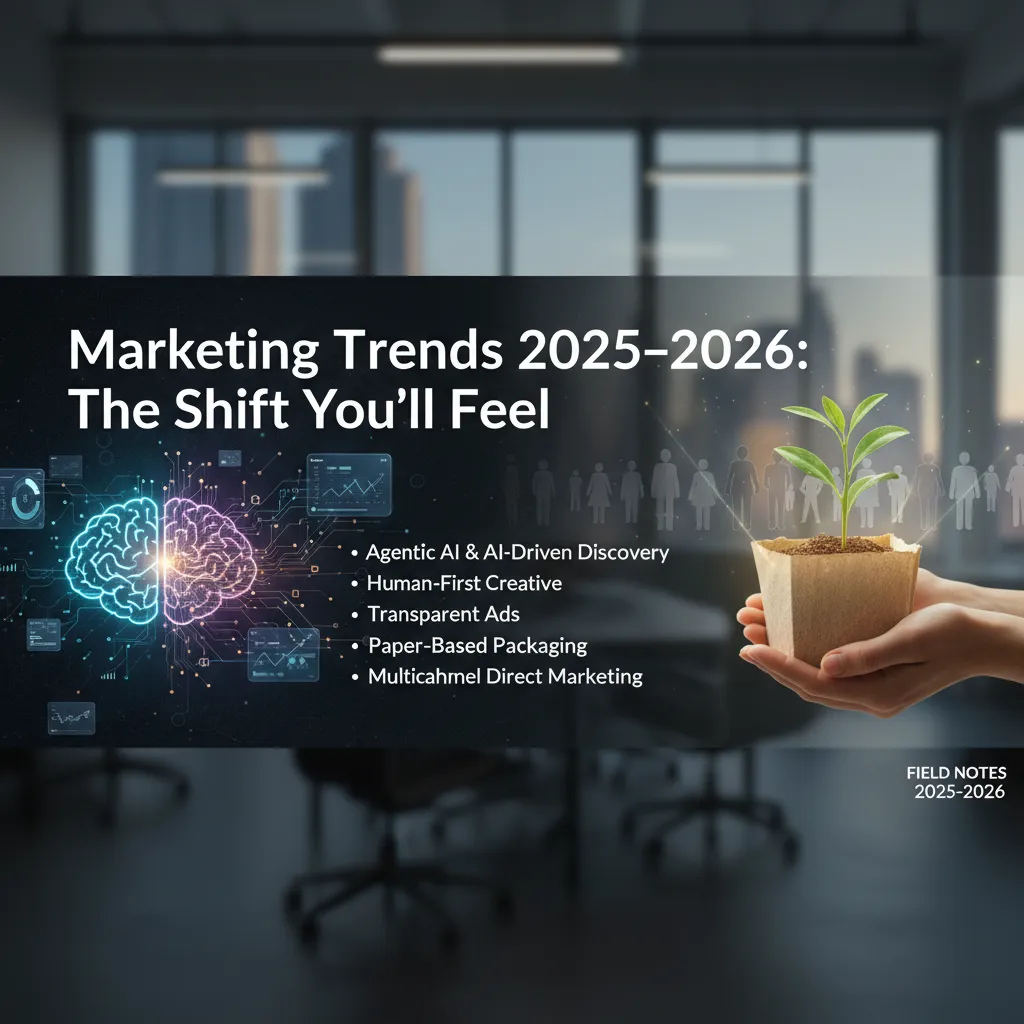
Last fall, I watched a junior marketer on my team ship a week’s worth of campaign variants in one afternoon—then spend two days arguing about what “worked” because our measurement didn’t agree across channels. That little whiplash—speed exploding while certainty shrinks—is basically the vibe of marketing trends 2025–2026. In this post, I’m not doing the usual trend-bingo. I’m mapping what’s changing, where I’m personally placing bets, and the uncomfortable parts nobody puts on a slide.
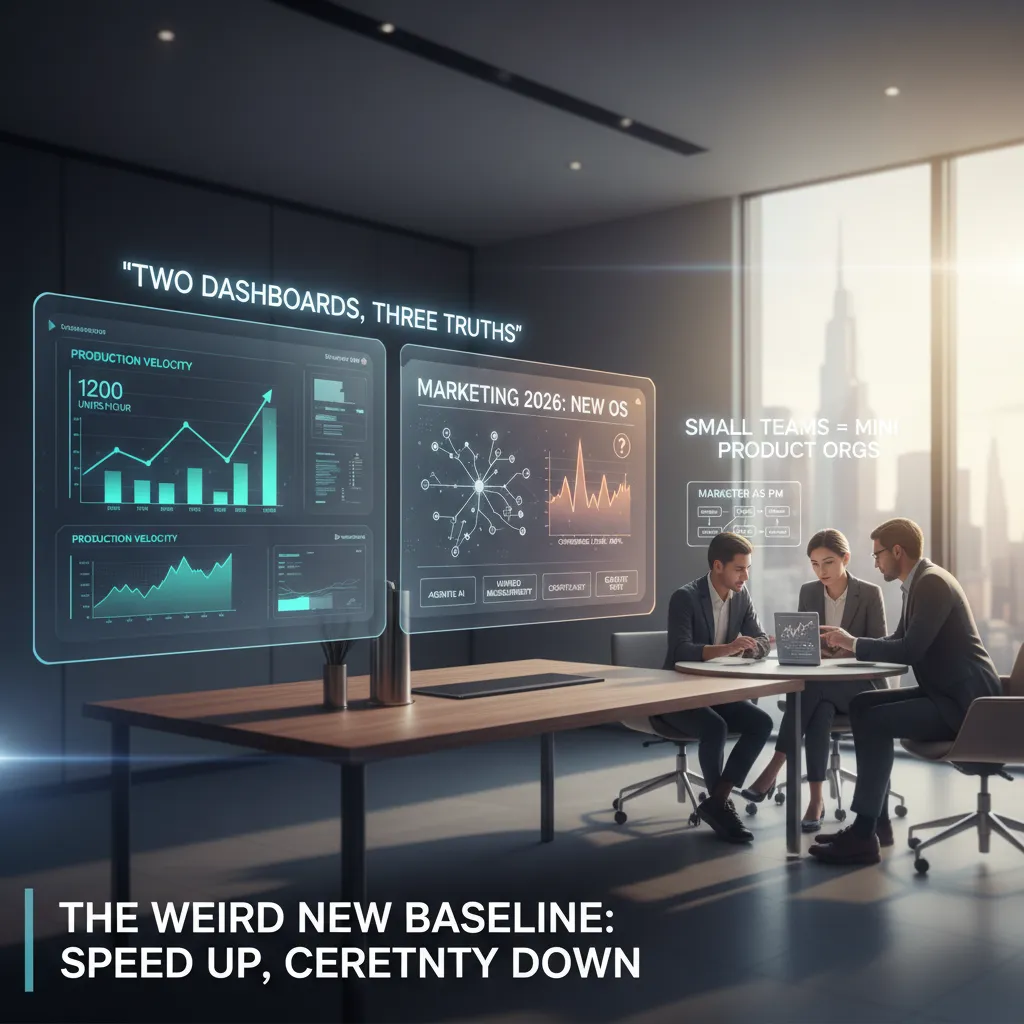
The Weird New Baseline: Speed Up, Certainty Down
My “two dashboards, three truths” moment
I had a week where our content output doubled, yet our results looked worse—depending on which dashboard I opened. In one view, traffic was up. In another, pipeline was flat. In a third, “engagement” spiked because a platform changed how it counts a view. That was my two dashboards, three truths moment: faster production doesn’t equal clearer performance. In 2025–2026, speed is cheap. Signal is not.
Marketing trends 2026 aren’t a list—they’re a new operating system
When I look at marketing trends 2025–2026, I don’t see a checklist. I see a new operating system made of three parts:
- Agentic AI: tools that don’t just suggest ideas—they run tasks, test variants, and ship drafts.
- Unified measurement: one shared view across paid, owned, and product data, so we stop arguing about “whose numbers are real.”
- Creative taste: the human skill of choosing what’s worth making, what feels true, and what fits the brand.
AI can raise volume, but taste decides direction, and measurement decides what stays.
Small teams are acting like mini product orgs
I’m watching lean marketing teams work like product teams: short cycles, clear hypotheses, and constant iteration. In practice, marketers become product managers—owning a funnel like a roadmap.
- Define the user problem (not the channel goal).
- Ship a small experiment fast.
- Measure in one place, then decide: scale, fix, or kill.
Wild card: a 2026 headline I hope never happens
“Major platforms deprecate third-party attribution overnight; brands fly blind for 90 days.”
If it did, I’d shift budget to what I can verify: first-party data, incrementality tests, and simple holdouts. I’d also tighten creative QA, because when certainty drops, bad ads get expensive fast.
AI Powered Marketing (and the Agentic AI Frontier)
In 2025–2026, generative AI marketing is no longer a “nice to have.” It’s table stakes for faster drafts, more variations, and quicker testing. The real shift I feel now is the move from prompts to AI agents: systems that can run multi-step work (research → draft → QA → publish) using tools, with clear guardrails.
From Generative AI to Agentic AI (with guardrails)
When I use agents, I treat them like junior operators: they can execute, but they don’t decide what matters. My guardrails are simple: approved sources, brand rules, and “stop points” where a human must review before anything goes live.
Where I use chatbots vs. where I refuse (for now)
- I use chatbots for: FAQ support, order status, lead qualification, booking calls, and routing tickets to the right team.
- I refuse (yet) for: pricing exceptions, legal/medical advice, handling angry customers without escalation, and any promise that could create liability.
Synthetic data marketing (when tracking is limited)
As tracking gets harder, I’m seeing more teams use synthetic data to model outcomes. I’m okay with it when it’s done responsibly: we document assumptions, label modeled vs. observed data, and avoid “fake certainty.”
“Modeled insights can guide decisions, but they should never pretend to be ground truth.”
Mini playbook: human review loops that protect your voice
- Define voice rules (words we use, words we avoid, tone examples).
- Use AI for options, not final answers (3–5 variants per asset).
- Human edit pass for clarity, empathy, and brand fit.
- Compliance check (claims, disclosures, permissions).
- Post-launch audit: compare performance and update prompts.
SEO Strategies Shifting: Writing for AI-Driven Discovery
My blunt take: blogging is back, but not for the reason you think
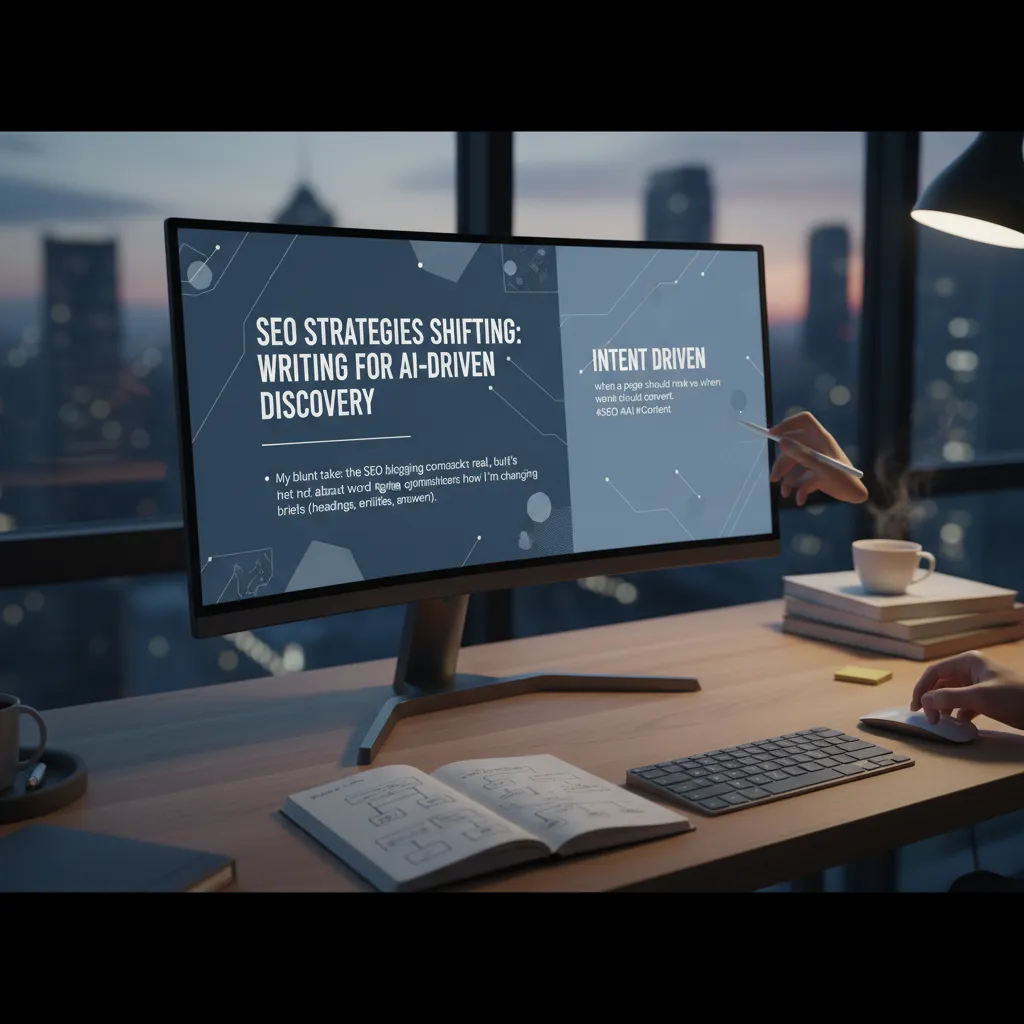
My blunt take: the SEO blogging comeback is real, but it’s not about word count. In 2025–2026, I’m seeing “more content” lose to clearer content. AI-driven discovery rewards pages that answer fast, stay on-topic, and are easy to scan. If I can’t explain the page in one sentence, I don’t publish it.
AI-powered search is replacing old SEO—so I’m changing my briefs
Traditional SEO used to be “pick a keyword, write a long post, add links.” Now AI-powered search pulls direct answers, summaries, and comparisons. So my briefs look different:
- Headings first: I outline questions as H3s before I write paragraphs.
- Entities: I list the people, tools, problems, and terms the page must mention (and define).
- Answers: I add short “direct answer” lines near the top of each section.
“Structure is the new ranking factor you can control.”
Intent-driven advertising meets content: rank vs convert
I separate pages by job. Some pages should rank (teach, compare, define). Others should convert (demo, pricing, signup). When I mix both, I usually get neither. For rank pages, I keep CTAs light. For conversion pages, I focus on proof, offers, and next steps.
A 30-day experiment: ‘search-first’ vs ‘AI-readable’
- Publish two versions of the same topic.
- Version A: search-first (classic keyword layout, longer intro, more internal links).
- Version B: AI-readable (tight intro, Q&A headings, definitions, table).
| Version | Primary goal | What I’d measure |
|---|---|---|
| Search-first | Clicks | Rank + CTR |
| AI-readable | Mentions in AI answers | Referral + assisted conversions |
Multichannel Direct Marketing Becomes a Cross-Channel Ecosystem
Triggered direct mail is a smart pattern interrupt
When I say direct mail is back, I don’t mean “retro.” I mean deliberate. In a world of endless ads and crowded inboxes, a triggered postcard or letter can break the scroll. And honestly, it prints better than you’d think—modern print quality, better paper options, and clean design make it feel premium without being expensive.
Triggered direct mail isn’t old-school. It’s a physical moment that shows up right when digital gets ignored.
Multichannel direct marketing now means dynamic customization
In 2025–2026, multichannel direct marketing is not “send the same message everywhere.” It’s dynamic customization across channels—text, images, and offers that change based on behavior. If someone browses pricing, abandons a cart, or books a demo, the next message should reflect that exact step.
- Email with product content based on viewed pages
- SMS with time-sensitive reminders tied to intent
- Direct mail triggered after high-value actions (like repeat visits)
- Landing pages that match the offer and the segment
From channels to ecosystems (stop reporting like it’s 2016)
I’m seeing teams shift from channel-by-channel reporting to cross-channel marketing ecosystems. The customer doesn’t experience “email” or “paid social” separately—they experience a journey. So I try to measure what the system produces: pipeline, revenue, retention, and speed to conversion, not just clicks.
Unified measurement in the messy middle
Unified measurement marketing is the messy middle between privacy changes and real business needs. I rely more on first-party data, modeled results, and incrementality tests, then connect it all in one view. A simple rule helps: if I can’t explain how a channel supports the journey, I don’t treat it as a standalone win.
Creative Trends Define Marketing: Taste, Texture, and Play
Design taste marketing is the skill I didn’t see coming
In the 2025–2026 shift, the biggest surprise for me is that design taste became a top marketing skill. I used to think “strategy wins, visuals support.” Now it’s flipped in many channels. People scroll fast, and taste is the filter: color, layout, type, pacing, and what you choose to leave out. When the creative feels “right,” the message lands faster—and the brand feels more premium without saying it.
Engage all senses with hyper textural imagery
I’m seeing more brands lean into hyper textural imagery: close-ups you can almost feel. Think condensation on a can, grain in wood, fabric weave, messy frosting, fingerprints on packaging. It works because it feels real. The same goes for using real people—not sterile perfection. Slight flaws signal honesty, and honesty is a growth lever when trust is hard to earn.
- Texture makes digital feel physical.
- Humans make brands feel accountable.
- Imperfection makes content believable.
Playful marketing earns attention without begging
The safest way I’ve found to earn attention is to get playful. Not random jokes—play with format. Mini games, “choose your path” stories, unexpected product demos, or a simple visual twist. Play creates curiosity, and curiosity buys you a few extra seconds—the rarest currency in marketing trends 2025–2026.
Cultural authenticity (without sounding like the internet)
My rule of thumb: if I wouldn’t say it out loud to a customer, I won’t post it. I avoid forced slang, trend-chasing captions, and borrowed memes. I’d rather be clear than “chronically online.”
“If it reads like you’re trying, it’s trying too hard.”
Tiny tangent: my best idea came from a grocery aisle
I got a strong campaign concept this year staring at shelf labels: bold benefit, simple proof, and one sensory cue. I wrote it down as a quick formula: Benefit + Proof + Texture. It’s basic—and it keeps working.
Advertising Becomes Transparent (and Sustainability Gets Practical)
In the 2025–2026 shift, I’m seeing digital advertising move toward proof over polish. The trend is simple: people want to know what they’re seeing, why they’re seeing it, and what’s true. That means clearer labeling on paid placements, cleaner sustainability claims, and fewer “mystery metrics” that look impressive but can’t be explained.
Digital ads: clearer labels, cleaner claims, fewer mystery metrics
- Clearer labeling: “Sponsored” and “Paid partnership” tags become harder to hide.
- Cleaner claims: “Eco-friendly” without details starts to feel risky and outdated.
- Fewer mystery metrics: I’m watching teams replace vague dashboards with numbers tied to real outcomes (sales, sign-ups, retention).
Paper-based packaging: the quiet disruptor
One practical sustainability move I keep noticing is paper-based packaging solutions. It’s not flashy, which is why it works. Consumers are starting to treat paper mailers, fiber trays, and refill-friendly cartons as normal, not premium. For marketers, this is a rare win: it’s visible, easy to explain, and often easier to measure than broad carbon promises.
Inclusive innovation: what I’m watching beyond statements
I’m paying attention to brands that build inclusion into the product, not just the campaign. Signals I trust include:
- More sizes, skin tones, and accessibility options in stock, not “limited.”
- Testing with diverse users and publishing what changed.
- Support teams trained for real needs (language, disability, cultural context).
Monday morning scenario: your top ad has your weakest claim
If my best-performing ad is also my least defensible claim, I’d do this Monday:
- Pause the ad and save the audience + creative data.
- Rewrite the claim into a specific statement (materials, sourcing, certifications).
- Swap “green” language for proof points and a simple FAQ landing page.
Transparency isn’t a trend I can “add later.” It’s becoming the cost of entry.
Smaller Agencies Growth + Specialists: The Anti-Mediocrity Plan
I’m seeing a clear shift in marketing trends 2025–2026: smaller agencies are winning more work, and specialists are getting pulled into core teams. Big brands still want scale, but they’re tired of “safe” ideas and slow delivery.
Smaller agencies growth is real
Challenger networks are suddenly on big brand rosters because they move fast, stay close to the work, and bring sharper points of view. When budgets are watched and results are questioned, a lean team that can test, learn, and ship weekly becomes a safer bet than a huge team that needs layers of approval.
Specialists are becoming more valuable (without going generic)
My advice is to build T-shaped skills: go deep in one area, then learn just enough around it to collaborate well. I like this simple model:
- Depth: pick one “home” skill (paid social, lifecycle email, SEO, creative strategy, analytics).
- Breadth: learn the basics of adjacent skills so you can brief, review, and improve work.
- Proof: keep a small portfolio of experiments, not just decks.
Internal influencers marketing: the hidden distribution engine
Most companies already have creators: sales reps, support leads, product managers, recruiters. I treat them like an internal creator network. Give them clear themes, simple templates, and a light approval path, and your content reach grows without buying more ads.
The easiest audience to activate is the one already inside your org chart.
Bring people together with micro communities marketing
Micro communities turn campaigns into habits. Instead of one big launch, I build small groups around a shared job-to-do: onboarding, power users, partners, or local chapters. The goal is repeatable moments—monthly Q&As, challenges, and peer stories—so the brand shows up as a routine, not a burst.
Conclusion: My 2026 Checklist (and One Bet I’m Nervous About)
As I look at Marketing Trends 2025–2026: The Shift You’ll Feel, I’m ending this with a simple checklist I’m using right now. This quarter, I’m auditing five areas: how we use AI agents (not just chat tools), how our content is structured for AI search so it can be found and summarized correctly, whether we have unified measurement that connects brand and performance, how strong our sensory creative is (sound, motion, texture cues, not just static ads), and whether our packaging and transparency match what we promise in campaigns.
My nervous bet is about what happens when AI agents become the customer. If an agent is comparing options, filtering features, and even placing the order, then the “buyer” may never feel our story the way a human does. That scares me because it can push teams to write copy for machines first—thin, keyword-heavy, and lifeless. I think the safer path is to make content that is clear for systems but still human at the core: real proof, real reasons, and a voice people trust.
The practical next step I’m taking is to run one experiment per trend—small, measurable, and reversible. For example, I’ll test one AI agent workflow in support, rewrite one key page with better structure for AI search, clean up one reporting view for unified measurement, produce one sensory-led creative concept, and update one packaging or transparency message to reduce doubt at the shelf and on the product page.
Speed is useless if you can’t explain the story of the result.
That’s my closing loop back to the intro: move fast in 2026, but make sure you can still tell a simple story about what changed, why it worked, and what you’ll do next.
TL;DR: 2025–2026 marketing is about intent (not traffic), AI-powered discovery (not just SEO), agentic AI (not just automation), unified measurement across channels, and human-first creative that makes brands feel real. Expect more transparent ads, more paper-based packaging, and more work shifting toward specialists and smaller agencies with sharper taste.


Comments
Post a Comment