Leadership Trends 2026: Human-AI Leaders Speak

I didn’t expect my most useful AI leadership lesson to come from a 12-minute hallway chat after a leadership roundtable. One director leaned in and whispered, “My team thinks I’m either a magician or a fraud—because AI makes my drafts look better than my brain feels.” That tiny confession sent me down a rabbit hole: what are leadership leaders actually saying about AI when the microphones are off? This post is my stitched-together “expert interview” notebook—part field report, part self-check, with a few messy side notes I wish someone had handed me earlier.
1) My messy notes from an “AI leaders” interview night
I went to an “AI leaders” interview night expecting polished answers. What I got—mostly in the hallway, between takes, and after the microphones were off—felt more useful. Panels are clean. Off-the-record moments are messy, and that mess shows how people really make decisions when the data is late, the model is wrong, and the team is tired.
Why I trust the off-the-record parts
In the interviews (and in the side chats), leaders kept describing the same pattern: they don’t “follow the AI.” They use it to pressure-test their thinking. That changes decision making for me. I now listen for what someone says when they’re not selling a roadmap—like how they handle uncertainty, who gets the final call, and what they do when the dashboard looks confident but feels off.
The phrase I heard on repeat: “parallel intelligence”
“We’re building parallel intelligence, not automation.”
That line came up again and again. It’s a small shift in language, but it matters. “Automation” sounds like replacement. “Parallel intelligence” sounds like a second brain running beside you—fast at patterns, weak at context, and always needing a human to set direction.
A quick personal audit: what I outsource vs. what I refuse to
On the train home, I did a simple check-in:
- I already outsource: summarizing long docs, drafting first-pass emails, spotting trends in messy notes.
- I refuse to outsource: performance feedback, hiring decisions, and anything that needs moral judgment or real empathy.
Tiny tangent: the best insight came from the catering line
While waiting for coffee, one leader said their best “AI policy” is not a policy document—it’s a habit: ask one more question before you trust the output. Not “Is it accurate?” but “What would make this misleading?” That stuck with me more than the keynote slide deck.
What I asked leaders in my interviews
- How they use AI analytics without letting metrics run the company.
- How they handle ethics: bias, privacy, and accountability when tools fail.
- How they manage stress when work speeds up and expectations rise.

2) The readiness gap: frontline worry vs exec optimism
In the expert interview, one stat landed like a dropped mic: frontline leaders are 3X more concerned about AI than executives. I felt the room go quiet because it explains so many “why is this so hard?” moments in AI adoption. Executives often see speed, savings, and dashboards. Frontline managers see risk, edge cases, and the human cost when a tool is wrong.
What the mismatch looks like in practice
When optimism at the top meets worry on the floor, the rollout gets messy. I’ve seen it show up as:
- Missed context: the model works in a demo, but fails on real customer exceptions.
- Rushed rollouts: “go live” dates set before workflows are updated.
- Awkward town halls: leaders say “AI will help you,” while employees ask “Will AI replace me?” and nobody answers clearly.
“We’re ready,” the exec team says. “Ready for what, exactly?” the frontline quietly wonders.
A scenario I watch for: your best supervisor becomes the bottleneck
Imagine your strongest shift supervisor. They care about quality and safety, and they’ve earned trust. Now you introduce an AI assistant that suggests staffing changes and flags “low performers.” The supervisor doesn’t trust the outputs, so they double-check everything manually. They stop delegating. Approvals slow down. The team thinks the AI is “extra work,” not help. No one complains loudly, but throughput drops and frustration rises.
What I’d do differently: a two-speed change plan
I’d run a two-speed plan: fast where risk is low, slower where trust and judgment matter. Most important, I’d treat frontline managers as co-designers, not recipients.
- Speed 1 (quick wins): low-risk use cases (drafting, summaries, search) with clear guardrails.
- Speed 2 (core work): pilots in real conditions, with frontline leaders defining “acceptable error” and escalation paths.
Quick aside: why “just train them” is usually a resource problem
When I hear “we just need more AI training,” I translate it to: we didn’t allocate time, backfill, or support. Training without protected hours, workflow fixes, and on-the-job coaching is not a plan—it’s a hope.
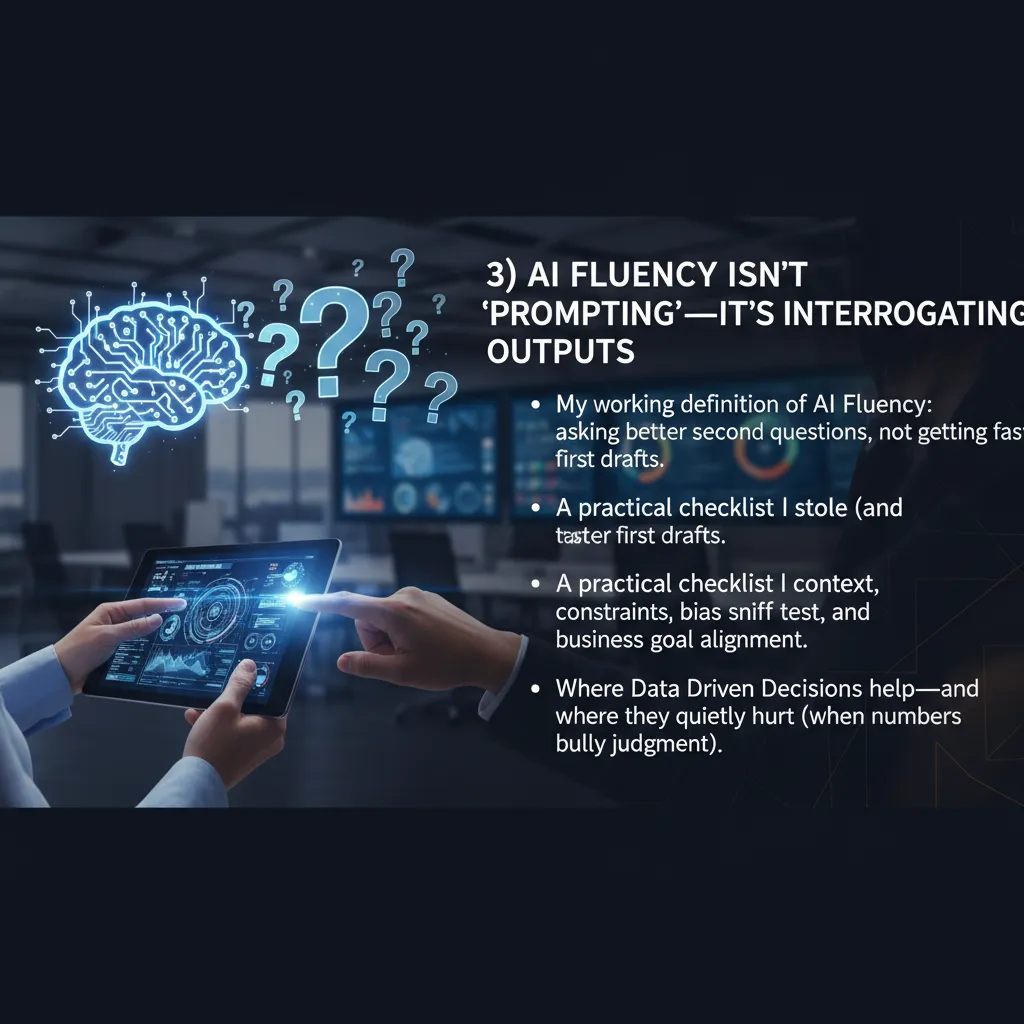
3) AI fluency isn’t “prompting”—it’s interrogating outputs
In the expert interview, one theme kept coming up: leaders who “get” AI don’t just write clever prompts. They challenge what comes back. My working definition of AI fluency is simple: asking better second questions, not getting faster first drafts.
My checklist for interrogating AI outputs
I stole this checklist from how experienced leaders described their workflow, then tweaked it for my teams. I run it every time an AI tool gives me an answer that looks “clean.”
- Context: What did the model assume about our company, customers, or culture that I never said?
- Constraints: What limits matter here (budget, time, policy, risk)? Did the output ignore them?
- Bias sniff test: Who might this recommendation disadvantage? What data might be missing?
- Business goal alignment: Does this help the real goal, or just optimize a proxy metric?
“The value isn’t the first answer. The value is the follow-up questions you know to ask.”
Where data-driven decisions help—and where they quietly hurt
AI can strengthen data driven decisions by spotting patterns I would miss, especially across large teams. But the interview also warned about a quiet failure mode: when numbers bully judgment. A dashboard can look objective while hiding messy reality—like workload spikes, new managers, or a team recovering from burnout.
Mini case: performance readiness without turning people into dashboards
I’ve used AI analytics to support performance readiness reviews. The rule I follow: AI can surface signals, but humans must supply meaning. For example, I’ll ask the model to summarize trends (delivery consistency, collaboration signals, learning pace), then I verify with managers and the employee.
- AI flags a “readiness risk” based on recent output.
- I ask: What changed in the environment? (scope, tools, staffing)
- I ask: What evidence would disprove this?
- We document a human decision, not an AI verdict.
My wild card analogy: AI is a very confident intern who never sleeps. Useful, fast, and often wrong in subtle ways—unless I keep interrogating the work.

4) The Great Flattening: why org charts are getting weird (in a good way)
In the expert interview, several leaders used the phrase “horizontal leadership”. When I asked what they meant, the answer was simple: less permission, more coordination. Instead of waiting for a manager to approve every step, teams move faster by sharing context, aligning on goals, and using AI to surface options. The org chart still exists, but it stops being the main tool for getting work done.
Flatter by 2030 doesn’t mean leaderless
The “Great Flattening” idea came up again and again: by 2030, many companies will look flatter. But that does not mean fewer leaders. It means leadership spreads across roles—product, data, legal, customer support—because AI touches everything. In practice, I’m seeing more “micro-leadership”: people lead a decision, a risk, or a customer moment, then hand off.
- Fewer gates (less waiting for approvals)
- More nodes (more people coordinating decisions)
- Clearer intent (shared goals matter more than titles)
Where it gets bumpy: AI vs. team judgment
The hardest part is ownership. When an AI system recommends one path and the team feels another, who decides? In the interview, leaders were blunt: AI can advise, but humans must own the call. The risk is “decision drift,” where everyone assumes the model is responsible. That’s how accountability disappears.
“Horizontal leadership only works when decision rights are explicit.”
The first AI review huddle I saw (and why it felt like jazz)
I remember watching a cross-functional AI review huddle: a PM, an engineer, a designer, a compliance lead, and a frontline manager. They pulled up the model output, asked quick questions, and adjusted the plan in real time. No long speeches—just short turns, active listening, and fast alignment. It honestly felt like jazz: structure underneath, improvisation on top.
Practical move: a lightweight escalation path for ethical dilemmas
I recommend a simple, written path—small enough to use, strong enough to protect people:
- Pause the release or change.
- Document the concern in 5 lines (impact, users, data, bias, safety).
- Escalate to a named “Ethics On-Call” group within 24 hours.
- Decide with a single accountable owner, with AI notes attached.
5) Human connection as a strategy (not a vibe)
In the Expert Interview: Leadership Leaders Discuss AIundefined, one theme hit me hard: empathy is no longer a “nice-to-have.” It became operational. AI can scale answers, but it cannot scale belonging. When people feel replaced, watched, or ignored, they don’t argue in meetings—they quietly disengage. That’s why human connection is a leadership strategy in 2026, not a vibe.
Why empathy suddenly became operational
AI leadership trends often focus on speed, cost, and automation. But the interview reminded me that the real bottleneck is emotional: trust, safety, and identity at work. AI can draft a policy, summarize a call, or recommend a next step. It cannot read the room the way a leader can, and it cannot repair a relationship after a rough change.
Employee engagement AI reality check
Here’s the reality check I took from the discussion: leadership support changes the story more than the tool does. The same AI assistant can feel like help in one team and like control in another. The difference is whether leaders explain the “why,” protect time for learning, and listen without punishing honest feedback.
“The tool is rarely the problem. The rollout is.”
The interview shared a specific lever I now repeat in my own notes: strong leadership support boosts positivity toward AI from 15% to 55%. That gap is not about features. It’s about people believing leadership is on their side.
My 30-minute weekly “human judgment” checkpoint
To prevent silent resentment, I’d run a weekly 30-minute checkpoint with three rules:
- Two wins, one worry: each person shares where AI helped and where it hurt.
- One decision stays human: we name a judgment call AI will not make.
- One fix in 7 days: we pick a small change (prompt, workflow, training, or boundary).
Tangent I can’t resist
The worst AI rollout I’ve seen was technically perfect—and socially tone-deaf. The model worked. The dashboards were clean. But leaders skipped the human conversation, and people filled the silence with fear. That’s how you lose engagement while “winning” the implementation.
6) Stress, burnout, and the part nobody brags about
In the expert interview, one theme kept coming up in quiet side comments: the stress leaders carry, especially when AI speeds everything up. The uncomfortable numbers are hard to ignore: 71% of leaders feel heightened stress, and 40% have considered leaving. Those aren’t “soft” signals. They are warning lights.
How AI can quietly add pressure
AI is supposed to reduce workload, but it can also raise the bar in ways people don’t say out loud. I’ve felt this in three common patterns:
- Always-on expectations: if a tool can answer in seconds, people start expecting me to respond in minutes.
- Faster cycles: planning, drafting, and analysis move quicker, so decisions get pulled forward.
- More scrutiny: AI creates more data, more dashboards, and more “why didn’t we see this?” moments.
“AI doesn’t just automate tasks; it can automate urgency.”
My coping tactic: a decision-making buffer
One practice I now protect is a decision-making buffer. For big calls—hiring, budget shifts, performance exits, major vendor changes—I schedule 24 hours before I finalize, unless it’s a true emergency. That pause helps me check assumptions, ask one more human question, and notice if I’m deciding from fear or fatigue.
I even write a simple rule in my notes: Big decision? Sleep on it.
A quick check for employee burnout in hybrid teams
In hybrid workforce leadership, burnout hides behind “fine” messages and muted cameras. I use this quick check in 1:1s:
- Ask: “What part of your week feels heaviest right now?”
- Look for: slower replies, more mistakes, shorter tone, missed handoffs.
- Confirm workload: “What did AI speed up—and what did it add?”
- Agree one change: remove one meeting, one report, or one alert channel.
Closing the loop
When AI takes routine tasks, I believe leaders must reinvest that saved time in conscience and clarity: clearer priorities, cleaner boundaries, and more honest conversations about capacity.
7) Chief AI Officers & the agentic enterprise: who’s actually in charge?
In my interview notes, one theme kept coming up: the rise of the Chief AI Officer (CAIO) role is both reassuring and slightly confusing. Reassuring, because it signals that AI leadership is no longer a side project owned by one team with spare time. Confusing, because “in charge” can mean very different things depending on where the CAIO sits and what they truly control.
Reporting lines vary widely. Some CAIOs report to the CEO, others to the CIO, CTO, or even the Chief Risk Officer. That difference is not just politics. It shapes Ethical AI oversight in real life. When the CAIO sits close to product, speed tends to win. When the CAIO sits close to risk or legal, safety checks tend to be stronger. Neither is “right” on its own, but the trade-off should be clear and intentional.
To reduce the confusion, I like a simple decision-rights map. I ask leaders to name, in plain language, who owns three approvals: who approves models (what gets built or bought), who approves use cases (where the model is allowed to be used), and who owns harm reviews (what happens when something goes wrong). In the interview, the strongest organizations could answer these questions quickly, and they could explain how decisions move across security, privacy, compliance, and business teams without getting stuck.
All of this matters even more as we move toward the agentic enterprise—the next slope, where AI doesn’t just recommend, it acts. When an agent can trigger a refund, change a price, approve a vendor, or send a customer message, “who’s accountable” becomes a daily operational question, not a policy document.
“What would you not delegate to AI, even if it was perfect?”
I now use that as my closing interview question. The answers reveal the real leadership boundary: the human decisions that define values, accept risk, and protect trust. In 2026, that boundary is where modern leadership lives.
TL;DR: AI is now part of everyday work, so Human AI Leadership is less about tools and more about habits: interrogate AI outputs, build AI fluency, shift toward horizontal leadership, and protect human connection to reduce burnout. Frontline leaders feel the pressure most (3X more concern than executives), and leadership support can move employee positivity toward AI from 15% to 55%.


Comments
Post a Comment