Leadership Trends 2025–2026: The New Rules
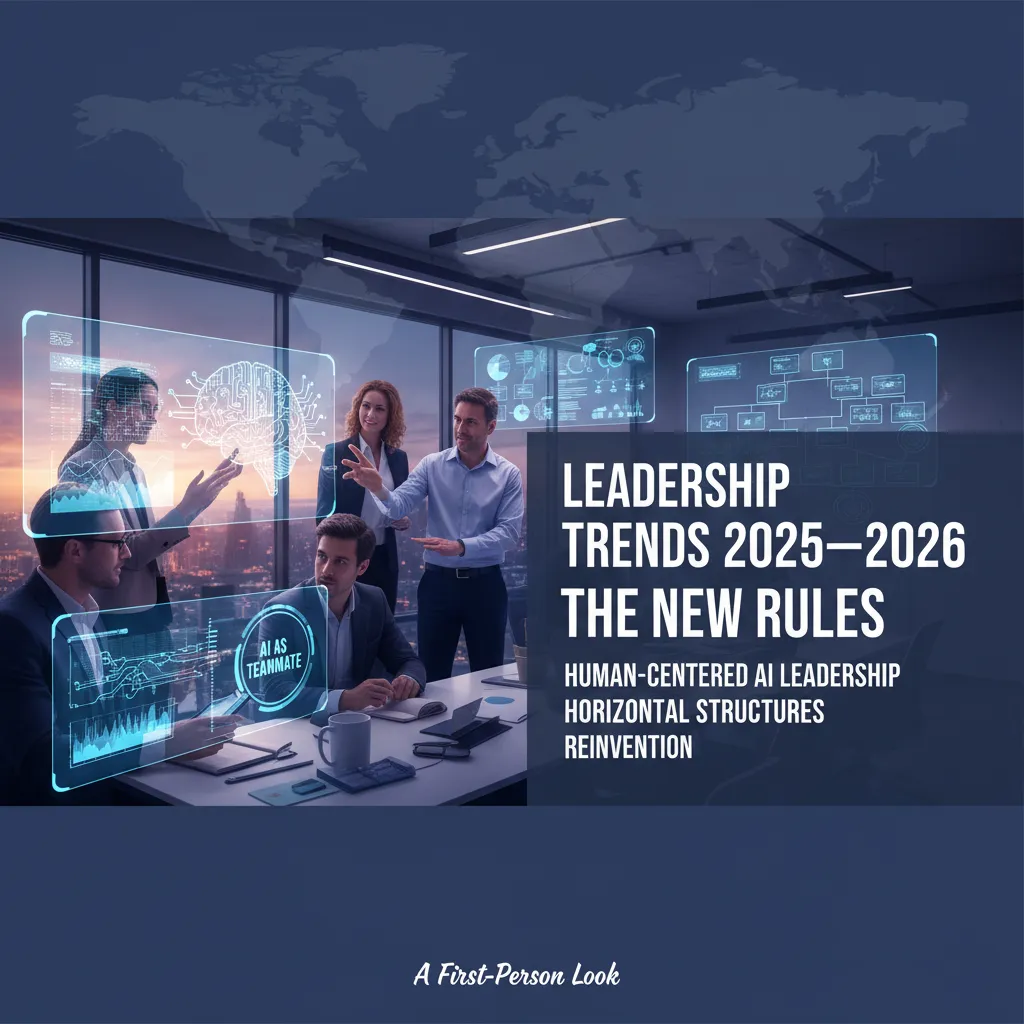
Last fall, I watched a manager in my network try to run a project kickoff, onboard two new hires, and “coach” three underperformers—between meetings that could’ve been emails. At one point they joked, “I’m basically air-traffic control with feelings.” That throwaway line stuck with me, because it captures what Leadership Trends 2025-2026 feels like on the ground: more complexity, wider spans of influence, and a growing expectation that leaders can be both strategic and relentlessly human—while AI quietly moves into the next chair.
1) Human AI Leadership: My “Second Brain” Moment
A hard conversation, drafted by AI
I used to think using AI in leadership would make me sound robotic. Then I had to lead a tough performance conversation with someone I respect. I was stressed, and my first draft agenda was blunt. So I asked AI to help me structure it: “Create an agenda that is clear, fair, and supportive.”
What came back surprised me. It didn’t soften the message. It softened me. The AI suggested I start with context, name the shared goal, and ask two honest questions before I gave feedback. It even reminded me to check for understanding and end with next steps the person could control. The result was kinder, not colder—more human AI leadership than I expected.
Human-AI partnership in practice
In the leadership trends 2025–2026 conversation, this is the shift I keep seeing: AI becomes a practical “second brain” for preparation, while humans stay responsible for meaning and trust.
- Where AI helps: spotting patterns in notes, summarizing meetings, drafting agendas, preparing coaching questions, and stress-testing options.
- Where humans must lead: ethics, fairness, psychological safety, and deciding what matters most when trade-offs appear.
AI can suggest words. Only I can own the relationship. AI can surface risks. Only I can choose the values we follow.
AI proficiency is now a leadership requirement
One of the biggest leadership trends 2025–2026 is that technology and AI proficiency is no longer a “nice-to-have for the nerds.” If I lead people, budgets, or strategy, I need to understand how AI works in daily workflows: what it’s good at, where it fails, and how bias can show up.
In my own routine, I treat AI like a junior staff member: fast, helpful, and sometimes wrong. I verify key facts, protect private data, and keep the final decision human.
Wild card: an agentic AI schedules my week
Imagine an agentic AI that reads my goals, inbox, and project plans, then schedules my entire week. Do I accept or override?
I’d accept as a draft, then override two things: time for people and time for thinking. If the schedule optimizes only for output, it can quietly erase trust-building conversations and deep work. My rule is simple: AI can optimize the calendar, but I set the priorities.

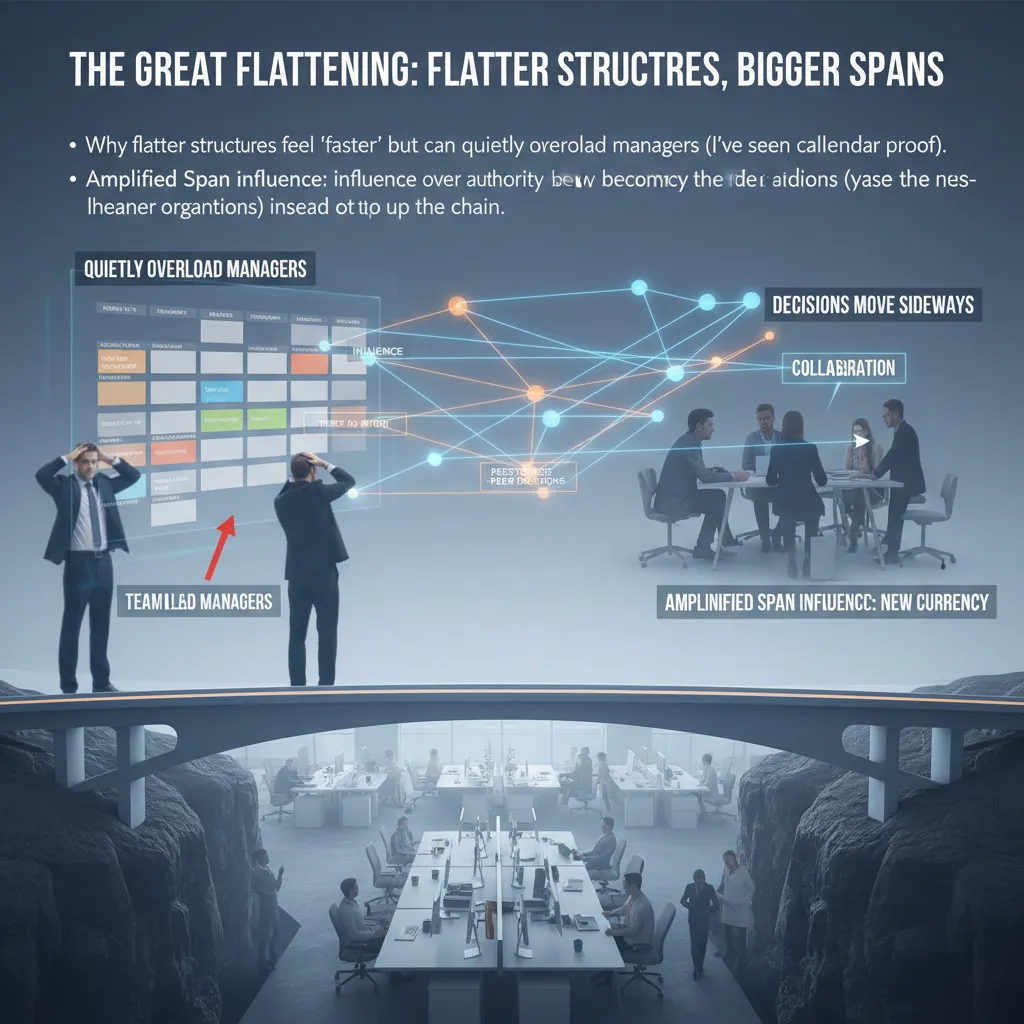
2) The Great Flattening: Flatter Structures, Bigger Spans
One of the biggest leadership trends I’m seeing for 2025–2026 is what I call the great flattening: fewer layers, wider teams, and leaders managing bigger spans. On paper, flatter structures look “faster” because there are fewer approvals and less waiting for the next level up. In practice, the speed is real—but so is the hidden cost.
Why flatter structures feel faster (and why managers quietly overload)
When you remove layers, decisions can move with less friction. But the work doesn’t disappear; it shifts. I’ve seen the calendar proof: the same manager who used to have two hours a day for deep work now has back-to-back check-ins, escalations, and “quick questions” that aren’t quick at all.
In leaner orgs, managers become the routing system for everything: priorities, people issues, cross-team alignment, and customer pressure. The result is a leadership bottleneck that looks like agility from the outside.
Amplified Span Influence: influence becomes the new currency
As spans get bigger, authority matters less than influence. You can’t “manage” 12–18 people the same way you managed 6. You have to lead through clarity, trust, and shared standards. In this model, the leaders who win are the ones who can:
- Set simple priorities that teams can repeat without them in the room
- Create decision rules (what needs approval vs. what doesn’t)
- Build strong peer networks so work doesn’t always climb upward
Horizontal leadership: decisions move sideways, not up
In flatter organizations, decisions increasingly move peer-to-peer. Instead of “send it up the chain,” it becomes “work it out with the other team lead.” That’s horizontal leadership: alignment through relationships, not rank.
I’ve found this works best when teams agree on a few shared basics—definitions, timelines, and what “done” means—so coordination doesn’t turn into endless negotiation.
A tangent I can’t resist: pancake org chart, non-syrupy communication
If your org chart looks like a pancake, your communication has to stop being syrupy.
Flatter structures can’t survive vague updates and polite hints. Leaders need crisp messages: what’s changing, what’s not, who decides, and by when. If you want speed, you have to trade softness for clarity.
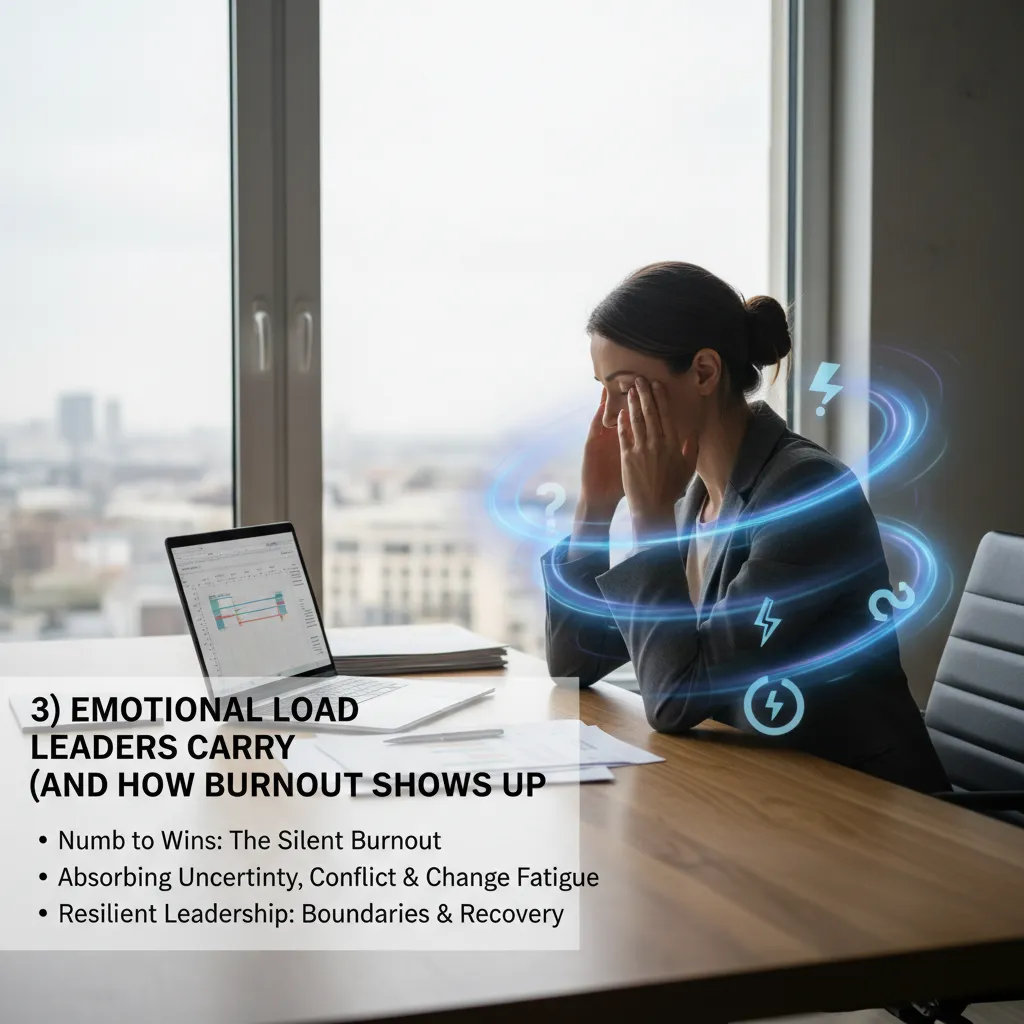
3) Emotional Load Leaders Carry (and How Burnout Shows Up)
One of the biggest leadership trends I’m seeing for 2025–2026 is that the job isn’t just strategy and execution anymore. It’s also emotional. Leaders are expected to hold the team steady through uncertainty, conflict, and constant change. That “hidden work” adds up, even when the calendar looks manageable.
The hidden work: absorbing uncertainty, conflict, and change fatigue
In many organizations, I’m the person who gets the first wave of worry: budget shifts, unclear priorities, layoffs rumors, customer pressure, or tension between teams. I may not be the cause of the stress, but I often become the container for it. Over time, that emotional load can feel like carrying a backpack I never set down.
Change fatigue is a big part of this. When priorities keep moving, people don’t just need new plans—they need reassurance, clarity, and a sense that their effort still matters. That emotional support is real work, and it’s easy to underestimate.
Burnout isn’t always dramatic—sometimes it’s numbness
Leader burnout doesn’t always look like a breakdown. Sometimes it looks like flatness. I’ve caught myself doing this: we hit a milestone, and instead of feeling proud, I immediately move to the next problem. Wins stop landing. I’m present, but not fully engaged.
- Numb to wins and less motivated by progress
- Shorter patience in meetings and 1:1s
- Decision fatigue and slower follow-through
- Always “on”, even after hours
“If I can’t feel the good moments, that’s a signal—not a personality trait.”
Resilient leadership is a practice: boundaries, recovery, capacity planning
What’s changing in 2025–2026 is the expectation that leaders build resilience like a system, not a slogan. For me, that means setting boundaries that protect focus and recovery, and doing honest capacity planning.
- Boundaries: define “no-meeting” blocks and real off-hours.
- Recovery: schedule downtime like a deliverable, not a reward.
- Capacity planning: say “we can do A or B” instead of “we can do both.”
Work-life balance pressure is real (and Gen Z is raising the bar)
Gen Z expectations around flexibility and values are shaping leadership norms. People want work that fits life, not the other way around. That creates pressure on leaders to be consistent: if I promote balance, I have to model it. If I talk about values, I have to make decisions that match them—even when it’s inconvenient.
4) Leadership Pipelines Are Getting Weird (In a Good Way)
When I look at leadership development in 2025–2026, the biggest shift is this: the pipeline no longer looks like a clean ladder. It looks more like a map with side roads, short detours, and fast turns. And honestly, that’s a good thing. The work is changing too quickly for “wait your turn” promotions to keep up.
Shifting Career Paths: Less Ladder, More Range
In the source material, what stands out is how often leaders are being built through lateral moves, not just upward titles. I’m seeing people jump from operations to product, from marketing to customer success, or from finance into transformation roles. These moves build range: the ability to understand the business from multiple angles.
- Fewer predictable promotions based on tenure
- More cross-functional rotations to build judgment
- More “tour of duty” roles tied to a business problem, not a career step
Succession Redefined: Bench Strength = Learning Speed
Succession planning is also getting redefined. “Who’s next” matters less than “who can step in and learn fast under pressure.” Bench strength isn’t a list of names anymore; it’s a set of capabilities spread across the org.
Bench strength in 2026 is less about readiness on paper and more about adaptability in real time.
One practical change I recommend: evaluate successors using short, high-stakes simulations (crisis comms, AI rollout, customer churn spike) instead of only performance history.
Continuous Upskilling: AI Fluency + Human Skills
The new core skill blend is clear: AI fluency plus human-centered leadership. I don’t mean everyone needs to code, but leaders do need to understand what AI can do, where it fails, and how to ask better questions.
| AI Fluency | Human-Centered Skills |
|---|---|
| Prompting & evaluation | Coaching & feedback |
| Data judgment | Trust-building |
| Risk & bias awareness | Conflict navigation |
A Slightly Controversial Take
I’ll say it plainly: high potentials who avoid messy projects aren’t high potential for 2026. If someone only wants clean wins, stable teams, and perfect inputs, they’re optimizing for comfort, not leadership. The future pipeline rewards people who can walk into ambiguity, learn in public, and still deliver.
5) Agility Change Management: Leading When Nothing Sits Still
In Leadership Trends 2025–2026: The New Rules, I’m seeing a clear shift: change is no longer a “project” with a start and end date. It’s the normal state of work. That means agility change management is not a one-time announcement—it’s a leadership practice I repeat every week, even when the plan keeps moving.
Change leadership isn’t a memo—it’s a weekly habit
When people feel constant change, they don’t need more slides. They need signals they can trust. I treat change leadership like a routine:
- Listening loops: short check-ins, quick pulse surveys, and open Q&A so I hear friction early.
- Small experiments: test one process, one team, one customer segment—then scale what works.
- Visible decisions: I explain what we chose, what we didn’t, and why. Silence creates rumors.
“People don’t fear change as much as they fear being left out of it.”
Organizational agility becomes the default operating system
In 2025–2026, agility is less about a framework and more about how work flows across the company. I push for cross-functional collaboration as the default: product, ops, sales, finance, and IT solving the same problem together. This reduces handoffs and speeds up learning.
One simple rule I use: if a decision affects customers and costs, it should not live in one department. I set up short “decision huddles” with clear owners and time limits, so we move fast without chaos.
Purpose-driven cultures stabilize shaky strategy
When markets shift, strategy can get blurry. That’s when purpose-driven leadership becomes the stabilizer. Purpose acts like a filter for trade-offs: what we protect, what we pause, and what we stop. I keep purpose practical by tying it to daily choices—pricing, hiring, product scope, and service levels.
- Does this decision match our purpose?
- Will customers feel the difference?
- Can our teams deliver it without burnout?
Environmental responsibility is leadership work now
Environmental responsibility is no longer a side project for “sustainability folks.” It shows up in leadership priorities: supplier choices, travel policies, energy use, packaging, and reporting. I treat it like any other performance area—set targets, assign owners, review progress, and make trade-offs visible. In agile organizations, sustainability moves faster when it’s built into everyday decisions, not added at the end.
Conclusion: Leadership Every Level (My 2026 Litmus Test)
As I look at the leadership trends shaping 2025–2026, one theme keeps repeating: leadership is moving to every level. It’s not just a title or a role at the top. It shows up in how we use AI as a teammate, how we work in flatter structures, how we carry (and share) the emotional load, how we rebuild the leadership pipeline, and how quickly we adapt when the plan changes again.
AI is no longer “a tool in the corner.” It’s becoming part of daily work—drafting, summarizing, testing ideas, and speeding up decisions. At the same time, teams are getting flatter, which means fewer layers to hide behind. That sounds efficient, but it also means more people are asked to lead without formal authority. Add the emotional load—uncertainty, burnout, conflict, and constant change—and it’s clear why the old rules of leadership don’t fit. The pipeline is being reinvented too: we can’t wait years for someone to “be ready.” We need coaching, feedback, and real chances to lead now, in small ways, every week.
My 2026 litmus test is simple: if a decision makes the team faster but less humane, it’s not leadership—it’s optimization.
I use that test because speed is easy to measure, but humanity is easy to lose. If AI helps us move faster, I ask: does it also protect focus, reduce stress, and make work clearer? If a flatter structure removes a manager layer, I ask: did we also add support, context, and healthy boundaries? If we push for change agility, I ask: are we giving people time to learn, recover, and stay connected?
When I want to turn these ideas into action, I keep a tiny Monday reset in my head: I choose one AI assist that saves real time, one boundary that protects deep work or personal life, one sideways collaboration that breaks a silo, and one coaching moment where I help someone think, not just do. Small moves, repeated, rebuild trust and capability.
My wild card analogy for 2026 is this: leadership is less “captain of the ship” and more gardener in weird weather. You don’t control the storm, but you can build resilience—healthier systems, stronger roots, and teams that can grow even when conditions keep changing.
TL;DR: Leadership Trends 2026 aren’t about louder charisma—they’re about Human AI Leadership, the Great Flattening, and protecting leaders from burnout while building leadership pipelines that work in leaner organizations. Expect wider spans of influence, more horizontal leadership, and continuous upskilling as table stakes.


Comments
Post a Comment