
Last quarter, I watched a leadership meeting go off the rails—not because we lacked ideas, but because we lacked time. Half the agenda was “status updates,” the other half was arguing about whose spreadsheet was correct. A week later, we tried an AI-assisted ops cadence: auto-summaries, decision logs, and an agent that chased missing inputs. The tone changed. Less theater, more decisions. That little experiment sent me down a rabbit hole: if AI is truly “transformational,” why are some exec teams getting calmer while others just get more tools to babysit? The 2026 leadership numbers helped me connect the dots—and they’re more practical (and messier) than the hype.
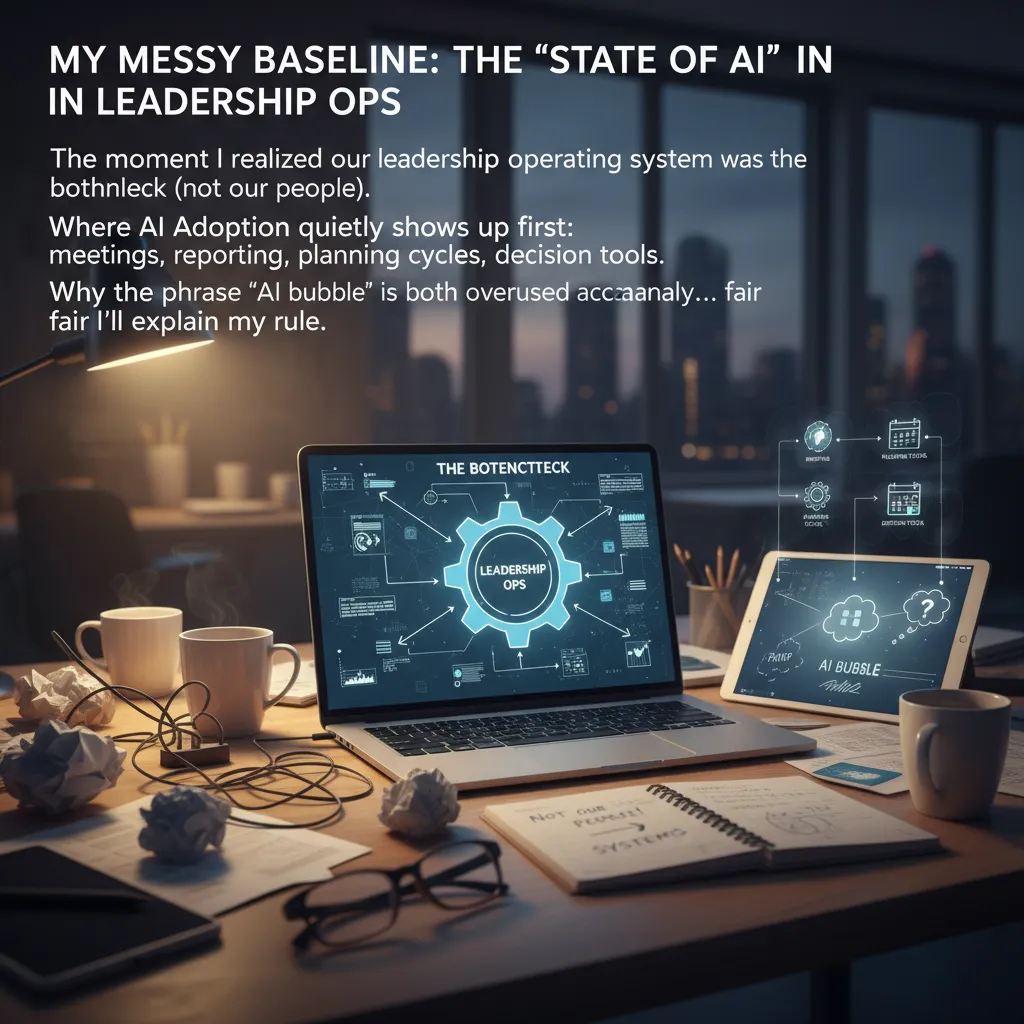
1) My messy baseline: the "State of AI" in leadership ops
The day I realized the bottleneck wasn’t our people
I used to think our leadership team needed “better execution.” Then I watched the same pattern repeat: smart people, good intent, and still we lost weeks to rework. Meetings ended with fuzzy owners. Updates lived in five places. Decisions got revisited because the context was scattered. That’s when it clicked—our leadership operating system was the bottleneck, not our talent.
In my notes from that week, I wrote: “We don’t have a performance problem. We have a system problem.” That became my baseline for the state of AI in leadership ops: before we “add AI,” we have to see where the work actually leaks.
Where AI adoption quietly shows up first
In real life, AI adoption doesn’t start with big strategy decks. It shows up in the unglamorous parts of leadership operations—the places where time disappears.
Meetings: agendas drafted faster, notes captured, action items pulled out, follow-ups written.
Reporting: weekly updates summarized, trends highlighted, and “what changed?” answered without hunting.
Planning cycles: first drafts of goals, risks, and dependencies created so leaders can edit instead of start from zero.
Decision tools: lightweight briefs, pros/cons, and scenario comparisons that make trade-offs visible.
This is why “How AI Transformed Leadership Operations: Real Results” resonated with me: the wins weren’t abstract. They were operational—less drag, clearer decisions, and fewer loops.
Why “AI bubble” is overused (and sometimes fair)
I hear “AI bubble” thrown around like a punchline. Most of the time it’s lazy. But it’s occasionally fair, and I use a simple rule:
If AI doesn’t reduce cycle time or improve decision quality within a real workflow, it’s hype—not impact.
When teams buy tools without fixing inputs (messy docs, unclear owners, no standard cadence), AI can’t save them. It just makes the chaos faster.
My wild-card analogy: AI as a new hire
I stopped treating AI like a magic wand and started treating it like a new teammate who needs onboarding. That means giving it:
Context: goals, definitions, and what “good” looks like.
Boundaries: what it can draft vs. what humans must decide.
Feedback: edits, examples, and a consistent format to learn from.
Once I made that shift, the “state of AI leadership” stopped feeling like noise and started looking like a practical upgrade to leadership ops.
2) CEOs Optimistic, but ownership is the real accelerator (C-Suite Strategy)
In the source material, How AI Transformed Leadership Operations: Real Results, one pattern shows up again and again: CEOs are optimistic about AI, but the teams that win are the ones with clear CEO ownership. I’ve learned that optimism creates energy, but ownership creates motion. When the CEO treats AI like a leadership operating system—not a side experiment—execution speeds up fast.
Why CEO ownership matters (metrics become habits)
I’ve watched a simple dynamic change behavior overnight: when the CEO asks for a metric, it suddenly becomes a habit. Not because people love dashboards, but because the question signals priority. If the CEO asks weekly, teams build the data pipeline. If the CEO asks in staff meetings, leaders align their work. If the CEO asks for outcomes, not activity, the AI program stops being “interesting” and starts being “real.”
“What gets asked for at the top becomes normal everywhere else.”
The C-Suite Strategy shift I’m seeing: from IT project to operating model
The biggest shift in AI leadership right now is this: AI is moving from an IT project to an operating model. In practice, that means the C-suite sets the rules of the road—how work gets done, how decisions get made, and how results get measured. IT still matters, but it’s no longer the “owner” of value. The business owns value, and the CEO makes that ownership visible.
A practical checklist I stole from ops
Operations leaders tend to be blunt in a helpful way. Here’s the checklist I borrowed and now use to pressure-test AI initiatives:
One business value statement per AI initiative (single sentence, no buzzwords).
One primary metric the CEO will ask for (weekly or monthly).
One accountable owner in the business (not “the AI team”).
One workflow that will change (name the exact step AI improves).
One adoption signal (e.g., % of leaders using the output in decisions).
Example value statement format:
We will use AI to reduce weekly leadership reporting time by 30% while improving forecast accuracy.
Mini-tangent: optimism is great—until it becomes tool-buying
I’m pro-optimism. But I’ve also seen the trap: “We bought tools, therefore transformation.” Tools don’t change leadership operations. Ownership does. If the CEO can’t name the metric, the owner, and the workflow change, the initiative is still a purchase—not a strategy.
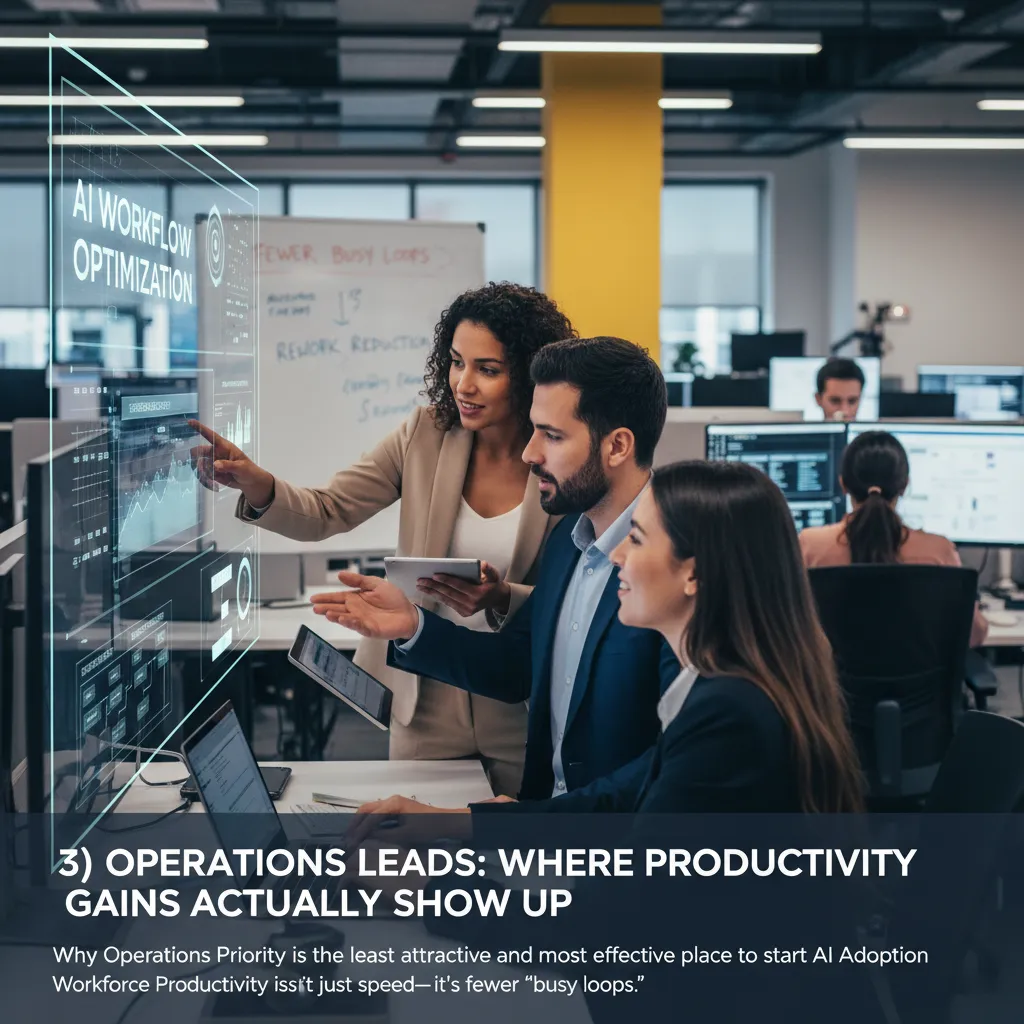
3) Operations Leads: where Productivity Gains actually show up
When people ask me where AI delivers real productivity gains, I usually point to Operations. It’s the least sexy place to start AI adoption—no flashy demos, no big “innovation theater.” But it’s the most effective because ops work is full of repeatable steps, handoffs, and decisions that already live in tools and tickets. In the source story, How AI Transformed Leadership Operations: Real Results, the pattern is clear: the wins show up where work is tracked, routed, and reviewed every day.
Why ops is the best starting line (even if it’s not exciting)
Operations is where small delays stack up into big misses. AI helps most when it reduces friction across teams, not just when it speeds up one person’s task. I’ve seen leaders get more value from fixing the “plumbing” than from chasing a perfect strategy deck.
Ops workflows I’ve seen improve fast
Forecasting handoffs: AI can summarize inputs from Sales, Supply, and Finance into one clean view, flag gaps, and ask for missing numbers before the meeting.
Exception handling: Instead of scanning dashboards, AI watches for outliers (late shipments, SLA risk, inventory dips) and opens the right ticket with context.
Root-cause notes: After an incident, AI drafts a simple root-cause write-up from logs, chats, and timelines, so teams stop rewriting the same story.
Customer escalations: AI pulls the account history, recent changes, and open issues into a single brief, so the escalation call starts with facts.
Productivity isn’t just speed—it’s fewer “busy loops”
Workforce productivity gains show up as fewer loops of rework and chasing. AI reduces:
duplicate status updates across Slack, email, and spreadsheets
approval chasing (“who owns this?” “who’s next?”)
handoff confusion between teams and time zones
The biggest ops win is not doing the same coordination work twice.
Hypothetical: an AI “ops air-traffic controller”
Imagine an AI agent that sits on top of your request intake. Every new ask gets classified, routed, and tracked. If a blocker appears, it pings the right owner, suggests next steps, and updates the timeline automatically. Leaders don’t get more alerts—they get a clean queue, clear priorities, and fewer surprises.

4) Governance Scale: the unglamorous system that keeps AI in production
In my work on leadership operations, I learned that centralized governance isn’t about control. It’s about not repeating the same mistake in five departments. When AI starts delivering real results, teams move fast. That speed is good—until the same prompt, the same vendor tool, or the same data shortcut shows up everywhere, and now one small issue becomes a company-wide problem.
Centralized governance = shared learning, fewer repeat failures
I treat governance like a simple operating system for AI. It gives teams freedom to build, but it also creates a single place to capture what worked, what broke, and what we fixed. Without that, every team “discovers” the same risks on their own timeline—usually after something goes wrong in production.
My lightweight governance framework
I keep it practical. The goal is to make the safe path the easy path. Here’s what I put in place:
Model inventory: a living list of every model and AI feature in use, who owns it, what data it touches, and what it’s used for.
Approval thresholds: clear rules for when a team can ship on their own vs. when they need review (for example: customer-facing outputs, regulated data, or automated decisions).
Audit trails: basic logging of prompts, versions, key inputs/outputs, and who approved changes—enough to debug and explain decisions later.
Human-in-the-loop rules: where humans must review, what “good” looks like, and what happens when confidence is low or the system flags risk.
Responsible AI as a business continuity plan
I don’t frame responsible AI as ethics theater. I frame it as business continuity. If a model drifts, a vendor changes behavior, or a data source gets restricted, I want a plan that keeps operations running. Governance helps me answer basic questions fast: What’s impacted? Who owns it? Can we roll back? What’s the manual fallback?
Governance is what keeps AI useful after the pilot glow fades.
My “AI Bubble” test
Before I scale any system, I run a simple test: if I can’t explain how it fails, I’m not ready to scale it. I ask teams to describe failure modes in plain language—wrong answers, biased outputs, data leaks, over-automation, silent model updates—and to show the guardrails.
If the explanation sounds like a bubble (“it’ll probably be fine”), I slow down. Production AI needs more than optimism; it needs a system that can take a hit and keep working.
5) The org chart reality: Chief Data Officer vs Chief AI Officer (and why I stopped arguing about titles)
I’ve watched too many teams lose months debating whether they “need” a Chief Data Officer (CDO) or a Chief AI Officer (CAIO). In real operations, the org chart is less important than the work getting done. Titles don’t ship value. Clear ownership does.
Chief Data Officer: the quiet force multiplier
In the source work on how AI transformed leadership operations, the biggest wins didn’t start with a model. They started with data that was finally treated like a product. The CDO is the person who makes that boring, essential work visible and funded.
Data priority: deciding what data matters for outcomes, not vanity dashboards
Quality: fixing definitions, duplicates, missing fields, and “mystery metrics”
Access: making sure teams can use data safely without ticket hell
Stewardship: ownership, lineage, retention, and governance that people can follow
Chief AI Officer: the translation layer
The CAIO, when it works, is not “the model person.” They are the translation layer between strategy, product, risk, and operations. They turn “we should use AI” into a scoped plan: where automation fits, what humans keep, what risk controls are required, and how results will be measured.
“AI leadership is less about picking algorithms and more about aligning incentives, workflows, and guardrails.”
How I’d split responsibilities (so the CAIO isn’t the scapegoat)
I’ve seen CAIOs blamed for every bad output, even when the root cause was messy data, unclear process, or missing approvals. Here’s the split I now push for:
CDO owns: data quality SLAs, master data, access policies, metadata, and stewardship
CAIO owns: AI portfolio, use-case selection, operating model, vendor choices, and adoption
Risk/Legal owns: policy, reviews, and escalation paths for sensitive use
Product/Ops owns: workflow design, training, and day-to-day performance targets
Small confession: I used to think CAIO was a fad
I’ll admit it: I used to roll my eyes at the CAIO title. Then I saw the numbers move when someone owned the “last mile” of AI in operations—cycle time dropped, rework fell, and leaders got consistent reporting they could trust. That’s when I stopped arguing about titles and started arguing for accountability.
6) AI Investments Surge: turning spend into measurable returns (without chasing shiny objects)
In How AI Transformed Leadership Operations: Real Results, the biggest shift I saw was mindset. I stopped treating “AI investments” like a one-time capital bet and started treating them like an operating expense with a learning curve. Models change, workflows evolve, and teams need time to build habits. If I fund AI like a single purchase, I get a short pilot and a long hangover. If I fund it like operations, I get iteration, training, and steady gains.
The 2026 spending signal: 1.7% of revenue—and what I’d track monthly
The signal for 2026 is clear: AI spending is expected to double to 1.7% of revenues. That number matters less than what it forces leaders to do: prove value in a way finance can trust. If I’m asking for that budget, I’m also asking finance to track a few simple monthly measures: total AI run-rate (tools, compute, vendors), adoption (active users and usage by workflow), and the “value ledger” tied to specific processes. I also want a clean view of rework costs—because hidden rework is where weak AI rollouts quietly burn money.
What measurable business value looks like in practice
When I say “measurable business value,” I mean outcomes that show up in operating reviews, not just demos. In leadership operations, I look for cost avoidance (hours not hired, vendors not added), throughput (more tickets closed, faster cycle time), fewer defects (less rework, fewer escalations, better compliance), and revenue uplift (faster proposals, better follow-up, higher conversion). The key is to tie each AI use case to one baseline metric and one owner. If no one owns the number, the number will not move.
“If we can’t measure it monthly, we’re not managing it—we’re hoping.”
My closing wild card: a 90-day bet
If I had 90 days to prove AI ROI without chasing shiny objects, I’d pick one ops workflow (like weekly business reviews or customer escalation triage), deploy one agent to draft, summarize, and route decisions, set one governance rule (no customer data without approved controls and human sign-off), and commit to one metric: cycle time from intake to decision. If cycle time drops and quality holds, I scale. If it doesn’t, I stop—fast, clean, and smarter than before.
TL;DR: AI is moving from experiments to AI production, especially in operations. The leadership teams seeing real results pair CEO ownership with strong CDO/CAIO roles, centralized governance, and Responsible AI safeguards—then measure value like it’s an ops metric, not a moonshot.


Comments
Post a Comment