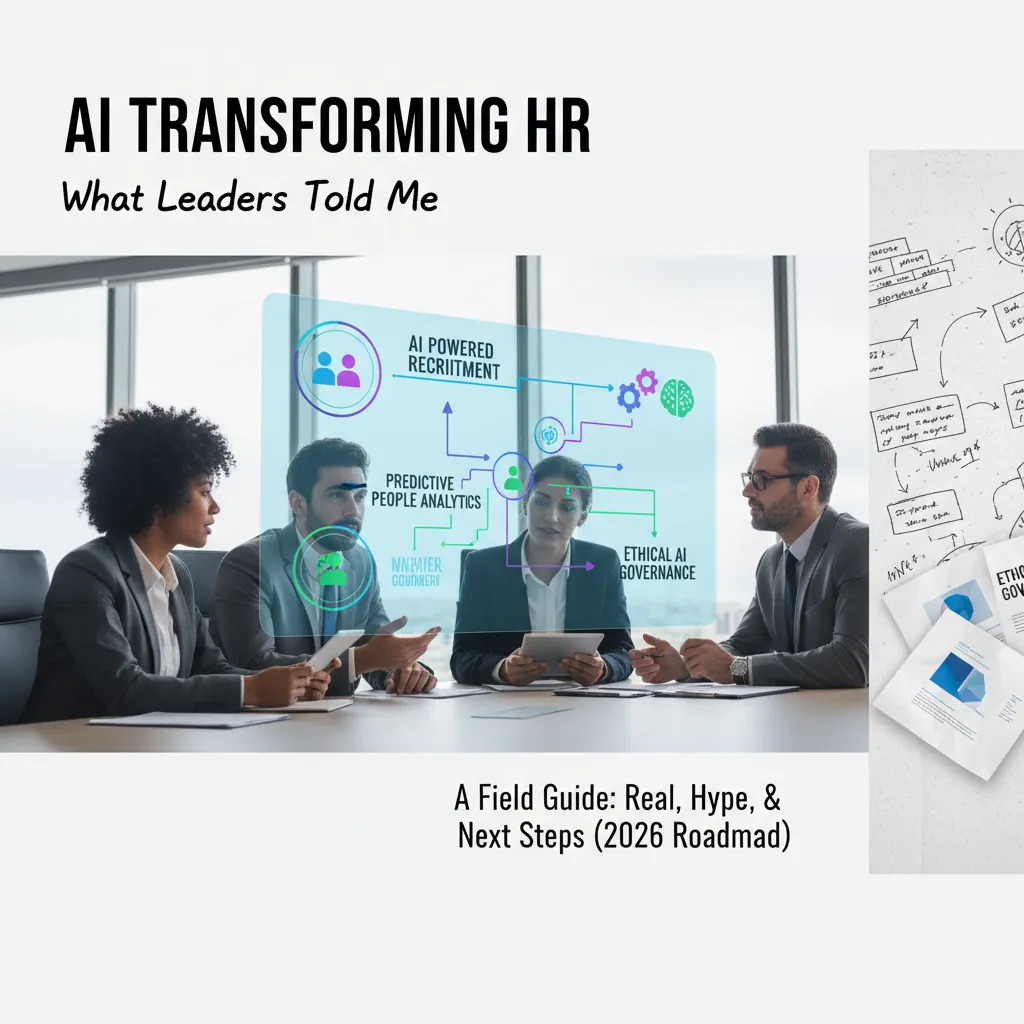
Last month I sat in on an “Expert Interview: HR Leaders Discuss AI” and caught myself doing that HR-person thing: nodding politely while mentally translating buzzwords into, “Okay, but who’s going to own this workflow on Monday?” On the walk back from grabbing coffee, I replayed one line about agents taking the grunt work off recruiters’ plates—and it reminded me of the first time I automated a tedious onboarding checklist. It didn’t make me feel replaced; it made me feel… weirdly protective of the candidate experience. This post is my attempt to bottle that tension: excitement, skepticism, and the real governance questions we keep postponing.
1) AI Powered Recruitment isn’t magic—it's math + judgment
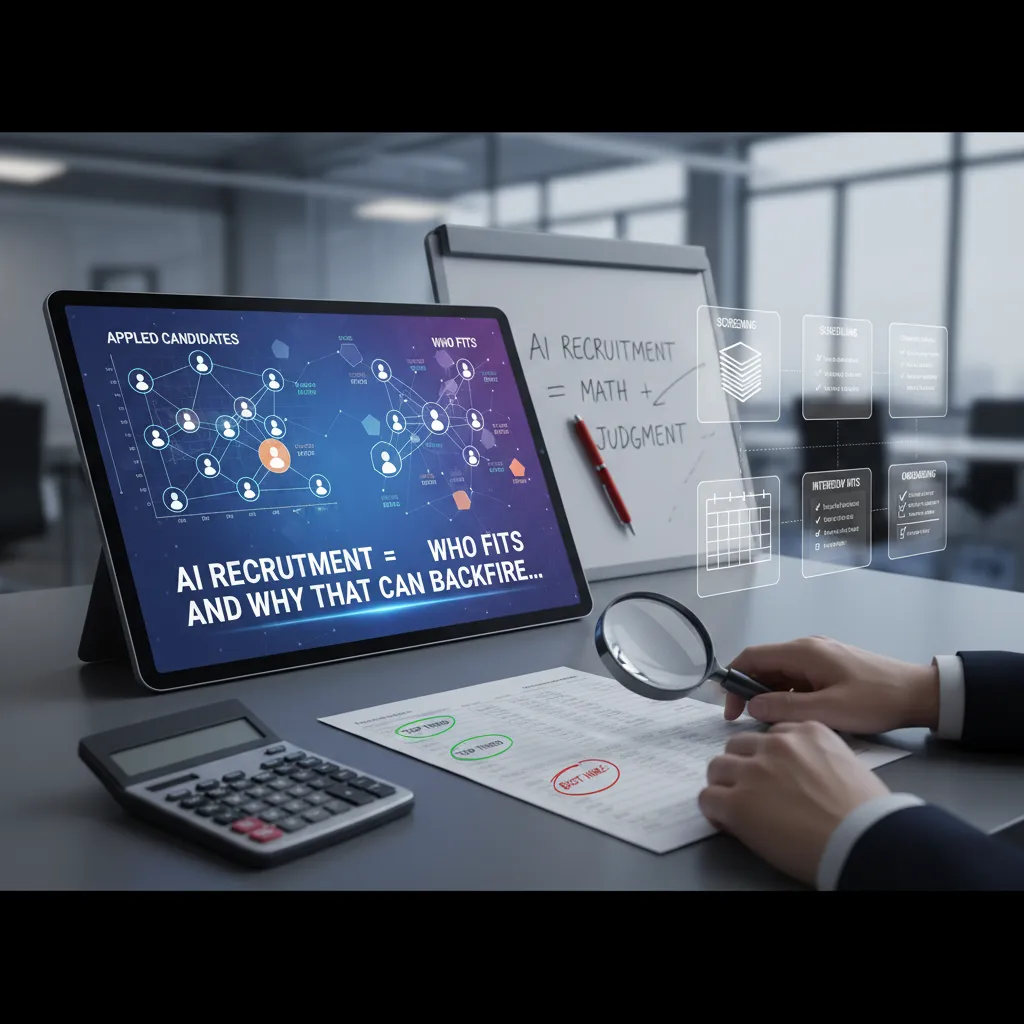
In my interviews for “AI Transforming HR: What Leaders Told Me”, one theme kept coming up: AI in recruiting is not a crystal ball. It’s math + judgment. The math finds patterns fast. The judgment decides what patterns matter, what trade-offs are acceptable, and when the model is simply wrong.
From “who applied” to “who fits” (and why that can backfire)
HR leaders told me that Talent Intelligence Platforms change sourcing in a big way. Instead of starting with “who applied,” teams start with “who fits” based on skills, past roles, and signals from internal and external data. That sounds like progress—and it can be—but it can also backfire.
If your “fit” definition is built on yesterday’s workforce, AI can quietly filter out the very people you need next: career changers, non-traditional backgrounds, or candidates from schools and companies your team hasn’t hired from before. In other words, AI-powered recruitment can turn “fit” into “familiar.”
My small confession: I once over-trusted a ranking model
I’ll admit it: I once leaned too hard on a candidate ranking model. I treated the top scores like truth. The best hire we made that cycle came from the bottom third of the list. The model didn’t “see” their potential because their resume didn’t match the common pattern. A human interviewer did.
Where Recruitment Platforms AI helps immediately
Most leaders agreed that AI delivers quick wins in the “busy work” parts of recruiting. In modern recruitment platforms, AI can help with:
Screening for basic requirements and skills signals
Scheduling interviews and reducing back-and-forth emails
Interview kits (structured questions, scorecards, note prompts)
Onboarding workflows like document routing and task reminders
Bias mitigation AI: the uncomfortable reality
One leader put it plainly:
“You can automate bias faster than you can remove it.”
If the training data reflects biased decisions, the system can scale those decisions at speed. Bias mitigation AI helps, but only if you measure outcomes and challenge assumptions.
Practical checkpoint: what I’d audit weekly
Drop-off rates by stage (application, screen, interview, offer)
Time-to-fill and time-in-stage to spot bottlenecks
Adverse impact flags across gender, ethnicity, age (where legally allowed)
2) Agentic AI Operations: when HR workflows start “doing”
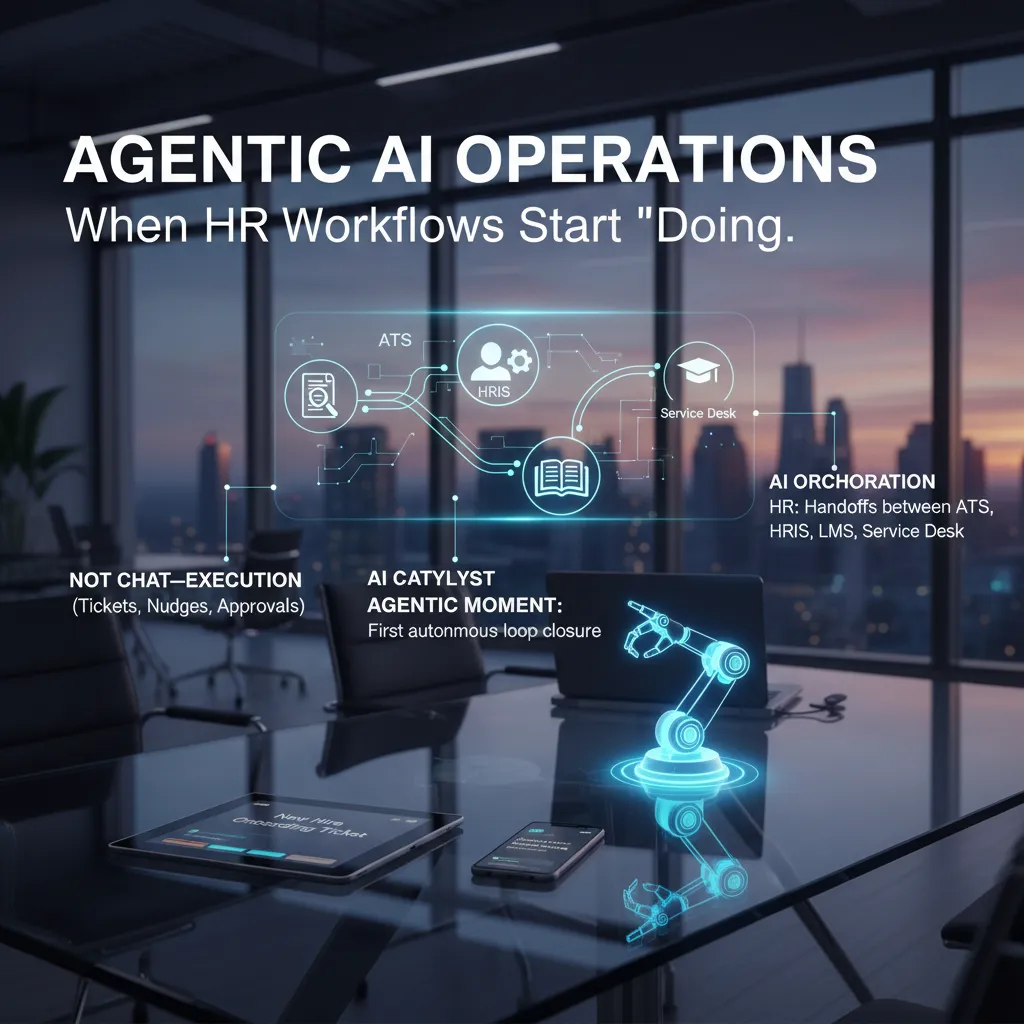
In my interviews for AI Transforming HR: What Leaders Told Me, one theme kept coming up: the shift from AI that talks to AI that acts. I explain Agentic AI in HR to my CFO like this: it’s not a chatbot answering questions. It’s software that can execute parts of a workflow—create tickets, send nudges, route approvals, update records, and confirm the task is done.
Agentic AI HR, in plain terms: not chat—execution
Several HR leaders described “agentic” as the moment AI stops being a side tool and becomes an operator inside the process. Instead of “Here’s what you should do,” it becomes “I did it.” In practice, that looks like:
Opening a service desk case when an employee reports an issue
Triggering an approval request for a policy exception
Sending reminders to managers when onboarding steps are late
Updating the HRIS after a form is completed
The AI catalyst moment: when the loop closes without you noticing
One leader told me their “aha” wasn’t a demo. It was a quiet week where fewer things escalated. The agent had been resolving routine requests end-to-end—intake, routing, follow-up, and closure—without anyone celebrating it. That’s the agentic moment: the loop closes, and the human only sees the outcome.
“The win wasn’t that it answered questions. The win was that it finished the work.”
What “AI orchestration in HR” looks like in the wild
When leaders said AI orchestration HR, they meant handoffs across systems that don’t naturally cooperate. I heard the same stack repeatedly:
ATS (candidate steps and offers)
HRIS (employee record and job data)
LMS (training assignments and completion)
Service desk (cases, SLAs, and audit trails)
The agent becomes the “glue,” moving tasks and status updates across tools so HR doesn’t have to.
The anxiety gap leaders can’t ignore
There’s also tension. Leaders cited that 78% have deployed AI somewhere, yet 1 in 3 U.S. workers fear job reduction. That gap shows up fast when AI starts taking actions, not just giving advice.
My rule of thumb
Based on what I heard, my rule is simple: start with Employee Services AI (cases, FAQs, onboarding logistics) before touching performance or other high-stakes decisions. It builds trust, proves control, and creates value without raising the biggest alarms.
3) Predictive People Analytics meets Continuous Listening Analytics (goodbye annual survey?)
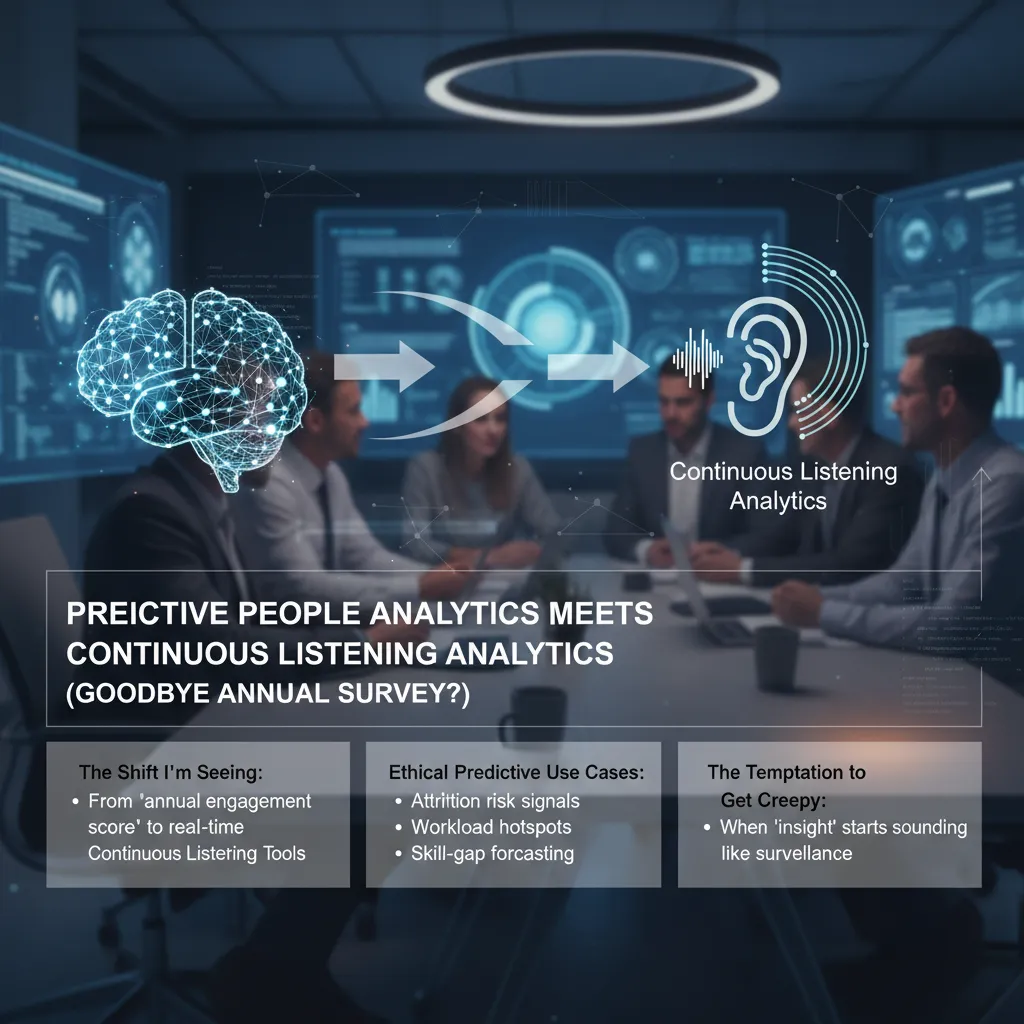
In my interviews with HR leaders, one shift came up again and again: we’re moving from the annual engagement score to real-time Continuous Listening tools. The old model was simple—run a big survey, publish a score, and hope managers “do something.” What I’m seeing now is more like a living signal: short pulses, always-on feedback channels, and trend lines that update as work changes.
Where predictive analytics feels helpful (and ethical)
When leaders talked about Predictive People Analytics, the best examples were not about “tracking people.” They were about spotting risk early and fixing systems. The use cases that felt most ethical were:
Attrition risk signals (team-level patterns, not “this person is leaving” labels)
Workload hotspots (where overtime, ticket volume, or meeting load is spiking)
Skill-gap forecasting (what capabilities we’ll need next quarter, based on strategy and hiring plans)
One leader put it plainly:
“If the output is a better work environment, it’s analytics. If the output is control, it’s surveillance.”
The temptation to get creepy
Continuous listening can slide into a gray zone fast. I heard concerns about tools that analyze every message, every meeting, every click. Even if the intent is “insight,” it can sound like monitoring. My rule of thumb: if I can’t explain the data source and benefit in one calm sentence to an employee, we’re too close to creepy.
A quick tangent: when my team ignored a pulse survey
We once sent a pulse survey after a busy launch—and response rates dropped hard. At first, I wanted to “fix participation.” But the silence taught me something: people were tired of being asked how they felt while nothing changed. The real signal wasn’t in the answers; it was in the non-answers. We paused surveys, reduced meetings, and shared what we were changing before asking again.
Narratives, not dashboards
Leaders told me the biggest win is communication. Dashboards don’t build trust—stories do. I try to share findings as a simple narrative:
What we’re seeing (trend, not individual)
Why it might be happening (context from managers and employees)
What we’ll do next (one or two actions, with owners)
That’s how AI-driven HR analytics stays human: clear signals, clear boundaries, and clear action.
4) Personalized Learning Upskilling—because “reskilling” is emotional
In my interviews for AI Transforming HR: What Leaders Told Me, one theme kept coming up: leaders can’t talk about “reskilling” like it’s a simple checklist. It lands on people as identity, status, and fear. One HR leader put it plainly:
“If learning feels like a threat, people avoid it—even when the business needs it.”
Personalized upskilling paths: business-critical and human-critical
The strongest idea I heard was to stop pushing one-size-fits-all training. AI in HR works best when it matches business-critical skills (what the company must build) with what people actually want to learn (what feels useful, interesting, and realistic). That overlap is where momentum lives.
Instead of “everyone take the data course,” leaders described role-based pathways that feel personal: “Here’s what good looks like in your role, here are two options to get there, and here’s how it connects to your next move.”
Training delivery: where AI helps, where humans still matter
AI can improve the delivery of learning in very practical ways: more practice, faster feedback, and pacing that adapts to the learner. Think short simulations, quick quizzes, and coaching prompts that respond to what someone gets wrong.
AI helps with: practice reps, instant feedback, personalized pacing, content recommendations.
Humans matter for: context (“why this matters here”), confidence, and psychological safety.
Several leaders stressed that managers are still the difference between “training assigned” and “learning applied.” AI can suggest, but a human has to connect it to real work.
My own learning flop: 7% completed
I once bought a big course bundle and finished… 7%. That wasn’t a content problem—it was a relevance problem. AI wouldn’t magically fix my motivation, but it might have fixed the mismatch by narrowing the path: “Skip the generic modules, practice the exact skill you need this week, and show proof in a small project.”
Why Learning & Development AI ties to mobility and retention
Leaders linked personalized learning directly to internal mobility. When people can see a clear path from “learn” to “move,” they stay. When learning feels random, they leave and grow somewhere else.
A practical 30-day experiment
Skills inventory: capture current skills + target skills for 3 key roles.
Three role-based pathways: 4 weeks, 15 minutes/day, with AI practice and feedback.
Manager nudges: weekly check-ins and one real-work assignment to apply the skill.
5) AI Governance HR: Culture Compliance Convergence (the unsexy superpower)
In my interviews with HR leaders, the least flashy topic kept coming up as the most important: AI governance. Not a one-time policy deck, but a daily habit that sits right where culture and compliance meet. One leader told me,
“If we can’t explain it in plain language, we shouldn’t deploy it.”
That line stuck with me.
Ethical AI governance as a daily habit
What I heard again and again is that governance only works when it’s built into normal HR workflows—like approvals and audits, not “special projects.” The basics sound boring, but they prevent real harm:
Approvals before any model touches candidate, employee, or pay data
Logging of prompts, outputs, and decisions (so you can trace what happened)
Red-team checks to test bias, privacy leaks, and unsafe edge cases
Plain-language comms to employees: what the tool does, what it doesn’t, and how to appeal
What breaks when you scale from one pilot to ten
Several leaders warned me that governance collapses during “pilot sprawl.” One team runs a careful test, then suddenly five other teams are also “just testing,” each with different vendors, settings, and data pulls. That’s when you lose track of:
Who approved what (and under which policy)
Which data sources are being used
Whether outputs are consistent across regions and roles
Culture dissonance: “human-first” policy, “efficiency-first” tools
I also heard frustration when company values say human-first, but the AI experience feels like speed over care—auto-rejections with no explanation, or performance summaries that read harsh. That gap creates distrust fast, even if the tool is technically “compliant.”
Pay transparency meets AI (the awkward moment)
Pay transparency policies add pressure. Leaders described the awkward moment when AI recommends a range managers don’t like—especially if it challenges legacy pay decisions. If HR can’t explain the range in simple terms, it turns into a credibility problem, not just a comp problem.
My bias: ship slower than apologize later
If it were up to me, I’d set up an Ethical AI Stewardship Council with clear gates:
HR + Legal + Security + DEI review before launch
Documented risk rating and mitigation plan
Employee-facing FAQ and appeal path
Quarterly audits with logged evidence
6) Skills Based Paradigm + Workforce Planning Skills: the part nobody can outsource
From my interviews with HR leaders, the most repeated “quiet win” was not a flashy chatbot. It was skills-based workforce planning. I call it my favorite boring advantage for HR reinvention with AI because it turns messy people data into clear decisions. AI can speed up the work, but leaders still have to choose what matters: which skills to build, which roles to protect, and where the business is really going.
Workforce planning skills in 2026: scenarios, critical roles, mobility
Several leaders told me the next version of workforce planning looks like a living model, not a yearly spreadsheet. In 2026, the core skills are scenario planning (what if demand drops, what if a new product takes off), identifying critical roles (the jobs that keep revenue, safety, or customers stable), and building internal mobility marketplaces. When internal gigs and projects are matched to skills, people move faster, and hiring pressure drops. AI helps by reading profiles, learning histories, and project needs, then suggesting matches—but HR still sets the rules so it stays fair and useful.
Job design: from titles to skill clusters (and why managers complain)
One theme came up again and again: moving from job titles to skills clusters. Instead of “Senior Analyst,” you define the bundle—data storytelling, stakeholder management, SQL, risk thinking. Managers often complain at first because titles feel simple and skills feel like extra work. But once they see clearer hiring, better internal moves, and fewer “we can’t find talent” surprises, the resistance softens. As one leader put it,
“Skills make the work visible. Titles hide it.”
HR ratios: what changes when 100:1 becomes 200:1–400:1
AI also shifts the HR benchmark ratio. Leaders expect many teams to move from 100:1 toward 200:1–400:1 employee-to-HR as admin work shrinks. That does not mean HR matters less. It means the job changes: fewer forms, more planning, governance, and coaching leaders through change.
I end this section with an image I can’t shake: HR as air-traffic control. AI handles more routine signals in the background, but HR keeps the system safe—sequencing talent, preventing collisions, and guiding more people to smooth landings.
TL;DR: AI is already reshaping recruiting, analytics, and learning—but the winners in HR Trends 2026 will pair Agentic AI Systems with Ethical AI Governance, continuous listening, and a skills-based workforce plan that employees can actually trust.


Comments
Post a Comment