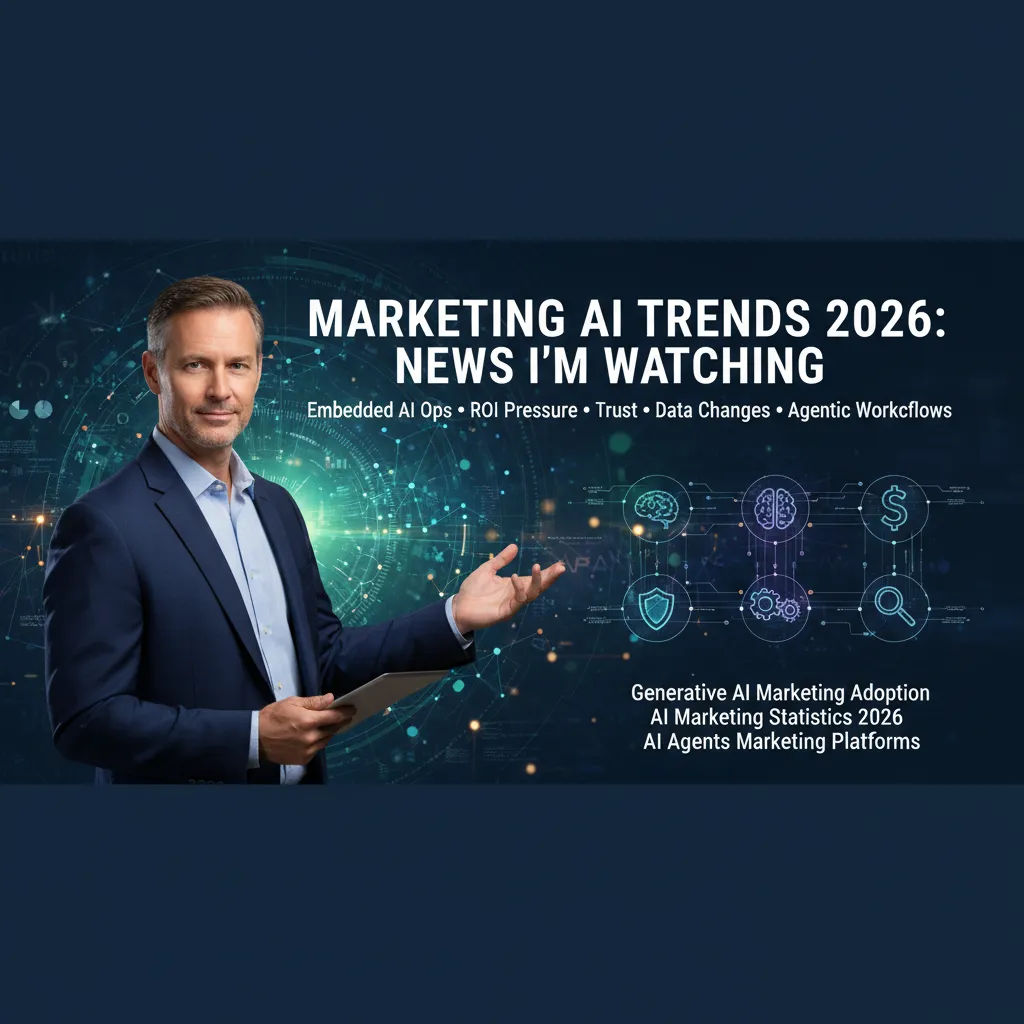
Last Friday I opened my inbox to what felt like the 12th “AI-powered” press release of the week… and realized I couldn’t tell which ones were real product leaps and which ones were just a new coat of chrome. So I started keeping a scrappy little ‘Marketing AI News’ notebook: what shipped, what broke, what saved me time, and what made me roll my eyes. This post is basically that notebook—cleaned up (a bit), with the trends and numbers that keep showing up when you zoom out.
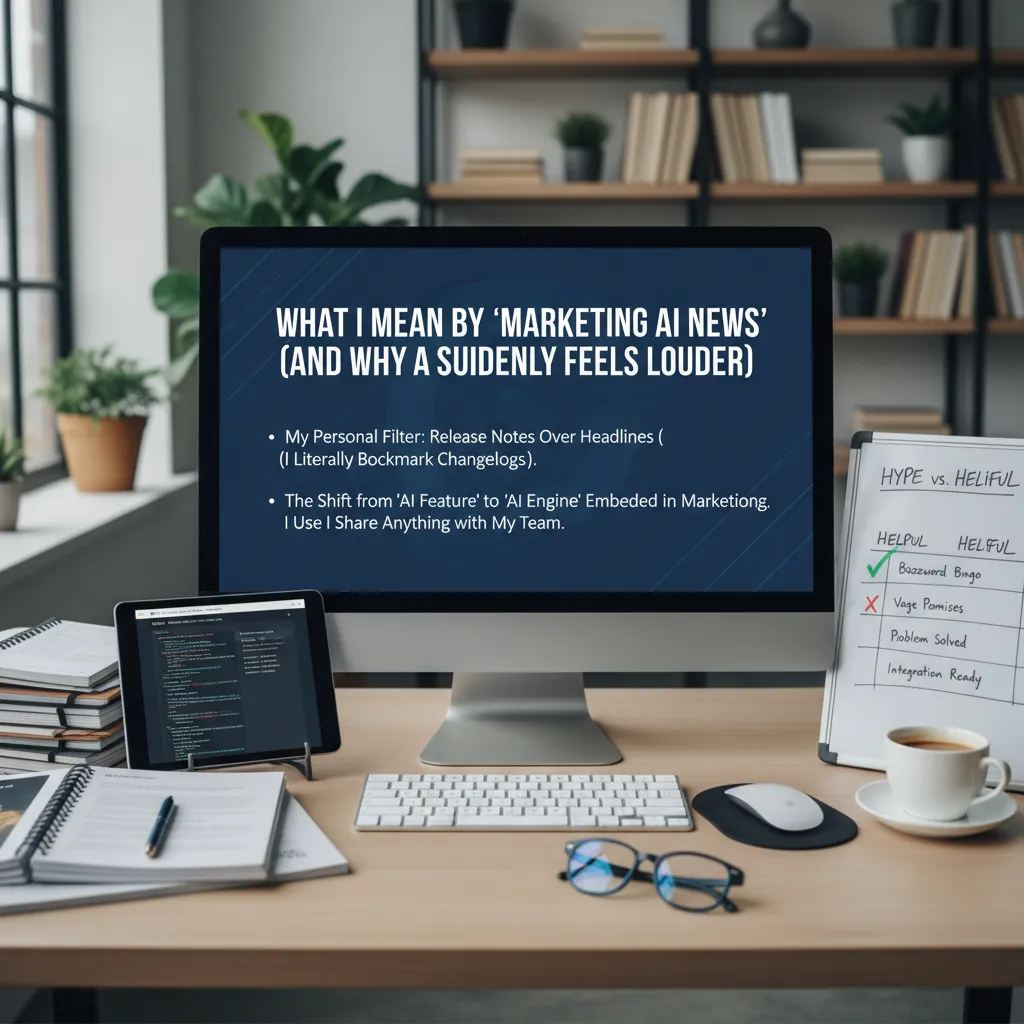
What I Mean by “Marketing AI News” (and why it suddenly feels louder)
When I say “marketing AI news”, I’m not talking about big headlines that promise a “revolution.” I mean the steady stream of product updates, model releases, API changes, and platform rollouts that quietly change how we plan, create, target, and measure. Lately it feels louder because updates are shipping faster, and almost every marketing tool now has an AI roadmap attached to it.
My personal filter: release notes over headlines
I trust release notes more than press releases. I literally bookmark changelogs. They tell me what actually changed: new targeting options, improved creative tools, updated attribution, or a new “assistant” inside the workflow. If an update can’t be found in a changelog, help doc, or product page, I treat it as noise.
From “AI feature” to “AI engine” inside operations
The bigger shift I’m watching is how AI moved from a single button (like “generate copy”) to an AI engine that runs across the system: audience building, budget pacing, creative testing, and reporting. That matters because it changes process, not just output. It also means teams need new habits: better inputs, clearer brand rules, and tighter review steps.
My “hype vs. helpful” checklist
Is it shipping now? I look for dates, regions, and access details.
What job does it replace? Drafting, QA, analysis, or routing work?
What data does it use? First-party, platform, or “trained on everything”?
Can we measure impact? Time saved, CPA change, lift, or error rate.
What’s the risk? Brand voice drift, privacy, or compliance issues.
Mini tangent: why SEO blogging is making a comeback
Everyone’s chasing short-form video, but I’m seeing SEO blogging return because AI tools need structured, searchable content to work with. A solid article becomes training wheels for your own team: it feeds internal search, supports sales enablement, and gives AI assistants clean context. Video is great for reach; blogging is great for retrieval and long-term demand.
AI reshaping marketing operations: the ‘invisible engine’ era
When I scan the latest Marketing AI news and product releases, the biggest shift I’m watching isn’t flashy “make me an ad” demos. It’s AI quietly moving into the operations layer—the invisible engine that keeps campaigns on track.
Where I’m seeing AI actually land
In real teams, AI is sticking to work that is repetitive, rules-based, and easy to verify. That includes:
Briefs: turning messy notes into structured creative briefs and channel checklists
Variants: generating controlled versions (headlines, CTAs, lengths) that match brand rules
QA: spotting broken links, missing UTMs, policy risks, and format issues before launch
Tagging: auto-labeling assets and campaigns so reporting isn’t a manual cleanup job
Pacing: monitoring spend and delivery, then suggesting small budget shifts
Contracts (surprisingly): summarizing terms, flagging renewal dates, and highlighting risky clauses
The new bottleneck: approvals and measurement
Creation is getting cheaper and faster. The slowdown I keep running into is approvals, brand constraints, and measurement alignment. If legal, brand, and analytics teams don’t agree on what “good” looks like, AI just produces more drafts that sit in a queue.
“The bottleneck isn’t creation; it’s getting work approved and measured the same way across teams.”
My “two-hour automation test”
I use a simple rule: if an AI workflow doesn’t save at least two hours this sprint, it’s not a priority. That pushes me toward practical automations like:
auto-building QA checklists per channel
generating naming conventions and tags
drafting weekly performance notes from dashboards
Wild-card scenario: the agent that works before standup
Here’s the scenario I can’t stop thinking about: your AI agent books media, requests creative, and files performance notes before your daily standup. If that becomes normal, the job shifts from “do the tasks” to set constraints, approve exceptions, and audit outcomes.
ROI will be critical (and I’m done guessing)
In 2026, marketing AI feels less like a playground and more like an audit. I’m seeing the same pattern across the latest marketing AI news and product releases: tools are shipping faster, promises are louder, and finance teams are asking better questions. My CFO doesn’t want “AI-powered” on a slide. They want proof it changed revenue, cost, or speed.
Why 2026 feels like an audit
Budgets are tighter and scrutiny is higher. When I propose an AI feature—an agent, an auto-creative tool, a predictive model—the first question is no longer “Is it cool?” It’s “What did it move?” If I can’t explain the impact in plain numbers, it doesn’t ship. “AI-powered” doesn’t pass anymore because everyone has access to similar tools now.
The metrics I’m prioritizing (and why)
I’m narrowing my scorecard to a few metrics that connect directly to outcomes:
Incremental lift: What changed versus a holdout or a clear baseline? Not correlation—lift.
Time-to-launch: Did AI reduce the cycle from idea → live campaign? Speed is a real advantage.
Cost per learning: How much did we spend to get a reliable insight we can reuse? This is not the same as CPL (cost per lead).
When I document results, I keep it simple:
Incremental Lift = (Test Conversion Rate - Control Conversion Rate)Cost per Learning = Experiment Spend / # of Valid Insights
How I’m allocating budget
My strategy is two lanes:
Sandbox spend: small tests with tight scopes, clear baselines, and short timelines.
Scaling spend: only after impact is sustained for multiple cycles (not one lucky week).
Quick confession: I once shipped a chatbot experiment because it was trendy; it moved nothing. Never again.
Now I treat every AI idea like a business case: measurable, repeatable, and easy to defend in a budget review.

Siloed AI features survive… until they don’t
Right now we’re in an awkward phase of marketing AI trends 2026: lots of tools do one thing brilliantly—write ad copy, score leads, summarize calls, auto-build reports—but they can’t really talk to the rest of my stack. I see this pattern constantly in Marketing AI News: Latest Updates and Releases: new “AI features” ship fast, but the integrations lag. The result is a pile of point solutions and a team stuck doing manual exports, messy tagging, and “just one more spreadsheet.”
The awkward phase: brilliant tools, isolated workflows
When an AI feature lives in one platform only, it often creates a new mini-process instead of removing work. I can’t personalize across channels if the model can’t access consented customer context, and I can’t trust performance insights if attribution data is trapped in a single dashboard.
Great output, weak inputs (no clean data in)
Fast demos, slow deployment (integration work is real work)
More “AI”, same bottlenecks (handoffs and approvals)
My take: winners pick a lane on data
The winners won’t be the tools with the flashiest model. They’ll be the ones that choose a clear data path:
Streamline first-party data for personalization: unify identity, consent, events, and content rules so AI can act safely.
Move fast with third-party data: partnerships, clean rooms, and compliant enrichment—then optimize targeting and measurement quickly.
Trying to do both without a plan usually means doing neither well.
Where synthetic data marketing analytics fits (less spooky than it sounds)
I’m watching more teams use synthetic data to test models, QA dashboards, and simulate scenarios when real data is limited or sensitive. Done right, it’s not “fake customers.” It’s a privacy-friendly way to stress-test pipelines and spot gaps before campaigns go live.
Tiny rant: “AI dashboard” isn’t a strategy
“AI dashboard” is not a plan. It’s a screenshot.
If the dashboard can’t drive an action—budget shifts, audience updates, creative swaps, or lifecycle triggers—it’s just a prettier report.
Trust in AI define brand equity (the vibes matter, sorry)
One trend I’m watching in Marketing AI Trends 2026 is how trust in AI is starting to define brand equity. In the latest marketing AI news cycle—new assistants, new “auto-generated” ad tools, new content features—the tech keeps improving. But the audience’s radar is improving too.
Brand authenticity: AI skepticism is real
People are getting better at smelling what I call machine-polish: perfect grammar, zero texture, and that oddly confident tone that says a lot while meaning little. When a brand sounds like that, it doesn’t feel “premium.” It feels unsafe. And once that vibe lands, every message after it has to work harder.
My practical rules (so AI helps, not hurts)
Disclose when it helps: If AI is part of the value (speed, personalization, support), I’ll say so. If it’s just how the sausage got made, I usually don’t lead with it.
Edit until it sounds like a person: I remove filler, add specifics, and keep one clear point per paragraph.
Avoid “AI-powered” as a punchline: If the only benefit is “we used AI,” I assume customers will hear “we cut corners.”
Conversational ads + social media: trust can flip fast
DM-style ads, chat widgets, and comment replies are where trust gets built—or wrecked—in one awkward exchange. If the bot dodges a simple question, over-promises, or uses fake friendliness, it reads like a scam. I’d rather have a short, honest reply than a long, glossy one.
A small experiment I ran
I tested two email subject lines. One was labeled (internally) “written by AI” and leaned clever. The other was plain and human. The human one won because it felt honest.
My takeaway: the best AI marketing doesn’t sound like AI. It sounds like a brand that means what it says.

Creative effectiveness becomes operating system (and it’s messy)
Why creative effectiveness measurement is suddenly the grown-up conversation
In the latest marketing AI news I’m watching, the tone has changed: we’re not debating whether AI can make ads, we’re debating whether those ads work. Creative effectiveness marketing measurement is becoming the “adult” topic because budgets are tighter and AI output is cheaper. When volume goes up, waste goes up too. So teams are asking for proof: which message, which edit, which hook, which format actually moved results—not just clicks, but lift, retention, and profit.
Real-time feedback loops: fusing creative + media data (what I wish every dashboard did)
Most dashboards still split the world into two tabs: creative metrics over here, media performance over there. What I want is one view that connects them in near real time. If a video’s first 2 seconds drop-off spikes, I want to see which audience, placement, and bid strategy it happened on—and what version fixed it.
Creative signals: hook retention, scroll-stops, replays, sentiment, brand recall proxies
Media signals: CPM, frequency, placement, audience, incrementality tests
Outcome signals: conversion quality, LTV, churn, store visits, margin
In plain terms: one loop, not three reports.
AI video ads improving: what’s better, what’s still uncanny, and where humans still matter
AI video ads are getting smoother: better lip-sync, more stable hands, cleaner motion, faster versioning. But some things still feel off—eye focus, physics, and that “too perfect” lighting that screams synthetic. Humans still matter most in taste: choosing the story, the emotional beat, and the brand boundaries. AI can generate options; people decide what’s true to the brand.
The top three trends I’m betting on
Agentic testing: AI agents that propose variants, launch tests, and learn across campaigns with guardrails.
Synthetic scenarios: simulated audiences and market conditions to pressure-test creative before spend.
“Mass one to one” personalization that doesn’t feel creepy: using context and intent, not sensitive identity guessing.
Key takeaway executives predict for 2026 (my slightly biased cheat sheet)
After tracking the latest Marketing AI news and product releases, one executive theme keeps repeating in different words: AI won’t “sit” in marketing—it will run through it. In summary, artificial intelligence is not a department, it’s plumbing. The teams that win in 2026 will treat AI like core infrastructure: connected to data, creative, media buying, customer support, and reporting. If it’s bolted on as a side project, it will break the moment budgets tighten or leadership changes.
Looking ahead, I think smart marketers prepare by training specialists (yes, specialists become valuable again). We spent years rewarding generalists who could “do a bit of everything.” Now the edge comes from people who go deep: prompt and workflow designers, marketing ops leaders who understand model limits, analysts who can validate lift, and brand folks who can keep voice consistent across AI-generated variations. The goal is not to replace the team with tools—it’s to build a team that can direct tools.
My release-watch list for 2026 is pretty specific. First: agent tools that can plan, execute, and report across channels without ten tabs open. Second: synthetic data features that help us test ideas while respecting privacy and shrinking access to third-party signals. Third: conversational ad formats—ads that don’t just send clicks, but start a guided chat that qualifies intent and answers questions in real time. And fourth: measurement that isn’t vibes. I’m watching for clearer incrementality, better experiment design inside platforms, and reporting that explains “why” instead of just showing a dashboard line going up.
Final wild card: imagine 2028’s offline-heavy budgets forcing “data-driven events” to become the new performance channel. If digital gets noisier and more expensive, the best growth loops may come from physical moments that are tracked like campaigns—registrations, attendance, follow-up journeys, and real revenue attribution. If that happens, the marketers who learned AI plumbing in 2026 will be ready to connect it all.
TL;DR: AI in marketing is moving from shiny tools to invisible infrastructure. In 2026, only AI that proves ROI, reduces workflow time, and earns trust will stick—powered by first-party data, synthetic data, and agentic platforms.


Comments
Post a Comment