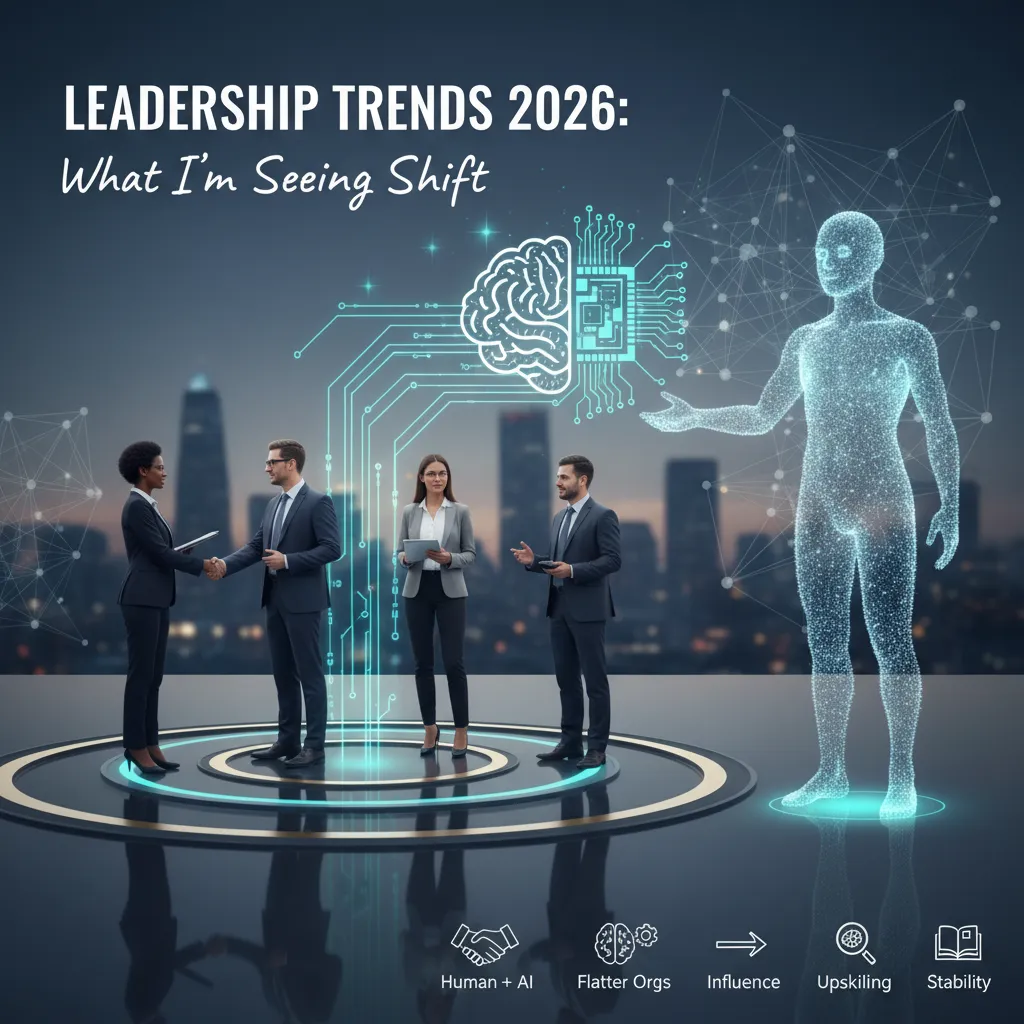
Last fall, I watched a director in my network get promoted… and immediately look like they’d aged two years in two months. Not because they couldn’t do the work—because the work changed shape. Half their decisions were now “AI-assisted,” their team was reorganized into a flatter pod structure, and their calendar filled with cross-functional negotiations where nobody technically reported to them. That’s the vibe heading into 2025–2026: less throne, more traffic circle. In this post I’m mapping the shifts I’m seeing, the data that backs it up, and a few scrappy habits I’m stealing for myself before the next wave hits.
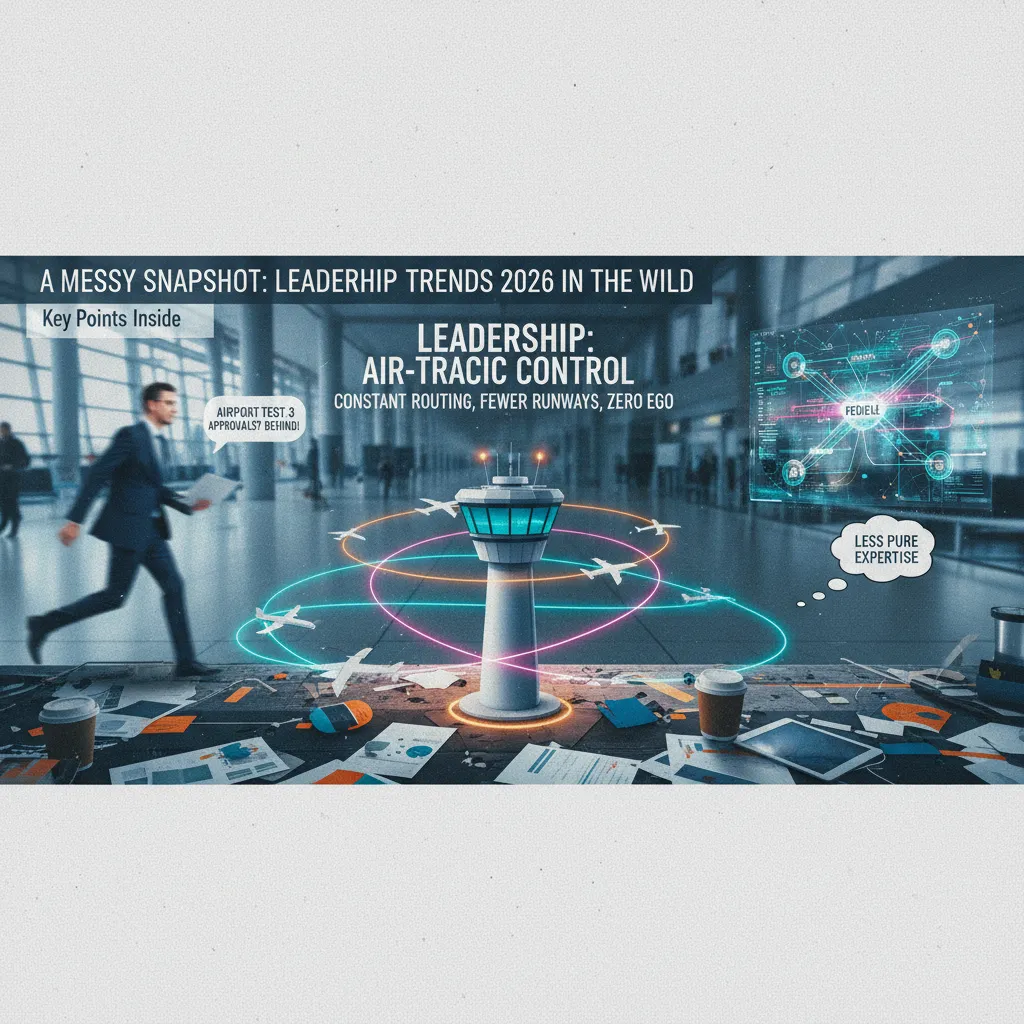
A messy snapshot: Leadership Trends 2026 in the wild
When I’m trying to sense where leadership is really going in 2026, I don’t start with a framework. I start with what I call my “airport test.” It’s simple: if your team still needs three approvals for a small decision, you’re already behind the curve. In the 2025–2026 leadership trends I keep seeing, speed isn’t about rushing—it’s about removing friction so good people can act.
My quick “airport test” for decision drag
I’ve watched teams lose days to tiny choices: a customer email, a pricing exception, a small tool purchase. The pattern is usually the same—too many gates, not enough trust.
Three approvals becomes the default, even when risk is low.
Managers act like routers, but without clear rules.
People stop deciding and start “checking.”
In the source material on Leadership Trends 2025–2026, the shift is clear: leaders are being pushed to design decision systems, not just make decisions.
Less “expert leader,” more integration leader
Another 2025–2026 pattern I keep hearing in leadership conversations: leaders are asked to do more integration work—bringing together people + tech + strategy—and less pure expertise. I still value deep skill, but it’s no longer the main job. The main job is connecting the dots:
Translating strategy into priorities people can actually execute
Making sure AI and tools fit the workflow (not the other way around)
Reducing handoffs between teams so work doesn’t stall
Wild-card analogy: leadership as air-traffic control
The best analogy I’ve found is a weird one: leadership is turning into air-traffic control. It’s constant routing, fewer runways, and zero tolerance for ego. In practice, that means I’m seeing leaders spend more time on:
Sequencing work so teams don’t collide
Creating clear “who decides what” lanes
Spotting bottlenecks early and re-routing fast
What’s Next Leaders question I’m asking myself weekly: “Where am I still leading like it’s 2019?”
That question keeps me honest—especially when I catch myself defaulting to old habits like over-reviewing, holding decisions too high up, or treating new tools like side projects instead of core operations.
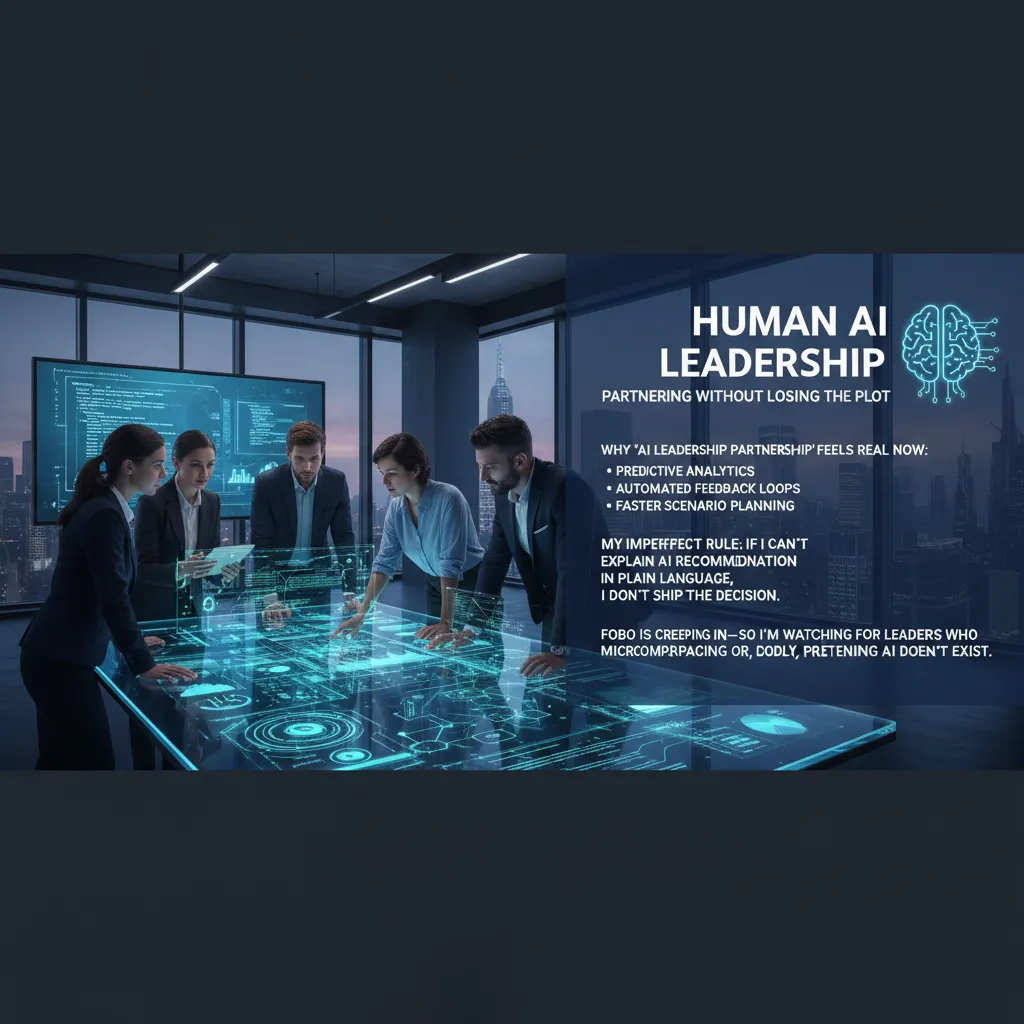
Human AI Leadership: partnering without losing the plot
In the 2025–2026 shift I’m watching, “AI leadership partnership” no longer feels like a buzzword. It feels operational. Leaders are using predictive analytics to spot churn risk before it shows up in exit interviews. They’re building automated feedback loops that summarize customer tickets, employee comments, and quality signals in near real time. And they’re doing faster scenario planning—not just one annual plan, but weekly “what if” runs that help teams move with less drama.
The upside is speed and clarity. The risk is that we start treating AI output like truth instead of input. So I’ve adopted an imperfect rule that keeps me grounded:
If I can’t explain the AI recommendation in plain language, I don’t ship the decision.
This rule forces me to ask basic questions: What data did we use? What is the model optimizing for? What trade-offs are hidden in the recommendation? If I can’t answer those in simple terms, I’m not ready to act—because my team won’t be ready to follow.
FOBO is creeping in (and it changes leader behavior)
I’m also seeing more FOBO—Fear Of Better Options. When AI can generate ten paths forward in seconds, leaders can get stuck. Some overcompensate by micromanaging every step, trying to control uncertainty. Others do the opposite and pretend AI doesn’t exist, as if ignoring it will protect culture or judgment. Neither works. Human AI leadership is about staying accountable while using the tool.
A practical habit: the 3-line “human override” note
After any AI-augmented decision, I write a short note. It takes two minutes, but it keeps ownership clear and builds trust over time.
What I accepted: the parts of the recommendation I used.
What I rejected: the parts I did not use.
Why: the human context (values, risk, timing, customer impact).
I keep it simple, like this:
Accepted: prioritize onboarding fixes for Segment B
Rejected: cutting live support hours
Why: short-term savings increase churn risk and hurt trust
This small practice supports better AI decision making, reduces second-guessing, and makes leadership accountability visible—without slowing the team down.
The Great Flattening Organizations: fewer layers, more sideways work
In the 2025–2026 leadership trend work I’ve been tracking, one shift keeps showing up across industries: organizations are getting flatter. Not in a “no managers” fantasy way, but in a practical way—fewer layers, fewer handoffs, and a lot more work moving sideways across teams.
What flattening looks like on Monday morning
On Monday, flattening is not a chart. It’s a set of small moments that repeat all week:
Fewer titles in the room, and less time spent “routing” decisions upward.
More cross-functional collaboration skills needed to get anything done (product, ops, sales, legal, data—together).
More “who owns this?” moments, because the old owner was a layer that no longer exists.
I’m also seeing more work organized around outcomes instead of functions. Teams form, solve, and reform. That makes speed possible, but it also makes role clarity a daily task, not a one-time org design exercise.
Horizontal leadership skills become the differentiator
In flatter organizations, influence over authority becomes the real currency. In performance cycles, I’m seeing leaders rewarded for:
Aligning peers without pulling rank
Making trade-offs visible and fair
Reducing friction between teams
Communicating decisions in plain language
This is what I think of as horizontal leadership: leading across, not just down. The best people here don’t “win” meetings—they build shared understanding fast, then move.
Distributed leadership in practice: closer to the work (and the mess)
Another pattern: decision rights are moving closer to the work. That means the people closest to customers, systems, and delivery are expected to decide more often—and to handle the mess that comes with real ownership.
“If you’re closest to the problem, you’re closest to the decision.”
But distributed leadership only works when decision rights are clear. I’m seeing teams use simple tools like:
DRI(Directly Responsible Individual) for ownershipLightweight
RACIto prevent confusionDecision logs so context doesn’t disappear
A small contrarian take: flatter can feel louder
Flatter orgs don’t magically feel better. They often feel louder: more opinions, more pings, more meetings, more “quick syncs.” If you don’t redesign rituals—how you plan, decide, escalate, and review—flattening can turn into constant noise instead of faster execution.
Human-Centered Leadership (still) beats cleverness
One of the biggest shifts I’m seeing for 2026 is that cleverness is getting cheaper. AI can draft, summarize, analyze, and even code faster than most teams. That doesn’t make leaders less important—it changes what leadership is for. As more technical tasks get “eaten” by AI, emotional intelligence becomes the leadership moat: trust, clarity, calm, and the ability to help people do good work together when the ground keeps moving.
Emotional intelligence is the new competitive edge
In the source material on leadership trends 2025–2026, the pattern is clear: the leaders who stand out aren’t the ones with the smartest answers. They’re the ones who can hold uncertainty without spreading panic, and who can read the room before they read the dashboard. AI can produce options. People still need a leader to make tradeoffs, explain the “why,” and keep dignity intact when decisions are hard.
What I’m practicing when uncertainty spikes
I’ve been tightening my own habits because ambiguity is expensive. When people don’t know what matters, they fill the gap with assumptions. Three practices are helping me lead with more humanity and less noise:
Shorter meetings: fewer attendees, a clear decision owner, and a written outcome.
Clearer expectations: what “good” looks like, what’s in scope, and what’s not.
Saying the quiet part out loud: naming the tension (“We don’t have perfect data,” “This may change,” “Here’s what we’re optimizing for”).
That last one matters more than it sounds. When I say the quiet part out loud, I’m not being negative—I’m reducing anxiety by making uncertainty discussable. It also keeps teams from confusing confidence with competence.
Purpose-driven culture as a decision filter (not a poster)
I’m also seeing “purpose” mature. The best purpose-driven cultures don’t use values as wall art. They use them as a decision filter when tradeoffs get ugly: customer impact vs. speed, quality vs. cost, innovation vs. risk. If purpose can’t guide a hard call, it’s branding—not leadership.
A tiny tangent I keep coming back to
“What do you want to learn next?”
The best leader I worked for ended reviews with that question. It signaled that growth mattered, that careers weren’t frozen, and that learning was part of performance. In a world where AI keeps shifting the skill map, that question feels even more practical—and more human.
Continuous Upskilling Leaders: learning as a public act
One of the clearest shifts I’m seeing in 2026 is that leadership learning is becoming more visible. In the source material on 2025–2026 leadership trends, the message is simple: the pace of change is not slowing down, so leaders can’t treat learning like a private side project. The leaders who build trust now are the ones who learn out loud—sharing what they’re trying, what they’re unsure about, and what they’re improving.
Shifting Career Paths: the old ladder is wobbling
The old career ladder (step-by-step promotions in one lane) is wobbling. I’m seeing more zig-zags, rotations, and “tour of duty” roles where someone takes on a mission for 12–18 months, then moves again. This is not chaos; it’s adaptation. It also means leaders need broader skills faster, because their next role may be adjacent, not “up.”
Rotations across product, ops, and customer teams
Short-term transformation roles with clear outcomes
Leaders building a “portfolio” of skills, not a single specialty
Widening Skill Gaps: transformation bottlenecks
Skill gaps are showing up as real bottlenecks in transformation work—especially where AI meets day-to-day operations. I keep seeing the same pattern: teams buy tools, but progress stalls because leaders don’t have enough AI fluency and change management competency to guide adoption. The result is slow decisions, unclear ownership, and people quietly going back to old habits.
When leaders learn in public—sharing prompts, workflows, and lessons learned—they reduce fear and speed up capability building across the team.
Succession redefined: adaptable integrators
Succession planning is also changing. Bench strength isn’t just “ready-now execs.” It’s leaders who can integrate across functions, translate between technical and business groups, and keep momentum during change. I look for people who can connect dots, not just run one playbook.
“Bench strength” now means adaptable integrators who can learn fast and bring others with them.
My favorite low-cost move: the monthly teach-back
My go-to practice is a monthly teach-back. I pick one new tool or process (often AI-related), explain it to the team, and then let them roast it (kindly). The format is simple:
10 minutes: what it is and why it matters
10 minutes: live demo (real work, not a perfect example)
10 minutes: questions + “what would break this?” feedback
This makes learning normal, shared, and practical—and it signals that upskilling leaders are not above the work.

Relentless Complexity Pressure: burnout, stability, and execution
The statistic I can’t unsee right now is this: 71% of leaders report increased stress, and 40% are considering leaving because the pressure and burnout feel endless. I see it in the way calendars fill up, decisions stack up, and “urgent” becomes the default setting. Complexity isn’t just more work—it’s more context switching, more stakeholders, and more risk in every choice. When that becomes normal, even strong leaders start to run on fumes.
What I’m seeing shift into 2026 is a renewed respect for stability. Not stability as “do nothing,” but stability as a leadership skill: creating a steady operating rhythm so people can execute without constant re-planning. In practice, that looks like fewer priorities, clearer tradeoffs, and a stronger bias toward finishing what we start—even when it’s boring. Especially when it’s boring. The unglamorous work (cleaning up processes, reducing handoffs, tightening decision rights) is what lowers stress over time because it removes friction from the system.
I’m also testing a personal boundary that feels small but has outsized impact: no-meeting mornings. I’m using that time for deep work, hard decisions, and writing down what I actually think before I’m influenced by the loudest voice in the room. It’s not perfect, and it requires saying “no” more often than I’m used to. But I’ve noticed my decision quality improves when I protect focus early in the day, and my patience improves when I’m not reacting from the first hour.
Here’s the wild-card scenario I keep coming back to, and I’ll leave you with it as a practical stress test: if your org froze hiring tomorrow, what would you stop doing within a week? I like this question because it cuts through performative busyness. It forces clarity on what’s essential, what’s legacy, and what’s simply “because we always have.” If you can’t stop anything, you don’t have a strategy—you have a pile of obligations.
My takeaway for 2026 is simple: the leaders who thrive won’t be the ones who carry more. They’ll be the ones who simplify, protect energy, and build teams that can execute with calm consistency.
TL;DR: Leadership in 2025–2026 shifts from authority to influence: Human + AI leadership, flatter orgs, continuous upskilling, and human-centered leadership become decisive—especially as stress and pipeline pressure rise.


Comments
Post a Comment