Implement AI in Finance: A Roadmap Guide
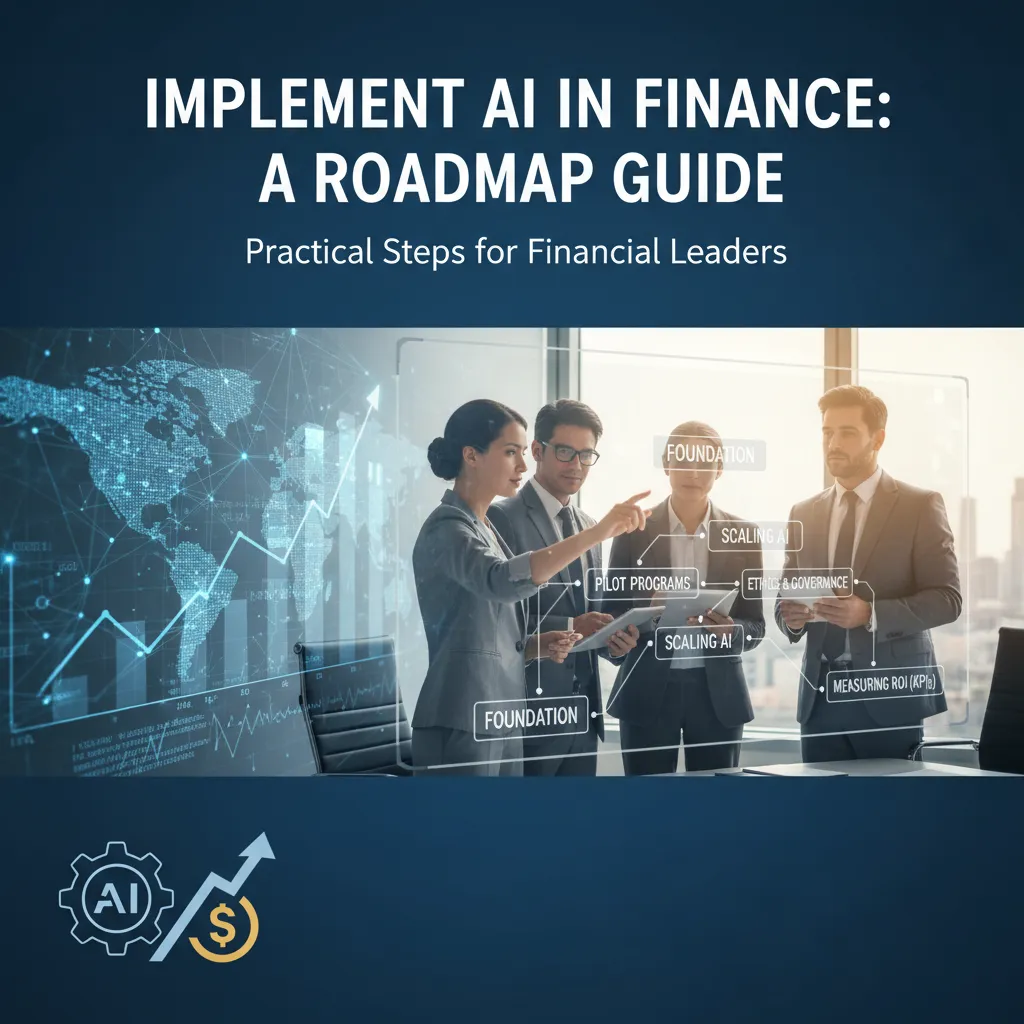
I still remember the first time I watched an accounts payable team spend an entire Friday “chasing invoices” that were technically already in the inbox—just buried under attachments, weird vendor naming, and a spreadsheet that had become its own living organism. That day is what made me stop treating AI as a shiny toy and start treating it like a discipline: an AI roadmap, grounded in business objectives, with boring (but vital) governance development and success metrics.
The “Why” (and the messy reality) behind AI in Finance Processes
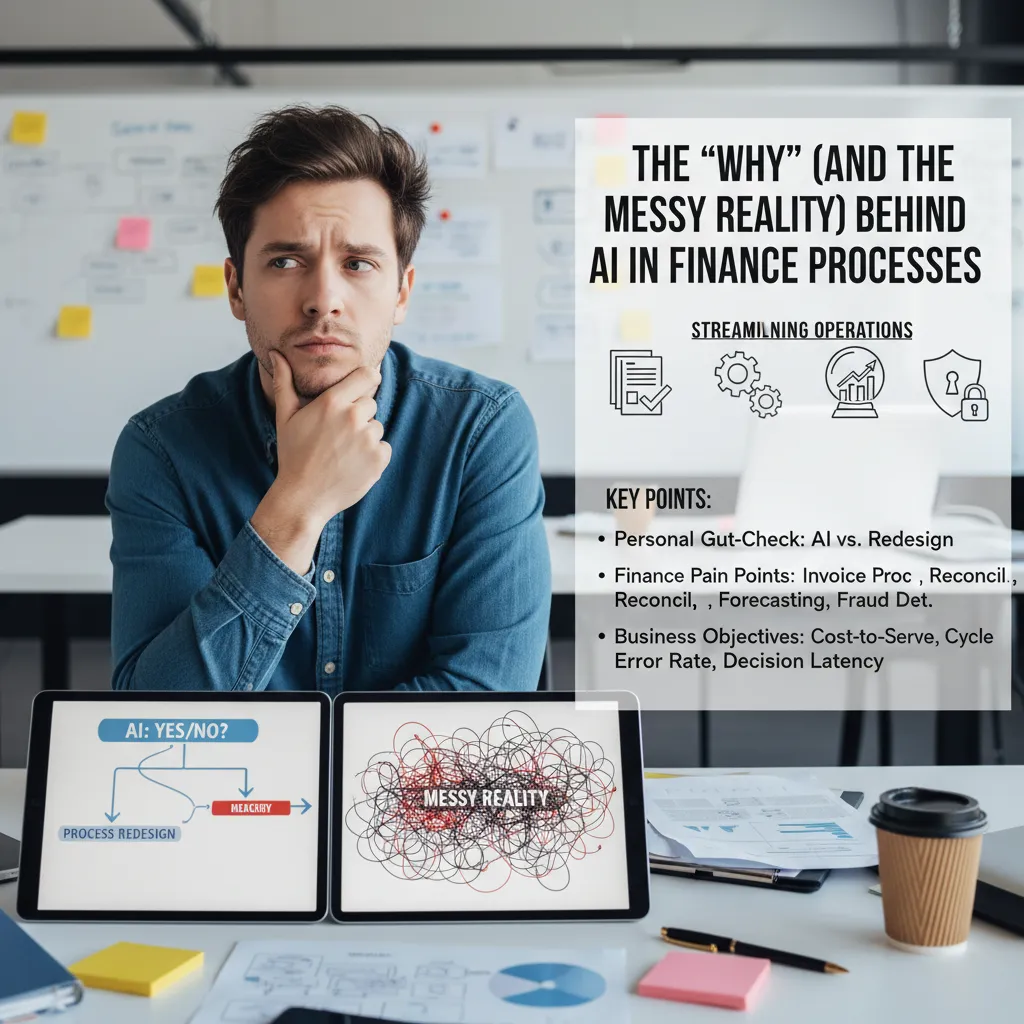
Before I talk tools or models, I do a quick gut-check: do we really need AI, or do we just need to fix a broken process? In finance, it’s easy to reach for automation when the real issue is unclear rules, too many handoffs, or messy data. If a workflow changes every week, or nobody agrees on “what good looks like,” AI will only scale the confusion faster.
A quick gut-check: AI vs. process redesign
I ask myself three simple questions:
- Is the task repetitive and high-volume (good for automation)?
- Are the rules stable (good for traditional automation) or fuzzy (maybe AI)?
- Is the data usable—consistent fields, clear definitions, and enough history?
If the answer is “no” to data or stability, I start with process redesign: simplify approvals, standardize templates, and clean master data. Then AI has something solid to work with.
Where AI actually helps in finance operations
When the basics are in place, AI in finance processes can remove real friction. The most common pain points I see are:
- Invoice processing: extracting fields, matching POs, flagging exceptions, and routing for approval.
- Reconciliations: suggesting matches across bank, GL, and subledgers, and learning from prior decisions.
- Forecasting: using drivers (sales, seasonality, pricing) to improve accuracy and reduce manual spreadsheet work.
- Fraud detection: spotting unusual patterns in payments, vendors, or employee expenses faster than manual review.
A simple lens for business objectives
To keep AI projects grounded, I tie every use case to a small set of outcomes. I use this lens:
| Objective | What I measure |
|---|---|
| Cost-to-serve | Cost per invoice, cost per close, cost per payment |
| Cycle time | Days to close, invoice-to-pay time, reconciliation turnaround |
| Error rate | Rework %, duplicate payments, posting errors |
| Decision latency | Time from data available to decision made |
The slightly spicy reality check
If you can’t name the owner of the process, don’t automate it yet.
AI implementation in finance needs accountability. If nobody owns the workflow, nobody owns the exceptions, model drift, or policy changes. I’d rather pause and assign a clear process owner than ship “smart” automation that fails quietly and creates audit risk.
Foundation Building (3–6 months): the unglamorous work that makes AI Implementation possible
When I follow a step-by-step approach to implement AI in finance, I treat the first 3–6 months as foundation work. It’s not exciting, but it’s what keeps AI models from turning into “one-off demos” that no one trusts. This phase is about clear ownership, clean(ish) data, stable systems, and one smart pilot.
Governance Development: who approves models, who owns data, and who gets paged when things break
Before I let a model touch forecasting, close, or risk decisions, I set basic governance. In finance, “good enough” rules are better than no rules.
- Model approval: define who signs off (Finance leadership, Risk/Compliance, and IT/Security).
- Data ownership: assign owners for key tables (GL, AP, AR, payroll, revenue) and document who can change definitions.
- Incident response: decide who gets alerted when outputs drift, pipelines fail, or access looks suspicious.
If nobody owns the model, the business will stop trusting it the first time it’s wrong.
Data Assessment: what’s usable, what’s missing, and where the “spreadsheet folklore” lives
Next, I run a practical data assessment. I’m not chasing perfection—I’m mapping reality. I look for what’s available, what’s messy, and what only exists in someone’s spreadsheet.
- Usable data: consistent fields, stable history, clear timestamps, and traceable sources.
- Missing data: gaps in vendor IDs, cost center coding, invoice status, or product/customer mapping.
- Spreadsheet folklore: offline trackers for accruals, manual revenue adjustments, and “shadow” KPI files.
Infrastructure Preparation: modernizing workflows, often starting with a Cloud-Based ERP like SAP S/4HANA
AI needs reliable pipes. I focus on workflow modernization and system readiness, often anchored by a cloud-based ERP such as SAP S/4HANA. The goal is to reduce manual handoffs and make data easier to access and govern.
- Standardize master data and chart of accounts where possible.
- Set up secure data access, logging, and role-based permissions.
- Automate extracts and refresh schedules so models don’t rely on ad hoc pulls.
Pilot Selection: picking one use case that’s valuable, measurable, and not a political landmine
Finally, I pick one pilot that proves value fast without triggering turf wars. I choose something with clear metrics and a single accountable owner.
- Value: reduces cycle time, errors, or cash leakage.
- Measurable: baseline exists (e.g., forecast error, DSO, close days).
- Low politics: minimal cross-team dependency and clear decision rights.
Pilot Programs: my favorite way to “prove it” without betting the quarter
When I implement AI in finance, I almost never start with a big rollout. I start with a pilot program because it lets me prove value fast, learn safely, and protect the quarter’s results. The goal is simple: pick one process, improve it, measure it, and decide what to do next based on data—not hype.
Pick a high-manual, high-volume use case
I look for work that is repetitive, rules-heavy, and painful at scale. These are ideal for an AI in finance roadmap because small gains add up quickly.
- Invoice automation (capture, coding suggestions, matching, routing)
- Data entry (vendor setup checks, field validation, form extraction)
- Exception handling (missing PO, duplicate invoices, out-of-policy spend)
Define success metrics before the build
I write the scorecard before anyone touches a model. If we don’t agree on “good,” we can’t claim a win. For finance teams, I usually track:
- Accuracy: correct classification/coding rate, and error types
- Time saved: cycle time per invoice or per case
- Cost per invoice: labor + rework + tooling costs
- Controls pass-rate: audit checks, approvals, and policy compliance
That last one matters most. A pilot that saves time but fails controls is not a success in finance.
Pair RPA with AI (each does what it’s best at)
I like a hybrid approach: Robotic Process Automation (Robotic Process) handles the repetitive steps, while AI supports classification and decisions. For example, RPA can move files, log into systems, and create tickets. AI can read invoice text, suggest GL codes, or flag likely duplicates. This keeps the workflow stable while the AI learns.
Run the pilot like a science experiment
I treat the pilot as a controlled test, not a demo. That means:
- Hold-out sample: keep a portion of invoices/cases fully manual for comparison
- Before/after comparisons: measure baseline vs pilot results weekly
- Kill switch: a clear rule to pause automation if errors spike or controls fail
If I can’t turn it off safely, I’m not ready to turn it on.

Phase Expansion (6–12 months): Scaling Pilots without breaking trust (or controls)
In months 6–12, I shift from “prove it works” to “make it repeatable.” This is where many AI in finance programs fail—not because the model is bad, but because the data, monitoring, and controls don’t scale with it. My rule: replicate what worked, but standardize first.
Scaling Pilots: replicate what worked, but standardize data and monitoring first
When a pilot delivers value (faster close checks, better anomaly flags, cleaner forecasts), I don’t copy-paste it into five teams. I standardize the inputs, the metrics, and the guardrails so every rollout behaves the same way.
- Data standards: common definitions for revenue, customer, risk grades, and time periods.
- Model monitoring: track drift, accuracy, false positives, and “unknown” cases.
- Controls: keep audit trails, approvals, and segregation of duties intact.
I also document “what the model can’t do” so we don’t create hidden risk by over-trusting outputs.
Capability Building: upskill finance teams—yes, even the spreadsheet wizards
Scaling means more people touch AI outputs. I invest in practical training for analysts, controllers, FP&A, and risk teams. The goal isn’t to turn everyone into data scientists; it’s to build AI literacy so teams can challenge results and spot issues.
- How to read model performance dashboards
- How to test outputs against known scenarios
- How to escalate exceptions and document decisions
Diversify use cases (without losing focus)
Once one pilot is stable, I expand into adjacent, high-value workflows:
- Predictive analytics for forecasting: demand signals, seasonality, and variance drivers.
- Risk assessment for credit/portfolio: early warning indicators and exposure views.
- Fraud detection triage: prioritize alerts so investigators start with the highest-risk cases.
I keep a simple intake process so new ideas are scored on value, data readiness, and control impact.
Change Management: communicate what changes, what doesn’t, and how roles evolve
I avoid corporate theater and speak plainly: AI changes how we work, not our responsibility for outcomes. I clarify what stays the same (policy, approvals, accountability) and what changes (faster checks, new review steps, new skills).
“AI can recommend, but finance still decides—and we can always explain why.”
Maturation (12–24 months): Process Integration, Centers of Excellence, and the part nobody posts on LinkedIn
By months 12–24, I stop thinking about “AI projects” and start treating AI like any other finance capability: it must live inside the process. This is the stage where Implement AI in Finance becomes less exciting to talk about—and far more valuable in daily work.
Process Integration: AI inside the workflow, not a side dashboard
The biggest shift is embedding models into core finance motions like close, procure-to-pay, and order-to-cash. If the output only shows up in a separate dashboard, adoption stays low and the team keeps using spreadsheets “just in case.” I aim for AI to trigger actions where people already work: in the ERP, ticketing queues, approval flows, and reconciliation steps.
- Close: auto-suggest journal entries, flag unusual accruals, and prioritize reconciliations by risk.
- Procure-to-pay: detect duplicate invoices, predict late approvals, and route exceptions to the right owner.
- Order-to-cash: score collections risk, recommend outreach timing, and spot pricing or billing leakage.
Advanced applications: scenario planning, anomaly detection, continuous controls
Once data pipelines and governance are stable, I can move beyond basic forecasting. This is where AI supports better decisions and tighter controls—without adding headcount.
- Scenario planning: test “what if” drivers (volume, FX, churn, commodity costs) and see the impact on cash and margin.
- Anomaly detection: identify outliers in expenses, revenue recognition patterns, and vendor behavior before month-end.
- Continuous controls monitoring: run automated checks daily (segregation of duties, threshold breaches, unusual approvals) instead of waiting for audits.
“The model is only half the work. The other half is getting the business to trust it, use it, and keep it clean.”
Centers of Excellence: small team, big leverage
I build a lean AI Finance Center of Excellence (COE) to prevent every team from reinventing the wheel. The COE sets standards, reusable templates, and shared components (feature libraries, prompt patterns, validation checklists). It also owns model monitoring and change control so updates don’t break the close.
Success metrics stay boring (and that’s good)
I keep measurement simple and tied to finance outcomes:
- Financial KPIs: forecast accuracy, DSO, working capital, close cycle time
- Revenue lift: reduced leakage, improved collections, better pricing compliance
- Cost reduction: fewer manual touches, lower exception handling, less rework
- Risk exposure: fewer control breaches, faster detection, cleaner audit trails

Ethical AI + Regulatory Compliance: the guardrails that keep your AI Roadmap on the road
When I implement AI in finance, I treat ethics and compliance as the guardrails—not paperwork at the end. If we skip them, the roadmap fails in the real world. This is where trust is built: with customers, regulators, and our own teams.
Ethical AI policy: privacy, bias, explainability, and job displacement
I start with a simple Ethical AI policy that everyone can understand. Privacy means we only use data we have a right to use, we limit access, and we avoid pulling in extra personal data “just in case.” Bias means we test outcomes across groups and fix unfair patterns before launch. Explainability means we can clearly describe why a model made a decision, especially when it affects a person’s money. And I say job displacement plainly: AI will change work. So I plan training, role changes, and clear ownership so people are not surprised or left behind.
Regulatory compliance in financial services: model risk management and proof
Finance has strict expectations, so I align early with model risk management. That includes documented assumptions, validation steps, and clear limits on where a model can be used. I also require audit trails: what data was used, which version of the model ran, who approved it, and what outputs were produced. Finally, I set approval workflows so releases are controlled—no “shadow models” in spreadsheets or untracked notebooks.
Monitoring: drift, performance decay, and “what changed?” alerts
Even a good model can go bad when the world changes. I set monitoring for data drift (inputs shifting), performance decay (accuracy dropping), and “what changed?” alerts that point to the likely cause—new customer behavior, policy updates, vendor data changes, or a pipeline break. This turns AI from a one-time project into a managed financial system.
A simple decision: explainable vs. black-box (with strong controls)
To close the loop, I make one clear decision: which models must be explainable and which can be black-box. If the model drives credit decisions, fraud actions that block customers, pricing, or anything customer-facing, I require explainability and human review paths. For back-office forecasting or operational optimization, I may allow black-box models, but only with strong controls: tight access, versioning, testing, and monitoring. This is how I keep the AI roadmap moving—fast, but safely—so the results last beyond the pilot.
TL;DR: Implement AI in finance in three phases: Foundation (3–6 months), Expansion (6–12 months), and Maturation (12–24 months). Start with data governance + cloud-based ERP readiness, run tight pilot programs (invoice automation is a classic), scale what works with RPA + predictive analytics, and lock in ethical AI and regulatory compliance—tracking ROI with financial KPIs.


Comments
Post a Comment