HR Tech 2026: The HR AI News I’m Tracking
I didn’t think an HR AI “release note” could make me spill coffee… until a demo showed an agentic AI quietly stitching together onboarding tasks across five tools while my calendar stayed mercifully unchanged. That was my “oh—this is different” moment. Lately, HR AI news hasn’t been about shiny chatbots; it’s been about systems of work, where AI agents orchestrate the boring-but-critical steps we usually babysit. In this post, I’m sorting the updates that feel like real shifts (and admitting a couple I rolled my eyes at) so you can decide what to pilot, what to govern, and what to ignore.
1) From HCM Systems to “Systems of Work” (and why I noticed)
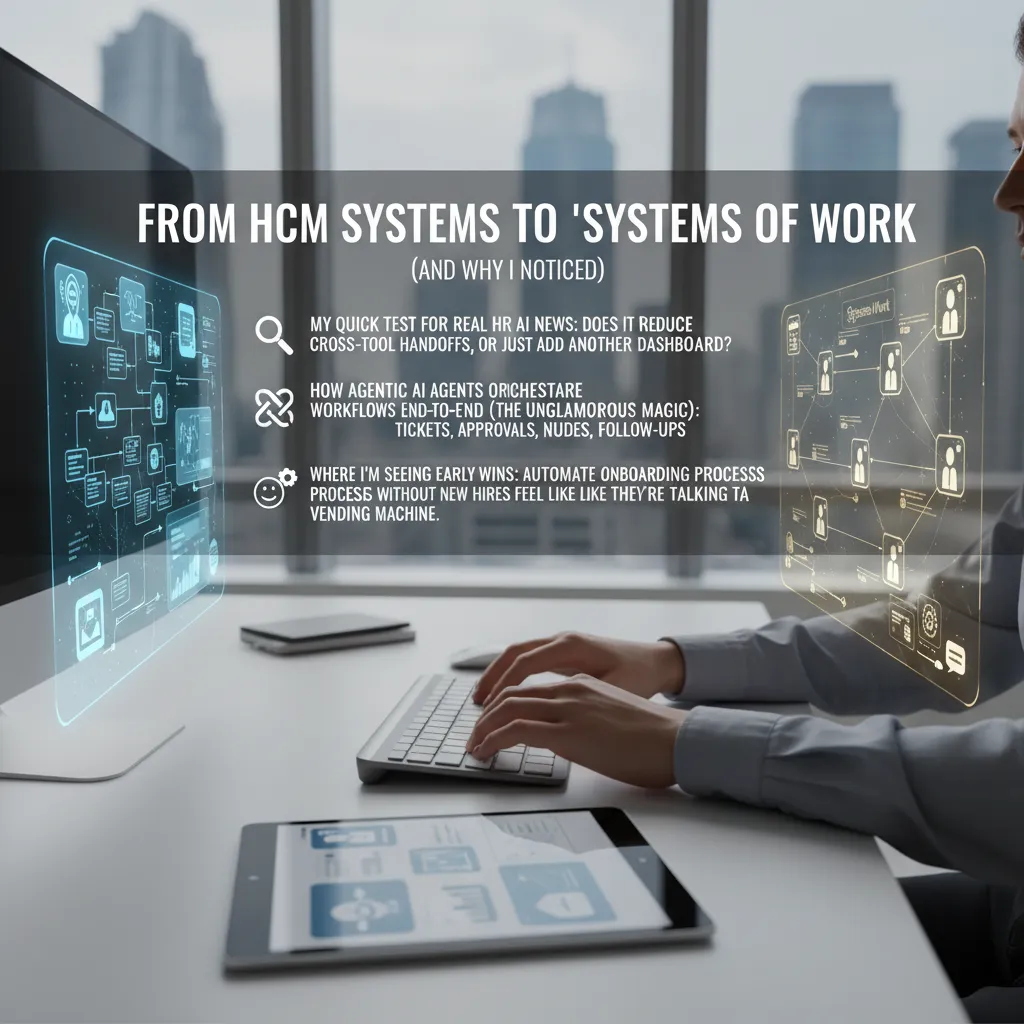
When I scan HR AI news and product releases, I use a quick test: does it reduce cross-tool handoffs, or just add another dashboard? A lot of “AI in HR” still looks like a shiny layer on top of the same old HCM systems. The updates I’m tracking for HR Tech 2026 feel different because they push HR platforms toward systems of work—tools that actually move work across HR, IT, finance, and managers without making employees chase links.
What “agentic” HR AI looks like in real life
The unglamorous magic is orchestration. The best agentic AI agents don’t just answer questions; they run the workflow end-to-end across tools:
- Create tickets (IT access, equipment, payroll setup)
- Route approvals (manager, HRBP, security)
- Send nudges (missing forms, overdue tasks)
- Follow up and close the loop (confirm access, log completion)
That’s the shift I noticed in recent HR AI updates: less “insight dashboards,” more action that happens in the background.
Early wins: onboarding without the “vending machine” feel
Onboarding is where I’m seeing the clearest value. Done right, automation can remove busywork while keeping the experience human. For example, an AI agent can schedule the first-week checklist, trigger equipment requests, and remind managers to do the welcome steps—without forcing a new hire to talk to a cold bot for every question. The goal is fewer handoffs, not fewer humans.
Mini tangent: I once watched HR and IT argue over “who owns the workflow”—spoiler: the employee experience does.
What I ask vendors before I believe the demo
- Latency: How fast does the agent act across systems, especially during peak onboarding?
- Audit trails: Can I see who did what, when, and why?
- Action vs. suggestion: Where is the agent allowed to execute (create accounts, submit tickets), and where does it only recommend?
2) Workforce Redesign: Decompose Roles, Re-bundle Work
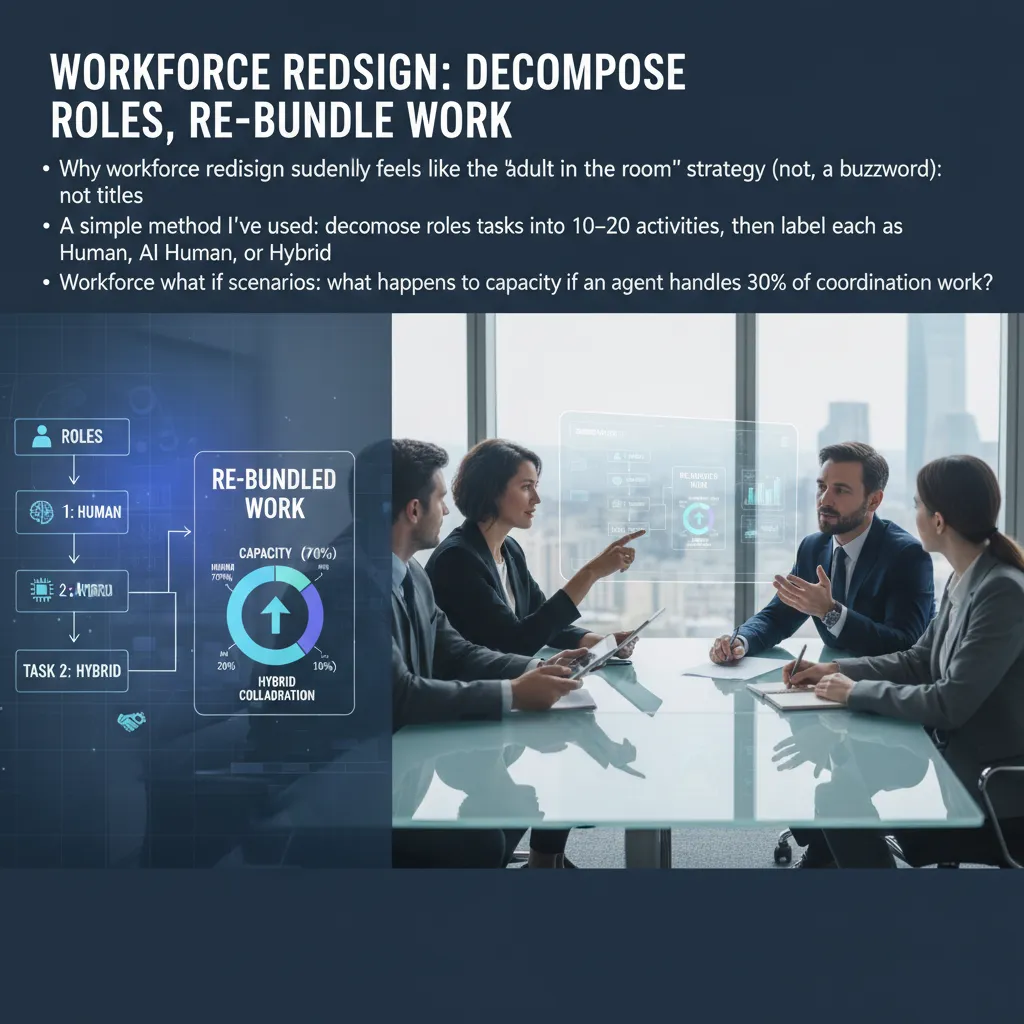
In the HR AI news I’m tracking for 2026, workforce redesign is starting to feel like the adult in the room strategy. Not because it’s trendy, but because it forces a practical shift: tasks, not titles. Job titles are slow to change. Work changes every quarter. AI makes that gap impossible to ignore.
My simple method: break the role into activities
When I’m trying to make sense of “AI impact,” I don’t start with the org chart. I start with the work. I decompose one role into 10–20 clear activities, then label each as Human, AI, or Hybrid (shared).
- List activities in plain language (not competencies).
- Mark what can be automated safely vs. what needs judgment.
- Re-bundle the remaining work into a role that still makes sense.
Sometimes I’ll capture it like this:
| Activity | Type | Owner |
|---|---|---|
| Schedule cross-team updates | AI | Ops lead |
| Resolve priority conflicts | Human | Manager |
| Draft status summaries | Hybrid | PM + agent |
Run “what if” scenarios (capacity is the real KPI)
The most useful question I ask is: what happens to capacity if an agent handles 30% of coordination work? In many teams, coordination is the hidden tax—meetings, follow-ups, handoffs, updates. If AI reduces that load, you don’t just “save time.” You can change throughput, service levels, and even span of support.
The uncomfortable part: accountability doesn’t disappear
Digital labor doesn’t eliminate accountability. Someone still owns outcomes, risk, and quality. I like to write it down explicitly:
AI can do the task. A human still owns the result.
Wild card: the org chart as a playlist
I keep picturing the org chart like a playlist. AI can reshuffle the tracks—automate a chorus here, remix a verse there—but we decide the vibe: what work stays human, what becomes hybrid, and what gets fully delegated.
3) Skills-First Hiring + AI Interviewing ROI (the part candidates didn’t hate)
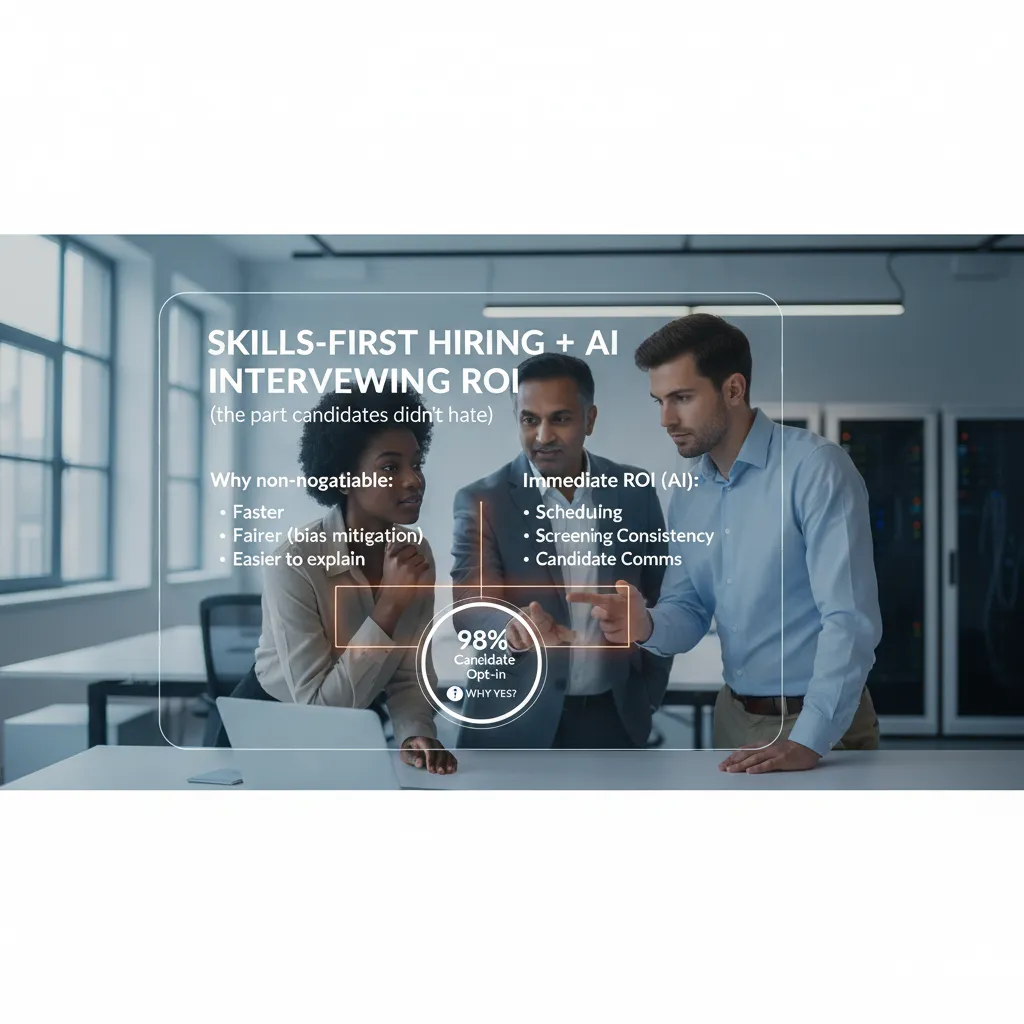
In the latest HR AI news I’m tracking, one theme keeps repeating: skills-first hiring is becoming non-negotiable. It’s faster because we stop over-filtering by pedigree and start matching people to the work. It can be fairer too—if you do bias mitigation (structured rubrics, consistent scoring, and regular adverse impact checks). And it’s easier to explain to candidates: “Here are the skills, here’s how we measure them.” That clarity matters.
Where AI interviewing shows immediate ROI
AI interviewing is one of the few HR AI releases where I’ve seen quick, practical ROI without a big culture war. The wins are not “robot decides who gets hired.” The wins are:
- Scheduling: fewer back-and-forth emails, faster interview loops.
- Screening consistency: the same questions, the same scoring logic, fewer “vibes-based” passes.
- Candidate communication: timely updates, clear next steps, fewer ghosted applicants.
The stat that surprised me: 98% candidate opt-in
One data point I keep coming back to from recent HR AI updates: 98% candidate opt-in for AI-supported interviewing steps. I think people say yes when three things are true: it’s transparent (they know it’s AI), it’s useful (saves time, reduces repeats), and it’s human-backed (a recruiter is still accountable).
“Use AI for speed and consistency, but keep humans responsible for decisions and relationships.”
Recruiting splits lanes: volume automation + human closings
I’m seeing recruiting split into two lanes: high-trust automation for high-volume steps, and high-touch human differentiation for finalist conversations, offer shaping, and closing.
Quality-of-hire signals to track (without ruining the experience)
- Interview-to-offer ratio by role and source (signals screening quality).
- New hire ramp time (time to first measurable output).
- 90-day retention and hiring manager satisfaction (simple pulse surveys).
- Candidate drop-off rate per step (a friction detector).
My rule: if your AI step adds more than 15 minutes of effort, give candidates a clear payoff—fewer rounds, faster decisions, or better feedback.
4) Talent Intelligence Insights + Predictive Analytics Standard (my “forecasting” reality check)
In the latest HR AI news I’m tracking, talent intelligence is moving from a nice-to-have dashboard to a real planning input. The idea is simple: blend internal skills data (what we have) with external market signals (what’s changing) so workforce planning isn’t just vibes. When HR tech connects skills profiles, learning history, project work, and job data with labor market trends, pay ranges, and demand signals, I can finally answer: “Do we build, buy, or borrow this capability?”
What “predictive analytics standard” should look like in 2026
I’m seeing more vendors position forecasting as a standard feature, not a premium add-on. For me, the bar is:
- Headcount planning that ties to business drivers (revenue, pipeline, service volume), not just last year’s org chart.
- Attrition risk that is explainable enough for managers to trust and act on.
- Scenario modeling that leadership actually reads—clear assumptions, simple outputs, and “what changes if…” toggles.
Where this goes wrong (my reality check)
Most “AI forecasting” fails for boring reasons:
- Messy job architecture: titles don’t match levels, families, or real work.
- Stale skills libraries: skills are too generic, outdated, or never validated.
- “One model to rule them all” thinking: one attrition model for every function, region, and role type.
If the foundation is shaky, the predictions look precise but behave like guesses.
A small win story: one monthly “what if” stopped panic-hiring
We ran a single monthly workforce “what if” scenario: What if demand dips 10%? What if it spikes 15%? We used the same assumptions each month and reviewed it with Finance. That rhythm helped us pause reactive hiring and focus on redeploying skills first.
What I’m watching next
The next step is prescriptive analytics: tools that nudge actions, not just charts—like “move these roles to internal mobility,” “target retention offers here,” or “shift recruiting spend to these markets,” with the assumptions shown in plain language.
5) HR Governance Board: Strong Guardrails Need (especially with agentic AI)
In the latest HR AI news I’m tracking, the biggest shift isn’t just new features—it’s autonomy. As HR tools move from “assistive” chat to agentic AI that can take actions (send messages, trigger workflows, change records), the risk profile changes fast. That’s why I’m seeing governance move from an HR policy doc to a real HR governance board conversation.
Why autonomy changes the risk profile
When an AI can act, small mistakes scale. A wrong eligibility rule, a misread policy, or a bad data pull can impact pay, access, or hiring decisions. In my view, governance has to match the new reality: systems that do things, not just suggest things.
Strong guardrails I look for
- Permissions: role-based access, least privilege, and clear approval steps for sensitive actions.
- Policy constraints: built-in rules that block actions that violate HR policy or labor agreements.
- Model monitoring: drift checks, quality sampling, and alerts for unusual outputs or actions.
- Incident playbooks: who investigates, who can pause the agent, and how employees are notified.
Policy-aware agents: “can do” vs “allowed to do”
A theme in recent HR AI updates is policy-aware automation. The agent may technically be able to update a job level or send a termination letter, but it must know whether it’s allowed in that workflow. I like to ask vendors to show policy checks in action, not just describe them.
In HR, “capable” is not the same as “permitted.”
EU AI Act: what I’m flagging even outside the EU
Even if you’re not EU-based, many HR tech vendors are global. I’m watching how they classify HR use cases, document controls, and support audits—because those practices often become the default product standard.
Quick audit list I keep
- Bias mitigation checks (testing, thresholds, and documented reviews)
- Audit logs (who did what, when, and why—human and AI actions)
- Data retention (training use, storage limits, deletion workflows)
- Escalation paths (clear owners, response times, and stop buttons)
6) HR Metrics Evolve: Measuring “Human Hours Returned” (not vanity KPIs)
In the latest HR AI news I’m tracking, the biggest shift isn’t a new chatbot feature—it’s how teams are measuring impact. I’m still watching “time-to-fill” and “time-to-productivity,” but I’m pairing them with metrics that reflect how AI agents actually change work.
What I’m replacing “time-to-x” with (or at least pairing it)
- Agent productivity: how many recruiter or HRBP tasks an AI agent completes per week, and the handoff quality (how often humans have to redo it).
- Skills velocity: how quickly employees gain verified skills after AI-driven learning nudges, coaching, or internal mobility matching.
“Human hours returned” makes automation less emotional
When automation debates get heated, I use one metric: human hours returned. It’s simple: hours saved from admin work that are reinvested into higher-value human work (coaching, candidate relationships, manager support). It turns “AI is replacing people” into “AI is giving people time back.”
Human hours returned = (hours automated) − (hours spent reviewing/fixing AI output)
Connecting AI interviewing to performance 90 days later
HR AI releases keep pushing deeper into screening and interview support. The metric I want is not “interviews completed faster,” but what shows up later:
- 90-day manager satisfaction (structured score, not vibes)
- new-hire ramp milestones hit on time
- early attrition and quality-of-hire signals
How I’d present this to finance (without a turf war)
I keep it practical and auditable. I’d show a small table with assumptions finance can challenge:
| Metric | How I calculate | Why finance cares |
|---|---|---|
| Human hours returned | automation − rework | capacity without headcount |
| Cost per resolved case | total cost / cases | unit economics |
| 90-day outcomes | ramp + retention | risk reduction |
Slightly imperfect aside
Sometimes the best metric is the one your team will actually update weekly. A “good enough” dashboard beats a perfect model nobody maintains.
Conclusion: My “Release Notes” Filter for the Next AI Leap
As I track the latest HR AI releases, one pattern keeps getting louder: agentic AI is moving from “nice assistant” to “active teammate.” That shift touches everything else I’m watching—workforce redesign, skills-first hiring, better analytics, and stronger governance. If an AI agent can draft a job post, screen for skills, schedule interviews, and trigger onboarding tasks, then HR teams have to rethink roles, workflows, and controls at the same time.
To keep myself grounded, I read HR AI news like product release notes and run a simple filter before I get excited. I ask three questions: Value (can we measure impact in time saved, quality, cost, or retention?), Risk (can we govern it with clear data rules, bias checks, and human review?), and Effort (can we integrate it into our HR tech stack without breaking core processes?). If a tool fails one of these, I treat it as “interesting,” not “urgent.”
In the next 30 days, I’d pilot updates that are easy to contain and easy to measure: skills extraction from resumes and profiles, job description rewrites that remove noise and focus on capabilities, and analytics copilots that help HR teams query dashboards in plain language. I’d also test governance basics early—logging, approval steps, and clear prompts—because small pilots can still create big trust issues.
What I’d postpone for six months: anything that promises full “autonomous HR” without strong audit trails, anything that makes hiring decisions feel like a black box, and large workforce redesign engines that require major org changes before we even trust the inputs. I want the data foundation and guardrails in place first.
If HR is the operating system, these tools are becoming background processes—quiet, constant, and powerful.
I’d love to learn from you: what’s one HR AI update you tried that worked, and one you quietly rolled back after the hype wore off?
TL;DR: HR AI news in 2026 is less “cool features” and more “new operating models.” Expect agentic AI inside HCM systems, workforce redesign via task decomposition, skills-first hiring with AI interviewing ROI, predictive analytics becoming standard, and stronger HR governance—especially with regulations like the EU AI Act.


Comments
Post a Comment