AI Statistics & Trends 2026: Inside AI News Ops

The first time I let an AI system help run my AI-news morning, it felt like hiring a super-fast intern who never slept… and also never stopped asking for clearer instructions. I was trying to ship a clean "what happened overnight" brief before coffee, and I watched the workflow flip: less frantic tab-hoarding, more orchestration. The surprising part wasn’t speed—it was how quickly the bottleneck moved from “finding news” to “deciding what matters.” This outline unpacks the real operational shifts, the numbers that frame the broader AI market, and the governance guardrails that kept the whole thing from turning into a content confetti cannon.
1) State AI in the newsroom: my messy before/after
Before: 17 tabs, half-remembered sources, and a panic refresh loop
My old AI-news routine looked “busy,” but it wasn’t smart. I had 17 browser tabs open: funding trackers, company blogs, X threads, newsletters, SEC filings, and three different AI research feeds. I’d skim, copy links into a draft, then panic-refresh everything again because I was sure I missed a key update. The worst part was the half-remembered source problem: I’d recall seeing a number or quote, but not where it came from. That meant extra time re-finding proof, or (too often) writing around it.
It also created duplicates. Two of us would spot the same model release from different sources and start separate write-ups. By the time we noticed, we’d already spent an hour each.
After: workflow orchestration felt like moving from solo work to a relay team
What changed wasn’t “more AI.” It was adding workflow orchestration—a simple system that routes signals, checks sources, and assigns tasks in order. The source material (“How AI Transformed AI News Operations: Real Results”) describes this shift as operational, not magical, and that matched my experience. Instead of me doing everything end-to-end, the work became a relay:
- Collect: monitored feeds and alerts pull items into one queue
- Cluster: similar stories get grouped to prevent duplicates
- Verify: key claims are matched to primary sources
- Draft: summaries and context blocks are generated with citations
- Publish: final checks run before anything goes live
It felt like going from “solo reporter with too many tabs” to a relay team where each handoff is clear.
The quiet win: fewer missed updates and fewer duplicate write-ups
The biggest improvement wasn’t speed (though that helped). It was coverage quality. I missed fewer late-breaking edits—like updated benchmarks, revised release notes, or corrected funding totals. And because clustering flagged overlap, we stopped producing two versions of the same story.
- Fewer misses: updates surfaced as “changes,” not new noise
- Fewer duplicates: one story owner, one shared source pack
Tiny tangent: the day I trusted the tool too much
I once published an outdated funding number because I trusted the summary and didn’t open the primary link. The next day I fixed the process with one rule:
No number goes live without a primary-source click.
Now our checklist forces a verification step for money, dates, and “first/only/biggest” claims, and the system logs the source URL beside the draft.

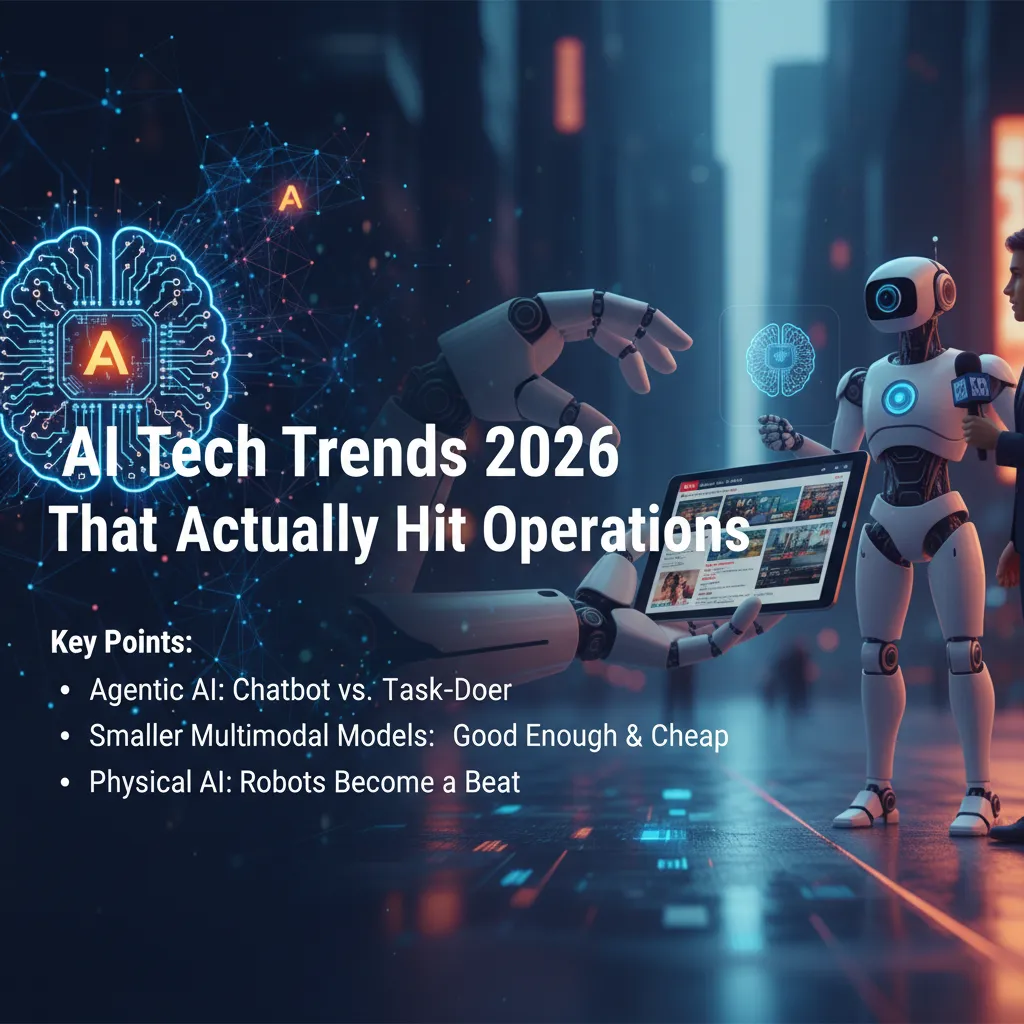
2) AI Tech Trends 2026 that actually hit operations
In our day-to-day AI news workflow, the trends that matter are the ones that change the work, not just the demos. Based on what I’ve seen in “How AI Transformed AI News Operations: Real Resultsundefined,” three shifts keep showing up in real operations: agentic AI, smaller multimodal models, and the odd-but-real rise of physical AI as a coverage beat.
Agentic AI: chatbot vs task-doer (and why I’m cautiously optimistic)
A chatbot answers questions. An agent completes tasks across steps: it checks sources, follows rules, and hands me a draft or a decision. That difference matters in a newsroom because it moves AI from “help me write” to “help me run the pipeline.” I’m cautiously optimistic because agents can reduce busywork, but they also need guardrails: clear prompts, approved sources, and a human stop button.
- Chatbot: responds to my prompt, one turn at a time.
- Agentic AI: monitors, gathers, drafts, and escalates when needed.
Smaller multimodal models: “good enough and cheap” wins daily news
In operations, speed and cost often beat raw model power. Smaller multimodal models (text + image, sometimes audio) are “good enough” for routine tasks: summarizing filings, extracting key numbers from charts, or turning a screenshot into structured notes. When I’m publishing multiple updates a day, I’d rather have a fast model that runs reliably than an amazing one that times out, costs too much, or adds delay.
In daily AI journalism, the best model is often the one that ships the update on time.
Physical AI as a weird sidebar: robots become a beat
Physical AI sounds like a sidebar until it isn’t. As robots and AI devices move into warehouses, hospitals, and retail, they create a new stream of stories: safety incidents, labor impact, regulation, and real-world performance. Operationally, that means I need templates for “robot rollout” coverage, a source list that includes hardware vendors and regulators, and a fact-check flow for videos and demos.
Hypothetical ops scenario: an AI Deals agent that drafts and pings me
Here’s the kind of agent I actually want in 2026: it monitors AI funding and M&A, drafts a short blurb, and only interrupts me when confidence drops.
- Watches trusted feeds (SEC, press releases, wire services).
- Extracts deal terms into a table and writes a 120-word draft.
- Checks for conflicts (duplicate reports, missing numbers).
- Pings me only if
confidence < 0.80or a key field is blank.
3) AI Statistics that changed my editorial priorities
Scale reset my idea of “normal” audience expectations
The first stat that forced me to rethink my editorial calendar was usage at scale. When I see numbers like 800M weekly users, I stop treating AI as a niche beat and start treating it like a daily utility. That kind of reach changes what readers expect from AI coverage: faster updates, clearer explainers, and fewer “what is AI?” intros. It also changes my story selection. I now prioritize pieces that answer practical questions (what changed, who it affects, what to do next) over trend-chasing headlines.
Market size signals louder competition (and louder noise)
The second shift came from market size stats. Big market projections don’t just mean “growth.” They signal more vendors, more funding announcements, and more PR competing for attention. In “How AI Transformed AI News Operations: Real Resultsundefined,” the takeaway for me was simple: as the AI market expands, newsroom competition expands too—because every company wants to be seen as an AI leader.
That’s also where “AI Bubble” anxiety shows up. When readers see huge numbers, they ask: Is this real adoption or hype? So I now treat market-size stats as a starting point, not a proof point. My editorial priority is to pair big numbers with evidence of real use: deployments, retention, cost savings, or measurable workflow changes.
Covering AI jobs without doomscrolling
Jobs stats changed my framing the most. Instead of writing “AI will replace X,” I focus on net change stories: what tasks are shrinking, what tasks are growing, and what skills are becoming baseline. I also try to separate short-term disruption from long-term shifts. Readers don’t need panic; they need a map.
My rule: if a jobs stat increases fear but doesn’t increase clarity, it needs more context before it earns a headline.
My practical rule for every statistic
To keep the coverage source-first (and to protect readers from PR math), I follow a simple checklist:
- Every stat gets a source link (primary when possible).
- Every stat gets a “so what” sentence written for readers, not insiders.
- Every stat gets a label: usage, revenue, funding, jobs, or productivity—so it’s not compared to the wrong thing.
Example format I use in drafts: Stat + Source + So what for readers
It keeps my editing tight and makes the story useful even when the numbers are loud.
4) AI Governance in media: the guardrails that kept me sane
When AI started speeding up my AI news ops, I learned a simple truth: governance is not paperwork. It’s the set of guardrails that keeps a fast workflow from turning into a credibility problem. In “How AI Transformed AI News Operations: Real Results,” the biggest wins came when I treated AI like a junior producer—helpful, but never the final authority.
My lightweight governance stack: labeling, source checks, and “stop-the-line” rules
I don’t run a big newsroom, so I built a lightweight AI governance stack that fits daily publishing. It’s three layers:
- Labeling: I label AI-assisted work internally (and externally when needed). If AI drafted, summarized, translated, or generated headlines, it gets tagged in my workflow.
- Source checks: Every claim needs a source I can open, read, and quote correctly. If the model can’t provide a verifiable link or document, I treat it as a lead, not a fact.
- “Stop-the-line” rules: If something feels off, I pause publishing. No debate. I’d rather miss a cycle than publish a wrong statistic or misquote.
My rule: speed is optional; accuracy is not.
Regulatory compliance reality: what I document even for a small operation
Even small AI news operations need basic documentation. I keep it simple and consistent:
- Prompt + output logs for sensitive stories (so I can audit what happened).
- Source list with URLs, access dates, and screenshots for paywalled pages.
- Human review notes (what I verified, what I removed, what I rewrote).
- Disclosure language templates for AI-assisted reporting and images.
This helps with platform policies, advertiser questions, and any future AI regulation that asks, “How did you produce this?”
Open Source vs vendor models: where transparency helps—and where it creates a different kind of risk
Open-source models give me transparency: I can test, tune, and understand behavior. But they also shift risk onto me—security, updates, and misuse controls. Vendor models reduce setup and often add safety layers, but I lose visibility into training data and some system decisions. In practice, I choose based on story risk: higher-risk topics get stricter controls and more human review.
A small confession: I used to hate checklists; now they’re my speed boost
I used to think checklists slowed me down. Now they’re how I publish faster with fewer mistakes. My AI governance checklist is short enough to run in minutes, and strong enough to protect trust—the only metric that really compounds in AI journalism.
5) AI Deals, AI Spending, and the “signal vs noise” problem
In AI news ops, deals are the loudest category and the easiest to misread. Every week I see funding rounds, “strategic” partnerships, and product launches that look important but are mostly marketing with a press release. My job is to triage fast, keep the signal, and protect readers from noise—especially readers building Enterprise AI who need facts, not hype.
How I triage AI deals (and spot the “secret marketing”)
I start by sorting every item into four buckets: funding, partnerships, product launches, and everything else. The “everything else” bucket is where the sneaky stuff lives: rebrands, vague “AI-first” announcements, and announcements that never mention customers, pricing, or deployment.
- Funding: I look for who led the round, what the money is for, and whether revenue or usage is mentioned.
- Partnerships: I ask: is this a real integration, or just co-marketing?
- Product launches: I check if it’s GA, beta, or a demo. GA with docs and pricing beats a flashy video.
- “Secret marketing”: lots of adjectives, few numbers, and no clear buyer.
My simple scoring rubric (and when I override it because… vibes)
To stay consistent, I use a quick rubric. It’s not perfect, but it keeps me honest.
| Signal check | Score |
|---|---|
| Clear enterprise use case + buyer | 0–3 |
| Proof (customers, benchmarks, revenue, adoption) | 0–3 |
| Execution details (pricing, GA date, docs, security) | 0–2 |
| Strategic impact (platform shift, distribution, moat) | 0–2 |
8–10 gets full coverage. 5–7 gets a short item. <5 usually gets ignored. And yes, I override it on “vibes” when something feels like an early platform move—like a new model distribution deal or a major data partnership that changes who can ship features faster.
Enterprise strategy lens: what matters vs what’s shiny
For Enterprise AI readers, I prioritize: security, data access, integration, cost control, and reliability. Shiny announcements often skip these. If a deal doesn’t change procurement, deployment, or unit economics, it’s usually not worth much attention.
Covering AI funding is like tasting espresso—one sip tells you a lot, ten sips ruins your day.

6) Conclusion: the “General Outlook” I didn’t expect
General Outlook (1/2): calmer ops when AI is infrastructure, not magic
After working through the results in How AI Transformed AI News Operations: Real Results, my biggest surprise was how much calmer AI-news ops became once I stopped treating AI like a miracle tool. When I frame it as infrastructure—like a CMS, a style guide, or a shared calendar—I make better choices. I don’t ask it to “be smart.” I ask it to do repeatable work: summarize long briefings, normalize headlines, draft first-pass outlines, and surface patterns across sources. That shift changes the mood of the newsroom. Less panic. Fewer last-minute scrambles. More time for real reporting and editing.
General Outlook (2/2): the best workflows feel boring—and that’s a compliment
The most effective AI workflows I’ve seen are not flashy. They’re boring in the best way. They run quietly in the background, reduce small errors, and keep the pipeline moving. In AI news operations, “boring” means the handoffs are clear: intake → verification → drafting → editing → publishing. AI helps at each step, but it doesn’t replace the step. When the system is stable, I stop thinking about the tool and start thinking about the story. That’s the outcome I didn’t expect: AI didn’t make the work more exciting; it made it more steady.
Where I’m still skeptical: the AI Bubble risk and automating judgment
I’m still cautious about two things. First is the AI Bubble risk: teams overbuy tools, overpromise results, and then blame staff when the numbers don’t match the hype. Second is the temptation to automate judgment. AI can rank topics, suggest angles, and predict performance, but it can’t own accountability. If we let models decide what matters, we slowly trade editorial values for optimization.
My next experiment: agentic story proposals with a hard human gate
My next test is an agentic system that proposes stories—complete with sources to check, counterpoints to include, and a draft structure—but it cannot publish without my notes. The rule is simple: no human annotations, no output. In practice, I want AI Statistics & Trends 2026 to reflect a newsroom reality: AI can speed up news ops, but the final call should stay human.
TL;DR: AI didn’t “replace” AI-news work—it reorganized it. The biggest wins came from workflow orchestration, agentic AI for repeatable tasks, and lightweight governance that reduced errors without killing speed. The broader AI market surge (spending, users, investments) matters mainly because it changes audience expectations: faster updates, clearer sourcing, and fewer hallucinations.


Comments
Post a Comment