AI News Leaders on Keyword Extraction & AI Search

The first time I tried to “let AI pick my keywords,” I did it at 11:47 p.m. with cold coffee and a deadline that didn’t care about my feelings. The tool spat out a gorgeous list—half of it irrelevant, a few phrases oddly poetic, and one suggestion that sounded like a robot pitching my editor. That’s when I realized the real story isn’t “AI writes/AI ranks.” It’s how leaders who live in AI news think about context-aware keyword extraction, semantic search, and the uncomfortable gap between user intent and what our dashboards *say* people want.
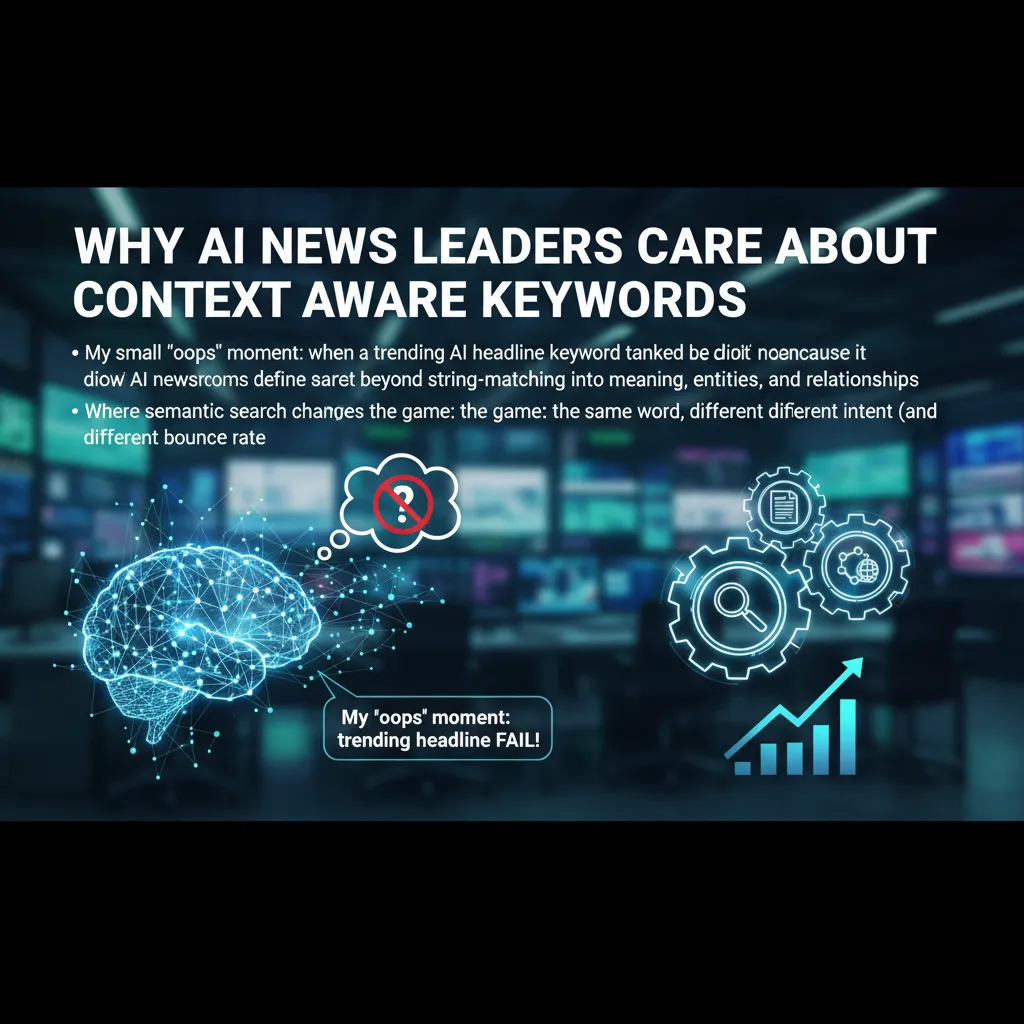
Why AI News Leaders Care About Context Aware Keywords
My small “oops” moment: when a trending keyword tanked
In the Expert Interview: AI News Leaders Discuss AIundefined, one theme kept coming up: keywords only work when they match intent. I learned that the hard way. I once pushed a story with a hot headline keyword—“AI agents”—because it was trending everywhere. Traffic came in fast, but the bounce rate was brutal. People weren’t looking for my newsroom-style update; they wanted “AI agents” as in tools they could use, comparisons, and setup guides. The keyword was popular, but my angle didn’t answer the question in their head.
How AI newsrooms define “context aware” keywords
When AI news leaders talk about context aware keywords, they mean moving past simple string-matching. It’s not just “does the phrase appear in the text?” It’s “does the story cover the meaning behind the phrase?” In practice, that means paying attention to:
- Entities: companies, people, products, models, and places (e.g., OpenAI, Gemini, NVIDIA).
- Relationships: who launched what, who partnered, who sued, what changed, what broke.
- Topic framing: policy, business impact, safety, how-to, or breaking news.
That’s why keyword extraction in AI search can’t stop at “top terms.” It has to surface the connected ideas that make the article useful.
Where semantic search changes the game
Semantic search makes one word behave like five different queries. “Apple AI” can mean earnings strategy, on-device features, a hiring push, or a rumor roundup. Same keyword, different intent—and a very different bounce rate if I guess wrong. In AI-powered search, the system tries to infer what the reader means, so my job is to make the context obvious with clear entities and precise wording.
“The keyword isn’t the destination. The reader’s question is.”
A quick gut-check ritual I borrow from editors
Before I lock a headline or primary keyword, I do a simple test: I read it out loud and listen for whether it sounds like a human question. If it feels robotic, it’s usually too broad.
- Read the keyword phrase out loud.
- Ask: “What would I expect to learn if I searched this?”
- Make sure the first paragraphs answer that expectation fast.
Sometimes I even rewrite a target phrase into a question format, like What changed in the new AI policy? That tiny shift forces me to align keyword extraction, AI search visibility, and real reader intent.
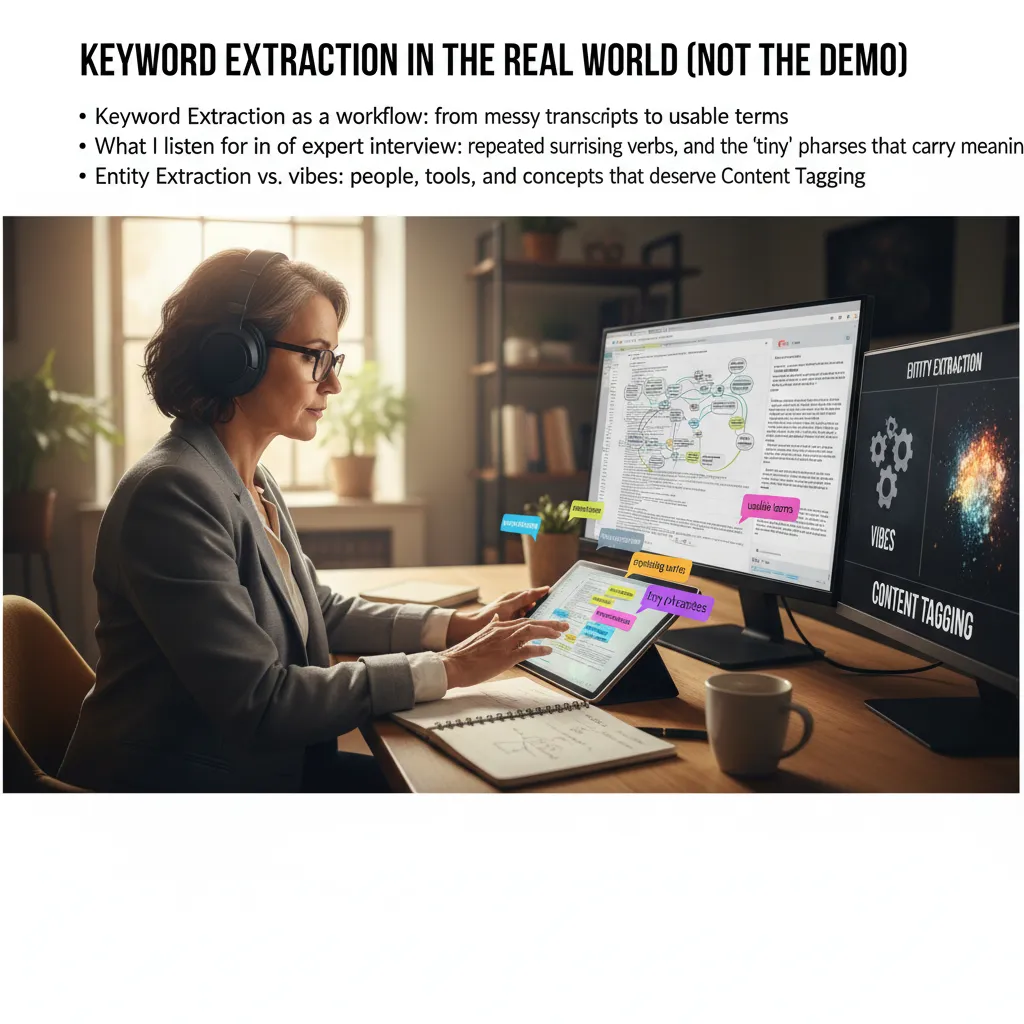
Keyword Extraction in the Real World (Not the Demo)
In the real world, keyword extraction is not a button you press after an interview. It’s a workflow I run from the moment I get a messy transcript to the moment I publish a clean, searchable story. In the “Expert Interview: AI News Leaders Discuss AIundefined” source, the raw material isn’t neat. People interrupt themselves, use shorthand, and switch between AI search, search experience, and retrieval like they’re the same thing. My job is to turn that noise into usable terms without losing meaning.
Keyword extraction as a workflow (from messy transcripts to usable terms)
I start by cleaning the transcript just enough to read it. Then I pull candidate terms in three passes:
- Surface pass: obvious repeated nouns and named entities.
- Meaning pass: phrases that explain “how” or “why” something works.
- Publishing pass: terms that match how readers actually search.
In practice, I’m not hunting for the longest list. I’m building a short set of keywords that can support headlines, internal links, content tagging, and AI search discovery.
What I listen for in an expert interview
When I listen back, I’m not only counting words. I’m listening for patterns:
- Repeated nouns: the “things” the experts keep returning to (models, rankings, sources, trust).
- Surprising verbs: verbs that show action and intent (audit, ground, cite, verify, route).
- Tiny phrases: short, sticky language that carries meaning, like “human in the loop” or “source of truth.”
“The small phrases are often the real keywords, because they capture the idea people remember and repeat.”
Entity extraction vs. vibes (content tagging that holds up)
I separate entity extraction from “vibes.” Entities are concrete: people, tools, companies, models, and concepts that deserve consistent content tagging. Vibes are fuzzy themes like “the future of AI” that don’t help search or navigation.
| Good for tagging | Too vague |
|---|---|
| AI search, keyword extraction, entity extraction | AI is changing everything |
| citations, grounding, retrieval | better answers |
A practical rule I use before I keep a keyword
My simplest filter is this: if a term can’t be used in a sentence naturally, it probably shouldn’t be a target keyword. If I can’t write, “This interview explains keyword extraction for AI search,” without it sounding forced, I drop it. That keeps the final keyword set tight, readable, and aligned with real queries.
NLP Powered Tooling I’d Actually Recommend (spaCy NLP, Spark NLP)
In the Expert Interview: AI News Leaders Discuss AIundefined, one theme kept coming up: keyword extraction and AI search only work when your NLP layer is dependable. In my own workflow, I’ve learned to pick tools the same way I pick editors—fast, consistent, and honest about what they miss.
spaCy NLP for speed (and why large models feel like a coworker)
If I need results quickly, I reach for spaCy. The larger English pipelines, like en_core_web_lg, feel like a reliable coworker because they handle the basics well: tokenization, lemmatization, entities, and decent vectors for similarity. That matters when I’m turning messy news text into clean keyword lists for AI search.
What I like most is the “tight loop”: I can parse, extract, and iterate without waiting. For newsroom-style keyword extraction, speed is not a luxury—it’s the difference between shipping today and “someday.”
Spark NLP for multilingual coverage (because the internet isn’t monolingual)
When my audience spans regions, Spark NLP becomes the practical choice. It’s built for scale and plays well with production pipelines, especially when you’re processing lots of articles, comments, or transcripts. More importantly, it gives me stronger options for multilingual NLP—so I’m not forcing every story through an English-only lens.
In AI search, multilingual coverage is not just translation. It’s recognizing names, topics, and phrases that don’t map neatly into English keywords.
YAKE! and other extraction techniques (short blurbs vs long transcripts)
I also keep YAKE! in my toolkit. It shines when I’m extracting keywords from short blurbs, headlines, or summaries where frequency-based methods don’t have much to work with. For long transcripts (podcasts, panels, earnings calls), I’ll compare YAKE! with other approaches like:
- TF-IDF for quick baseline keywords
- KeyBERT when semantic similarity matters
- NER-driven phrases (people, orgs, products) for search filters
The imperfect truth: different tools surface different “truths”
No single model gives “the” answer. Different tools surface different truths, so I compare outputs like taste-testing sauces. If spaCy highlights entities, YAKE! pulls quirky phrases, and Spark NLP catches multilingual terms, I treat that overlap as signal—and the disagreements as a prompt to refine my rules.
“Keyword extraction is less about finding the perfect list and more about building a repeatable process you can trust.”
Long Tail Keywords & Question Keyword Hunting (My Slightly Nerdy Ritual)
When I listened to the AI News Leaders interview, one theme kept popping up: AI search rewards content that answers real intent, not just broad topics. That’s why I lean hard on long tail keywords. Long tail isn’t just “longer.” It’s closer to a decision (or at least a real question someone is trying to solve). In AI-driven search, that closeness matters because the system is often looking for the best direct answer, not the most general page.
My routine: from seed keywords to question clusters
I start simple, then get more specific. Here’s my repeatable flow:
- Seed keywords: I write 5–10 plain phrases tied to the topic (example:
keyword extraction,AI search optimization,entity extraction). - Auto complete: I type each seed into Google/YouTube and copy the suggestions. These are “real user language,” which is gold for AI search.
- Related searches: I scroll to the bottom of the results and grab those variations too.
- Question-based clustering: I group terms by the question behind them: “what is,” “how to,” “best tools,” “vs,” “for beginners,” “for newsrooms,” etc.
This clustering step is where the “nerdy ritual” pays off. Instead of chasing 30 random phrases, I end up with 4–6 tight clusters that can become sections, FAQs, or even separate articles.
How I pick winners (without overthinking it)
I use three filters, in this order:
- Editorial usefulness: Can I answer it clearly with examples? Would an editor actually publish it?
- Keyword Difficulty: I love a 0–30 sweet spot because it’s realistic for newer or mid-authority sites.
- Search Volume: I don’t need huge volume. For long tail, even small numbers can be high intent.
| Signal | What I want |
|---|---|
| Intent | Specific, problem-based, decision-leaning |
| KD | 0–30 |
| Volume | Enough to justify a clean answer |
My weird but effective trick: FAQ first
Here’s the move that consistently improves my keyword extraction: I write the FAQ first, like I’m answering a reader in a newsroom Slack thread. Then I backfill the terms the FAQ naturally uses. It keeps the language human, and it often surfaces phrases I wouldn’t have “researched” but that match how people actually ask questions.
Long tail works best when it sounds like a real question—because in AI search, it often is.
Automatic Content, Editorial Guardrails, and the AI Powered Temptation
When news breaks fast, Automatic Content feels like a shortcut I can’t ignore. In the interview, the leaders were clear: speed matters, but trust matters more. My rule is simple and non-negotiable: automate the boring parts, not the judgment. That mindset keeps me focused on what readers actually need—context, accuracy, and a clear “so what?”
Where AI Powered workflows help (and why I use them)
I’ve seen AI Powered workflows make teams faster without lowering standards—if we set guardrails. The best use cases are the repeatable tasks that don’t require a human point of view.
- Drafts: quick first passes that I rewrite with reporting, quotes, and real framing.
- Summaries: turning long transcripts or filings into clean bullet points.
- Content Optimization: checking headings, internal links, and keyword coverage without stuffing.
- Tagging at scale: consistent topics, entities, and sections for better AI search discovery.
For keyword extraction and AI search, I like using AI to propose entities and terms, then I confirm them against the source. A simple workflow looks like:
Extract entities → verify in source → map to tags → publish with human headline
Where they hurt: the hidden costs
The same tools can quietly damage a newsroom if we let them run unchecked. I watch for three failure modes that came up in the discussion:
- Homogenized takes: AI tends to average the internet, which makes every story sound the same.
- Accidental plagiarism vibes: even when it’s “original,” phrasing can mirror common patterns too closely.
- Missing the “so what?”: summaries can report facts but skip impact, stakes, and accountability.
“Automation should support editorial work, not replace editorial responsibility.”
Editorial guardrails I won’t publish without
| Guardrail | What it protects |
|---|---|
| Source-first verification | Accuracy and credibility |
| Human-written headline + lede | Judgment and framing |
| Attribution checks | Originality and fairness |
Wild card: if AI ranked novelty over accuracy
If an AI engine rewarded only what’s new—not what’s true—what would we publish? I’d still choose the slower path: confirm the facts, label uncertainty, and resist “novelty bait.” In AI search, being first is tempting, but being right is the brand.

Conclusion: My ‘Newsroom-to-Search’ Loop (And a Tiny Promise)
After listening to AI news leaders talk about keyword extraction and AI search, I keep coming back to one simple idea: context-aware extraction plus semantic search plus human taste is the real moat. Tools can pull terms fast. Search systems can connect meaning across topics. But the part that protects trust is still human—knowing what matters, what’s missing, and what will actually help a reader understand the story.
In the newsroom, I learned that a headline can be “right” and still be wrong for the audience. The same is true for keywords. A trending phrase might bring clicks, but if it doesn’t match the real question behind the search, it creates disappointment. That’s why I’m making a small promise to myself (and to you): if a keyword doesn’t help a reader, I don’t chase it—even if it’s trending. I’d rather earn fewer visits than publish something that feels like bait.
To keep that promise, I use a repeatable loop that connects reporting to search in a way that stays honest. It starts with the interview, because interviews give me the language people actually use and the context that machines can miss. Then I run keyword extraction, but I treat the output like a draft, not a verdict. Next, I expand into long-tail and question-based queries, because that’s where real intent lives—“how,” “why,” “what does it mean,” and “what should I do next.” After that, I validate: I check the SERP, scan related questions, and compare the terms to the story I’m truly telling. Then I publish, watch what readers do, and refine the piece so it answers better over time.
In my head, I picture keywords as ingredients. They matter, and good ingredients make cooking easier. But the story is the meal. Semantic search helps people find the kitchen. Context-aware keyword extraction helps me stock the pantry. Human taste decides what’s worth serving, and what needs another minute in the oven. And yes, sometimes you burn the toast. When that happens, I don’t blame the ingredients—I adjust the recipe, listen harder, and run the loop again.
TL;DR: AI news leaders don’t treat keyword extraction as a magic trick—they treat it as a context-aware, NLP-powered workflow: start with seed keywords, expand with long tail and question keywords, validate with search volume + difficulty, then use content tagging to improve AI search relevance. Tools like Lucidworks AI Boosters, ClickRank, spaCy, and Spark NLP help—but editorial judgment still decides what not to publish.


Comments
Post a Comment