AI Marketing Ops: Real Results, Less Chaos

The first time I let a generative AI draft a campaign brief, I felt like I’d cheated on my own brain. It was… good. Too good. Then the legal comments came back and we discovered the brief had invented a feature we definitely didn’t ship. That week became my accidental crash course in AI transformation: speed is easy, truth is hard, and the real win is building an ops system that catches mistakes before customers do.
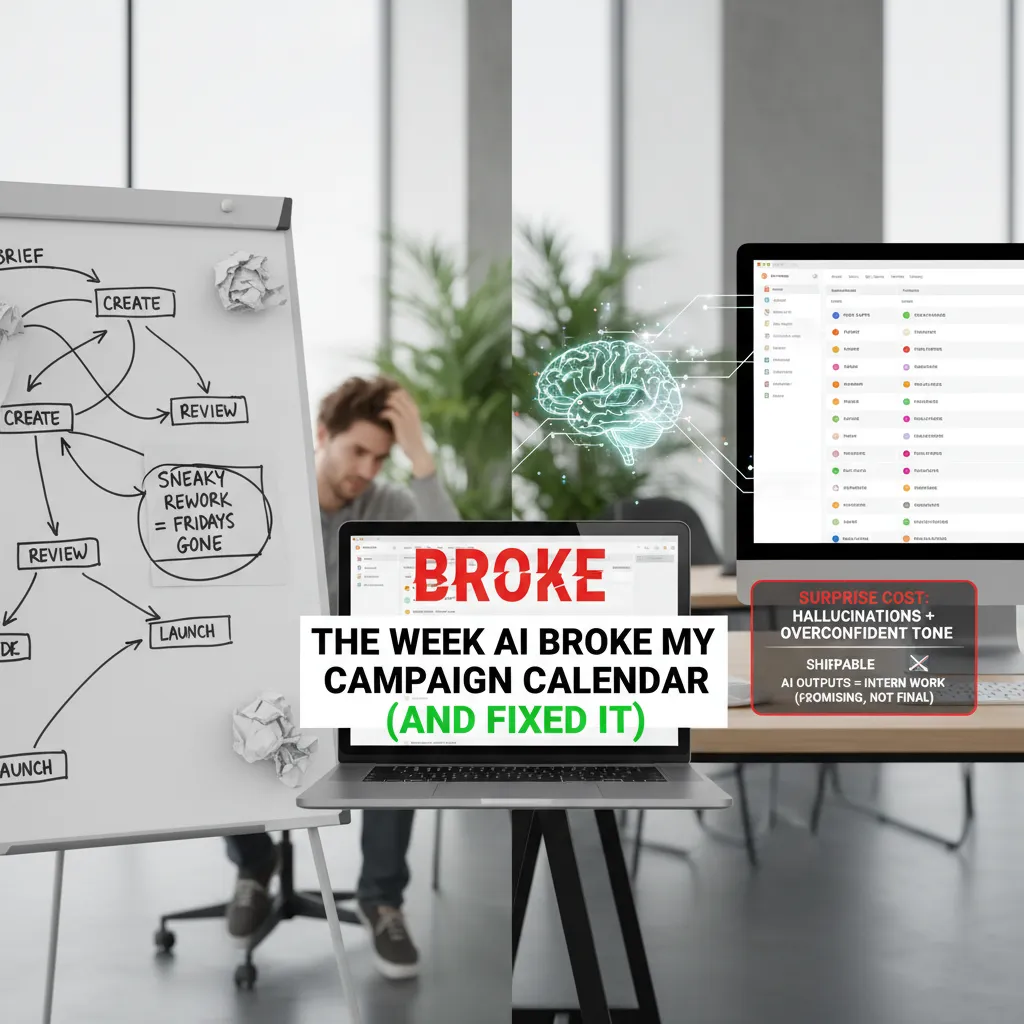
1) The Week AI Broke My Campaign Calendar (and Fixed It)
Before AI touched my marketing ops, my calendar followed the same “simple” path: brief → creative → review loops → launch. On paper, it looked clean. In real life, the sneaky part was rework. Every Friday, I’d find a last-minute note like “can we make it more punchy?” or “legal needs one more disclaimer,” and suddenly the whole campaign timeline slid into next week.
My baseline: the loop that ate time
The biggest drag wasn’t the first draft. It was the back-and-forth: version names, missing context, and approvals that came in pieces. I’d spend more time translating feedback than improving the work. That’s the chaos AI marketing operations promised to reduce, and honestly, it did—just not in the way I expected.
Where generative AI actually helped
Generative AI didn’t replace my process. It sped up the parts that used to stall it. I started using it for:
- First drafts of emails, landing page sections, and ad copy (fast enough to keep momentum).
- Variant ideation (subject lines, CTAs, value props) so testing didn’t feel like extra work.
- QA checklists for launches: links, UTMs, brand terms, compliance notes, and formatting.
- Handoff notes for marketing teams so creative, ops, and analytics had the same context.
The surprise cost: confident nonsense
Then AI “broke” my calendar. It gave me outputs that looked finished, sounded sure, and were sometimes wrong. Hallucinations showed up as fake stats, made-up feature claims, or confident wording that didn’t match our brand. That’s when I started treating AI like an intern: promising, fast, and helpful—but not shippable without review.
My rule: AI can draft. Humans approve. Ops verifies.
Mini case: two days instead of two weeks
One campaign used to take two weeks because approvals were loud: everyone commenting everywhere. With AI, I drafted the email sequence and landing page copy in one afternoon, generated five variants, and produced a simple QA list. The real win came when we made the approval chain smarter: one doc, one owner per section, and AI-generated handoff notes that reduced repeat questions. We launched in two days—not because we rushed, but because we stopped re-litigating decisions.
Wild-card aside: my “nonsense jar”
I keep a running list of AI-made claims in a “nonsense jar.” It’s funny until it isn’t. Now, anything that sounds like a fact gets checked, or it doesn’t ship.
2) Marketing Measurement Got Less Glamorous—and Way More Useful
For a while, my favorite “win” was simple: we launched faster. New landing page in days, not weeks. More emails out the door. More ads tested. Then my CFO asked a question that killed the vibe: “What business outcome did that create?” Not clicks. Not excitement. Not “the team feels productive.” Real outcomes.
“Speed is nice. Show me impact.”
That was the moment I stopped treating measurement like a nice-to-have and started rebuilding it like an operations system. AI didn’t magically fix measurement, but it made the gaps obvious. When AI can produce 10 versions of something in an hour, you either measure what matters—or you drown in activity.
The measurement stack I rebuilt (so I could answer hard questions)
I stopped relying on one dashboard and built a simple stack with three layers:
- Operational metrics (how we work): cycle time, handoff delays, rework rate, and “stuck” approvals.
- Campaign optimization metrics (how the market responds): CTR, CVR, CPC, and email engagement.
- ROI impact (what the business gets): pipeline influence, sourced pipeline, and revenue contribution where attribution allowed.
This structure helped me connect the dots. If cycle time dropped but CVR didn’t move, we weren’t actually improving the customer experience—just moving faster. If CTR went up but pipeline influence stayed flat, we were buying attention, not intent.
A tiny confession: I used to avoid measurement
I avoided measurement because it made my favorite ideas lose. Some campaigns I loved were “creative wins” and business losses. AI made that harder to ignore because it removed excuses. When production gets easier, performance becomes the only honest judge.
The routine that kept it practical (not performative)
I set a weekly measurement review—30 minutes, same agenda, no storytelling. And I added one rule:
- Every AI tool must justify itself in one metric. Example: “This AI QA step reduces rework rate by 15%,” or “This AI subject-line testing improves CTR by 8%.”
If a tool couldn’t earn a metric, it didn’t earn a budget.
One tangent I repeat to my team: dashboards are like kitchen scales—annoying until you cook without them. Once you’ve tried to scale a recipe by guessing, you stop calling measurement “extra.”
3) Brand Discovery Is Moving to AI Overviews (and I’m Nervous)
My newest marketing anxiety is simple: customers can ask an AI assistant what to buy before they ever hit my site. In the past, discovery started with a search result, a click, and then my landing page did the work. Now, the “first impression” might be an AI Overview that summarizes my category, names a few brands, and gives a recommendation in seconds. If I’m not mentioned there, I’m invisible in the moment that matters.
From ranking-only thinking to mention tracking
In How AI Transformed Marketing Operations: Real Results, the big theme is reducing chaos by measuring what actually moves the needle. For me, that meant changing brand tracking. I used to obsess over rankings like they were the whole game. Now I track mentions across AI summaries and AI Overviews, plus the sources those systems cite.
- Are we named? Not just “do we rank.”
- How are we described? The words matter: “cheap,” “secure,” “best for teams,” etc.
- Where is the AI pulling proof from? Reviews, forums, social posts, press, docs.
Social SEO meets old-school PR
This is where social media started pulling double duty. A strong post is no longer just “engagement.” It can become searchable proof that an AI system uses to understand what we do and why we’re trusted. That pushed me to treat social like lightweight PR: clear claims, real examples, and consistent language.
I now write posts that include:
- One clear problem we solve
- One specific result (even a small one)
- One “why trust us” detail (customer quote, metric, or process)
The 2-sentence AI test
If an AI agent had to explain my product in 2 sentences, what would it say?
Then I write for that. I tighten my homepage copy, FAQs, and product pages so the “two sentences” are easy to extract and hard to misunderstand. Sometimes I’ll even draft the answer like a mini-brief:
[Product] helps [who] do [job] by [how]. It’s best for [use case] because [proof].
My unpopular opinion: chasing search rankings alone is a comfort blanket. It feels measurable, but it ignores how discovery is shifting. If AI Overviews become the new front door, I want my brand to show up with the right story, not just a blue link.

4) AI Agents: The Agentic AI Frontier (Useful, Not Magical)
My first experiment: I delegated, then watched it argue with itself
My first real test of AI agents in marketing operations was simple on paper: run a competitor scan, draft a creative brief, and produce a UTM plan. I set it up like a mini “team” of roles. Within minutes, it started debating its own assumptions—one part pushed bold positioning, another warned about weak evidence, and a third tried to standardize everything into a template.
It was messy, but useful. The output wasn’t “done.” It was a fast first pass that surfaced gaps I would have missed until much later.
Where AI agents actually fit in marketing ops
In my day-to-day, agentic AI works best when the tasks are repeatable and the success criteria is clear. I’ve found four practical lanes:
- Task routing: sorting requests, tagging tickets, and sending work to the right owner or channel.
- QA: checking links, naming rules, UTM consistency, and basic brand tone issues before anything ships.
- Experimentation: generating test ideas, building variant matrices, and tracking what changed across versions.
- Lightweight reporting: summarizing weekly performance and calling out anomalies for review.
Strategic oversight is the job now (adult supervision)
The biggest shift is that I spend less time “doing” and more time directing. Agents need boundaries, or they will confidently wander. I now define:
- Guardrails: what data it can use, what tools it can touch, and what “good” looks like.
- Tone rules: words to avoid, claims that require proof, and how we speak to different audiences.
- Escalation paths: when it must stop and ask a human (budget changes, legal risk, brand-sensitive topics).
Agents don’t replace judgment. They replace the blank page and the busywork.
Human connections still matter
The campaigns that performed best weren’t fully automated. The strongest results came when I stitched human interviews—sales calls, customer quotes, support tickets—into an AI-generated structure. The agent could organize, summarize, and draft, but the human voice made it believable.
Reality check: overhyped, but I’m planning anyway
Agentic AI is overhyped in the sense that it’s not a self-driving marketing team. It still needs clean inputs, clear rules, and active review. But it’s improving fast, and I’m building my ops stack so agents can plug in safely as they mature.
5) Corporate AI Spend Is Rising—So I Got Picky About Tools
When AI budgets started showing up as a real line item (not a “nice-to-have”), I felt the pressure. Corporate AI spend is rising, and that means leadership asks harder questions. I learned fast that the fastest way to lose trust is to buy too many tools and still ship the same work at the same speed.
The tool sprawl problem (I lived it)
At one point, I had five AI tools doing the same three things: drafting copy, summarizing notes, and generating ideas. None of them talked to each other. I was copying and pasting between tabs, re-uploading the same files, and creating new “mini systems” that only I understood. It looked like progress, but it was chaos.
My selection rubric (simple, but strict)
I got picky and built a rubric I could defend in a budget review. Every tool had to earn its place:
- ROI is critical: Will this reduce cycle time, cut costs, or improve conversion in a way I can measure?
- Data privacy: What data is stored, where, and for how long? Can I control retention and access?
- Integration with my stack: Does it connect to our CRM, analytics, project management, and content workflow?
- Failure modes: How does it break? Hallucinations, bad formatting, missing sources, downtime—what’s the backup plan?
Budget reality: scrutiny climbs, so I document wins like a scientist
As spend climbs, so does scrutiny. I started documenting results like experiments: baseline, change, outcome. I keep a simple log with dates, inputs, and metrics. If a tool saves two hours per campaign, I write it down. If it doesn’t, I cut it.
“If I can’t measure the win, I can’t defend the spend.”
What I stopped doing (and what I kept)
I stopped buying tools for “inspiration”. Idea generators are fun, but they rarely move marketing operations forward. What I kept were tools that improve throughput (more work shipped) and measurement (clear performance signals).
Quick checklist you can steal
- What workflow step does this replace (be specific)?
- What metric will improve (time, cost, quality, revenue)?
- Can it integrate with my current tools without manual copy/paste?
- What data touches it, and is that allowed?
- How does it fail, and what’s my fallback?
- What will I remove if I add this?

6) Conclusion: My Weird Test—Can AI Explain Us Without Lying?
I started this whole journey with a mistake that felt small at the time: I used AI to move faster, but I didn’t check if it was telling the truth about us. The output looked clean, the turnaround was instant, and the team felt productive. Then the cracks showed up—wrong claims, off-brand language, and reporting that made us feel “busy” without being clear. That’s when I learned the hard lesson: speed without truth is just faster failure.
After testing what worked (and what broke), I landed on a simple AI marketing ops operating model I actually trust. It’s not fancy, but it’s stable: guardrails → measurement → brand tracking → agent-ready workflows. Guardrails come first because they prevent the obvious mess—approved sources, do-not-say lists, compliance checks, and clear definitions. Measurement comes next because “better” has to mean something you can see. Brand tracking follows because consistency is a system, not a vibe. And only then do I push toward agent-ready workflows, where AI can run repeatable tasks without me babysitting every step.
Here’s my wild-card analogy that keeps me honest: AI is a powerful espresso machine. It can produce a lot, fast. But you still need a recipe—dose, grind, timing—or you’ll get bitter shots all day. And someone has to clean it, or the whole thing starts tasting off. In marketing operations, the “recipe” is your process and your data. The “cleaning” is ongoing governance: updating prompts, fixing inputs, and reviewing outputs.
If you want practical next steps, keep it simple. Pick one workflow (like campaign brief creation, UTM QA, lead routing checks, or weekly performance summaries). Set one metric (time saved, error rate, MQL-to-SQL conversion, or content rework hours). Then run one experiment for two weeks. Treat it like a controlled test: same team, same channel, same definition of success. If it improves, document it and make it repeatable. If it doesn’t, you learned cheaply.
My final takeaway from “How AI Transformed Marketing Operations: Real Results” is simple: the point isn’t to look futuristic. It’s to make marketing teams saner and outcomes clearer. When AI helps us explain what we’re doing without lying, that’s when it stops being hype and starts being operations.
TL;DR: AI transformed my marketing operations when I treated it like a teammate with guardrails: invest where ROI is measurable (faster cycles, less rework, scalable content production), track brand discovery across AI summaries/overviews, and prepare for AI agents as the next gatekeepers—without losing human connections.


Comments
Post a Comment