Operational Excellence: AI Transformation, Real Results
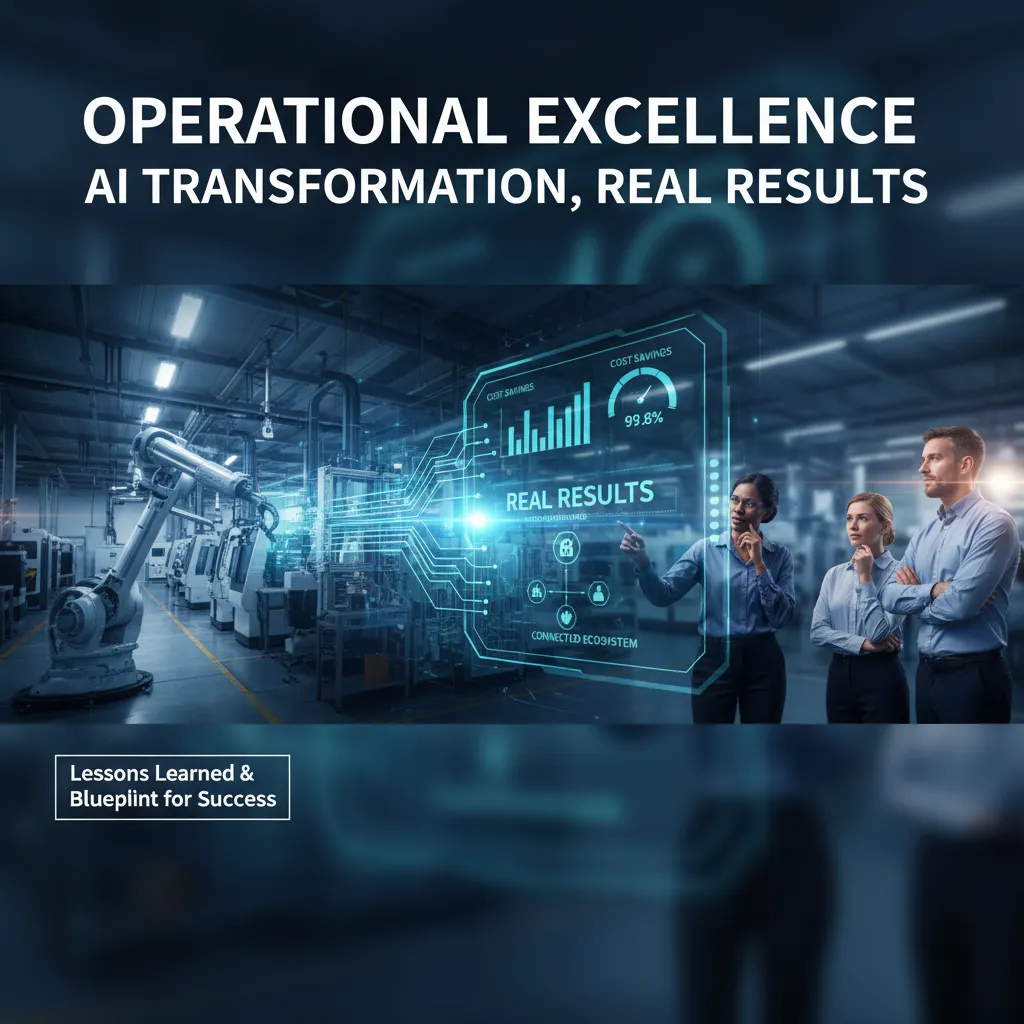
I still remember the day our “simple” ops dashboard crashed five minutes before a leadership review. We had data everywhere, answers nowhere. That little panic spiral became my turning point: if systems stay fragmented, real-time intelligence stays a myth. This post is my field notes on what changed once we treated AI as an operations teammate—sometimes brilliant, sometimes messy—and started aiming for operational excellence instead of shiny demos.
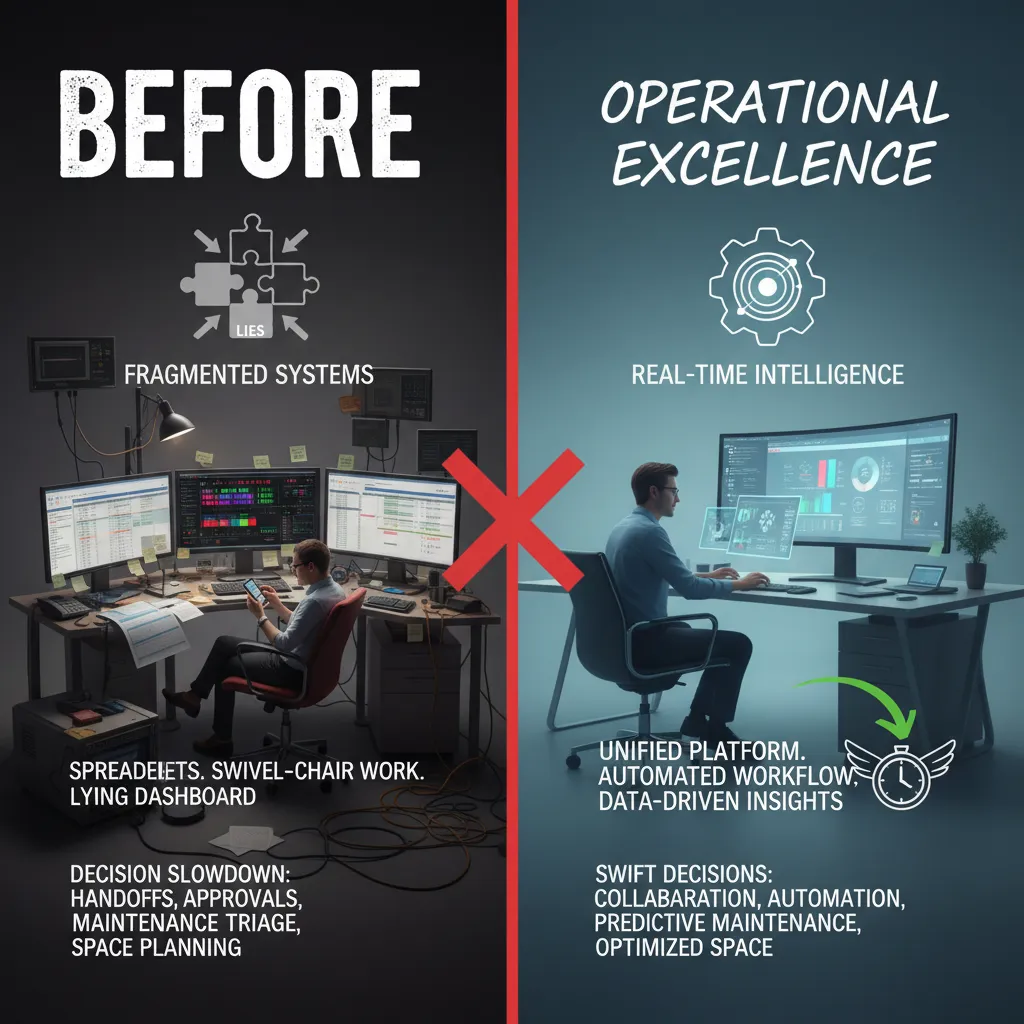
1) The “Before” Photo: Fragmented Ops vs. Operational Excellence
Before our AI transformation delivered real results, my operations world was a patchwork. I lived in spreadsheets, copied numbers from one system to another, and did constant swivel-chair work between email, CMMS, finance, and space tools. Worst of all, I trusted a dashboard that looked official but lied (unintentionally). It refreshed late, pulled the wrong fields, and hid exceptions behind averages.
Why fragmented systems kill real-time intelligence
Operational excellence needs fast, shared truth. Fragmented systems do the opposite: they create delays, duplicate data, and “version wars.” By the time a report reached leadership, the situation had already changed. That meant we were managing yesterday’s problems while today’s risks grew quietly.
“If the data can’t agree, the team can’t move.”
My quick self-audit: where decisions slowed down
When I mapped our workflows end to end, the bottlenecks were not mysterious. They were predictable handoffs and unclear ownership. I asked one simple question: Where does work wait?
- Handoffs: tickets moved between teams with missing context
- Approvals: budget sign-offs stuck in inboxes
- Maintenance triage: urgent vs. important decided by whoever shouted loudest
- Space planning: occupancy data lagged, so moves were reactive
Wild-card analogy: the kitchen with five timers
Running ops like this felt like cooking in a kitchen with five timers and no head chef. Every station had its own clock, nobody owned the full meal, and things didn’t explode—they just burned quietly. That’s how risk shows up: small misses that stack into big cost.
What I wish I’d measured earlier
From the source material, the biggest lesson was simple: AI can’t prove value if you don’t know your starting line. I wish I had captured baselines for:
- Cost control: overtime, vendor spend, repeat work
- Risk reduction: safety incidents, compliance gaps, downtime exposure
- Cycle time: request-to-complete for work orders and approvals
2) AI-Backed Workflows: Where the Magic (and Grief) Lives
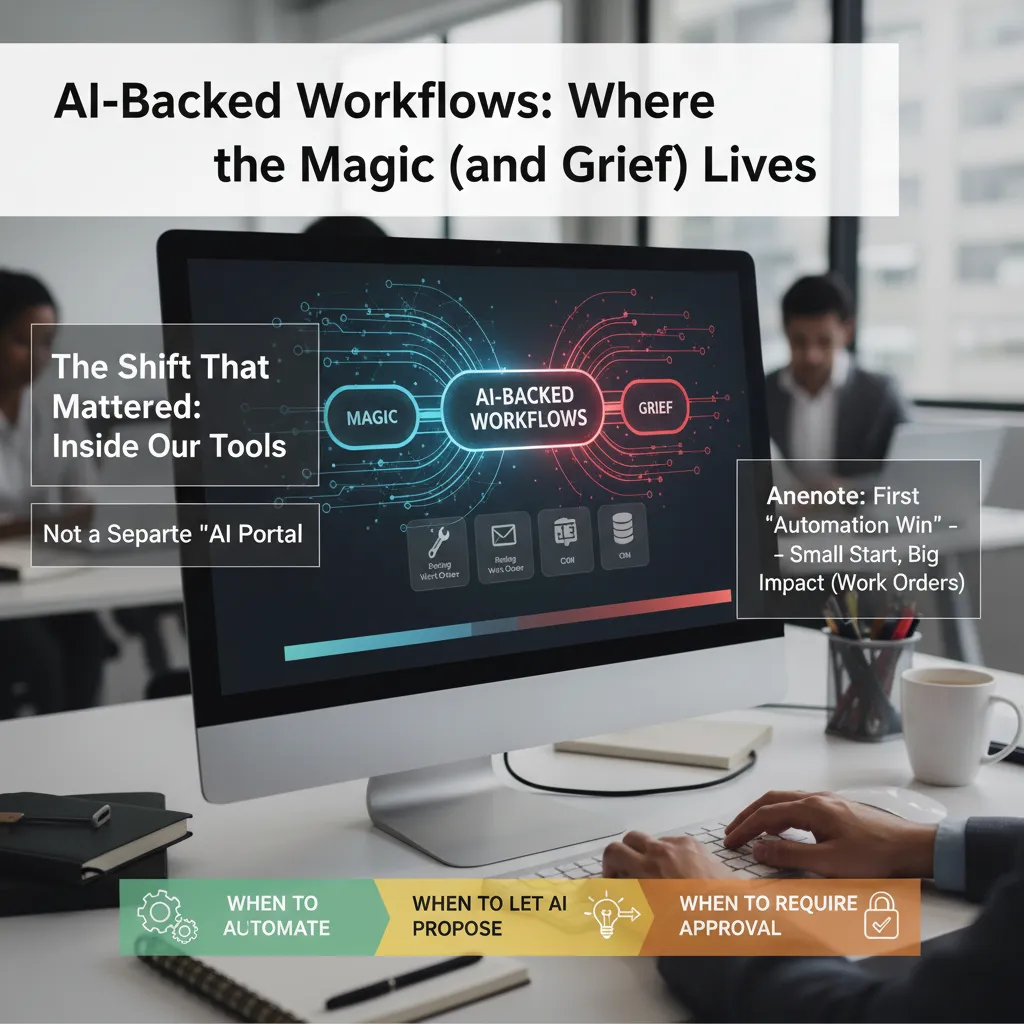
The biggest shift in our AI transformation wasn’t a flashy model or a new “AI portal.” It was AI-backed workflows inside the tools we already used: the ticketing system, the CMMS, email, chat, and the scheduling board. When AI lives where work already happens, people try it. When it sits in a separate place, it becomes “that extra step” and adoption drops fast.
My first automation win was embarrassingly small
I still remember it: we used AI to route work orders correctly. That’s it. No robots, no big redesign. The model read the request text, matched it to the right trade/team, and filled the right fields. It felt tiny, but it removed daily friction. Fewer bounced tickets. Less rework. Faster response. That small win built trust for bigger changes.
Business workflows vs. agentic workflows
I learned to separate what should be fully automated from what should stay supervised:
- Automate when rules are stable and risk is low (routing, tagging, data entry).
- Let AI propose actions when context matters (drafting a response, suggesting parts, proposing a schedule).
- Require approval when cost, safety, or customer impact is high (purchase orders, shutdowns, policy exceptions).
This avoided the “all or nothing” argument and kept us moving.
Embedded intelligence beats “one more dashboard”
We already had dashboards. Adding another one didn’t change behavior. What worked was cross-platform analytics that showed up inside the workflow: a risk flag on a work order, a predicted delay in the schedule view, or a “likely repeat issue” note in the ticket. That’s intelligence people can act on in the moment.
How I framed outcomes to stop endless debates
Instead of arguing about model accuracy in the abstract, I tied every workflow to outcomes:
- Time saved per ticket or work order
- Errors reduced (misroutes, missing fields, duplicate work)
- Customer/employee impact (faster fixes, fewer handoffs, less frustration)
3) Connected Ecosystems: The Unsexy Backbone of AI Transformation
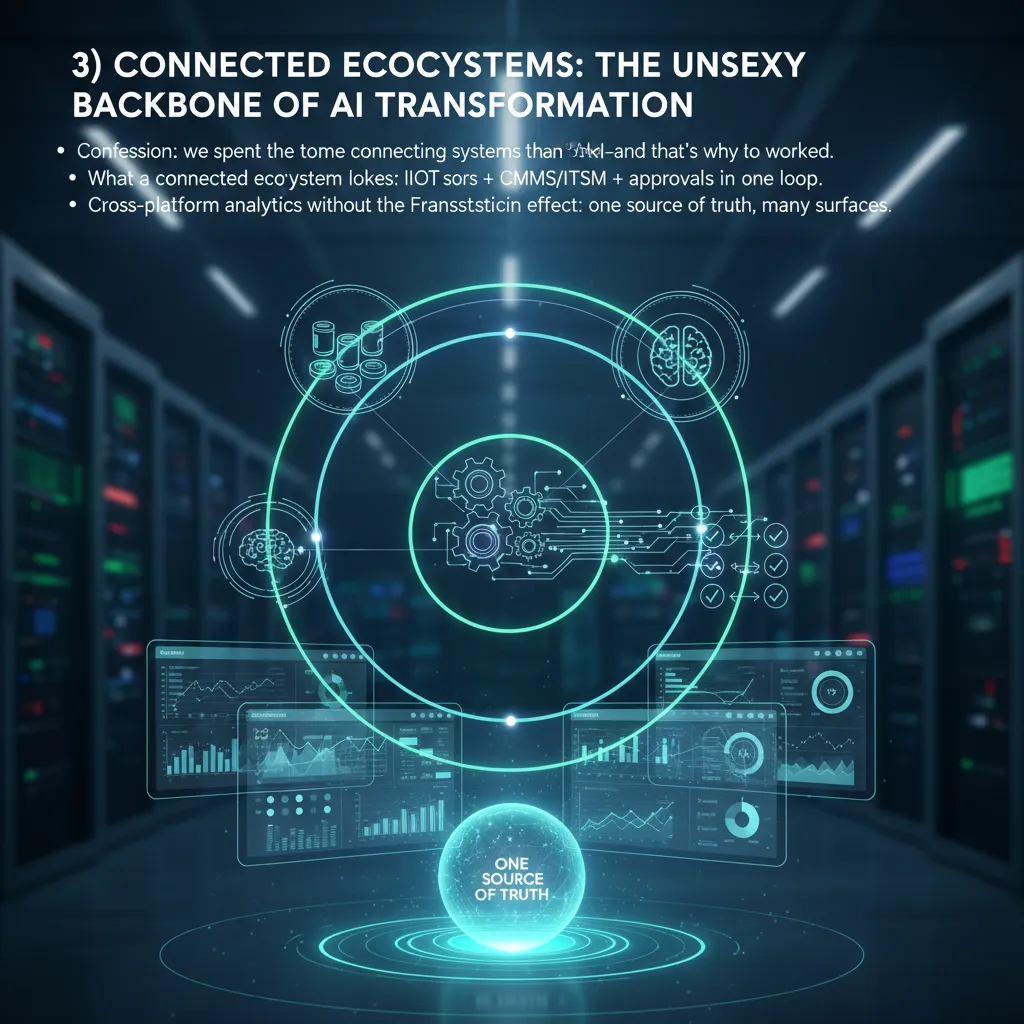
I’ll start with a confession: we spent more time connecting systems than “doing AI”—and that’s exactly why it worked. In the source story of How AI Transformed Operations: Real Results, the biggest wins didn’t come from a flashy model. They came from making sure data could move cleanly, safely, and on time across the tools people already used.
What a connected ecosystem looks like in real operations
For us, a connected ecosystem meant one closed loop from signal to action:
- IIoT sensors capture machine health (vibration, temperature, run time).
- Data flows into CMMS/ITSM so work orders and incidents are created in the right place.
- Analytics flags risk and recommends next steps based on history and thresholds.
- Approvals route to the right owner, with timestamps and comments.
When that loop is tight, AI stops being a dashboard and becomes an operational habit.
Cross-platform analytics without the “Frankenstein effect”
I’ve seen teams bolt tools together until nobody trusts the numbers. We avoided that by building one source of truth (clean asset master + consistent event data), then letting many surfaces consume it: maintenance views, reliability reports, finance rollups, and leadership KPIs. Same data, different screens—no copy-paste chaos.
“If the data is right once, it can be right everywhere.”
Risk mitigation: fewer shadow spreadsheets, clearer audit trails
Connected ecosystems reduce the quiet risks that grow in the gaps:
- Fewer shadow spreadsheets and manual re-entry
- Clearer audit trails for who approved what, and when
- Less compliance drift because rules live in workflows, not in memory
A small tangent: the “simple integration” that wasn’t
One day, a “simple integration” exposed three competing definitions of asset: the sensor ID, the CMMS equipment record, and the finance depreciation item. Oops. Fixing that mapping felt boring, but it unlocked reliable analytics and stopped false alerts. Sometimes the most valuable AI work is just agreeing on what things are called.
4) Predictive Maintenance: Downtime Math That Finally Made Sense
Why predictive maintenance beat our old routine
Our old routine was simple: service equipment on a fixed schedule and hope nothing failed in between. In practice, it meant surprises—a pump that died early, a motor that overheated on a holiday, and a weekend call list that never stayed quiet. Predictive maintenance changed the math because it shifted us from “time-based” to risk-based. We planned parts earlier, booked labor with less panic, and stopped treating every vibration as a fire drill.
IIoT sensors: quiet heroes with basic signals
The breakthrough wasn’t fancy data. It was consistent signals from IIoT sensors: vibration, temperature, and run-time. Those three told us more than many manual checks. When the model flagged a trend—like rising vibration at a steady load—we could inspect before failure. It felt almost boring, which is exactly what operations needs.
- Vibration: early warning for bearings, alignment, imbalance
- Temperature: friction, lubrication issues, electrical stress
- Run-time: true wear exposure, not just calendar time
What we predicted first (portfolio optimization)
We didn’t try to predict everything. We used a simple portfolio approach: start where downtime hurts most and failures repeat. That kept the program grounded and made the ROI easy to explain.
- Critical assets that stop the line
- High downtime cost per hour (lost output + overtime)
- Repeat failures with clear patterns
The cost savings story that sold it
The first avoided outage was the moment the “downtime math” finally made sense. A single catch—one bearing replaced during a planned window—saved enough lost production to pay for more sensors than my budget pitch ever could. After that, the conversation changed from “Why spend?” to “Where else can we instrument?”
Wild-card: an AI agent negotiating maintenance windows
I keep wondering: if an AI agent could negotiate maintenance windows across production, maintenance, and supply chain, what breaks first—the calendar or the culture? The scheduling logic is solvable. The real constraint is trust: who gets to say “yes” when the model says “now”?
5) Occupancy Analytics + Hybrid Work: Stop Heating Empty Rooms
My “facepalm” moment
I still remember the day I realized we were celebrating the wrong win. We had used AI to optimize cleaning schedules, and the dashboards looked great. Then I walked the floor on a Friday and saw it: half the space was empty, yet we were still heating, cooling, lighting, and servicing it like a full house. That was my facepalm moment—operations were “efficient,” but not aligned to reality.
Occupancy analytics = operational excellence for space
Occupancy analytics helped me shift from assumptions (“people are in on Fridays”) to facts (“this zone is at 20% after 1 p.m.”). In the source material, the big lesson is simple: AI works best when it connects daily operations to real behavior, not static plans. When I started using occupancy signals, I could match services to actual usage patterns.
- Cleaning based on traffic, not a fixed calendar
- HVAC and lighting tuned by zone and time
- Room booking validated against real presence
Energy efficiency meets employee experience
What surprised me most: comfort complaints dropped when schedules matched how people really used the office. Instead of blasting AC across empty areas, we focused on the spaces that were busy. People stopped saying, “Why is it freezing in here?” and “Why is this room always stuffy?” AI didn’t just cut waste—it made the workplace feel more consistent.
“Stop heating empty rooms” became our simplest rule for hybrid work operations.
Business outcomes that actually matter
Once we had reliable occupancy insights, the conversations changed. We saw measurable cost savings from reduced energy use and smarter service routing. We also improved space planning, because we could prove which areas were underused and which were truly in demand. Best of all, we had fewer random “we need more desks” arguments—because we could point to data instead of opinions.
Privacy and AI governance aren’t optional
One gentle reminder: occupancy analytics only works long-term if people trust it. I treat privacy, anonymization, and clear AI governance as non-negotiable. Trust is the real sensor, and without it, the best model won’t survive rollout.
6) Governance, AI Literacy, and Change Fitness: The Part I Tried to Skip
I’ll admit it: I wanted a shortcut. I thought we could “just ship” the AI and fix issues later. But governance forced a grown-up conversation about risk reduction and accountability. In operations, “later” usually means a customer impact, a compliance issue, or a messy rollback. Governance didn’t slow us down—it stopped us from moving fast in the wrong direction.
Agentic workflows raise the stakes
Once we moved from simple AI suggestions to agentic workflows (systems that take actions), the questions got real:
- Who approves actions before they hit production systems?
- Who audits outputs and checks if decisions are traceable?
- Who owns mistakes when automation triggers the wrong step?
From the source material, the biggest operational gains came when we treated AI like a teammate with permissions—not a magic tool with unlimited access.
AI literacy: the 30-minute workshop that saved me weeks
I used to skip training because it felt “nice to have.” Then I ran a simple 30-minute AI literacy session for the ops team. We covered what the model can and can’t do, how prompts affect results, and what “hallucinations” look like in real workflows.
That short workshop saved me weeks of rework later, because people stopped trusting outputs blindly and started validating the right things.
Change fitness beats one heroic rollout
Operational excellence with AI is not one big launch. It’s building change fitness: small releases, clear feedback loops, and regular tuning. We made improvement a habit, not a rescue mission.
A practical checklist for AI governance in operations
- Guardrails: role-based access, allowed actions, data boundaries
- Monitoring: accuracy checks, drift signals, cost and latency tracking
- Escalation paths: when to hand off to a human, who gets paged
- Auditability: logs for prompts, actions, approvals, and outcomes
- Pause buttons: a clear way to stop automation fast
7) Conclusion: Operational Excellence Is a Habit, Not a Hack
I keep thinking about the day our dashboard crashed. For a moment, it felt like we lost control. But the real lesson wasn’t “we need a better dashboard.” The real fix was changing how we decide, not just what we see. When we rebuilt our operations with AI in mind, the biggest shift was moving from reactive reporting to steady, repeatable decisions that held up even when the screen went dark.
If I could tape three reminders above my desk from this AI transformation journey, they’d be simple. First, connect ecosystems: building systems, sensors, and tools can’t live in silos if you want real results. Second, embed AI-backed workflows: AI can’t be a side project or a “nice-to-have” model; it has to sit inside the daily work where tickets, approvals, and schedules happen. Third, measure business outcomes: uptime, energy use, and response time matter, but I learned to translate them into cost, risk, and service impact so leaders can act with confidence.
Here’s my wild-card way to explain it: I imagine the ops team as a jazz band. AI plays rhythm—steady, consistent, always on time. Humans improvise strategy—reading the room, making trade-offs, and choosing when to push or pause. When we treat AI like the drummer instead of the soloist, the whole group sounds better.
If I were starting fresh, what I’d do in the next 30 days is straightforward: pick one workflow (like preventive maintenance scheduling), one asset class (like HVAC units), and one space metric (like occupancy-to-energy ratio). Then I’d ship a small change, learn from the data, and repeat. That loop is where operational excellence lives.
I’ll close with a grounded promise: the cost savings are real, and the performance gains are real. But so is the discipline required to keep them. AI can accelerate operations, yet only habits—clear decisions, connected systems, and outcome tracking—make the results stick.
TL;DR: AI transformation works when it’s tied to measurable outcomes (cost-to-serve, downtime, energy efficiency) and supported by connected ecosystems, AI-backed workflows, and practical AI governance. Start small, integrate fast, and measure relentlessly.


Comments
Post a Comment