Leadership AI News for Smart Managers in 2026

Last month I caught myself doing something I used to roll my eyes at: asking an AI tool how to phrase a tough feedback message. It gave me a clean, corporate-sounding draft—and I felt my stomach drop a little. Not because it was wrong, but because it was so… frictionless. That tiny moment sent me down a rabbit hole of Leadership AI news: agentic AI, multi agent orchestration, governance, and the quiet shift away from command control. This post is my “field notes” version of the latest updates and releases—filtered through what actually matters when you’re the one who has to explain the decision to a real person.
Executive Summary: What Changed in Leadership AI (Fast)
From my “news desk” view of Leadership AI News: Latest Updates and Releases, the biggest change is speed. The shift from old-school command-and-control to AI-augmented leadership is no longer theoretical. In 2026, I’m seeing managers move from “I decide, you execute” to “we decide with AI support,” where the system helps surface risks, options, and trade-offs in near real time.
My quick rundown: the new default is AI-augmented leadership
What used to be a pilot project is now daily work. Leaders are using AI to draft plans, summarize meetings, map stakeholders, and spot patterns across customer feedback and team performance. The practical shift is that leadership is becoming more about setting direction and constraints than micromanaging steps.
The big headline I keep hearing: multi-agent orchestration
The loudest theme in the updates is multi-agent orchestration becoming the backbone for enterprise systems in 2026. Instead of one model doing everything, companies are coordinating multiple specialized agents—one for research, one for finance checks, one for policy, one for execution—so work moves faster and is easier to audit.
- Specialization: each agent has a narrow job and clearer boundaries.
- Coordination: an orchestrator routes tasks, merges outputs, and flags conflicts.
- Traceability: better logs of “who did what” inside the AI workflow.
Why this matters to smart managers
The job isn’t to outcompute the model—it’s to decide what to do with AI insights. I’m spending more time on questions like: What decision are we actually making? What data is allowed? What risk is acceptable? What does “good” look like? AI can generate options, but it can’t own accountability.
“AI gives me speed and range. I still own the call.”
My aside: I treat AI like a brilliant intern
I now treat AI like a brilliant intern—useful, eager, occasionally overconfident. I ask for sources, I request alternatives, and I sanity-check numbers. When it’s wrong, it’s often wrong confidently, so I build review steps into the workflow.
What I’m watching next: tools that act, and the trust gap
Next up are agentic landscape tools that can act, not just suggest—creating tickets, updating dashboards, changing settings, even negotiating schedules. That power also creates a governance trust gap: who approved the action, what policy applied, and how we prove it later?

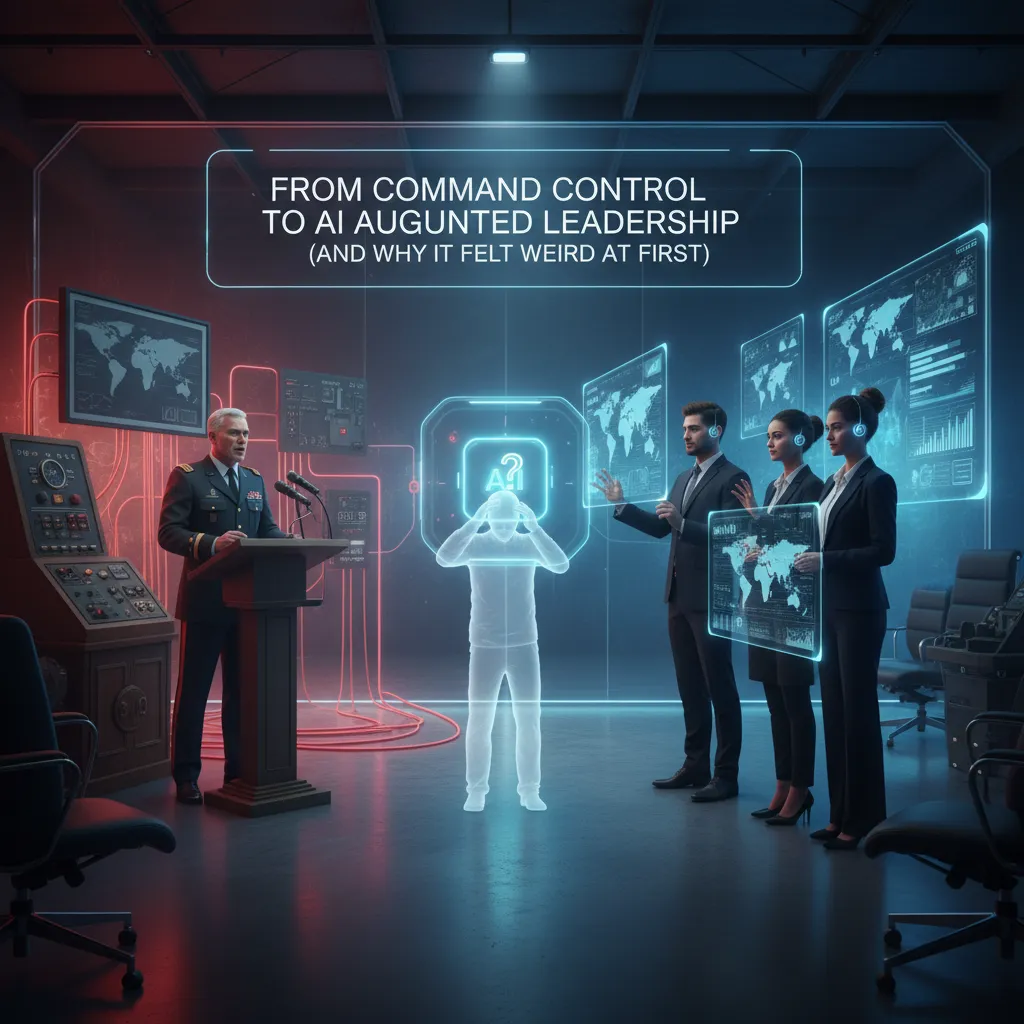
From Command Control to AI Augmented Leadership (and why it felt weird at first)
In the latest Leadership AI News updates, I keep seeing the same shift: command control leadership breaks when AI can generate 10 “reasonable” options in seconds—and none of them own the consequences. That was the weird part for me. I was used to being the person with the answer, or at least the final call. Now the “answer” shows up instantly, in a clean list, with confident wording. It can feel like leadership got easier—until it doesn’t.
Where it started to rub in real life
My real-world friction point is simple: AI recommendations are easy to accept when the stakes are low; they get ethically loud when people’s careers are involved. If an AI tool suggests a meeting agenda, fine. If it suggests who is “high potential,” who should be put on a performance plan, or how to rank people, that’s different. The tool doesn’t sit across from the person. It doesn’t see the stress at home, the new manager learning curve, or the quiet teammate who carries the hard work.
AI can draft the decision. Only a leader can carry it.
The success pattern I’m seeing in 2026
The managers doing well with AI aren’t handing over authority. They’re combining three things: human judgment + data informed decisions + emotional intelligence in the room. Data helps me notice patterns. AI helps me explore options. But my job is still to weigh tradeoffs, protect fairness, and explain the “why” in a way people can trust.
- Human judgment: context, values, and accountability
- Data informed decisions: trends, evidence, and consistency checks
- Emotional intelligence: tone, timing, and dignity
Mini-scenario: performance review, AI draft vs. leader edit
I’ve tested this. An AI-written review often sounds polished but generic: “meets expectations,” “opportunity to improve,” “strong collaborator.” It may even miss what matters most. When I edit it as a leader who knows the person, I add specifics: the project that went sideways, the growth since then, and the support they actually need.
| AI Draft | Leader-Edited |
|---|---|
| “Improve stakeholder communication.” | “In Q3, your updates were late; let’s use a Friday summary template and I’ll join your next two stakeholder calls.” |
What to practice this week
Before I ask “Is it right?”, I ask this:
What would make this recommendation wrong?
That one question forces me to look for missing data, bias, and human impact—before I let a “reasonable” option become a real outcome.
Multi Agent Orchestration: The 2026 Backbone I Didn’t Know I Needed
I used to think multi agent orchestration was just a fancy phrase. Then I watched separate tools fight over the same calendar slot—one assistant booked a customer call, another dropped an internal review on top of it, and a third “helpfully” moved both. That small mess made the bigger point clear: when AI tools act alone, they can create chaos faster than they create value.
What it really means in practice
In the 2026 wave of Leadership AI News, the shift I’m seeing is from “one smart bot” to autonomous agents coordinating tasks across enterprise systems—tickets, docs, CRM, calendars, chat, and dashboards—without stepping on each other. Orchestration is the layer that decides who does what, in what order, and with what permissions.
- Agent roles: one agent drafts, another verifies, another executes.
- Shared context: they reference the same project status, customer record, and policy rules.
- Guardrails: limits on actions like “can create a ticket” vs “can close a ticket.”
Where it quietly boosts employee productivity
The biggest gains aren’t flashy. They show up in the boring gaps between steps—handoffs, updates, and prep work that drains managers and teams.
- Handoffs: Agent A summarizes a thread, Agent B opens the right ticket, Agent C assigns it based on on-call rotation.
- Status updates: weekly project notes pulled from docs, CRM changes, and ticket queues—then posted to the right channel.
- Meeting prep: agenda drafts, open decisions, risks, and “last time we met” notes, all in one brief.
- Incident response: one agent gathers logs, another pings owners, another updates the incident timeline.
The governance trust question
Here’s the part smart managers can’t ignore: who’s accountable when Agent A triggers Agent B and something goes sideways? I now ask for three basics before rollout:
- Audit trails: a clear record of actions and approvals.
- Ownership: a named human responsible for each agent’s scope.
- Stop buttons: easy ways to pause automation when risk spikes.
A tangent (sorry): I name my agents like coworkers
I literally name them. “Casey” handles CRM notes. “Riley” does ticket triage. It sounds silly, but it helps me remember they have roles and limits, not magic powers.
“Orchestration isn’t about more AI. It’s about fewer surprises.”
AI Driven Strategies: Measuring Value Without Turning People Into KPIs
In the latest Leadership AI News updates, I keep seeing the same theme: executives are bullish on AI for 2026, but the value demonstration problem is real. I’ve sat through the awkward dashboards where a team shows “AI usage” charts, yet nobody can answer the simple question: what changed in the work? If the only proof is logins, prompts, or licenses consumed, we’re measuring activity—not outcomes.
The agentic promise only works if we redesign work
Agentic AI is being positioned as the next step: systems that plan, act, and hand off tasks across tools. The promise I keep hearing is big—30% productivity uplift and 19% labor cost reduction—but only if leaders redesign workflows instead of just adding tools on top of old habits. When we bolt AI onto a broken process, we often get faster confusion: more drafts, more handoffs, and more “who approved this?” moments.
My low-drama metric: cycle time + rework + sentiment
When I want a calmer, more honest view of AI value, I track three signals together. This keeps us from turning people into KPIs while still being clear about performance.
- Cycle time: How long does the work take end-to-end?
- Rework: How often do we redo, correct, or escalate?
- Employee sentiment: Are people feeling supported or squeezed?
I like this trio because it catches trade-offs. If cycle time drops but rework spikes, the “gain” is fake. If both improve but sentiment falls, we may be burning trust to hit numbers.
A simple reinvestment thought experiment
Here’s a hypothetical I use with managers: what if we reinvest half the saved hours into coaching and innovation culture? Not as a perk, but as a strategy. For example:
- Weekly coaching blocks for new managers and team leads
- Monthly “fix the workflow” sessions led by the people doing the work
- Small experiments to improve quality, not just speed
Where I still hesitate
I hesitate when cost reduction becomes the only story and ethics becomes an afterthought. If AI-driven leadership metrics are used to pressure headcount cuts without redesigning roles, we create fear, not value. I’d rather see AI strategy framed as: better work, better decisions, and healthier teams—with savings as one outcome, not the whole purpose.
Governance Trust & Ethical Challenges: The Part of the Release Notes Everyone Skips
In the 2026 wave of “Leadership AI News” updates, the biggest risk is rarely a dramatic failure. Ethical challenges don’t arrive as villains; they arrive as “minor” shortcuts under deadline pressure. I see it when someone says, “Just ship the agent,” or “We’ll add guardrails later,” or “It’s only internal.” Those small choices are exactly how trust breaks—quietly, then all at once.
Governance trust is built with boring artifacts
When I review AI release notes, I look for the unglamorous parts: audit trails, permissions, model cards, and escalation paths. These are not paperwork; they are leadership tools. They tell me who can do what, what data the system touched, and how we respond when something goes wrong.
- Audit trails: who prompted, what the model answered, what actions were taken.
- Permissions: role-based access so interns and admins don’t share the same power.
- Model cards: what the model is for, what it is not for, known limits, and test results.
- Escalation paths: when the agent should stop and ask a human.
My rule of thumb for autonomous agents
My rule of thumb: if an autonomous agent can send an email, it can also create a mess. Email is not “just communication.” It can trigger legal commitments, HR issues, customer churn, and brand damage. That’s why I treat logs and approvals as core management controls, not technical extras.
“If it can act, it must be accountable.”
Even a simple approval step helps:
IF action = external_message THEN require_manager_approval
Human + AI cooperation: ethics as a design constraint
The best teams I’ve seen don’t bolt ethics on at the end. They treat it like latency or uptime: a design constraint. That means product, legal, security, and frontline managers review workflows together—especially where the model can influence hiring, pricing, performance feedback, or customer decisions.
Quick checklist I use before I greenlight a rollout
- Data sources: where did training and retrieval data come from, and do we have rights to use it?
- Bias tests: do outcomes shift by group, region, or language?
- Role-based access: least privilege, with clear admin controls.
- Confidently wrong plan: what happens when the model sounds sure but is incorrect?

Change Fitness & the AI Mindset: Staying Human in an AI Driven World
As I track Leadership AI News for Smart Managers in 2026, one theme keeps showing up behind every product update and “new model” headline: the leaders who win aren’t the ones who predict every change. They’re the ones who can keep moving while the ground shifts. I call that change fitness, and it’s still an underrated leadership competency. In an AI driven world, the tools will keep changing faster than our org charts. The real question is whether our teams can adapt without losing trust, clarity, or energy.
The AI mindset I’m trying to keep
My default stance is simple: curious, skeptical, and humble enough to ask for help. Curious means I test new AI features early, before they become “mandatory.” Skeptical means I don’t treat AI output like truth; I treat it like a draft from a smart intern. Humble means I say, “I don’t know,” and I invite the people closest to the work to show me what’s real. This mindset helps me use AI as leverage without handing it the steering wheel.
Emotional intelligence is now operational
In 2026, emotional intelligence isn’t a soft add-on. It’s operational. When AI tools are always on, people can feel watched, rushed, or quietly replaced. I try to notice fear, shame, and fatigue early—before they turn into silence, sloppy work, or conflict. If someone is avoiding a tool, I don’t start with “Why aren’t you using it?” I start with “What’s making this hard?” That one shift keeps the conversation human and keeps adoption honest.
Digital skills and soft skills move together
I also remind myself that digital skills and soft skills aren’t rivals; they’re a pair of shoes. You need both, or you limp. AI literacy helps my team work faster and spot risks. Communication, judgment, and empathy help us decide what should be automated, what must stay human, and how to explain decisions in plain language.
My weekly “AI debrief” routine
To stay grounded, I run a weekly 30-minute AI debrief. I write three short notes: what the AI got right, what it got wrong, and what I decided anyway. This keeps me accountable, builds better prompts over time, and protects the most important leadership skill in an AI era: owning the final call.
TL;DR: Leadership AI is pushing managers from command control to AI augmented leadership. 2026 looks like the year of enterprise AI economics and multi agent orchestration. Expect productivity gains (30%) and cost pressure (19%), but also more leadership stress (71%). The winners will pair digital literacy with emotional intelligence and ethical judgment—plus governance trust that employees can feel, not just read in a policy.


Comments
Post a Comment