Latest AI News: What’s Next in AI (2026)
Last week I opened my notes app to jot down “AI news, again,” and realized my list had quietly turned into a diary: the day I tested a blazing-fast model, the day weather forecasts got weirdly better, and the day I caught myself treating an AI tool like a teammate. This post is my attempt to tidy that diary into something useful—without sanding off the messy, human bits.
My “Latest AI News” Rule: Does It Ship or Just Shine?
When I scan latest AI news and “AI news: latest updates and releases,” I use one simple filter: can I point to a real change? I’m looking for a product update I can use today, a workflow shift inside a team, or a clinical trial result—not just a polished demo video.
My headline filter: proof over polish
If the story can’t answer “what changed on Monday morning?” I treat it as hype. In 2026, the best AI updates show up as quieter wins: fewer clicks, fewer errors, faster handoffs, and clearer decisions.
My quick scorecard
- Speed: Does it cut time in a task I repeat weekly?
- Cost: Is the pricing realistic for a small team, not just enterprises?
- Reliability: Does it work on messy, real inputs, or only curated examples?
- Job impact: Does it make people better at their work—or just busier managing the tool?
Why 2026 feels like a pivot
To me, 2026 is where AI moves from experimentation to real-world applications. The “wow” moments still exist, but the news that matters is more “useful”: models embedded in software people already use, clearer safety testing, and measurable outcomes in areas like support, finance ops, and healthcare.
My rule: if it doesn’t ship, it doesn’t count.
Small tangent: the first time an AI tool corrected my meeting notes—names, dates, even action items—I felt grateful… and slightly replaced. Both can be true, and that tension is part of reading AI headlines honestly.
Apple Siri AI Overhaul: On-Screen, Cross-App, Finally Helpful
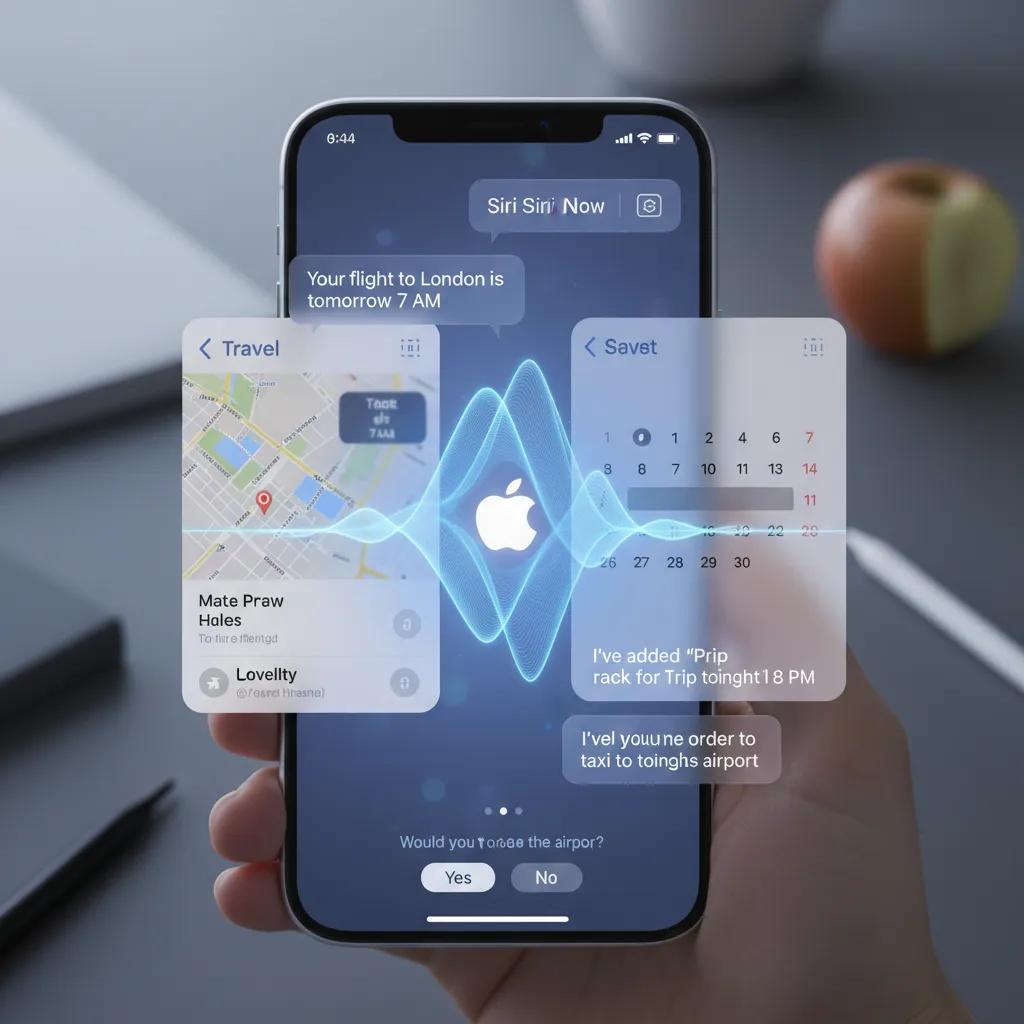
I’m watching Apple’s Siri moment closely because assistants only matter when they understand what’s on my screen and what I’m trying to do next. For years, Siri has been fine for timers and quick facts, but weak at the real work: turning context into action without making me repeat myself.
On-screen awareness in real life
If Siri can “see” what I’m looking at, it can stop guessing. Imagine I’m reading an email about a meeting change. Instead of me copying details into three places, I could say: “Move this to Friday at 2 and tell the group.” That’s the promise of on-screen awareness: fewer steps, fewer mistakes, less app-hopping.
Cross-app flow (calendar → messages → maps)
The best part of cross-app integration is removing the copy-paste gymnastics. In everyday use, I want one request to trigger a chain:
- Update the event in Calendar
- Message attendees in Messages
- Adjust my route in Maps
If Apple gets this right, Siri becomes a true “doer,” not just a voice search box.
Gemini under the hood?
The intriguing bit in the latest AI news is the report that Siri could be powered by Google’s Gemini model—rumored at 1.2 trillion parameters. That’s big partnership energy, and it raises expectations for better reasoning, better language, and better follow-through across apps.
My cautious take
I’m excited, but careful. AI assistants are great until they’re confident-and-wrong in the middle of a busy day. I want Siri to show what it plans to change, ask when it’s unsure, and let me undo actions fast.
Google Gemini 3 Flash: Speed as a Feature (Not a Bonus)
In the latest AI news cycle, I keep seeing a clear theme: speed is becoming the product, not just a nice extra. That’s why a lightweight model like Google Gemini 3 Flash matters. When I’m coding, debugging, or translating a message mid-call, a “smart but slow” model breaks my flow. Low latency help—answers in the moment—often beats a deeper response that arrives too late to use.
Why a lightweight model matters
Lightweight models can run with fewer compute demands, which usually means faster replies and easier deployment. For me, that translates into practical wins: fewer pauses, less context switching, and more “keep going” momentum while I work.
Where I expect Gemini 3 Flash to show up first
- Live translation for calls, travel, and quick chats where waiting is not an option
- Rapid coding assistance inside IDEs: autocomplete, quick fixes, and short explanations
- On-device or near-device helpers for search, notes, and summaries in “don’t make me wait” moments
A practical lens on scaling
We talk a lot about bigger models, but real adoption is shaped by efficiency and deployment limits: battery, bandwidth, cost, and privacy needs. Scaling isn’t only about size—it’s also about how well a model fits into everyday tools without heavy infrastructure.
Wild card scenario: the commute as an AI lab
I can imagine my commute turning into a rolling “AI lab,” where translation, navigation, and work drafts run fast and locally-ish—with only occasional cloud calls. If Gemini 3 Flash lands there, speed won’t feel like a bonus; it’ll feel like the baseline.
AMD Ryzen AI Processors and the Quiet Rise of the NPU
CES season always feels like a gadget carnival, but AMD’s Ryzen AI 400 talk made me think about something less shiny: running AI locally. In a lot of “AI News” coverage, the spotlight stays on big cloud models. Yet the quiet story is the upgraded Neural Processing Unit (NPU) inside everyday laptops, doing more work without sending everything to a server.
What a stronger NPU changes for normal people
When the NPU is better, small AI tasks can happen on-device. That means fewer cloud round-trips and a faster feel in daily apps.
- Real-time translation during calls or meetings, with less lag
- Content creation help (summaries, captions, quick edits) inside local apps
- Background AI features like noise removal or webcam effects without spiking CPU use
The tension: acceleration vs real-world limits
I’m excited about AI hardware acceleration, but I also feel the risk: the party ends fast if battery life drops, thermals get loud, or software support is messy. An NPU is only useful when Windows, drivers, and popular tools actually target it. Otherwise, the workload falls back to CPU/GPU and the “AI PC” label feels thin.
Cloud compute vs on-device AI (quick view)
| Factor | Cloud | On-device (NPU) |
|---|---|---|
| Privacy | Data leaves device | More local control |
| Cost | Usage fees possible | Mostly upfront hardware |
| Responsiveness | Depends on network | Often instant |
Disney Generative AI Integration: Magic, But Operational
I used to think “AI at Disney” meant de-aging actors or making a character talk in real time. But the bigger story in the latest AI news is generative AI integration across operations—unsexy work that can have huge impact. It’s less about a single flashy demo and more about how many small systems get smarter at once.
Where generative AI actually lands
From what I’m seeing in AI news updates, Disney-style adoption tends to cluster in three places: content creation, post-production, and personalized guest experiences. And honestly, it’s probably also a thousand internal tools that never get a press release.
- Content creation: faster concept art, storyboards, and marketing variations for different audiences.
- Post-production: cleanup, localization, and versioning that used to take teams days.
- Guest personalization: smarter recommendations in apps, dynamic itineraries, and tailored offers.
Personalization: helpful… until it’s creepy
My take as a viewer (and a park guest) is simple: personalization is great until it feels like the park knows me better than my friends do. If generative AI starts predicting what I want before I say it, the experience can shift from “magical” to “managed.” That’s where clear consent and data limits matter.
AI isn’t the wand; it’s the stage crew moving sets when nobody’s looking.
That analogy stuck with me because it explains the real value: operational AI makes the show smoother, even when you never notice it.
Weather AI: NOAA Models and DeepMind GenCast Make Forecasts Feel Different
One of the most underrated pieces of latest AI news isn’t a new chatbot feature—it’s weather forecasting models getting faster and sharper. I notice it when I’m planning a weekend hike or a kid’s soccer game, not when I’m scrolling tech blogs.
NOAA: Machine Learning + Physics, Working Together
From what I’ve been following in recent AI updates, NOAA’s direction is practical: use machine learning to speed up parts of the pipeline, while keeping physics-based modeling as the backbone. That mix matters because the atmosphere still follows real rules, but the data is huge and messy. The result is forecasts that can be produced faster, with better detail, without throwing away decades of meteorology.
DeepMind GenCast: Probabilities at High Resolution
DeepMind’s GenCast is the other shift I can actually feel. Instead of giving one “best guess,” it focuses on probabilistic forecasting—high-resolution, medium-range predictions that show what’s likely, not just what’s possible. The big deal is that it can do this with much lower computational power than traditional ensemble approaches, which usually need massive compute to run many simulations.
- Faster runs can mean more frequent updates.
- Sharper local detail helps with real plans, not just headlines.
- Probability helps me decide whether to cancel, delay, or just bring a jacket.
My Small, Annoying Realization
I stopped trusting my weather app years ago; lately, it’s been… oddly right. I don’t love admitting that. But this is what “AI in daily life” looks like: not flashy, just quietly changing how confident I feel about Saturday.
Artificial Intelligence Healthcare: The AI Healthcare Gap and Real Drug Progress
The part that makes me hopeful (and impatient)
In the latest AI news cycle, the healthcare updates are the ones I keep rereading. What makes me hopeful (and impatient) is seeing AI-designed molecules aimed at pancreatic cancer, especially work that targets drug resistance mechanisms. Pancreatic cancer is known for adapting fast, so using machine learning to design compounds that anticipate resistance feels like a real step forward—not just another “AI can predict X” headline.
Why this matters beyond headlines
What stands out in 2026 is that multiple AI-discovered drug candidates are reaching mid-to-late-stage clinical trials. That is a milestone because trials are where ideas get tested against biology, safety, and real patients. It also signals that AI in drug discovery is moving from “promising” to “proven enough to bet on,” at least for some programs.
The uncomfortable counterpoint: the AI healthcare gap
At the same time, I can’t ignore the AI healthcare gap. Top hospitals sprint ahead with better data pipelines, dedicated AI teams, and clearer governance. Smaller clinics often struggle with basic needs: clean data, secure systems, and staff time to adopt new tools.
- Tools: expensive platforms and limited IT support
- Data:
- Governance:
A grounded takeaway
“Machine learning breakthroughs” only count when they survive regulation, workflows, and outcomes.
If an AI system can’t fit into clinical routines—or can’t show better results—it’s not progress yet.
Open Source AI Models vs Agentic AI: Hype Cycles, Useful Niches, and a Tiny Paradox
In the latest AI news, I’m noticing a quiet shift: open-source AI models are getting more practical, not just bigger. Instead of chasing the largest model, teams are shipping smaller, domain-specific models that do real work with less cost and less setup. Models like IBM Granite and DeepSeek keep showing that “small” can still be strong when the training and tools match the job.
Why open source feels more useful in 2026
- Better fit: domain models can be tuned for support, coding, or internal docs.
- Lower friction: easier to run on your own stack, with clearer control over data.
- Surprising quality: they often punch above their weight in narrow tasks.
Agentic AI and the Gartner “trough”
At the same time, agentic AI is heading into what many predict will be the Gartner trough of disillusionment in 2026. Honestly, that might be healthy. Agents are exciting, but real-world use exposes the hard parts: tool failures, messy permissions, and plans that look smart until they hit a weird edge case.
The tiny paradox: digital colleague, unclear accountability
The paradox I keep seeing is simple: we want AI to act like a digital colleague, but we’re still deciding who is accountable when it acts like one.
My rule of thumb: if an agent can’t explain its plan in plain English, it’s not ready to run anything expensive (including my calendar).
When I test agents, I ask for a step-by-step plan first, then I approve actions. If it can’t do that, I treat it like a demo—not a teammate.
Conclusion: What’s Next in AI Is Mostly… Boring (And That’s Good)
When I look across the latest AI news, the pattern is not a single “big bang” moment. It’s a lot of steady, practical change. Assistants like Siri are being pushed to feel more useful in daily life. Speed upgrades like Gemini 3 Flash point to a future where answers arrive fast enough to stay in the flow of work. And local hardware, like Ryzen AI, hints that more tasks will run on-device, with less waiting, less cost, and sometimes better privacy.
On the business side, AI is becoming operations, not just demos. When companies like Disney use AI to support planning, production, or customer work, it signals a shift: AI is moving into the “boring” middle of how organizations run. The same is true for infrastructure stories—better weather modeling, smarter compute use, and efficiency gains that don’t look flashy but matter at scale. And in healthcare, the reality check is healthy: progress is real, but it’s tied to safety, evidence, and workflow, not hype.
To keep myself sane, I’m adopting a simple AI “news diet”: one weekly scan, one deep dive, and one build/test. Anything beyond that is just doomscrolling with smarter headlines.
One wild card thought experiment I can’t shake: if AI becomes a colleague, what’s the etiquette? Do we “onboard” models like humans, set expectations, and define what they should never do?
If you take one action, keep a tiny log of real-world AI uses you notice. The shift from novelty to impact is the actual story.
TL;DR: 2026 AI news isn’t just bigger models—it’s faster, cheaper, more embedded, and more accountable. Expect an AI-powered Siri overhaul, lightweight Gemini 3 Flash use-cases, Ryzen AI NPUs pushing local workflows, big bets in generative AI integration (Disney), serious leaps in weather forecasting (NOAA/GenCast), and a reality-check year for agentic AI hype—plus open-source models quietly winning practical niches.


Comments
Post a Comment