What Is Agentic AI? A Complete Guide for Business Leaders in 2026
Agentic AI is having a moment. If 2023–2024 were the years of copilots that helped you write, summarize, and search, 2026 is shaping up to be the year businesses turn those copilots into agents that can plan, take action, and close the loop on real work.
This guide explains what agentic AI is, why it matters now, how it works under the hood, and how to deploy it safely and profitably in your organization. We’ll cover use cases, architecture, ROI, risks, and a practical rollout roadmap.
Quick definition
Agentic AI refers to AI systems that can plan and execute multi-step tasks toward a goal with minimal human intervention. They:
Interpret goals (natural language or structured prompts)
Break goals into steps and decide what to do next
Use tools (APIs, databases, enterprise apps) to take actions
Learn from feedback, self-critique, or outcomes
Escalate to humans when needed (human-in-the-loop)
Think of agentic AI as the evolution from “autocomplete for knowledge work” to “autonomous task runners” that operate within guardrails and your enterprise stack.
Why agentic AI matters now
Several shifts make agentic AI practical for 2026 roadmaps:
More reliable models and tool use: Foundation models now handle structured tool invocation, function calling, and multi-step reasoning more robustly than early generations.
Enterprise-ready orchestration: Mature frameworks, vector databases, and workflow engines make it easier to connect models to systems of record with auditability.
Better guardrails: Policy engines, red-teaming, and runtime monitors lower operational risk so agents can act safely in production.
Business pressure: Leaders need automation beyond chat to lift margins, speed cycle times, and unlock 24/7 “digital labor” that complements teams.
What agentic AI can actually do
Agentic AI shines where the work involves context, judgment, tool use, and repetitive sequences. Typical enterprise patterns include:
Triage and resolve: Intake, classify, gather context from systems, propose and execute resolutions, escalate exceptions.
Research and synthesis: Search across internal knowledge, compare sources, assemble reports, cite evidence.
Transaction orchestration: Prepare quotes, reconcile invoices, update CRM/ERP, schedule shipments, and confirm outcomes.
Monitoring and follow-up: Watch queues or events, identify anomalies, open tickets, notify stakeholders, and close loops.
Agent vs. copilot: what’s the difference?
Copilot: Assistive, in-the-loop, usually produces content or suggestions for a human to act on.
Agent: Goal-driven, can take actions via tools or APIs, and only asks for help when uncertain or when policies require approval.
Many leaders start with copilots embedded in tools and progress to agents in scoped workflows with clear guardrails.
How agentic AI works under the hood
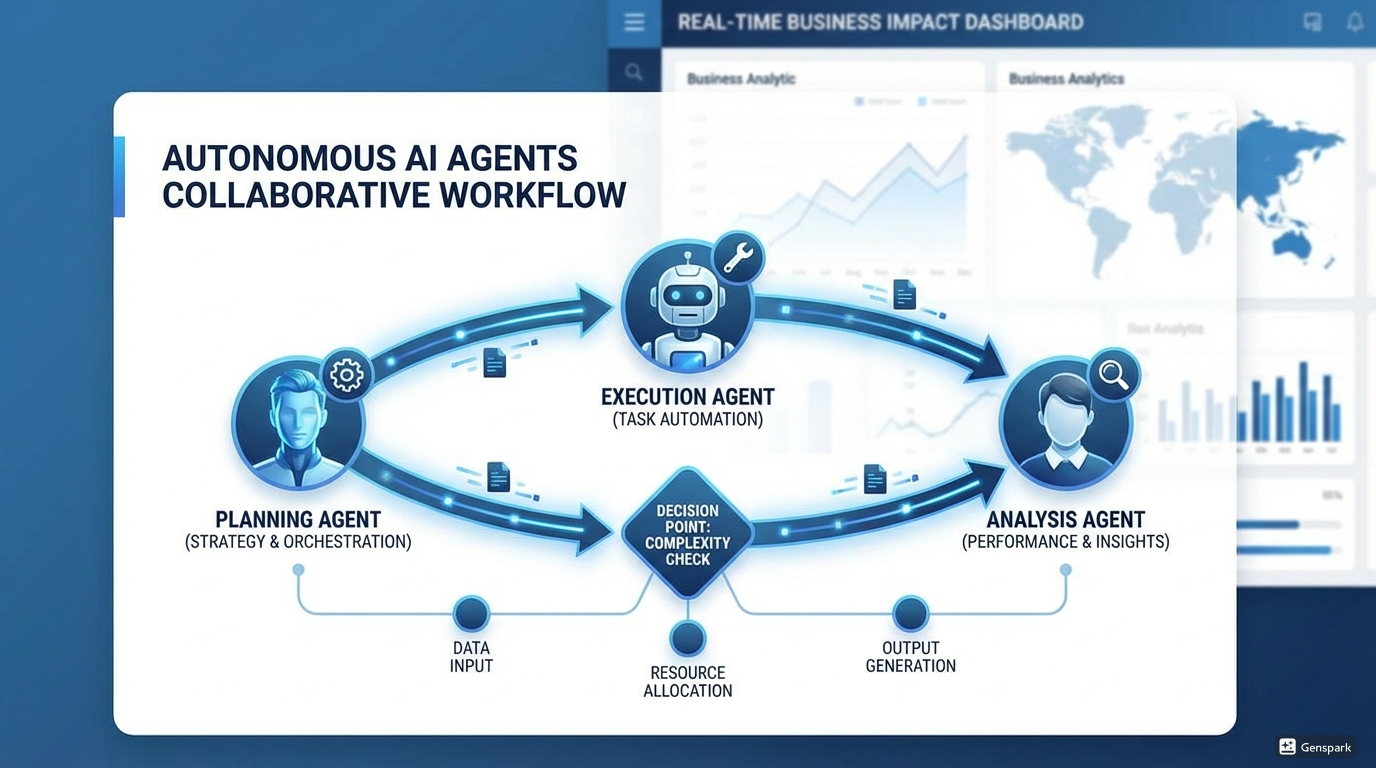
While implementations vary, most agent architectures share these components:
Goal understanding: The agent parses a goal and constraints (SLAs, budget, policy) from natural language or a template.
Planning: The agent breaks the goal into steps, using a planner module or prompting strategy (e.g., chain-of-thought, trees of thought, or a planner-executor loop).
Tool use: The agent calls tools (APIs, RPA, SQL, search, CRM/ERP connectors) through a controlled interface with permissions.
Memory and context: The agent uses short-term scratchpads and retrieves long-term context (knowledge base, past tasks) via a vector database.
Reflection and learning: The agent critiques outputs, checks against constraints, and adapts its plan. Some systems learn from feedback or outcomes across runs.
Human-in-the-loop: Policies determine when to request approval, hand off to a human, or collect labeled feedback.
Governance and observability: Logging, evaluations, safety filters, rate limits, and kill switches keep the system safe and accountable.
A simple architecture might look like this in words:
User or system sets a goal → Planner proposes steps → Executor runs steps using tool adapters → Validator checks results & policies → If flagged, request human review; else continue → Logger records all actions → Monitor triggers alerts if anomalies or budget limits exceed thresholds.
Key capabilities to understand
Planning and decomposition: Turning high-level goals into ordered tasks plus contingencies.
Tool affordances: Knowing which tools to use when; mapping actions to permissions and data scopes.
Retrieval-augmented generation (RAG): Pulling relevant knowledge just-in-time to ground decisions.
State management: Keeping track of progress, context, and outcomes across steps or days.
Multi-agent collaboration: Specialized agents (researcher, planner, executor, reviewer) working together under an orchestrator.
Guardrails and policy enforcement: Pre-, mid-, and post-action checks to avoid unsafe or noncompliant actions.
Where agentic AI creates value: enterprise use cases
Below are pragmatic, near-term patterns executives are funding in 2026. Each can start as a pilot and scale.
Customer operations
Intelligent case resolution: Agents triage tickets, pull account history, propose fixes, execute standard changes (e.g., refunds or credit memos within limits), and follow up with customers.
Knowledge deflection: Agents maintain help-center content by monitoring gaps in search queries and drafting articles for approval.
Proactive support: Agents monitor telemetry and open cases before customers notice issues.
Revenue and growth
Sales ops assistant: Agents qualify leads, enrich accounts, draft outreach tailored to industry, and log activities in CRM.
Quote-to-cash: Agents prepare quotes from catalogs and pricing rules, validate terms, and route for approvals.
Marketing content supply chain: Agents generate first drafts, localize content, ensure brand and compliance checks, and schedule distribution.
Supply chain and operations
Purchase order automation: Agents reconcile POs against invoices and delivery notes, raise disputes, and update ERP.
Inventory balancing: Agents watch stock and lead times, propose transfers or expedite requests within budget constraints.
Logistics exception handling: Agents rebook shipments after delays, notify partners, and update tracking.
Finance and risk
Close acceleration: Agents collect missing entries, reconcile accounts, and flag anomalies for human review.
Expense compliance: Agents check claims against policy, auto-approve low-risk ones, and escalate edge cases.
Claims processing (insurance): Agents verify coverage, gather documentation, propose decisions, and issue payments in low-risk cases.
HR and IT
Recruiting coordination: Agents screen resumes against role criteria, schedule interviews, and manage candidate communication.
IT service desk: Agents resolve common requests (password resets, access provisioning) and open tickets with full context for complex issues.
Onboarding: Agents orchestrate tasks across departments and confirm completion.
Illustrative case snapshots
To ground the possibilities, here are anonymized scenarios. These are illustrative examples used in enterprise planning; actual results will vary by context.
Global retailer, customer service: An agent triages emails, queries order systems, and issues partial refunds up to a set limit, escalating when policies trigger. Outcome after pilot: 35% faster resolution for low-complexity cases and higher CSAT on those tickets due to faster responses (illustrative).
B2B SaaS company, sales ops: An agent enriches accounts, drafts first-touch messages, logs interactions, and books discovery calls through a calendar API. Outcome after pilot: 20% more qualified meetings per rep with similar effort (illustrative).
Regional insurer, claims: An agent verifies policy, checks incident metadata, requests missing docs, and proposes a payout bracket for adjuster approval. Outcome after pilot: 25% reduction in cycle time for low-severity claims (illustrative).
Build vs. buy: how to choose
Most enterprises blend in-house orchestration with vendor capabilities.
Buy when: You need out-of-the-box vertical workflows (e.g., claims, service), tight SaaS integrations, and regulated features (audit trails, role-based approval, policy packs).
Build when: Your processes are highly bespoke, competitive advantage lives in your data and tools, or you want deep control of safety, cost, and performance.
Hybrid approach: Use a commercial agent platform for orchestration and governance, but build custom tools, prompts, and evaluators around your data and policies.
Key vendor evaluation criteria:
Security and compliance: SOC 2/ISO 27001 posture, data residency options, SSO/SCIM, private networking, key management.
Governance features: Policy engine, human-in-the-loop controls, granular permissions, action budgets, audit logs, and simulation environments.
Tooling ecosystem: Prebuilt connectors for your CRM/ERP/ITSM, support for custom APIs, event-driven triggers.
Observability: Traces, cost/latency dashboards, task success analytics, and drift detection.
Model flexibility: Ability to bring your own model (BYOM), switch providers, and use small, cost-effective models for simple steps.
Total cost of ownership: Transparent pricing for inference, storage, orchestration, monitoring, and egress.
The economics: modeling cost and ROI

Before you scale, model both unit economics and strategic value.
Cost components:
Model inference: Token usage or per-call pricing across planning, tool selection, and generation steps.
Orchestration: Platform fees, serverless execution, queues, and data transfer.
Data layer: Vector databases, feature stores, storage, and backups.
Tool calls: API fees for third-party services (e.g., enrichment, search, RPA).
Safety and monitoring: Evaluation runs, red-teaming, logging, and alerting.
People: AgentOps engineers, AI product managers, prompt/tool developers, and reviewers.
Value levers:
Throughput and cycle time: Faster case resolution, order processing, or time-to-quote.
Quality and compliance: Fewer errors, better documentation, consistent policy enforcement.
Coverage: 24/7 operation, lower abandonment, and long-tail task coverage.
Employee experience: Reduced toil, more time on high-value work, lower burnout.
Suggested KPIs:
Task success rate (automatic vs. human-assisted)
Human override/approval rate (should drop with maturity)
Average handling time and queue time
Cost per resolved task (vs. baseline)
Error/exception rate and rework
Customer outcomes (CSAT, NPS, retention for relevant workflows)
Risk, compliance, and safety by design
Agentic AI changes your risk surface because systems take actions, not just generate text. Put safeguards in at multiple layers.
Identity and permissions: Use least privilege and role-based access. Grant agents only the scopes they need per workflow.
Policy guardrails: Hard rules (never wire funds above X without approval), soft rules (brand tone), and dynamic constraints (budget/time/region).
Human-in-the-loop: Approval gates for high-impact actions, canary releases, and progressive trust models.
Observability and audit: Log every decision, prompt, tool call, and outcome; ensure exportable, immutable audit trails.
Safe execution: Sandboxes, allowlists, idempotent operations, and rollback plans for external actions.
Testing and evaluation: Pre-deployment simulations, scenario libraries, adversarial prompts, and ongoing regression tests.
Incident response: Playbooks for disabling agents, revoking keys, and communicating impact.
Compliance frameworks to anchor your program:
NIST AI Risk Management Framework (AI RMF): For risk identification, measurement, and mitigation.
ISO/IEC 42001 (AI management systems): For governance, roles, and process discipline.
Privacy regulations: GDPR/CPRA for personal data handling, minimization, and consent.
Sector guidance: Model risk management in financial services, medical device rules in healthcare. Engage counsel early.
Note: Regulatory timelines and obligations evolve. Work with legal and risk partners to map agent workloads to applicable requirements in your jurisdictions.
From pilot to production: a pragmatic 90-day plan
Days 0–15: Align and scope
Pick one workflow with clear boundaries, measurable outcomes, and accessible data (e.g., support refunds under a set limit).
Define success: baseline metrics, target KPIs, constraints, and compliance requirements.
Form the team: AI product manager, process owner, AgentOps engineer, data/ML engineer, domain reviewers, and a security partner.
Days 16–45: Build and validate
Connect tools: Read-only first, then write actions behind approval gates.
Design policies: Hard stops for risky actions, approval rules, rate limits, and action budgets.
Implement evaluations: Golden tasks, test suites for safety, accuracy, and policy adherence.
Shadow mode: Run the agent in parallel, compare outputs to human decisions, and refine prompts/tools.
Days 46–75: Pilot with humans in the loop
Enable limited write actions with approvals.
Track KPIs: success rate, override rate, cost, and time-to-resolution.
Collect feedback from agents’ “customers” (internal teams or end users) and improve loops.
Days 76–90: Harden and decide
Security review: Pen tests on tool endpoints, secrets management, and auditability.
Reliability: Incident playbooks, SLOs, retries/backoffs, and fallback behaviors.
Go/no-go: If KPIs meet thresholds and risks are controlled, expand scope gradually.
Operating model: who does what

Roles you’ll likely need:
AI product manager: Owns outcomes, backlog, and stakeholder alignment.
AgentOps engineer: Builds orchestration, tool adapters, and observability.
Prompt/tool developer (“toolsmith”): Designs prompts, schemas, and tool contracts.
Evaluations engineer: Curates test sets and builds automated evals.
Domain reviewers: Approve edge cases and provide feedback.
Safety and compliance lead: Defines policies, audits logs, and triages incidents.
Rituals to institutionalize:
Weekly reviews of agent metrics and exceptions.
Change management for prompts, policies, and tools (with rollback).
Quarterly red-teaming and scenario drills.
Technical checklist for leaders
Data readiness: Do we have clean, accessible knowledge (docs, FAQs, playbooks) and appropriate retrieval for grounding?
Tools and permissions: Are critical actions available as APIs with least-privilege keys and audit logs?
Model strategy: Which models for planning vs. execution? Do we need small, fast models for simple steps and larger models for complex reasoning?
Evaluation strategy: What test sets and acceptance criteria define “good” for each workflow?
Cost controls: How are we budgeting tokens, tool calls, and retries? Do we have per-agent action budgets?
Security posture: How do we isolate agents, secrets, and data flows? Do we have kill switches and rate limits?
Architecture patterns you’ll encounter
Planner–executor loop: One agent plans, another executes, with periodic self-critique.
Multi-agent specialization: Dedicated agents for research, planning, execution, and review under an orchestrator.
Event-driven agents: Triggered by messages, webhooks, or scheduled jobs; maintain state across time.
Retrieval-centric agents: Heavy use of RAG to ground actions in enterprise knowledge.
Human-in-the-loop gateways: Policies route specific steps to approvers, then resume automation.
Evaluating agent quality: beyond accuracy
Traditional “accuracy” isn’t enough because agents act. Evaluate across:
Task success and end-to-end outcomes
Policy adherence and safety incidents
Calibration: Does uncertainty cause appropriate deferrals to humans?
Efficiency: Steps taken vs. minimal steps; cost and latency per step
Robustness: Behavior under noisy inputs, missing data, and tool failures
Build an evaluation harness that runs daily against regression suites and real-world samples. Treat agents like products with SLAs.
Common pitfalls and how to avoid them
Over-scoping v1: Start with a narrow workflow where agents can win quickly; add complexity later.
Tool deserts: If critical systems lack APIs or clear contracts, the agent will stall. Prioritize tool enablement.
Unbounded autonomy: Always enforce budgets, rate limits, and approval gates for high-impact actions.
Knowledge drift: Keep retrieval sources fresh; agents can make outdated decisions if knowledge bases are stale.
Hidden costs: Logging, evaluations, and monitoring are essential—budget for them up front.
Shadow IT agents: Centralize governance so teams don’t deploy unsanctioned agents with production access.
The maturity roadmap: from copilots to autonomous workflows
Level 0: Copilots only
Assistive suggestions, content drafting, and search. No actions.
Level 1: Agents with approvals
Agents propose actions and request sign-off for execution. Strong evaluation and logging.
Level 2: Semi-autonomous agents
Agents execute low-risk actions within limits, escalate exceptions. Clear SLAs and rollback paths.
Level 3: Autonomous segments
End-to-end workflows automated with outcome guarantees, continuous monitoring, and periodic audits. Humans focus on exception handling and optimization.
Most organizations will operate across levels simultaneously depending on risk and complexity.
Frequently asked questions (for leadership teams)
Q: Will agents replace jobs?
Agents automate tasks, not entire roles. They augment teams by taking over repetitive sequences so people can focus on judgment, relationships, and innovation. Expect role redesign, not wholesale replacement.
Q: How do we keep agents from going off the rails?
Use strict tool allowlists, role-based credentials, approval gates, action budgets, and real-time monitoring. Start in sandboxes, then canary into production.
Q: How do we explain decisions to auditors?
Log prompts, retrieved context, plans, tool calls, results, and approvals. Summarize runs into human-readable decision records.
Q: Which model should we use?
Match model to task: smaller, faster models for routine classification and tool selection; larger models for complex planning and reasoning. Keep the option to swap as models and economics evolve.
Q: What about data privacy?
Keep sensitive data in your control; prefer providers that support data isolation, do not train on your inputs by default, and offer region controls. Minimize data passed to models and redact where possible.
A short glossary
Agent: An AI system that can plan and act toward a goal using tools.
Tool: An external capability the agent can call (API, database query, RPA action).
Orchestrator: The runtime that coordinates planning, tool calls, and policies.
RAG: Retrieval-Augmented Generation; grounding outputs in relevant documents or data.
Human-in-the-loop (HITL): A human approval or review step during execution.
Policy engine: A rule layer that constrains agent behavior.
Make 2026 your year of responsible autonomy
Agentic AI turns “chatty” assistants into reliable doers. For leaders, the opportunity is to target high-friction workflows, equip agents with the right tools and guardrails, and manage them like products with clear metrics and SLAs. Start narrow, build trust with approvals and audits, and scale where the economics and risk profile make sense.
The playbook is straightforward: pick a bounded use case, stand up the technical and governance foundations, run a disciplined pilot, and let results—not hype—pull you forward. Done well, agentic AI will reduce cycle times, boost quality, and free your teams to focus on the work only humans can do.


Comments
Post a Comment