Semrush, Ahrefs & Moz: AI SEO Tool Face-Off
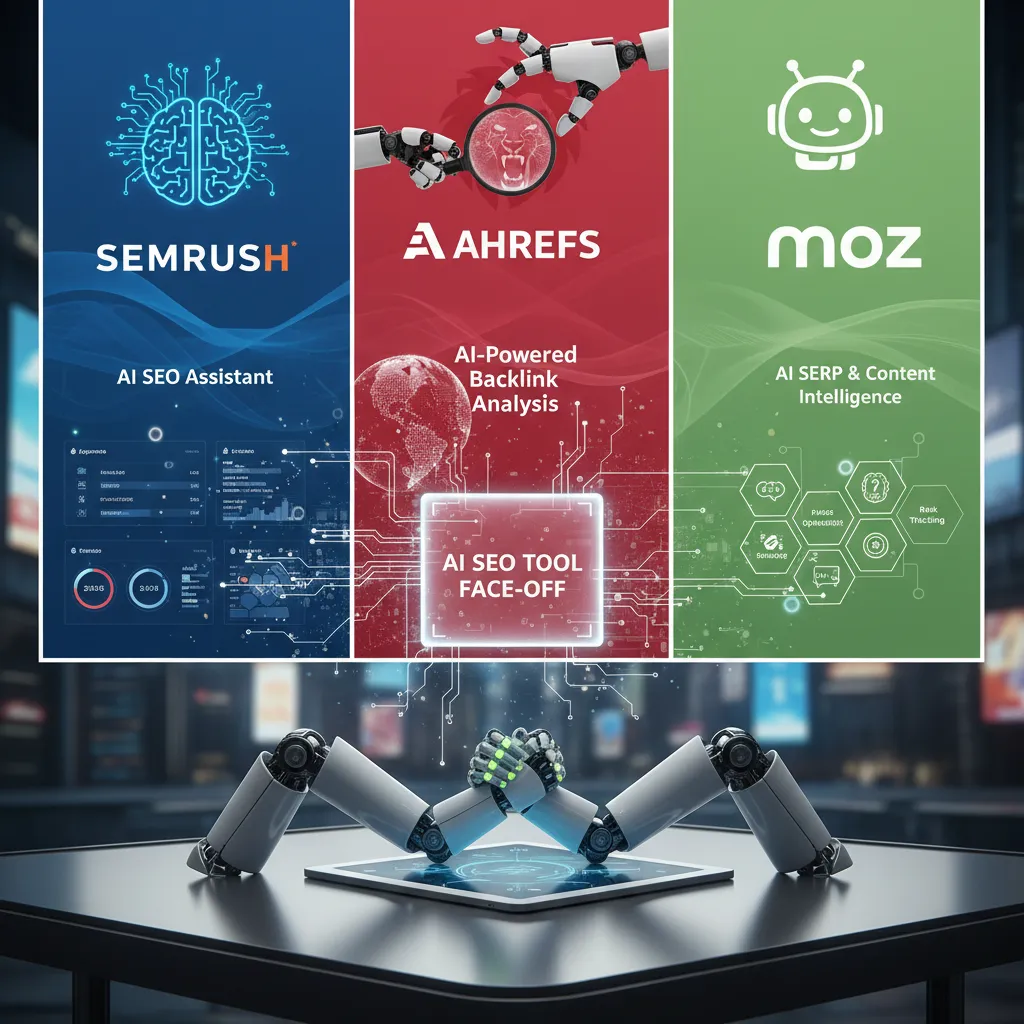
The first time I tried to “do SEO with AI,” I didn’t start with a grand strategy—I started with panic. A client asked why their organic traffic dipped, and I had three tools open, each confidently telling a different story. Semrush waved a competitor analysis report like a courtroom exhibit. Ahrefs pulled up a backlink analytics graph that looked like a heart monitor. Moz, politely, suggested I fix a few basics and go outside. That week is basically what this post is: not a lab test, but a lived-in comparison of Semrush, Ahrefs, and Moz—where AI features help, where they don’t, and which tool I reach for depending on the problem in front of me.
1) My “Battle SEO” moment: why AI isn’t the decider
My first real Semrush vs. Ahrefs vs. Moz “battle” happened on a normal workday: three tabs open, one deadline, and one simple goal—make a smart SEO call fast. I expected the “best” AI SEO tool to win. Instead, I learned the tool doesn’t decide. The question does.
I treat it like a workflow problem
Before I click anything, I ask myself what I’m trying to answer:
- Traffic potential: Is this keyword worth writing for?
- Broken technical SEO: What’s stopping pages from ranking?
- Who’s stealing my SERP: Which competitor is taking clicks and why?
My quick gut-check list
When tools disagree, I run a fast checklist that keeps me honest:
- Speed to insight: How quickly do I get a usable direction?
- Confidence in data freshness: Does it feel current enough to act on?
- Explainability: Can I explain the result to a non-SEO without a 10-minute lecture?
Three tabs, three narratives
That day, each platform told a different story. One made keyword research feel obvious, another made backlink gaps jump out, and the third gave me a cleaner way to talk about priorities. The “winner” changed depending on whether I needed keyword ideas or link evidence. That’s why I don’t crown a single champion tool—I match the tool to the job.
AI in SEO is usually assisted analysis and pattern-spotting, not magical rankings.
The flashlight analogy I use
I think of SEO tools like flashlights. Brightness matters, but beam shape matters more. A wide beam helps you scan topics fast. A narrow beam helps you inspect link profiles or technical issues with detail.
My comparison lens
For the rest of this face-off, I judge Semrush, Ahrefs, and Moz through the same practical categories: Keyword Research, Backlink Analysis, Site Audit, Rank Tracking, Competitor Research, plus Features and Pricing.

2) Key Features I actually touch daily (not the brochure)
Semrush Suite: my “one tab for everything” workflow
When I’m juggling SEO, paid search, and content at the same time, I treat Semrush like an all-in-one digital marketing suite. I’m not opening it for one shiny AI feature—I’m opening it because it connects the dots across channels. In a normal day, I bounce between keyword research, competitor checks, and quick PPC reality checks without switching tools.
- SEO + PPC in one place when I need to align organic and paid intent
- Content tools for briefs, on-page checks, and “did we cover the topic?” audits
- Social scheduling/monitoring when the campaign isn’t SEO-only
Ahrefs: my Site Explorer habit
Ahrefs is where I go for fast, confident scans. I live in Site Explorer to sanity-check what’s real before I promise results. If a page looks strong, I want to know why—links, top pages, and what keywords are actually driving visibility.
- Quick scans of a domain or URL to spot strengths and weak spots
- Content gap checks to see what competitors rank for that we don’t
- Traffic potential checks so I don’t over-sell a keyword that can’t deliver
Moz Pro: calm UI + a shared language
Moz Pro has a calmer interface, which makes onboarding easier when I’m working with a new teammate or client. And yes, I still use Domain Authority as a lingua franca—especially when stakeholders want one simple metric to compare sites, even if it’s not the whole story.
What “AI” feels like in these tools
In this AI SEO tools compared face-off, AI mostly shows up as suggestions, clustering, and prioritization. It’s helpful when it matches my intent, and annoying when it pushes generic advice.
AI is best when it speeds up decisions, not when it replaces them.
Tiny tangent: the feature I wish all three shared
I want a one-click “explain this” button that translates metrics and recommendations into plain English—no robot legalese, no vague scoring, just clear cause-and-effect.
3) Backlink Analysis: the ‘Backlink Database’ reality check
When people say an AI SEO tool has a “huge backlink database,” I treat it like a reality check, not a brag. In backlink analysis, coverage and freshness decide how much I trust what I’m seeing—especially when rankings dip or a competitor suddenly jumps.
Ahrefs: database size = confidence when things break
Ahrefs is the tool I lean on when I need high confidence in my diagnosis. If I’m investigating a traffic drop, I want to know whether I lost a key link, got hit with spam, or simply missed a new mention. The stat that sticks with me is that Ahrefs reports indexing 12+ trillion links and updating every 15–30 minutes. That freshness matters when a big link lands and I need to confirm it fast—before I change my plan based on old data.
Semrush: strong context for competitors and outreach
Semrush backlink analytics feels strongest when I’m pairing SEO with broader campaigns. I use it to map competitor link sources, spot patterns by category, and pull outreach context (who links, what pages earn links, and what content angle is working). If I’m running PR + SEO together, Semrush helps me connect backlinks to the bigger marketing story.
Moz Link Explorer: simpler, easier to teach
Moz Link Explorer is solid and more straightforward. I use it when the goal is understanding, not exhaustive link mining. It’s easier to explain to a client or a new teammate: what a linking domain is, why anchor text matters, and how authority signals generally work.
Practical scenario: is a “link spike” good or bad?
When I see a sudden spike, I check anchor text patterns and the linking pages. My quick checklist looks like this:
- PR spike: branded anchors, real publications, varied URLs
- Spam spike: exact-match anchors, weird TLDs, thin pages
- Legit mention: relevant sites, natural anchors, steady growth
In backlink analysis, the “best” tool is the one that shows the most accurate story right now.

4) Keyword Research & Keyword Explorer: chasing intent, not just volume
When I compare Semrush, Ahrefs, and Moz for AI SEO work, I’m not trying to “win” the biggest keyword list. I’m trying to match search intent so the page earns clicks, not just impressions.
Semrush: intent labels + CPC context
Semrush keyword research is my go-to when I’m planning content and paid together. I like its search intent labels (informational, commercial, transactional, navigational) because they help me decide if I should write a guide or build a landing page. The CPC and ad competition data also give me quick “money signals.” And the global databases are useful when I’m mapping topics across countries, not just the US.
Ahrefs: the click-based lens
Ahrefs Keyword Explorer saves me from writing “high-volume” posts that nobody clicks. I lean on its clicks and traffic potential to size a topic based on what the top-ranking page can realistically get. For AI keywords, this matters because SERPs often answer questions directly, which can reduce clicks.
Moz: friendly, but I hit the ceiling
Moz Keyword Explorer feels the most beginner-friendly to me. It’s clean, easy to scan, and great for learning prioritization. But when I’m hunting deep long-tail niches, I feel the ceiling—Moz tracks about 500 million keywords, so I sometimes run out of variations compared to the other two.
My messy method (that works)
- Start broad with a seed topic (example: AI SEO tools).
- Refine by SERP reality: I check what’s actually ranking and what formats win (list posts, product pages, templates).
- Decide the page type: content piece vs. landing page, based on intent and competition.
Hypothetical pick: volume vs. clicks
If I’m choosing between “AI SEO checklist” (higher volume) and “AI SEO audit template” (lower volume), Ahrefs might show the checklist SERP has low clicks because Google answers it fast. The template keyword may have fewer searches, but stronger clicks and clearer intent—so I’d build a downloadable landing page and support it with a short guide.
5) Site Audit & Technical SEO: where the boring stuff pays rent
When people ask me where AI SEO tools really earn their keep, I point to site audits. Keyword ideas are fun, but technical SEO is what keeps pages crawlable, indexable, and fast. In this Semrush vs. Ahrefs vs. Moz comparison, audits are where the “boring” work turns into rankings you can actually hold.
Semrush Site Audit: exhaustive, but organized
Semrush Site Audit gives me the most “full inspection” vibe. It finds a lot—sometimes a lot—but the best part is how it prioritizes issues. That helps me sequence fixes without drowning in warnings. I treat it like a project plan: start with the highest impact items, then work down.
Ahrefs Site Audit: fast reality check
Ahrefs site checks feel like my quick “is the house on fire?” scan. I run it when I want a fast read on broken pages, redirects, and obvious crawl problems. If it flags something serious, I’ll dig deeper elsewhere (or rerun a more detailed crawl) before I assign work.
Moz audits: simple enough to run weekly
Moz audits are simpler and less intimidating, and that can be a feature. If you’re just building the habit of regular audit runs, Moz makes it easier to stay consistent. I’ve seen teams actually fix more because the report feels doable.
My rule of thumb for technical fixes
- Indexing & crawlability first (robots, noindex, canonicals, sitemap issues)
- Speed & UX next (slow templates, heavy scripts, mobile problems)
- On-page polish last (thin pages, duplicate titles, missing headings)
Mini confession: I sometimes export the audit, delete half the warnings, and only send what the team can realistically do this sprint.
That’s also where the “AI” part helps me: not by magically fixing technical SEO, but by helping me triage, explain impact in plain language, and keep the backlog focused.

6) Rank Tracking & Competitor Research: the Monday-morning dashboard test
On Monday mornings, I don’t want a single rank number that makes me panic. I want trend + context: what moved, how much, and what else changed around it. That’s where AI SEO tools can help—if the dashboard tells a story instead of just reporting positions.
Rank tracking: trend beats “one keyword, one number”
My baseline check is simple: Are we generally up, down, or flat? Then I look for clusters (pages, topics, or intent groups) so I can act fast. The best rank tracking view for me includes:
- Visibility trend over time (not just today vs. yesterday)
- Winners/losers with the landing page attached
- SERP context (features, intent shifts, and new competitors)
Semrush competitor research: fast “market visibility” vibes
When I’m doing agency-style reporting or supporting a business team, Semrush is the tool I open for quick comparisons. I can size up competitors, see overlap, and get a “share of voice” feel without building a custom spreadsheet. I also like the tie-ins to paid search, because organic and PPC often react to the same SERP changes.
Ahrefs competitor analysis: content gaps + links, answered
If the question is “Who’s outranking me and why?” I lean on Ahrefs. I use it to spot content gaps (topics they cover that I don’t) and to sanity-check link strength. For AI-driven SEO planning, this is where I connect the dots between:
- Missing pages or weak sections
- Backlink patterns that support their rankings
- Which URLs are actually winning (not just domains)
Moz rank tracking: clean, teachable, less noisy
Moz feels straightforward. When I’m teaching a team to build a reporting rhythm, I like that it’s easier to stay consistent: check the trend, review key pages, log actions, repeat.
Wild-card: Google rewrites titles again
If Google starts rewriting titles at scale, I want the tool that helps me spot the pattern fastest: sudden CTR drops, page-level shifts, and SERP snippet changes. In practice, I catch it quickest by pairing rank trend with page-level SERP review—then confirming in Search Console.
7) Features Pricing: what I’d pay if it were my own card (it is)
When I compare Semrush vs. Ahrefs vs. Moz as AI-powered SEO tools, I don’t start with the sticker price. I start with a simple question: how many jobs does this tool replace, and how often will I actually open it? A cheaper plan that I never use is still expensive. A higher-priced tool that becomes my daily workflow can be a bargain.
Semrush pricing starts at $139.95/month, and it feels built for people who want a “one dashboard” setup. If I’m doing SEO research, content planning with AI help, PPC checks, competitor tracking, and client-ready reporting, Semrush can replace multiple subscriptions. That’s when I’m comfortable paying more, because it reduces tool-hopping and makes reporting faster.
Ahrefs Lite starts at $129/month, and I justify that cost when backlinks are the growth engine. If link building is central to my strategy—finding link gaps, checking referring domains, and monitoring new/lost links—Ahrefs earns its spot. For me, it’s less about having every marketing feature and more about having the cleanest link and competitor data I can act on quickly.
Moz has a more affordable entry point starting at $49/month, with Moz Pro plans starting at $99/month. That’s a gentler ramp if I’m newer to SEO or I’m managing a smaller site and want solid keyword tracking, on-page guidance, and a simpler interface. It’s also easier to “grow into” without feeling locked into a heavy platform.
My personal heuristic is simple: if a tool saves me 2–3 hours per month in reporting, research, or cleanup work, it’s paying for itself. Time is the real budget line.
My closing thought is that the “best” pick changes as your SEO maturity changes. I’d start simple, learn what moves rankings, then specialize—adding the tool that matches the work I’m doing most often right now.
TL;DR: If you live in backlinks and link building, I keep coming back to Ahrefs (huge backlink database, frequent updates). If you need an all-in-one SEO tools + PPC tools + content workflow, Semrush is the “Swiss Army” pick. If you want beginner friendly SEO with Domain Authority and a simpler UI (and lower entry pricing), Moz is a calmer starting point—just expect lighter long-tail keyword coverage.


Comments
Post a Comment