Salesforce Einstein vs HubSpot AI: 2025 Verdict

I remember the first time I let an AI suggest an email subject line for a big campaign. It saved me 20 minutes and a frayed brow. Fast forward to 2025 and that little boost has become full-blown automation wars between Salesforce Einstein and HubSpot AI. In this piece I walk through features, numbers, and the odd anecdote from my own trials to help you decide which CRM AI actually wins for your team.
1. Head-to-Head: Features and AI Capabilities (Salesforce Einstein vs HubSpot Breeze)
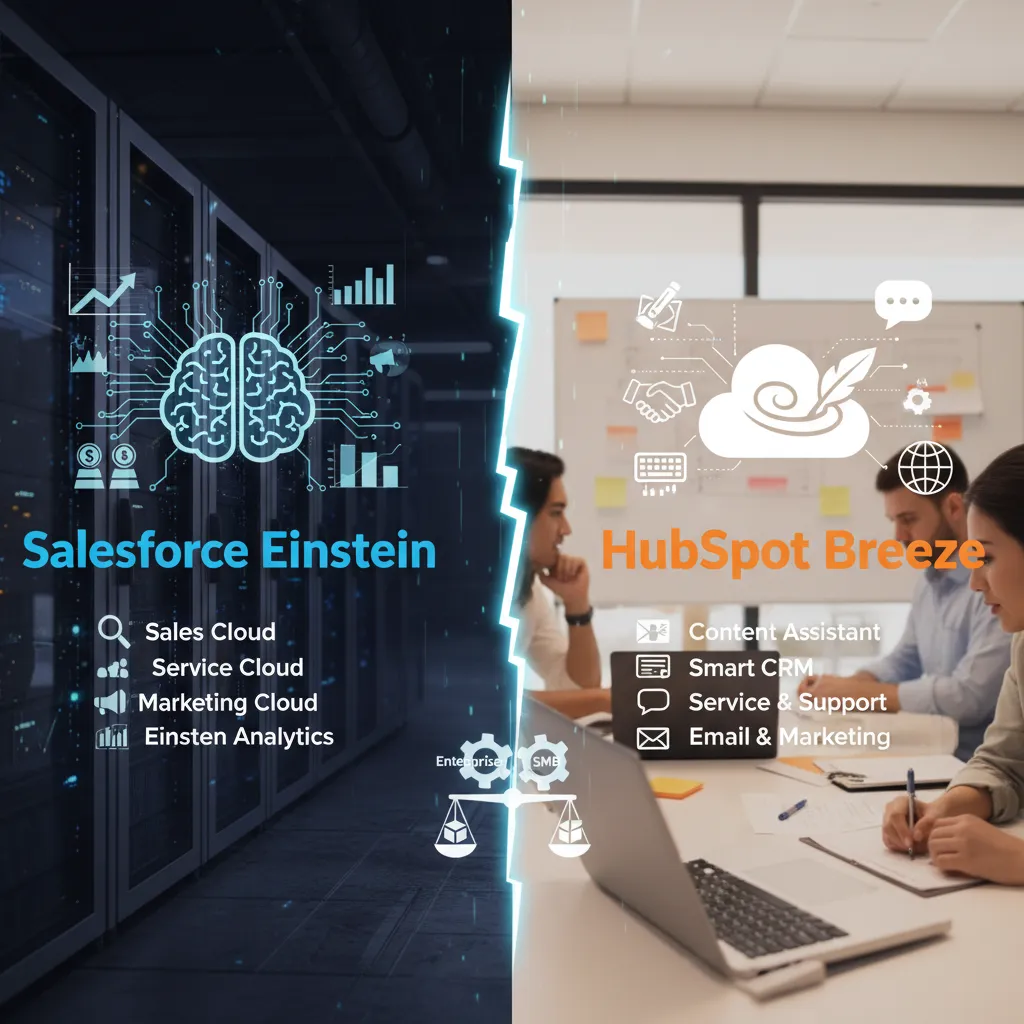
When I compare Salesforce Einstein and HubSpot Breeze in 2025, I see two very different ideas of “CRM AI.” Einstein is built for teams that want deep control: custom setups, complex data, and serious forecasting across regions and business units. Breeze is built for teams that want fast wins: content help, smart suggestions, and quick deployment without a long AI project.
Core strengths: enterprise depth vs instant utility
- Salesforce Einstein: Best when I need enterprise customization, multi-region forecasting, and complex integrations across tools and data sources. It’s designed to work with large pipelines, layered permissions, and advanced reporting needs.
- HubSpot Breeze: Best when I want content assistance, workflow suggestions, and rapid deployment. It’s very marketing-friendly and tends to feel “ready on day one” for common CRM tasks.
Feature highlights (what each AI does best)
Both platforms cover the basics—like lead scoring and pipeline insights—but they shine in different places.
| Capability | Salesforce Einstein | HubSpot Breeze |
|---|---|---|
| Lead scoring | Strong for complex sales orgs; can align scoring with large datasets and custom fields. | Simple to activate and use; great for quick prioritization in smaller-to-mid teams. |
| Opportunity insights | Deeper pipeline analytics, risk signals, and forecasting support across segments/regions. | Helpful prompts and next-step suggestions that keep reps moving fast. |
| Predictive analytics | More advanced when I need forecasting and performance analysis at scale. | More lightweight; focuses on practical guidance rather than heavy modeling. |
| AI Copilot tools | Einstein Copilot-style assistance can support sales/service actions inside Salesforce workflows. | Breeze-style assistance is strong for writing, summarizing, and speeding up CRM work. |
| Data integrations | Data Cloud integrations help unify customer data for richer insights and automation. | Typically easier setup; connects quickly for common marketing and CRM needs. |
| Content assistant | Useful, but not the main reason I pick Einstein. | A standout: email, landing page, and campaign content support is a core strength. |
How I think about “fit” in real teams
If my org has multiple regions, complex product lines, or strict reporting needs, Einstein’s advantage is that it can match that complexity. If my goal is to help marketing and sales ship better emails, follow-ups, and workflows quickly, Breeze feels more direct and less heavy.
Quick takeaway: If you want custom models and deep pipeline analytics, pick Salesforce Einstein. If you want instant utility and marketing-friendly tools, pick HubSpot Breeze.
2. Performance & ROI: Metrics That Matter (Predictive Analytics, Win Rates, Time Savings)
Predictive analytics: what “better” looks like in real work
When I compare Salesforce Einstein and HubSpot AI (Breeze) in 2025, I focus on one thing: does the AI change outcomes—not just create nicer dashboards. Predictive analytics matters when it helps me prioritize the right deals, reduce admin work, and move faster from lead to close. In practice, that means looking at time saved, win-rate lift, and speed-to-resolution in service.
Hard numbers I use to judge ROI
- Salesforce Einstein: trials and reports commonly cite sellers saving 3.5 hours per day through automation and AI assistance. On the service side, Einstein-powered workflows are reported to close service chats 80% faster.
- HubSpot AI (Breeze): HubSpot-shared data says 76% of sales pros spend more time selling, and 73% report improved win rates using Breeze.
My takeaway: Einstein’s headline value often shows up as time compression (hours back, faster service). Breeze’s headline value shows up as seller effectiveness (more selling time, better win rates).
Translate time savings into dollars (simple scenarios)
I like to model ROI with conservative assumptions. Here’s a quick way to think about it: time saved × fully loaded hourly cost becomes capacity you can reinvest into pipeline, customer calls, or support coverage.
| Scenario | AI metric applied | Assumption | What it can mean |
|---|---|---|---|
| SMB sales team (5 reps) | Einstein: 3.5 hours/day saved | 220 workdays/year; $60/hour loaded cost | ~$231,000/year in reclaimed selling capacity (5×3.5×220×$60) |
| Enterprise sales org (100 reps) | Einstein: 3.5 hours/day saved | Same math; $80/hour loaded cost | ~$6.16M/year capacity (100×3.5×220×$80) |
| Support team (20 agents) | Einstein: 80% faster chat closure | If chats average 10 min, new avg ~2 min | More coverage per agent; shorter queues; lower cost per ticket |
Win-rate lift: how I estimate revenue impact
HubSpot’s Breeze data is especially useful when I’m forecasting revenue. If 73% of users report improved win rates, I test a modest lift in my model—say +2 to +5 points—and apply it to qualified pipeline.
- If an SMB has $200k in monthly qualified pipeline and improves win rate by +3 points, that’s roughly $6k/month in additional closed revenue (
$200,000 × 0.03), before margin. - At enterprise scale, the same lift on $5M monthly pipeline is $150k/month (
$5,000,000 × 0.03).
For me, the best “performance” metric is the one I can tie directly to either more selling hours, higher win rates, or lower service cost per interaction—because those are the levers that show up fastest in ROI.

3. Implementation, Pricing, and Who Should Buy (Setup Time, Licensing, Enterprise Integration)
Setup Time: How Fast You Can Get Value
In my experience, the biggest difference between HubSpot AI (Breeze) and Salesforce Einstein is how quickly you can go from “we bought it” to “we’re using it daily.” HubSpot Breeze is built to work inside HubSpot’s CRM with fewer moving parts, so most teams can stand it up in days to a few weeks with low admin needs. You’re usually configuring prompts, permissions, and pipelines—not rebuilding your data model.
Einstein can absolutely deliver strong results, but it often takes longer because Salesforce environments are more customized. For many orgs, implementation runs 1–6 months, especially when you need data cleanup, security reviews, and specialist resources (Salesforce admins, solution architects, or SI partners).
- HubSpot Breeze: days to weeks, lighter admin load, faster onboarding for sales and marketing teams
- Salesforce Einstein: 1–6 months, more dependencies, typically needs specialist support
Licensing and Pricing Reality (What You Actually Pay)
Pricing is where the “AI” label can get confusing. HubSpot’s approach is more bundled: Breeze features tend to be packaged with HubSpot tiers, so the cost is easier to forecast. I still recommend checking which AI features are included in your exact plan, but the model is generally simpler for budgeting.
With Salesforce, Einstein value often depends on add-ons and the broader data stack. In 2025, many teams find they need extras like Data Cloud (and sometimes additional automation, analytics, or integration tooling) to get the best outcomes. That’s why the real-world cost can jump—sometimes 3–5x compared to a more bundled HubSpot Breeze setup, depending on your edition, user counts, and data needs.
| Cost Factor | HubSpot AI (Breeze) | Salesforce Einstein |
|---|---|---|
| Typical packaging | More bundled into HubSpot tiers | Often layered with add-ons |
| Common “hidden” drivers | Seat upgrades, higher-tier hubs | Data Cloud, services, integration work |
| Budget predictability | Higher | Lower (varies by architecture) |
Enterprise Integration: Flexibility vs Simplicity
If I’m advising an enterprise team, I look at integration depth. Salesforce Einstein shines when you need custom objects, complex permissions, multi-business-unit workflows, and deep connections across systems. It’s built for large-scale CRM architecture, and it can be tailored heavily—at the cost of time and implementation effort.
HubSpot Breeze is usually the better fit when you want speed and a cleaner operating model. Integrations exist, but the sweet spot is a growth team that wants AI help inside marketing, sales, and service without a long enterprise rollout.
Who Should Buy What in 2025?
- Choose HubSpot AI (Breeze) if you’re an SMB or growth team that needs fast setup, lower admin overhead, and predictable pricing.
- Choose Salesforce Einstein if you’re an enterprise that needs customization, complex integrations, and governance across large datasets—even if rollout takes 1–6 months.

4. Real-World Scenarios, Recommendation, and Wild Cards (AI Agents, Copilots, and the Future)
Scenario A: SMB marketing team that needs wins this week
If I’m advising a small or mid-sized marketing team, I lean toward HubSpot AI (Breeze Copilot) for fast, practical results. In day-to-day work, the value shows up where SMBs spend most of their time: writing, tweaking, and shipping campaigns. Breeze Copilot helps me move quicker on email personalization (subject lines, preview text, and tailored copy), and it’s also strong for landing page optimization when I need cleaner messaging and better conversion flow without a long testing cycle. The content assistant features are the real time-saver: I can draft blog outlines, ad variations, and nurture sequences inside the same CRM where contacts and campaign performance already live.
My recommendation here is simple: if your team is small, your tech stack is lighter, and you want AI that feels like a built-in teammate for marketing execution, HubSpot AI is usually the better 2025 fit. It’s less about building a perfect model and more about getting consistent output that improves speed and quality.
Scenario B: Global enterprise sales org with complex data and forecasting
If I’m working with a global sales org, I usually recommend Salesforce Einstein. This is where Salesforce’s depth matters: custom workflows, complex territories, multiple product lines, and strict reporting. Einstein is built for teams that need custom lead scoring aligned to their real pipeline, not generic “hot lead” labels. I also see strong results from opportunity insights that help reps and managers focus on deal risk, next best actions, and pipeline hygiene.
The biggest enterprise advantage in 2025 is how Einstein can connect across clouds and forecasting layers, especially with Data Cloud in the mix. When I need multi-cloud forecasting that pulls from sales activity, service signals, and marketing engagement, Salesforce is simply better positioned. It’s not always the easiest setup, but it’s the platform I trust when leadership needs one forecast story across regions and business units.
Wild cards: AI agents, privacy shifts, and pricing surprises
My 2025 verdict also comes with a few wild cards. First, Agentforce-style AI agents (or similar autonomous copilots) could change expectations fast. If AI can not only suggest actions but also execute them—routing leads, updating records, launching sequences, and escalating service issues—then “which AI writes better copy” becomes less important than “which AI runs the workflow safely.”
Second, privacy regulation shifts could reshape what data each platform can use for personalization and scoring. If consent rules tighten, the winner may be the vendor that offers the cleanest governance, auditing, and first-party data strategy.
Finally, a surprise pricing change could reshuffle the field overnight. If advanced AI features move behind higher tiers (or become bundled more aggressively), the best choice may come down to total cost, not capability.
So here’s how I close it: for SMB marketing speed, I pick HubSpot AI. For enterprise sales intelligence and forecasting, I pick Salesforce Einstein. In 2025, the “winner” depends on whether you need quick execution or deep, cross-cloud control—and how the next wave of AI agents rewrites the rules.
TL;DR: Salesforce Einstein is the enterprise powerhouse with deeper customization and forecasting. HubSpot AI (Breeze) wins for speed, ease, and SMB value. Pick Einstein for scale, Breeze for speed.


Comments
Post a Comment