Ops Automation Reimagined: AI Results in 2026
Last fall I watched a “simple” invoice bot melt down because someone changed a single header in a PDF template. It didn’t fail loudly—it failed politely, posting the wrong totals into our system. That was my moment of clarity: automation isn’t just a tool problem, it’s an operating model problem. In 2026, the teams getting real results aren’t stacking more scripts—they’re building an AI and automation platform with multi-agent systems automation, governance as code agents, and dashboards that tell the truth in real time trust metrics (even when it’s uncomfortable).
1) Why AI automation trends 2026 feel… different
My “PDF header” story: the quiet failure
I used to trust automation because it was “deterministic.” Then a tiny PDF header change broke a workflow that had been running for months. Nothing crashed. No alert fired. The bot just started filing documents into the wrong case folder, one by one, like a polite employee making the same mistake all day. That quiet failure made me stop trusting brittle automation that depends on fixed layouts, exact strings, and perfect inputs.
“If it fails silently, it isn’t automation. It’s risk wearing a mask.”
Agentic automation trends 2026: from task bots to teams
In 2026, what feels different is that AI automation is shifting from single-purpose task bots to agentic systems—small teams of agents that collaborate. Instead of one script doing one thing, I’m seeing patterns like:
- One agent watches for changes (new formats, new vendors, new rules).
- Another agent validates outcomes (spot checks, anomaly detection, confidence scores).
- A coordinator agent routes work, asks for human review, and logs decisions.
This matches the “Automation Operations Reimagined with AI” idea I keep coming back to: real results show up when automation can adapt, not just execute.
What I’m hearing in exec meetings: operating models, not tooling
In exec meetings, the conversation has moved. Leaders aren’t asking, “Which tool should we buy?” They’re asking, “What is our operating model for AI-run ops?” That includes:
- Who owns the agent workflows end-to-end
- How we approve changes and manage risk
- What metrics prove value (cycle time, error rate, audit readiness)
A small tangent: deleting 400 lines of fragile script
I still remember deleting ~400 lines of parsing logic and feeling a weird emotional relief. It wasn’t just cleanup—it was letting go of constant fear. The old approach looked like:
if header == "INVOICE v3": parse_block_A()Now I’d rather use AI extraction with validation and a human-in-the-loop threshold, because it fails loudly and learns faster.

2) Multi-agent systems automation: my “relay race” model
In my early AI ops builds, I kept trying to create one “mega-agent” that could do everything: read tickets, pull logs, fix configs, and write the update. It looked smart in demos, but it failed in real operations. One agent had too many tools, too many prompts, and too many chances to drift. When it made a mistake, it was hard to tell where the mistake started.
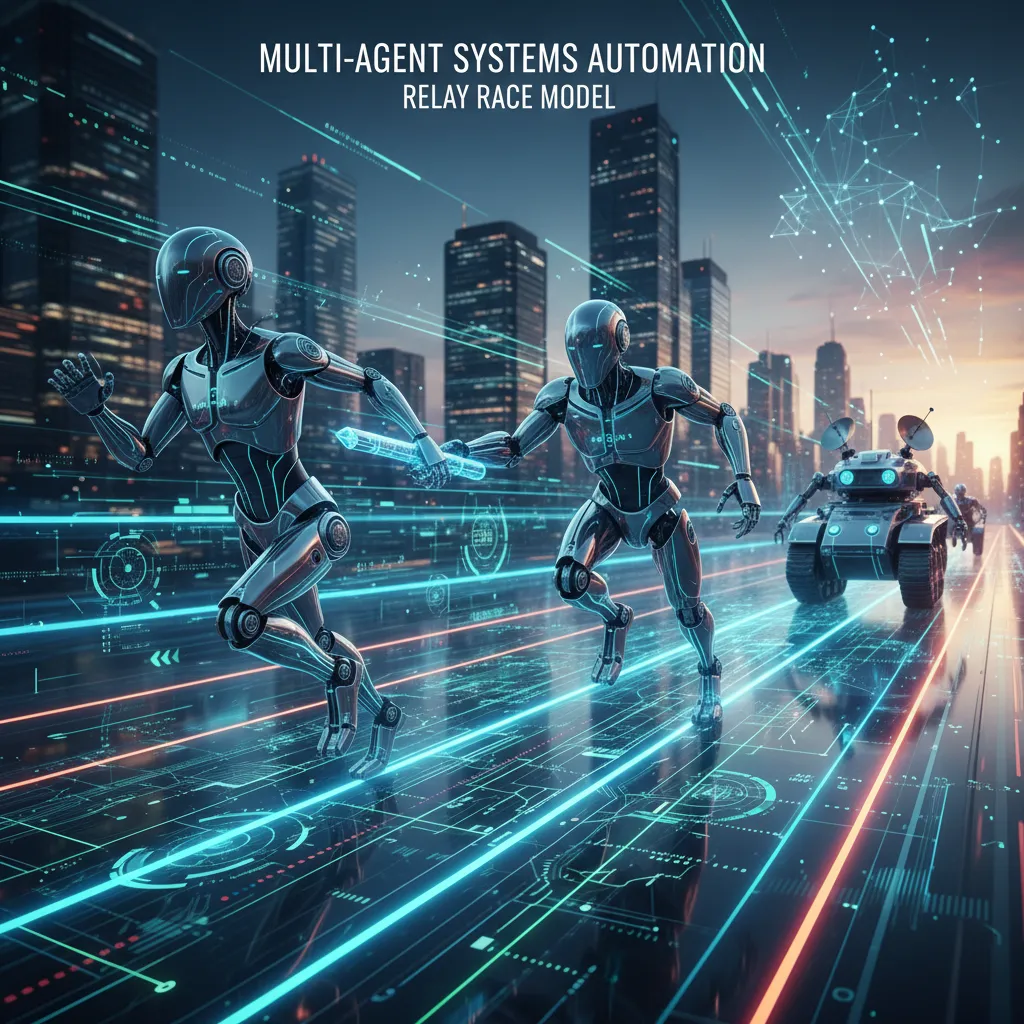
So I switched to what I call my relay race model: smaller agents with clear jobs, passing work forward with clean handoffs. This is the core of how I now approach multi-agent systems automation in 2026.
The handoff pattern I use most: triage → specialists → validator
- Triage agent: reads the request, classifies it, and decides the route (incident, change, invoice, access, etc.).
- Specialist agents: each one handles a narrow task (log analysis, policy checks, vendor lookup, ERP posting).
- Validator agent: checks outputs against rules, past examples, and required fields before anything ships.
This pattern matches what I saw in “Automation Operations Reimagined with AI: Real Results”: the best outcomes came from controlled collaboration, not one giant brain.
Cooperative routing for documents (yes, invoices again)
Invoices are perfect for routing because they look similar but hide edge cases. My triage agent first detects the document type and confidence. Then it routes to specialist agents based on signals like vendor name, currency, PO presence, and tax format. A simple routing note might look like:
{"doc":"invoice","route":["vendor_match","po_check","tax_rules"],"risk":"medium"}
The validator then confirms totals, tax math, and required approvals before posting. This keeps invoice automation fast, while still safe.
Wild card: what if your best agent quits mid-run—who notices?
In a relay race, if a runner drops out, the baton hits the ground. In ops automation, that “drop” is a silent timeout, a tool failure, or an agent that returns empty output. I design for this by requiring:
- Heartbeat checks per step (no response = escalation)
- State logs so another agent can resume
- Validator gating so partial work never reaches production
3) Governance as code agents (the part I used to skip)
My confession: I treated governance like a checklist
I’ll admit it: I used to see governance as a box to tick at the end of a project. I’d skim a policy PDF, paste a link into the ticket, and move on. Then an auditor asked a simple question during a rollout: “Show me where customer data traveled, who approved it, and what controls enforced that path.” I froze. The rollout froze too. That moment made it clear that in AI operations, governance can’t be a document. It has to be a system.
Governance as code agents: policies that execute
In 2026, the biggest shift I’ve seen is governance as code agents: turning policies into executable controls, not PDFs. Instead of “please follow the rule,” an agent checks the rule automatically at build, deploy, and runtime.
- Pre-deploy gates: block releases if logging, encryption, or retention settings drift.
- Runtime enforcement: stop a workflow if it tries to call an unapproved model or tool.
- Auto-evidence: generate audit trails as a byproduct of normal operations.
policy "data_residency" { allow if region in ["EU","UK"] and storage.encrypted == true }
Regulatory compliance + data sovereignty you can prove
“We think data stays in-region” is not compliance. Governance agents map where data goes and keep proof ready. I now treat data sovereignty like a living map: inputs, prompts, embeddings, logs, backups, and vendor hops. When a regulator asks, I can show what moved, where, why, and under which control.
| Artifact | Where it can live | Control |
|---|---|---|
| Prompts | EU only | Token redaction + region lock |
| Logs | EU/UK | PII scan + retention policy |
| Embeddings | EU only | Encryption + access review |
Validation as a service + independent model audits
I also stopped relying on “trust me” testing. Validation as a service runs repeatable checks (bias, leakage, jailbreak risk, drift) and stores results as evidence. And when stakes are high, independent model audits give confidence that isn’t vibes.
Governance works best when it’s automatic, measurable, and always on.
4) Enterprise workflow orchestration: where ROI becomes real (or imaginary)
In Automation Operations Reimagined with AI: Real Results, the biggest lesson for me was simple: AI automation only “works” when it moves real work across the business, not just inside one tool. That’s why enterprise workflow orchestration is where ROI becomes real—or where it turns imaginary because nobody can prove it.
Agentic automation ROI: the scoreboard I wish I’d built on day one
I used to celebrate demos. Now I track outcomes. My early mistake was not defining a scoreboard before shipping agentic automation. Without it, every win felt like a win, even when the business didn’t feel it.
“If you can’t measure the handoff from intent to completion, you’re measuring vibes, not ROI.”
Orchestration across tools: tickets, ERP, CRM, warehouse systems
Real operations run through messy handoffs: a ticket becomes an ERP change, which updates CRM, which triggers a warehouse task. Orchestration means the agent can read and write across these systems with clear rules, approvals, and logs. I focus on:
- Ticketing: intake, routing, SLA timers, escalation
- ERP: orders, invoices, inventory adjustments
- CRM: account updates, renewals, customer notes
- Warehouse: pick/pack exceptions, stock checks, returns
Super agent control planes: one planner, many workers
The pattern that scaled best was a planner agent that breaks a goal into steps, then assigns “worker” agents to execute in each system. The control plane enforces guardrails: permissions, retries, and human approval when risk is high. I keep the planner’s output structured, like:
{"goal":"resolve return","steps":["verify order","create RMA","update CRM","notify warehouse"]}
A practical checklist: what I measure weekly (and what I ignore on purpose)
- End-to-end cycle time (request → completion)
- Automation completion rate without human rescue
- Exception rate by system (ERP vs CRM vs warehouse)
- Cost per resolved workflow (people time + compute)
- Audit quality: logs, approvals, and replayability
What I ignore on purpose: raw “agent actions,” prompt counts, and vanity accuracy scores that don’t map to business outcomes.
5) Data quality AI enabler: the unglamorous foundation
The hard truth from my 2026 ops automation work is this: most “agent failures” I’ve seen were actually data failures. The agent didn’t “hallucinate” out of nowhere. It was fed stale tickets, missing asset IDs, unclear status fields, or three different meanings of “owner.” When the inputs are messy, the outputs look random, and teams blame the AI instead of the pipeline.
What I do before scaling agents
Before I roll out more AI agents across operations, I treat enterprise data modernization as the foundation. I don’t start with a big data lake dream. I start with the few systems that drive daily work: ITSM, CMDB, monitoring, identity, and the runbook or knowledge base. Then I make sure the “golden path” data is reliable enough for automation operations.
- Pick the top 10 workflows (incident triage, access requests, patch exceptions, etc.).
- Map required fields per workflow (what the agent must know to act safely).
- Fix the joins: consistent IDs across tools (user, device, service, ticket).
- Add freshness rules: what “current” means for each dataset.
Tactic: “good enough” data contracts
Perfection blocks progress, so I define “good enough” data contracts. A contract is a simple agreement: which fields exist, allowed values, update frequency, and who owns fixes. I keep it lightweight and measurable.
| Field | Rule | Minimum |
|---|---|---|
| ticket_status | Enum | 95% valid values |
| asset_id | Not null | 98% coverage |
| last_updated | Freshness | < 15 minutes |
“If the agent can’t trust the data, it can’t earn trust from the business.”
My favorite quick win (it’s boring): naming conventions
The fastest improvement I’ve seen is standard naming. I’ll take one afternoon to align service names, queue names, and environment tags. Even a small rule like:
service = <domain>-<product>-<env>
reduces confusion, improves search, and makes AI results in 2026 feel far more consistent.
6) Physical AI production systems: from pilot to production (without drama)
In 2026, I see warehouses as the best proving ground for Physical AI production systems. The work is repeatable, the space is controlled, and the results show up fast: fewer touches, cleaner inventory counts, and tighter ship times. Unlike a flashy demo, a warehouse forces AI to deal with real constraints—battery levels, blocked aisles, late pallets, and humans who do things “their way.”
Why warehouses make Physical AI deployment practical
- Clear metrics: picks per hour, dwell time, mis-picks, damage rate.
- Stable processes: SOPs exist, even if they’re not perfect.
- High exception volume: great training data for continuous improvement.
Pilot to production: the 3 traps I fell into
- Integration: My pilot worked in isolation. Production required tight links to WMS/ERP, scanners, label printers, and dock scheduling. If the AI can’t read and write the same “truth” as operations, it becomes a side tool.
- Safety: I underestimated how much time goes into safety cases, geofencing, speed limits, and near-miss reviews. Physical AI needs rules that never negotiate, even when the model is confident.
- Ownership: In the pilot, engineering “owned” it. In production, ops must own it day to day—alerts, overrides, and continuous tuning—without waiting for a sprint.
Where multi-agent systems meet the physical world
Multi-agent AI becomes real when it runs scheduling, routing, and exception handling together. One agent can assign tasks, another can optimize paths, and a third can watch for anomalies like congestion or missing totes. The key is a shared state model and simple handoffs:
if aisle_blocked: reroute(); notify_supervisor(); replan_queue()
Wild card analogy: robots are new hires
“If you wouldn’t throw a new employee into peak season without training, don’t do it to a robot.”
- Onboarding: map the site, learn zones, test edge cases.
- SOPs: clear escalation steps and human override rules.
- Performance reviews: weekly scorecards for uptime, safety events, and task quality.
Conclusion: My 2026 “ops reimagined” scorecard
After living through “Automation Operations Reimagined with AI: Real Results,” my biggest takeaway is simple: agents are a capability, but orchestration is a discipline. Agents can draft, classify, route, and even remediate. But without clear workflows, guardrails, and ownership, they turn into fast chaos. In 2026, the teams getting real AI operations results aren’t the ones with the most tools—they’re the ones who treat automation operations like a system that must be designed, measured, and improved.
My scorecard: four things that matter
When I judge “ops automation reimagined,” I use one scorecard with four checks. First is value: did cycle time drop, did backlog shrink, did customers feel it? Second is trust: do people believe the agent’s output, and can they see why it acted? Third is compliance: are data use, approvals, and audit trails built in, not bolted on? Fourth is resilience: when models drift, APIs fail, or edge cases hit, does the system degrade safely and recover quickly? If any one of these is weak, the “AI win” won’t last.
If I had to start tomorrow: my 30-day plan
In week one, I’d be intentionally scrappy: pick one painful workflow (like ticket triage or access requests), map the steps, and ship a small agent that only assists—no auto-execution. Weeks two and three, I’d add orchestration: clear handoffs, human review points, logging, and a simple rollback path. I’d also define success metrics and run side-by-side comparisons against the old process. In week four, I’d harden it: permissions, policy checks, audit-ready records, and failure testing, then expand to the next workflow only after the first one is stable.
The goal isn’t fewer humans—it’s fewer preventable headaches.
That’s my 2026 scorecard in one line: use AI to remove repeat work, reduce risk, and make operations calmer, not emptier.
TL;DR: In 2026, enterprise AI automation is shifting from solo bots to multi-agent systems automation managed through agent control planes. Governance as code agents and regulatory compliance data sovereignty requirements are now non-negotiable. Measure Agentic automation ROI with trust + risk metrics, modernize data quality AI enabler foundations, and move physical AI production systems from pilot to production—without losing sleep.


Comments
Post a Comment