Mid-Year AI Review: 2025 Business Trends

I didn’t plan to spend my February budget meeting arguing about semiconductors. But there I was—coffee gone cold—watching our “AI pilot” suddenly turn into a conversation about cloud bills, data plumbing, and whether we should wait for better models or just ship something imperfect. That whiplash is basically the story of 2025 (so far). AI stopped being a slide-deck noun and became a line item with owners, deadlines, and consequences. Below is my mid-year review of the biggest business trends I keep seeing across industries—some obvious, some oddly under-discussed, and at least one that surprised me mid-conversation.
1) AI Reasoning becomes the new “it works” test
In early 2025, most AI talk in business stopped being about “can it write an email?” and became “can it decide what to do next?” I see it in every AI pilot review: leadership is less impressed by fluent text and more focused on whether the model can follow rules, weigh tradeoffs, and explain a choice. In other words, AI reasoning is now the real “it works” test.
Why the shift: writing is cheap, decisions are expensive
Good writing saves minutes. Good decisions save money, reduce risk, and protect trust. That’s why my evaluation changed from “does it sound right?” to “does it reason right?” When AI is used in business contexts, the cost of a confident mistake is high—especially in regulated or customer-facing workflows.
My red-flag checklist for AI reasoning
- Invented facts: cites policies, numbers, or events that don’t exist.
- Rule skipping: ignores a required step (approval, threshold, escalation).
- Overconfidence: no uncertainty language when the input is incomplete.
- Inconsistent logic: changes its rationale when asked the same question twice.
- Bad refusals: either refuses too often or complies when it shouldn’t.
Where AI reasoning shows up first
I’m seeing “show your work” moments in three places:
- Compliance Q&A: “Which policy applies, and why?” needs traceable steps.
- Incident triage: classify severity, pick an owner, and justify escalation.
- Forecasting explanations: not just a number, but the drivers behind it.
Mechanistic interpretability: not trendy, just demanded
Mechanistic interpretability entered my conversations for a simple reason: a CFO asked,
“Why did the AI recommend this?”At that point, “because the model said so” is not an answer. Even lightweight tools—decision traces, retrieved sources, and constraint checks—help connect outputs to business logic.
A quick tangent: the hallucinated policy number
The first time our model confidently cited a policy number that didn’t exist, we treated it like an incident. The next day we changed two things: forced retrieval (answers must quote an internal document) and safe fallback (if it can’t find the policy, it must say so and route the question).
What I measure now (beyond tokens)
| Metric | What it tells me |
|---|---|
| Reasoning accuracy | Correct steps and correct final decision |
| Refusal quality | Refuses when needed, and explains how to proceed |
| Time-to-decision | Speed from question to usable action, with review time |

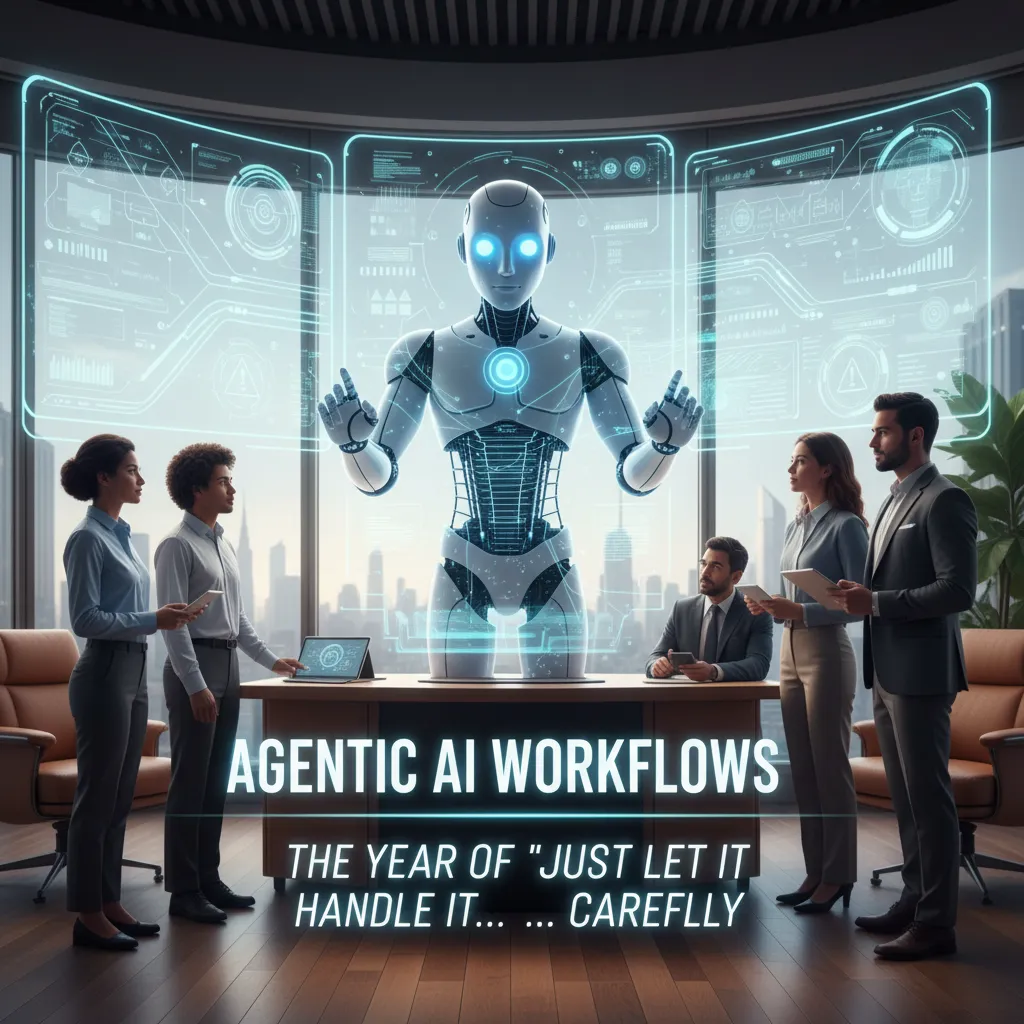
2) Agentic AI workflows: the year of “just let it handle it”… carefully
In my mid-year AI review, the biggest shift I keep seeing is agentic AI workflows. Here’s how I explain it to a teammate: it’s not a chatbot that answers questions. It’s more like a digital worker with a to-do list, tools, and permissions. You give it a goal (“resolve this request”), it breaks the work into steps, takes actions across systems, and reports back.
Where agentic AI is landing first
Most businesses aren’t starting with “let the AI run everything.” They’re starting where tasks are repetitive, rules exist, and speed matters. The early wins I’m seeing in 2025 are practical:
- Customer support routing: classify tickets, detect urgency, assign to the right queue, and draft replies.
- Sales ops follow-ups: update CRM fields, schedule reminders, send “nudge” emails, and flag stalled deals.
- Internal IT ticket triage: collect missing details, suggest fixes, reset access, and escalate when needed.
My uncomfortable realization: agents amplify messy processes
Agentic AI doesn’t magically fix broken workflows—it accelerates them. If your intake form is unclear, your tags are inconsistent, or your approvals are vague, the agent will fail faster and at scale. I’ve learned to treat agents like a mirror: they show you where your process is weak, because they can’t “wing it” the way a human can.
“If the workflow is broken, the agent breaks faster.”
Reskilling isn’t optional: the rise of the AI supervisor
As agents take on more steps, operators become AI supervisors. That’s not a buzzword. It’s a real job: setting rules, reviewing edge cases, monitoring quality, and improving prompts, tools, and handoffs. The best teams I’ve seen train people to think in workflows, not just tasks.
Practical guardrails that actually work
To “just let it handle it”… carefully, I rely on a few guardrails:
- Permissioning: least-privilege access (read-only by default, write access only where needed).
- Human-in-the-loop thresholds: require approval for refunds, contract changes, or account access.
- Audit trails: simple logs of what the agent did, why, and which system.
One small but useful pattern is to define “safe actions” vs. “risky actions” in plain language, like:
Safe: tag, route, draft, summarize
Risky: send, delete, refund, change permissions
3) Cloud migrations meet AI workloads (and my cloud bill got loud)
In the first half of 2025, I watched cloud migrations jump back to the top of business roadmaps. The reason is simple: AI workloads change the math of where compute lives. Training, fine-tuning, and even high-volume inference can spike usage fast. When my team moved a few AI experiments from “small pilot” to “daily workflow,” the cloud bill didn’t just rise—it got loud.
AI changes “where compute lives”
Before AI, I could plan capacity around steady apps and predictable traffic. With AI, demand is bursty: one new model, one new dataset, or one new feature can multiply compute and storage needs overnight. That’s why I see more companies rethinking hybrid setups, data gravity, and whether workloads should sit near data, users, or specialized chips.
Hyperscalers bundle AI with migration deals (read the fine print)
Hyperscalers are pushing hard: migrate now, and get credits, managed AI services, and “easy” paths to production. I’ve learned to read the fine print twice. Credits expire. Discounts may apply only to certain instance types. And some managed AI tools can create lock-in through proprietary APIs or data formats.
My new habit: I treat every migration incentive like a contract negotiation, not a coupon.
Custom silicon is now a business topic
In 2025, it’s not just GPUs. I’m hearing more about custom silicon (TPUs, NPUs, and cloud-designed accelerators) in budget meetings. The decision isn’t only technical—it’s about:
- Cost: price per token, per image, or per batch job
- Availability: can I actually get capacity when I need it?
- Latency: can inference meet real-time product needs?
Technical debt: every legacy data pipeline is a tax on model performance
The biggest surprise for me: AI performance often fails because data is slow, messy, or trapped. Every legacy pipeline adds friction—missing fields, unclear definitions, delayed refresh cycles. That becomes a direct tax on model quality and speed.
My rule of thumb for 2025 migrations
- Migrate what you can measure (clear cost, uptime, and usage metrics).
- Modernize what blocks AI (data pipelines, identity, observability).
- Retire what nobody defends (systems with no owner and no value).
4) Predictive analytics gets a glow-up (because CFOs love forecasts)
In my mid-year AI check-in, I keep noticing a quiet comeback: predictive analytics. It is not as flashy as generative AI, but it is the kind of AI that wins budgets because it ties directly to money, risk, and planning. When a CFO asks, “What happens next quarter if demand drops 8%?” a solid forecast beats a clever demo every time.
The quiet comeback: less hype, more impact
Predictive models feel “boring” compared to chatbots, but they are getting a glow-up in 2025 because teams can deploy them faster and measure results clearly. I’m seeing leaders treat forecasting as a core business system, not a side project.
Where I’m seeing it deliver right now
- Inventory planning: better demand signals, fewer stockouts, and less cash tied up in slow-moving items.
- Churn risk: earlier warnings on which customers may leave, plus clearer triggers (usage drops, support tickets, renewal timing).
- Fraud detection in financial services: faster flagging of unusual patterns, with fewer false positives when models are tuned and monitored.
How genAI + predictive analytics pair up
This is where “AI” starts to feel practical. I’m watching teams combine predictive outputs with genAI to make forecasts easier to use, not just easier to build.
- Narrative explanations for forecasts: genAI can translate model outputs into plain language, like “Demand is down in the Northeast due to lower repeat orders and longer delivery times.”
- Faster scenario planning: instead of waiting on an analyst to rebuild a spreadsheet, teams can ask for scenarios like “What if we raise prices 3% and cut paid ads 10%?” and get structured options quickly.
I have a small confession: I trust a boring model more when it’s monitored well than a brilliant one nobody can explain.
From dashboards to decision loops (and yes, politics)
Business intelligence is shifting from static dashboards to decision loops: predict → act → measure → retrain. That changes org politics because the question becomes, “Who owns the action?” not “Who owns the report?”
| Old BI | 2025 AI-driven BI |
|---|---|
| Dashboards for review | Forecasts that trigger workflows |
| Monthly reporting cycles | Continuous monitoring and alerts |
| Insights as opinions | Decisions with tracked outcomes |
5) The data lakehouse and the unsexy work that makes AI feel smart
What a “data lakehouse” means in plain English
When I say data lakehouse, I’m not trying to sell a platform. I mean a simple idea: one place where analytics and machine learning stop fighting over copies of the truth. In older setups, teams build a data lake for raw files, a warehouse for reporting, and then separate feature stores or marts for AI. Every handoff creates another version of “the same” customer, patient, or product record.
A lakehouse approach aims to keep data in one governed home, so BI dashboards and AI models can work from the same definitions, the same history, and the same permissions.
Why it matters in 2025
In my 2025 check-ins with business teams, the biggest AI blocker isn’t model choice—it’s data friction. A lakehouse-style foundation helps because it reduces the time spent stitching systems together and arguing about numbers.
- Faster experimentation: analysts and ML teams can test ideas without waiting weeks for new pipelines.
- Fewer broken pipelines: fewer copies means fewer places for schemas and logic to drift.
- Fewer “why are these numbers different?” meetings: shared metrics and lineage cut down on confusion.
Healthcare AI is the proof point
Healthcare is where I see the value most clearly, because the use cases are data-hungry and high-stakes. Diagnostics models need clean imaging + clinical context. Personalized medicine needs consistent patient timelines. Drug discovery needs well-labeled datasets and traceable experiments. In all of these, AI only looks “smart” when the underlying data is clean, linked, and governed.
In healthcare AI, the model is rarely the bottleneck. The bottleneck is trusted data that can be used safely.
Governance isn’t paperwork—it’s the price of scaling
I used to think governance slowed teams down. In 2025, I see it as the cost of running AI in production and sleeping at night. Without it, you get silent data leaks, biased outputs, and models that drift until someone notices in a quarterly review.
My “two pizza” governance kit
If a small team (two pizzas) can’t run it, it’s too heavy. Here’s the kit I recommend:
- Ownership: name a data owner per domain and a model owner per use case.
- Access rules: role-based access, sensitive-field controls, and audit logs.
- Evaluation: agreed metrics, bias checks, and monitoring for drift.
- Incident playbook: what to do when data is wrong, access is abused, or outputs cause harm.

6) Mid-year reality check: ROI, risk, and what I’m betting on for H2
At the mid-year mark, I’m grading AI in 2025 with a simple question: did it make the business run better, not just look smarter? My scorecard has three buckets—where AI clearly paid off, where it stalled, and where it quietly improved morale in ways that don’t show up in a revenue chart.
My mid-year scorecard: wins, stalls, and morale boosts
The biggest wins I’ve seen came from narrow, repeatable workflows: support triage, knowledge search, meeting summaries, and first-draft content for internal teams. The ROI was real because cycle time dropped and quality became more consistent. In a few cases, the best metric wasn’t sales—it was fewer 2 a.m. escalations because the on-call team had better context and faster handoffs.
Where AI stalled was predictable: projects that tried to “boil the ocean.” If the data was messy, permissions were unclear, or the process itself was broken, the model couldn’t save it. I also saw teams underestimate the cost of review. If humans must check every output, you need to design for that reality, or the time savings disappear.
The quiet morale improvements surprised me most. When AI handled the boring parts—formatting, searching, rewriting, summarizing—people had more energy for judgment and customer conversations. That’s still ROI, even if it shows up as retention and fewer mistakes rather than a clean revenue line.
A wild-card scenario: frontier models get cheap
My biggest “what if” for H2 is a frontier model becoming cheap enough that model choice stops being the differentiator. If that happens, advantage shifts overnight to data quality, governance, and how fast you can ship safe workflows. In that world, the winners aren’t the teams with the fanciest prompts—they’re the teams with clean inputs, clear policies, and strong audit trails.
What I’m watching in H2 2025
I’m tracking three signals: reasoning benchmarks (can models handle multi-step work reliably?), custom silicon availability (can we actually get the compute we planned for?), and AI governance enforcement (are rules becoming real consequences?).
My closing thought: scaling AI is mostly about operational choices—ownership, data, review, and controls—not model worship.
TL;DR: By mid-2025, businesses are moving from AI experiments to scaled enterprise AI: reasoning-focused large language models, agentic AI workflows, and predictive analytics are driving ROI—while cloud migrations, custom silicon, and AI governance determine who can sustain it.


Comments
Post a Comment