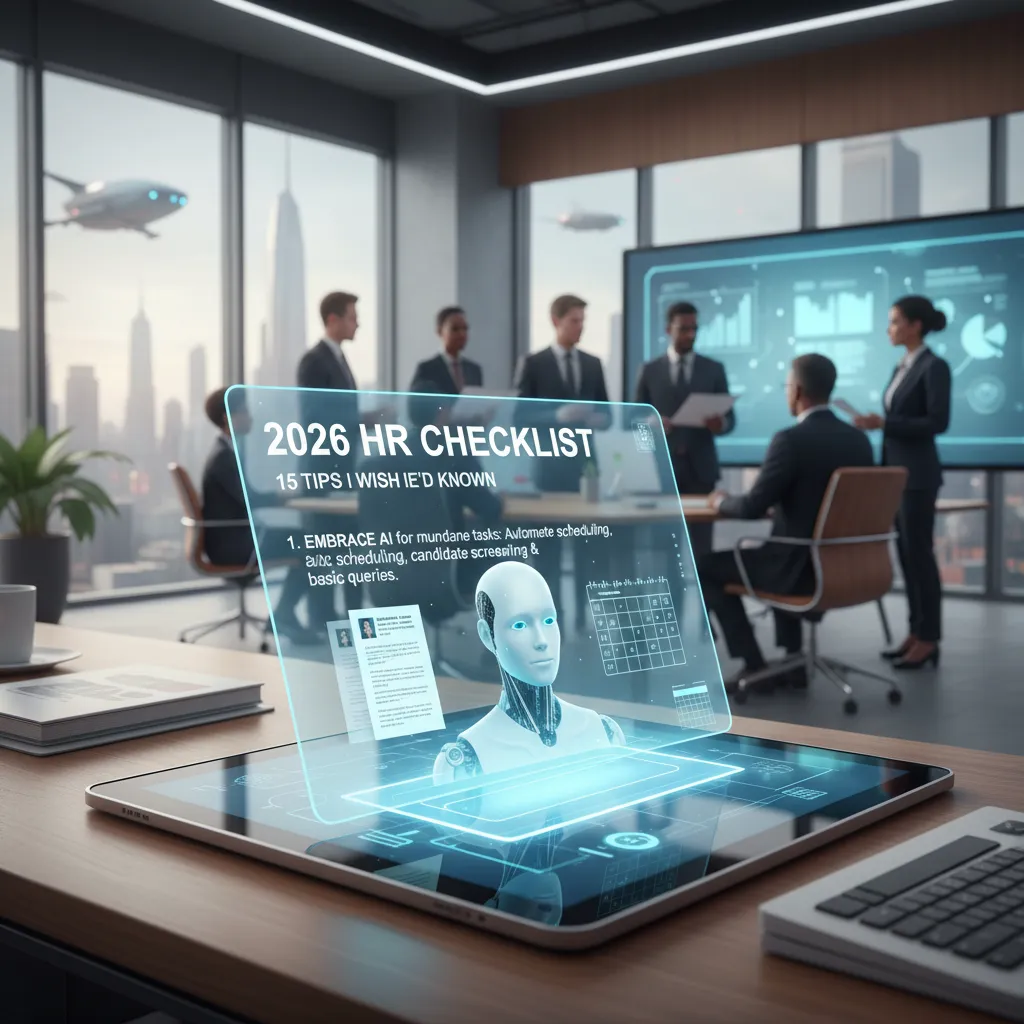
I still remember the first time I tried to “fix HR” with a spreadsheet and good intentions. It was a Tuesday, obviously—because all preventable HR fires seem to start on Tuesdays. We had a spike in resignations, a manager who swore burnout was “just a mindset,” and a shiny new AI tool someone bought on a corporate card. That week taught me something I now repeat like a mantra: HR doesn’t win by being heroic; it wins by being prepared. This post is my personal, field-tested set of 15 essential tips—less theory, more “here’s what actually helps when your inbox looks like a disaster movie trailer.”
1) The “Tuesday Fire Drill” Audit: Learn From 2025 Before You Plan 2026
I call this my Tuesday Fire Drill because it’s the kind of surprise request that lands at 10:07 a.m.: “Can you pull the policy, the approval trail, and the training record… now?” Before I plan 2026, I force myself to learn from 2025 with a fast HR audit that’s simple, honest, and useful.
Pull the three numbers I can’t ignore
I start with turnover, engagement, and performance trends. I write down what I think caused the changes—manager shifts, pay gaps, workload spikes, unclear goals—then I check my assumptions against exit notes, survey comments, and manager feedback. This keeps my HR planning from turning into guesswork.
Do a 10-minute HR records sweep
I open a timer and ask: could I find these in 10 minutes during an audit?
- Current policies and handbook versions
- Approvals (offers, promotions, exceptions)
- Compliance docs (I-9, training logs, incident reports)
If the answer is “not sure,” I fix the folder structure, naming, and access rights before the year gets busy.
Ask IT what’s launching next quarter
HR technology implementation hits HR second and employees first. I ask IT what’s changing—SSO, device rollouts, ticketing tools, payroll integrations—so I can prep comms, training, and support.
Wild-card: my “regret list”
I keep a running list of tiny issues I waved away that later became big resignations: slow approvals, unclear career paths, messy onboarding, or one “small” manager behavior. It’s uncomfortable, but it’s the most practical HR checklist item I have.
2) HR Strategy Creation That Doesn’t Live in a Slide Deck
I used to think an HR strategy had to look “executive.” In reality, if it can’t be explained fast, it won’t be used. My rule now: write a one-page HR strategy I can explain to a new manager in under 90 seconds. If I can’t, it’s not a strategy—sorry.
Make it one page, then make it usable
I keep the plan simple: 3–5 goals, who owns them, and what “done” looks like. This is the core of practical HR strategy creation—something managers can repeat without opening a slide deck.
Tie every HR goal to the business (and a proof)
Every HR goal must connect to a business objective and a measurable proof, even if the proof is messy at first. For example:
- Business objective: Grow revenue
HR goal: Reduce time-to-fill for sales roles
Proof: Average days open, offer acceptance rate - Business objective: Improve customer retention
HR goal: Strengthen frontline training
Proof: Training completion + quality scores - Business objective: Control costs
HR goal: Reduce regrettable turnover
Proof: 90-day and 12-month retention
Quarterly check-ins that feel like maintenance
I schedule quarterly check-ins as “maintenance,” not judgment. We review what moved, what didn’t, and what to adjust. Proactive HR management beats panic, especially when hiring slows or turnover spikes.
I once shipped a “perfect” strategy nobody could remember. The next year I used plain language, and adoption doubled.
3) Employee Wellbeing Assessment: Burnout Is a Systems Bug
I used to treat burnout like a personal problem: “Try self-care.” Now I treat it like a systems bug. If people are exhausted, something in the work design is failing—capacity, priorities, or manager support.
Run pulse surveys fast, then slow
When things feel “off” (more sick days, short tempers, missed deadlines), I run monthly pulse surveys for 90 days. Keep them short: 5–7 questions on workload, clarity, and recovery time. Once patterns stabilize, I move to quarterly so it doesn’t become noise.
Train managers to spot distress (and give scripts)
Most managers don’t ignore problems—they freeze in real conversations. I train them on basic distress signals: sudden withdrawal, sharp drops in output, constant overtime, or “I’m fine” said too quickly. Then I give scripts they can actually use:
“I’ve noticed you’ve been online late. What’s driving that?”“What’s one thing we can pause or delegate this week?”“On a 1–10, how sustainable is your workload right now?”
Audit workload drivers, not symptoms
An employee wellbeing assessment should point to root causes like chronic understaffing, unclear priorities, or too many meetings. I pick one driver to fix first—like setting a weekly priority list or adding coverage—because fixing ten symptoms usually fixes none.
My blunt opinion: free meditation apps don’t cancel out back-to-back meetings and impossible deadlines.
4) Total Rewards Alignment: Pay Isn’t the Whole Story (But It’s a Loud One)
I used to think “competitive pay” would carry our offer. Then I learned total rewards only work when they match real life. My first fix is a simple compensation and benefits analysis using what we already have: benefits enrollment data plus a short “what do you actually use?” survey. Enrollment shows choices; the survey shows why people choose them (or ignore them).
Use data, not guesses
- Pull enrollment by plan, location, and job level.
- Ask 5 questions: what you use, what you don’t, what you wish we had, and what feels confusing.
- Compare cost vs. usage so you can stop overfunding low-value perks.
Modernize for different life stages
My multigenerational workforce taught me a hard lesson: one-size benefits fit no one. Early-career employees asked for student loan help and learning budgets. Parents cared about predictable schedules and dependent care. Later-career employees valued stronger retirement support and health coverage. A modern total rewards strategy offers options, not a single “best” package.
Translate rewards into plain language
People can’t value what they don’t understand. I now rewrite rewards in simple terms: “This plan saves you about $X per paycheck,” or “You get Y paid days off, plus Z company holidays.”
“If employees can’t explain the benefits, they won’t trust them.”
Document what wins offers
Hypothetical scenario: two candidates, same salary. One chooses the role with clearer growth and flexibility. I document the why in our ATS notes so we can improve our HR total rewards messaging and future offers.
5) AI Governance Implementation: The New HR Compliance Requirements Nobody Warned Me About
In 2026, AI is in HR whether we call it “AI” or not. I learned the hard way that auditors don’t care if a tool is “just helping.” If it touches employee data or influences a decision, it needs governance.
Create an AI intake form (before anyone clicks “Enable”)
I now require a simple intake form for every AI tool—paid, free, or built-in. It keeps HR compliance and IT security aligned, and it creates a paper trail when questions come up.
- What tool is it (vendor, version, feature)?
- What data does it use (resumes, performance notes, payroll, chat logs)?
- What decision does it influence (screening, scheduling, pay, discipline)?
- Who owns risk: HR + IT together (not “the vendor”).
Update compliance training to include AI governance
My old training covered privacy and harassment, but not employee data rights in AI systems or how to run basic bias checks. Now I add short modules on: approved tools, data minimization, consent/notice where required, and how to document human review.
Map AI impact by role (because risk isn’t equal)
Recruiters face screening bias risk. Managers risk over-trusting summaries in performance reviews. HR ops risks data leakage in workflows. Employees risk unclear decisions and bad records. I map each role to the tools they touch and the controls they need.
Quick aside: I love automation; I just don’t love surprises in audits—or in people’s paychecks.

6) Skills Gap Identification: Build a Skills Inventory Without Making It Weird
I used to avoid skills inventories because they can feel like surveillance. What changed everything was framing it as career support. I tell people exactly how it helps them: clearer growth paths, better project matches, and stronger cases for promotions or pay reviews. I also keep it simple—self-ratings plus manager notes, updated in minutes, not hours.
Make the inventory feel like a benefit
- Explain the “why” in plain language: we’re mapping strengths to opportunities, not ranking people.
- Ask for skills people want to build, not just what they already have.
- Share how the data will be used (and what it won’t be used for).
Forecast skills for 6–12 months, not 5 years
Strategic workforce planning works best when the horizon is short. I’ve learned forecasts age like milk. I look at upcoming product changes, customer needs, and tech shifts, then define a small set of “must-have” capabilities for the next 6–12 months.
“We’re planning for the next two quarters, not the next decade.”
Tailor learning by role, generation, and choice
My best L&D wins came from letting teams choose paths. Some people want short videos, others want live practice, and some learn best by doing.
- Offer 2–3 learning options per skill (micro-course, peer shadowing, project stretch).
- Match learning to real work so it sticks.
Micro-win: celebrate one skill gained
Pick one new skill and recognize it publicly—Slack, all-hands, or a team note. It signals that learning is part of the job, not extra credit.
7) Employment Law Changes & Compliance Monitoring: Make It Boring on Purpose
I used to treat employment law updates like “background noise” until I realized how fast small misses turn into big problems. Now I try to make compliance boring on purpose—repeatable, scheduled, and easy to prove.
Build a simple compliance calendar (then actually use it)
I keep one shared calendar for the rules most likely to change and impact daily HR work: pay transparency, flexible work policies, family leave rules, and employee data rights. I review it monthly, even if nothing looks urgent. That one habit has saved me from last-minute policy rewrites and awkward manager conversations.
Centralize policies and audit trails
HR compliance requirements get painful when documentation is scattered across email threads, random folders, and “only Sarah knows where that is.” I centralize:
- Current policies (with version dates)
- Signed acknowledgments
- Training records
- Leave decisions and accommodations notes
- Pay range and posting history
If I can’t find it in two minutes, I assume it doesn’t exist.
Run mini scenario drills
Once a quarter, I do a quick tabletop drill with one leader:
“If we’re audited tomorrow, what’s our story and our evidence?”
We pick one topic (like pay transparency or leave) and list what we’d show: policy, process, and proof.
My opinion: compliance isn’t HR’s hobby; it’s the guardrail that lets everything else move faster—hiring, performance, and culture included.
8) Culture Strategic Planning: Build a Business Resilience Culture (Not a Poster)
I used to think culture was the values slide and a few nice posters. What I learned (the hard way) is that culture is what gets rewarded—and what gets ignored. If I want a business resilience culture, I have to name the behaviors we celebrate and the ones we’re quietly tolerating.
Call out what we reward vs. what we allow
- Reward: early risk flags, cross-team help, calm problem-solving, learning from mistakes.
- Tolerate (by accident): last-minute heroics, blame, meeting overload, “we’ve always done it this way.”
In my HR checklist for 2026, I now write these down and review them with leaders quarterly.
Run engagement like a product launch
Employee engagement programs work better when I treat them like product work: test, measure, iterate. I run small pilots, track simple metrics (participation, manager follow-through, retention signals), and then I communicate what changed because people spoke up.
“You said X. We changed Y. Here’s what happens next.”
Use leader visibility deliberately
Leader visibility should not be performative. I’ve seen small recurring rituals beat giant once-a-year speeches every time:
- 15-minute monthly “Ask Me Anything”
- weekly customer or incident review with learning notes
- two employee listening sessions per quarter
Wild card analogy: sourdough starter
Culture is like sourdough starter: neglect it and it turns on you; feed it consistently and it does the work. Strategic culture planning is the feeding schedule.
Conclusion: My 2026 HR Checklist in One Sentence (And One Small Dare)
If I had to summarize my 2026 HR checklist in one sentence, it’s this: make decisions with data, protect people with systems, and keep culture real enough to survive stress. That’s the thread running through these 15 HR tips I wish I’d known—because good HR work is not just kind, it’s clear, consistent, and easy to prove when questions come up.
Now for the small dare. This month, pick one “boring” fix and one “human” fix, and actually finish them. The boring fix could be tightening records, cleaning up your HR calendar, or setting simple governance so decisions don’t depend on who is in the room. The human fix could be coaching one manager through a hard conversation, building a habit of recognition, or running a listening check-in that leads to one visible change. One of each is enough to shift momentum.
I keep thinking about my Tuesday lesson: preparedness beats heroics. When I relied on last-minute saves, I looked busy but not credible. When I built repeatable systems—clear policies, clean documentation, steady communication—my credibility started to compound. People trusted HR more, leaders asked earlier, and problems got smaller before they got loud.
Before you close this page, I want to invite reflection.
What’s the one tip you wish you’d learned earlier—before it cost you time, trust, or talent?If you name it, you can build it into your 2026 plan—and make the next year calmer, fairer, and easier to run.
TL;DR: My 2026 HR checklist: use 2025 data to set priorities, assess wellbeing, modernize total rewards, implement AI governance, close skills gaps, stay ahead of employment law changes, and build a culture that holds under pressure.


Comments
Post a Comment