How AI Analytics Saved One Firm $5M a Year

I didn’t believe the “AI will save millions” line until I watched our monthly ops review turn into a weird ritual: fewer fires, fewer late-night calls, and a finance lead who stopped bracing for bad surprises. The funny part? The first win wasn’t glamorous—it was a boring dashboard that told us which machines were about to misbehave and which orders were about to miss their promised dates. From there, AI-powered analytics stopped being a science project and became a habit. This post breaks down the moves that (in my experience) can realistically stack up to a $5M annual impact, and the awkward lessons we learned along the way.
The $5M Problem: Death by a Thousand Tiny Losses
My first clue was simple: we weren’t losing money in one dramatic place. There was no single “bad contract” or one huge mistake. Instead, the losses were spread across delivery misses, overtime, write-offs, and that frustrating line item everyone hates: “mystery shrink.” Each issue looked small on its own, so it was easy to explain away. But together, they quietly stacked into a problem that was costing us about $5M a year.
What I saw when I zoomed out
When I started tracing the patterns, I realized our operations behaved like a chain reaction. I literally drew a quick “leak map” on paper to show how one tiny miss became a bigger cost later:
- Downtime → missed production windows
- Missed windows → rush shipments and premium freight
- Rush shipments → more errors and late deliveries
- Late deliveries → customer churn
- Churn → higher customer acquisition costs (CAC)
That map made it clear: we weren’t dealing with separate problems. We were dealing with one system that kept leaking value in dozens of places.
Why AI analytics became the only real option
We tried to manage it with spreadsheets and weekly reports. The issue was that spreadsheets explained yesterday. They told me what already happened—after the overtime was paid, after the shipment was rushed, after the customer complained. What we needed was AI-powered analytics that could connect signals across teams and help us act earlier: predict delays, flag risk, and show which “small” issues were about to become expensive.
Running ops without predictive intelligence felt like driving at night with sunglasses—technically possible, emotionally exhausting.
Once I admitted the losses were “tiny but everywhere,” it became obvious that only AI could watch everything at once and spot the patterns humans miss.
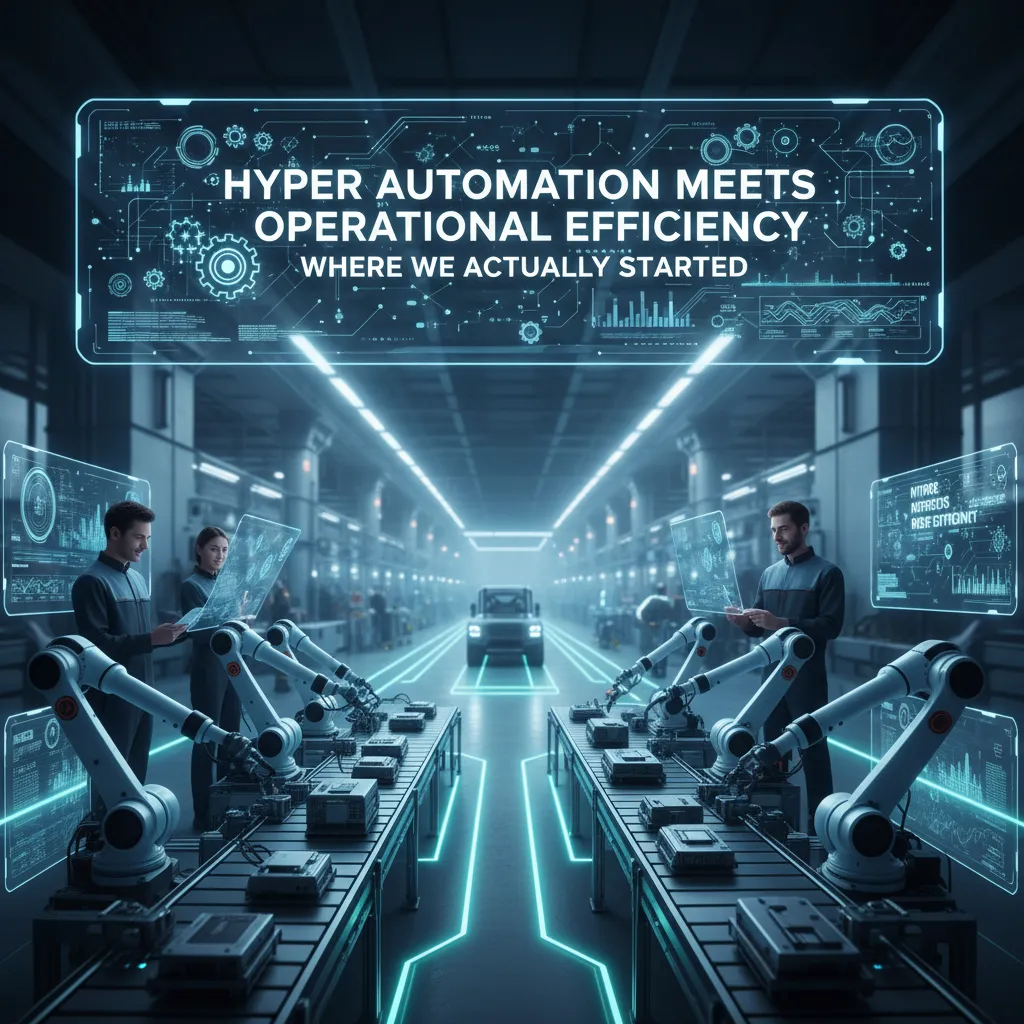
Hyper Automation Meets Operational Efficiency (Where We Actually Started)
When people hear AI and “hyper automation,” they picture robots running the whole plant. That wasn’t our reality. We started with one messy workflow that had constant handoffs: maintenance tickets + parts ordering. It was the perfect place to begin because every delay showed up fast in downtime, rush shipping, and finger-pointing.
We chose one workflow and automated the boring steps first
Our first rule was simple: don’t automate decisions that require deep context. Automate the repeatable steps that slow everyone down. We used AI-powered analytics to read incoming tickets, pull key details, and pre-fill what humans usually typed by hand.
- Auto-categorize tickets (asset, issue type, urgency)
- Suggest likely parts based on past fixes and failure patterns
- Check inventory and preferred vendors before anyone emailed around
- Draft the purchase request with the right fields filled in
AI agents didn’t “run the factory”; they nudged people inside existing tools
We didn’t replace our CMMS or procurement system. The AI sat inside the tools teams already used and offered next-best actions. Think of it like a smart assistant that says, “Based on similar tickets, order Part X, and route approval to Person Y.” Humans still clicked approve, edit, or reject.
“The goal wasn’t autopilot. The goal was fewer dead ends and faster handoffs.”
The non-obvious win: fewer meetings
The biggest surprise wasn’t speed alone—it was fewer debates. Once the model was right often enough, the back-and-forth got shorter. Instead of a 30-minute meeting to argue priority and parts, we had a clear recommendation and a shared view of the data. People still challenged it, but they did it with evidence, not guesses.
Imperfect aside: we over-optimized alerts and invented a new kind of spam
At first, we pushed too many notifications. Every “maybe” became an alert, and teams started ignoring them. We fixed it by tightening thresholds, bundling updates, and adding a simple rule:
Alert only when action is needed within 24 hours.
Predictive Intelligence in the Messy Middle: Maintenance + Downtime
In our push to use AI in a way that actually paid off, predictive maintenance became our “gateway drug.” Downtime had a clear price tag, and everyone understood it. When a key machine stopped, we didn’t just lose output—we lost schedules, overtime, and trust with customers. That made it the easiest place to start with AI-powered analytics.
We made downtime visible, then measurable
Before any model, we tracked machine downtime weekly and treated it like a business metric, not a shop-floor annoyance. We logged stop time, reason codes, and the part that failed. Then we compared it to production impact.
| Metric | How we used it |
|---|---|
| Unplanned downtime (hours) | Baseline for savings |
| Top failure modes | Targets for prediction |
| Mean time between failures | Proof the model helped |
Predictions only mattered when they changed the schedule
The model started flagging risk windows—“this motor is likely to fail in the next 10–14 days.” But the real win came when we tied predictions to action: maintenance scheduling and parts availability. If the system predicted a bearing issue, we didn’t just watch it—we reserved a slot on the calendar and staged the part.
- Scheduling: planned repairs during low-demand shifts
- Inventory: stocked the right parts, not “more parts”
- Accountability: tracked whether alerts were acted on
The hard lesson: sensors can lie
We learned fast that predictive diagnostics fail when sensors lie. A drifting vibration sensor can make an AI model look “wrong” when the data is the real problem. Data-driven still needs calibration discipline, so we added a simple rule: if the model and the mechanic disagreed, we checked the sensor before we blamed either one.
“The model isn’t magic. It’s only as honest as the signals we feed it.”
One small human moment sealed adoption: our best mechanic became the model’s toughest critic. He challenged every alert, found bad sensors, and pushed for better labels. A month later, he was the one telling others, “Check the dashboard before you tear it down.”
Demand Forecasting + Inventory Management: The Quiet $18M Lesson
My favorite surprise in this project was learning that demand forecasting wasn’t about being “right.” It was about being less wrong in the same direction. Before we used AI, every team had its own forecast logic, so errors pulled us in different directions: sales pushed for more stock, finance pushed for less, and operations tried to split the difference. The result was predictable—stockouts on fast movers and slow-moving inventory piling up in corners.
How AI analytics changed reorder points (without bloating inventory)
We used predictive analytics to tune reorder points and safety stock by SKU, store, and season. Instead of one static rule, the model learned from patterns like promotions, local events, lead times, and supplier reliability. The goal wasn’t “perfect forecasts.” The goal was fewer surprises that forced expensive last-minute decisions.
- Reduced stockouts by flagging items likely to spike before shelves went empty
- Lowered excess inventory by spotting items that looked “stable” but were quietly slowing down
- Improved reorder timing by adjusting for real lead-time swings, not the average on paper
The benchmark that reset our expectations
A retail benchmark from the research changed our conversation. It showed an 8.8% on-shelf availability improvement paired with an $18M working capital reduction. That combination mattered because it proved you don’t have to “buy more” to be in stock more often—you have to buy smarter. Once we had that reference point, our internal debates shifted from opinions to measurable trade-offs: service level, cash tied up, and risk.
“Forecasting isn’t a crystal ball. It’s a way to make fewer expensive mistakes, more consistently.”
The fridge problem in the warehouse
Tangent I can’t resist: the warehouse felt like a fridge—when you can’t see what you have, you buy duplicates. AI-driven visibility helped us trust the numbers, clean up item records, and stop “just in case” ordering. That’s where the quiet savings lived: fewer emergency shipments, fewer write-offs, and less cash stuck on shelves.
Fraud Risk and Leakage: Saving Money Without ‘Making Money’
When I look back at how AI-powered analytics helped us save $5M a year, fraud risk and leakage was the least glamorous win—and the easiest to defend in a budget meeting. No one argues with stopping money from leaving the business for the wrong reasons. It doesn’t require a big story about growth. It’s simply: we paid less for the same work.
We hunted patterns, not “bad people”
We didn’t start by trying to label someone as fraud. We started by letting AI analytics surface patterns that humans miss when they’re busy:
- Unusually timed transactions (late-night approvals, weekend spikes, end-of-quarter rushes)
- Duplicate invoices (same amount, same vendor, small changes in invoice numbers)
- Repeating policy exceptions (the same “one-time” override showing up again and again)
These signals weren’t proof. They were prompts. The value came from finding the small leaks that add up over thousands of payments.
False positives can hurt trust
Customer experience mattered more than I expected. A false positive feels like an accusation, especially when it delays a payment to a real vendor. So we built human review loops into the workflow:
- AI flags a transaction with a clear reason code.
- A reviewer checks context (contract terms, past history, supporting docs).
- We approve, reject, or request clarification—then feed that outcome back into the model.
Our goal wasn’t to “auto-decline.” It was to catch risk early without breaking relationships.
The math that sold the program
I often used a simple scenario in meetings. If we blocked just 1% of bad payouts on a large vendor spend, that alone could fund the whole AI analytics program. For example:
| Vendor Spend | 1% Leakage | Annual Savings |
|---|---|---|
| $200M | 0.01 | $2M |
That’s “saving money without making money”—and it’s one of the cleanest wins AI can deliver.
The Logistics Angle: Delivery Times and Fuel Consumption (A Reality Check)
When people hear “logistics,” they picture trucks and warehouses. But in my experience, every business has a last mile—the final stretch where value is delivered and where delays get expensive. Sometimes it’s shipping. Sometimes it’s a handoff between teams, an approval queue, or a service visit that depends on the right parts arriving on time.
Why I kept coming back to delivery and fuel benchmarks
In the AI research I leaned on, one benchmark kept showing up: 22% reduction in delivery times and a 15% decrease in fuel consumption with AI-driven optimization. I’m not claiming every firm will hit those exact numbers, but they gave me a reality check: if AI analytics can cut time and waste in something as messy as routing, it can likely improve our own “last mile” too.
How we borrowed the idea without being a logistics company
We used AI analytics to map our internal routes: which requests moved where, how long they waited, and what caused rework. Then we applied the same logic logistics teams use—route/queue optimization—to reduce waiting time and avoid unnecessary back-and-forth.
- Queue optimization: We prioritized work based on urgency, effort, and downstream impact, not just “first in, first out.”
- Smarter ETAs: We improved our time promises by predicting delays early and updating customers before they had to ask.
- Fewer escalations: Better timing reduced rush shipping, overtime, and the hidden cost of managers jumping into “fire drills.”
Nothing builds trust in analytics like fewer angry calls from customers.
That last point surprised me. The cost savings mattered, but the real shift happened when customer support volume dropped and our teams stopped arguing about whose fault the delay was. The data made the bottlenecks visible, and the AI recommendations made the fixes feel practical—not theoretical.
What Made the Savings Stick: Governance, ROI, and the ‘Boring’ Habits
The biggest lesson I learned is that AI analytics only saves money when it is managed like money. We stopped treating AI like a special project and started treating it like finance: a weekly cadence, clear owners, and a single place to record decisions. Not just predictions. Every forecast had to connect to a real action, and every action had to have a name next to it. That simple habit kept the work from drifting into “interesting dashboards” that no one used.
We also made return on investment real. ROI was not a slide at the end of a presentation. For each AI use case, we built a savings model and a confidence range. If the model said we could cut overtime, we wrote down how many hours, what rate, and what assumptions had to be true. If the confidence was low, we treated it like a small bet, not a company-wide rollout. This kept trust high, because leaders could see what was solid, what was still a guess, and what we needed to measure next.
Over time, we learned to look for compounding effects, not one-time wins. Better forecasting improved maintenance scheduling. Maintenance became more planned and less reactive. And once maintenance stabilized, our delivery promises became more reliable. That reliability reduced expediting costs, reduced customer complaints, and lowered the hidden “fire drill” work that burns budgets quietly. AI did not just find savings; it helped us build a calmer system where fewer things broke at once.
“The $5M wasn’t magic—it was fewer surprises, repeated.”
That is how the savings stuck. We kept the governance boring, we kept the ROI honest, and we kept the feedback loop tight. In the end, AI analytics didn’t replace good management—it forced it. And when good habits meet better data, the results show up year after year.
TL;DR: AI-powered analytics can stack savings fast when tied to real workflow changes: predictive maintenance cuts downtime (up to 50%), forecasting reduces waste, and fraud detection blocks leakage—together enabling multi-million-dollar annual impact when scaled.


Comments
Post a Comment