Gong vs Chorus vs Clari: My AI Sales Platform Pick
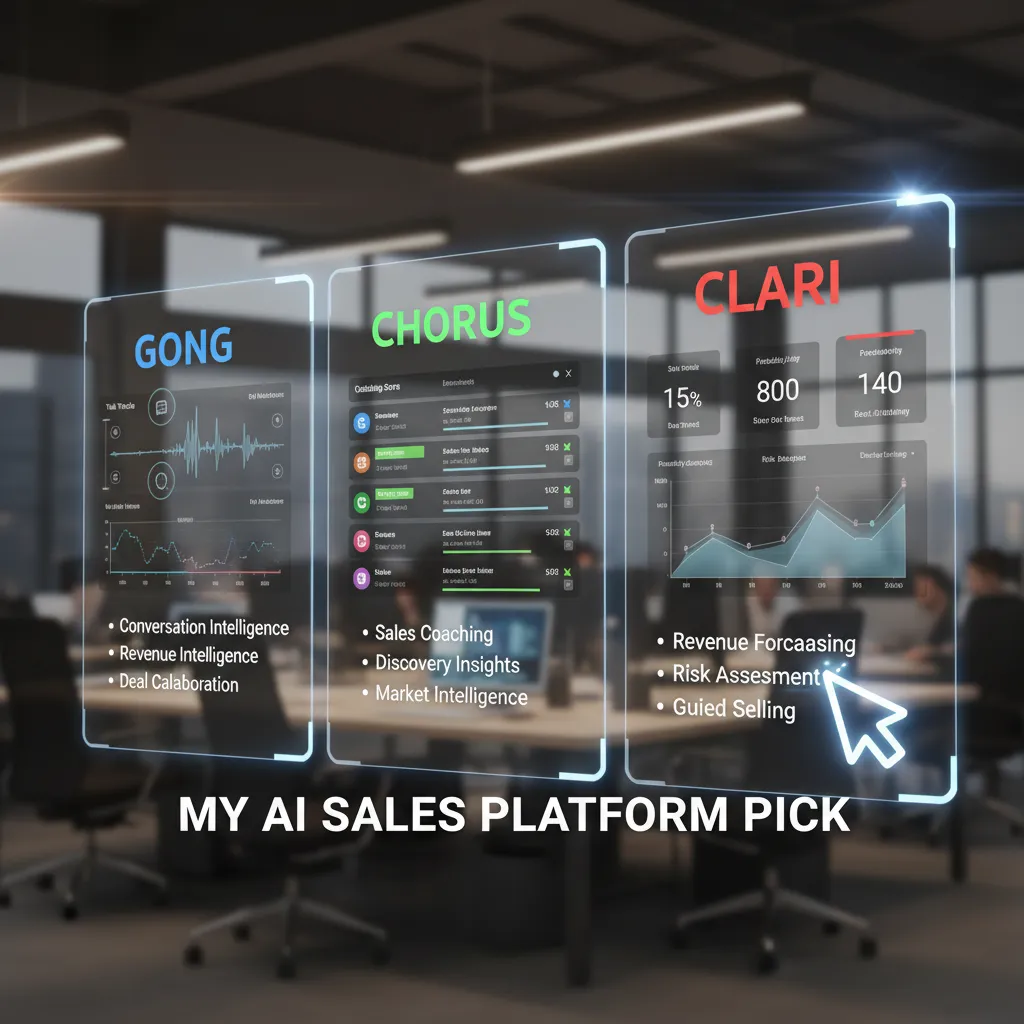
The first time I rolled out a conversation intelligence tool, I thought the hardest part would be getting reps to record calls. Nope. The real fight was over “truth”: whose version of the pipeline was real—the CRM, the forecast spreadsheet, or what buyers were actually saying on calls. That little tension is why this Gong vs. Chorus vs. Clari debate matters. These tools don’t just transcribe. They nudge behavior, reshape coaching, and—when they work—stop your forecast meeting from feeling like group therapy. In this post I’m not trying to crown a universal winner. I’m trying to help you pick the least-wrong option for your team, your timeline, and your tolerance for setup pain.
1) The “why now” moment for AI sales intelligence
My “why now” moment with AI sales intelligence wasn’t a shiny demo. It was a missed quarter. We were a few days from the end of the month when leadership pulled me into a frantic forecast call. Everyone had a different story: “Deal is solid,” “Procurement is slow,” “Legal is fine.” Then I opened the CRM and realized the notes were basically vibes—late updates, copy-paste summaries, and missing context from the calls that actually mattered.
That’s when I understood the problem: the CRM is where we report sales activity, but it’s not always where the truth lives. The truth is in the conversations—what the buyer asked, what we promised, what we avoided, and what we never followed up on.
What “AI” means here (in plain English)
When platforms like Gong, Chorus, and Clari say “AI,” I think of four practical jobs:
- Call recording + transcription: turning meetings into searchable text.
- Pattern detection: spotting trends like talk-time, pricing mentions, next steps, and risk words.
- Coaching nudges: prompting reps and managers with what to improve.
- Forecasting signals: using activity + conversation data to flag deal health.
Where these tools sit in the stack
These are not CRM replacements. They’re complements that plug into Salesforce/HubSpot and make the CRM cleaner by feeding it better inputs. Think: fewer “trust me” updates, more evidence.
Choosing an AI sales platform is like choosing a gym: the equipment matters, but your habits—especially coaching cadence—decide the results.
2) Cost Comparison Reality (and the budget traps)
When I priced Gong vs Chorus vs Clari for a 50-person sales team, the sticker shock was real. In most quotes I’ve seen, Gong lands around $1,600–$2,400 per user/year, while Chorus often comes in 50–60% less (roughly $700–$1,200 per user/year). That’s a wide gap in an AI RevOps budget.
| Platform | Typical $/user/year | 50 users (annual) |
|---|---|---|
| Gong | $1,600–$2,400 | $80k–$120k |
| Chorus | $700–$1,200 | $35k–$60k |
Clari is different: it’s more about forecasting and pipeline AI than call recording alone, so pricing can stack depending on modules. In practice, I treat Clari as a “second line item,” not a direct swap for Gong/Chorus.
Why cheaper sometimes wins
If my bottleneck is coaching capacity (managers can’t review enough calls), then paying extra for deeper analytics may not move the needle. A simpler tool that gets adopted fast can beat a premium platform that sits unused.
The budget traps nobody warns you about
- Admin time: permissions, integrations, and keeping fields clean.
- Onboarding: rep training + manager workflows.
- Call library setup: tagging, playlists, “gold calls,” and governance.
- Enablement scramble: “we need content yesterday” becomes a real cost.
What I’d buy with the savings
If Chorus is 50–60% less, I’d reinvest the difference into:
- One part-time coach or enablement lead.
- Better onboarding (playbooks + live practice).
- More experimentation with AI prompts, scorecards, and deal reviews.
3) Feature Deep Dive: coaching-first vs forecast-first
When I compare Gong vs Chorus vs Clari, I don’t start with “who has more AI.” I start with what problem shows up every week: is it the forecast call, or the rep coaching session? These platforms feel different because they are built around different meetings.
Gong feels like a “deal lab”
Gong’s AI shines when I want to inspect a deal like a scientist. It’s less about “did the rep say the right thing?” and more about “is this deal actually real?” I see value in:
- Hidden deal risk signals (slipping timelines, weak next steps, missing stakeholders)
- Deal-level predictive analytics that flags patterns across similar wins/losses
- Pipeline analytics intelligence to spot where stages clog and why
Chorus feels like a “coach in your pocket”
Chorus is where I go when I’m focused on rep behavior and call quality. It’s practical, simple, and very “what do I fix on the next call?” Helpful coaching-first features include:
- Talk-to-listen ratios to reduce rep monologues
- Filler words and pacing cues that improve clarity
- Sentiment and engagement signals to spot buyer interest
- Automated next steps detection so follow-ups don’t get missed
Where Clari fits: forecast-first discipline
Clari fits when leadership wants cleaner rollups and tighter inspection. It’s built for forecasting discipline: consistent deal hygiene, clear commit logic, and fewer “surprises.” The Copilot angle matters when managers need help turning messy pipeline notes into a reliable forecast view.
My rule of thumb: pick the platform that fixes your weekly meeting—forecast call (Clari) vs 1:1 coaching (Chorus) vs deal inspection (Gong).

4) Transcription Intelligence Quality (and why it changes trust)
In any AI sales platform, transcription is the quiet foundation. If the words are wrong, the “insights” are basically cosplay. I’ve learned that the fastest way to lose trust in a dashboard is to hear a rep say one thing, then see the transcript claim something else. Once that happens, every keyword trend, talk ratio, and “next step” suggestion feels shaky.
Why accuracy changes everything
Most coaching moments live in small details: pricing numbers, competitor names, dates, and exact objections. When those details are misheard, the platform can push the wrong narrative. That’s not just annoying—it can lead to bad coaching and messy forecasts.
Gong: strong accuracy, minor quirks
In my experience, Gong is often praised for solid transcription accuracy. I generally agree. The main issue I’ve run into is occasional redaction quirks—where sensitive info gets hidden a little too aggressively or in odd places. It’s annoying, but not fatal, and it usually doesn’t break the core coaching workflow.
Chorus: “hit or miss” when it matters most
Chorus can feel more hit or miss on transcription quality, especially on noisy calls or with accents. That’s painful when I’m coaching specifics like “what did the buyer say about budget?” or “did we confirm the timeline?” If the transcript is off, I spend more time replaying audio than using the AI.
My practical workaround
- Spot-check samples: I review 5–10 calls across reps, regions, and call types.
- Set expectations: I tell the team transcripts are a starting point, not a legal record.
- Choose “good enough” when speed matters: for trend tracking, near-perfect text isn’t always required.
5) Language Support Transcription: global team, global pain
The moment you go multilingual, your “best” call library becomes English-only overnight (ask me how I know). One quarter, we expanded into new regions, and suddenly my coaching clips, keyword trackers, and “top objections” playlists stopped working for half the team. The calls were still great—but the AI couldn’t reliably transcribe, label, and search them across languages, so the insights stayed locked away.
Why transcription language support changes everything
If your reps sell in more than one language, transcription isn’t just about readable notes. It affects:
- Search: finding the same objection across regions
- Coaching: sharing clips without awkward “can you translate this?” moments
- Consistency: keeping scorecards and talk tracks comparable
Gong: the multilingual advantage
Gong’s big edge here is breadth and consistency: 70+ languages with solid quality. That matters when you want one global library, not separate “English insights” and “everything else” folders. In practice, it makes cross-region coaching feel normal instead of forced.
Chorus: good coverage, English-first feel
Chorus supports 30+ languages, but it’s clearly optimized for English. If most of your pipeline is English-speaking and you only have a few non-English calls, that’s usually fine. But if you’re trying to run the same enablement program across regions, you may feel the gaps faster.
Decision shortcut I use
When you sell in multiple regions, multilingual transcription becomes a buying criterion, not a nice-to-have.
If your revenue depends on non-English calls, I treat language support like a core feature—right up there with AI insights, coaching workflows, and call search.
6) Setup and Implementation: speed vs “enterprise-grade” gravity
When I compare Gong vs Chorus vs Clari, setup is where the “AI” promise meets real work. “Being live” is not just turning on call recording. For me, it means the full loop is running: calls are captured, data lands in the CRM, dashboards answer basic questions, and managers have a repeatable coaching workflow.
What “live” actually includes
- Recording + consent: dialer/Zoom/Meet connections, legal language, and user permissions
- CRM sync: matching calls to accounts/opportunities, field mapping, and activity logging
- Dashboards: baseline views for reps, managers, and leadership
- Coaching workflows: scorecards, playlists, deal reviews, and weekly habits
Chorus: momentum in 2–4 weeks
In my experience, Chorus is the fastest path to “operational.” Many teams can get value in 2–4 weeks because the core pieces (recording, CRM sync, and simple coaching) come together quickly. If you need adoption fast—new managers, a growing SDR team, or a tight quarter—Chorus tends to feel lighter and easier to roll out.
Gong: ~3 months, but deeper gravity
Gong often takes closer to ~3 months to feel fully implemented, especially if you want deep analytics, custom views, and strong governance. The trade-off is “enterprise-grade” gravity: more configuration, more training, and a steeper learning curve. I think it’s worth it when leadership will actually use the insights (deal risk, rep behavior trends, and pipeline patterns) week after week.
Clari Copilot alternatives: faster without a big project
If leadership wants speed and less configuration, I look at Clari Copilot (and similar approaches) as a practical alternative. It can deliver AI-driven visibility with fewer moving parts—useful when you want impact quickly without turning implementation into a major internal program.
7) Strengths and Weaknesses (the stuff reps complain about)
When I compare Gong vs Chorus vs Clari, I try to separate what leaders love from what reps actually feel every day. These are the AI platform strengths—and the common complaints I hear on the floor.
Gong: strong inspection, but can feel “big brother”
- Strengths: Deeper deal risk signals (next steps, multi-threading gaps, stalled momentum), a broader integration ecosystem, and stronger transcription quality—especially on messy calls.
- Best fit: Inspection-heavy orgs where leadership wants consistent deal reviews and tight process.
- Rep complaints: Lots of alerts and scorecards can feel noisy. Some reps feel monitored, and admins may spend time tuning fields, trackers, and permissions.
Chorus: clear coaching workflows, lighter lift
- Strengths: Coaching workflow clarity, faster rollout, and often a lower cost profile. Managers can standardize what “good” looks like and ramp new reps faster.
- Best fit: Teams focused on rep development and manager consistency.
- Rep complaints: Fewer “deep” deal risk signals than Gong in some setups. Integrations can feel more dependent on your ZoomInfo stack choices.
Clari: forecasting discipline, less call-level magic
- Strengths: Forecasting and analytics discipline—pipeline inspection, commit hygiene, and rollups that force clean inputs.
- Best fit: When the forecast is the product and leadership needs predictable numbers.
- Rep complaints: More time in fields and updates. If your CRM data is messy, Clari will surface that pain fast.
ZoomInfo Integration Reality (Chorus)
Chorus has been under ZoomInfo since July 2021. In practice, that can mean tighter alignment with ZoomInfo data and workflows, but also “roadmap vibes” that prioritize the broader ZoomInfo platform. I’ve seen teams love the bundle—or worry about flexibility outside that ecosystem.

8) Top Gong Competitors 2026 + my decision checklist
When I compare Gong vs Chorus vs Clari, I also zoom out to the wider AI sales platform market. A few names keep showing up in real buying cycles, and they matter because they “slide” into different parts of the stack.
Quick tour of the wider market
Revenue Grid often fits when the team wants stronger pipeline process and CRM-driven guidance without making every workflow about call recordings. People.ai is usually about activity capture and revenue productivity—great if your biggest issue is “we don’t know what reps are doing” and your CRM is missing key touches. Aviso tends to come up when leaders want forecasting help and deal risk signals that sit closer to revenue operations than frontline coaching.
When “Clari alternatives” is the search you should be doing
If your pain is forecast accuracy—missed commits, sandbagging, and end-of-quarter panic—then I stop searching “Gong competitors” and start searching Clari alternatives. That’s the moment the problem is less about conversation intelligence and more about predictability, inspection, and rollups that leadership trusts.
My slightly opinionated decision checklist
I ask five questions: Is our data hygiene good enough for AI insights to be real? Do we have a consistent coaching cadence (weekly 1:1s, deal reviews), or will the tool become shelfware? What integrations are non-negotiable (CRM, calendar, dialer, Zoom/Teams)? Do we need global language support for calls and notes? And what’s our timeline—do we need value this quarter or can we run a longer rollout?
What success looks like 90 days in
In my experience, the best outcome is simple: fewer surprise slips, better 1:1s with real examples, and cleaner next steps that actually show up in the CRM—so the forecast feels calm instead of chaotic.
TL;DR: Gong is the heavyweight for revenue intelligence software and pipeline analytics (and strong multilingual transcription). ZoomInfo Chorus is the scrappy coaching-first option that’s often 50–60% cheaper and faster to implement. Clari shines when forecasting discipline is the main problem, especially if you want quicker setup than a full Gong rollout. None replaces your CRM; they complement it.


Comments
Post a Comment