BambooHR vs Workday vs Rippling — 2026 Comparison Guide
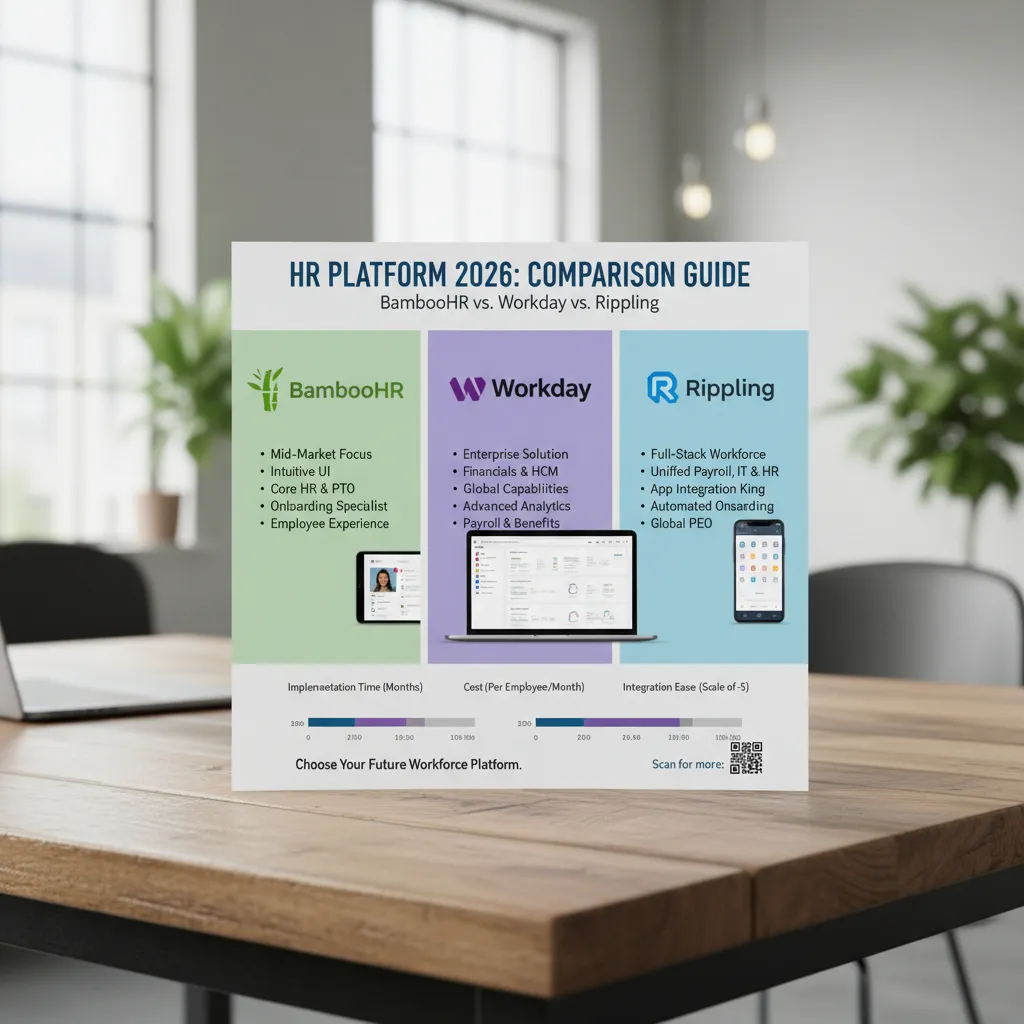
I still remember the first time I watched an HR demo and thought: this could either save our team dozens of hours or become another abandoned login. Over the last few years I've tested BambooHR, Rippling and seen Workday in several enterprise pilots. In this piece I’m sharing what I learned — the concrete numbers, the human costs, and the surprising trade-offs that rarely show up in vendor slides.
Why This Showdown Matters (Overview BambooHR)
When I compare BambooHR vs Workday vs Rippling for modern HR teams, I start with a simple question: how fast can people actually use it well? In my on-the-ground experience helping teams roll out HR systems, BambooHR often wins when ease-of-use and onboarding speed are the top priorities. It’s the platform I see adopted quickly, with fewer “how do I find this?” messages and less training time.
Where BambooHR Fits Best
BambooHR is built for small to mid-sized businesses, typically around 20–500 employees. That size range matters because HR teams in this bracket usually need strong basics—clean employee records, simple workflows, and self-service—without the heavy setup that larger enterprise tools can require. BambooHR’s focus on user-friendly HR and employee self-service shows up in everyday tasks like requesting time off, updating personal details, and completing onboarding steps.
In practice, BambooHR feels like it was designed for the HR generalist who needs things to “just work” without a long implementation.
Quick Snapshot: Market Positions in 2026
These three platforms compete, but they don’t aim at the same core buyer. Here’s how I frame it when advising teams:
- Workday → enterprise organizations that need deep HR, finance, and complex reporting at scale
- Rippling → growth-stage companies (often 50–1,000+) that want HR plus broader automation, including IT workflows
- BambooHR → SMB to mid-market teams that value clarity, speed, and a friendly employee experience
Why This Comparison Is Worth Your Time
Choosing an HR platform in 2026 isn’t just about a feature checklist. It impacts how quickly you can hire, how clean your data stays, and how confident employees feel using self-service tools. BambooHR’s strength is often day-to-day usability, but the right choice depends on what you need beyond core HR.
What I’m Evaluating in This Guide
To keep this comparison practical, I’m focusing on:
- Features that matter for real HR workflows (onboarding, time off, reporting, performance)
- Pricing and how costs scale as headcount grows
- Integrations with payroll, benefits, accounting, and recruiting tools
- IT & payroll scope (what’s native vs what requires add-ons or partners)
- Real-world fit based on team size, complexity, and internal resources

Head-to-Head: Key Features (Key Features, Employee Database, Applicant Tracking)
Key Features at a Glance
When I compare BambooHR vs Workday vs Rippling for core HR needs, I look at how each platform handles the basics: where employee data lives, how hiring flows, and how well time and performance tools connect to reporting. These “everyday” features often matter more than flashy add-ons.
| Feature | BambooHR | Workday | Rippling |
|---|---|---|---|
| Employee database | Unified records + reporting | Enterprise HCM data model | Unified HR + IT employee graph |
| Applicant tracking | Built-in, straightforward ATS | Robust recruiting suite (enterprise) | ATS via native integrations |
| Time off / time tracking | Popular Time Off for small teams | Deep time/absence options (complex) | Time ties into payroll + IT provisioning |
| Reporting & performance | Strong reports + performance modules | Powerful enterprise analytics | Good cross-system reporting (HR/IT) |
Centralized Employee Database
BambooHR puts a lot of focus on a clean, centralized employee database. In my experience, it’s built for fast access to employee records, documents, and standard reports without a steep learning curve.
Rippling also centralizes employee data, but it goes a step further by connecting HR and IT. That means the same employee profile can drive onboarding steps like app access and device setup, which is useful if you want fewer handoffs between teams.
Workday is typically the most “enterprise” option here. It’s designed for complex org structures and large-scale data governance, but it can feel heavier if you just want simple employee record management.
Applicant Tracking (ATS)
BambooHR includes a straightforward ATS that covers the essentials: posting jobs, tracking candidates, and moving them through stages. For many small to mid-sized teams, that simplicity is the point.
Rippling often approaches ATS needs through many native integrations. I like this approach when a company already has a preferred recruiting tool and wants it connected to onboarding, payroll, and IT provisioning.
Workday tends to shine for larger organizations that need structured recruiting workflows, approvals, and deep reporting across hiring pipelines.
Time Off, Time Tracking, and Reporting
- BambooHR: Time Off is especially popular with small teams, and reporting plus performance modules are strong for its category.
- Rippling: Time tracking can connect tightly to payroll and IT workflows, which helps reduce manual steps.
- Workday: Advanced reporting and analytics are a major strength, especially for enterprise-wide visibility.
Pricing Structure & Implementation Process (Pricing Structure, Pricing Per Employee)
Pricing Structure
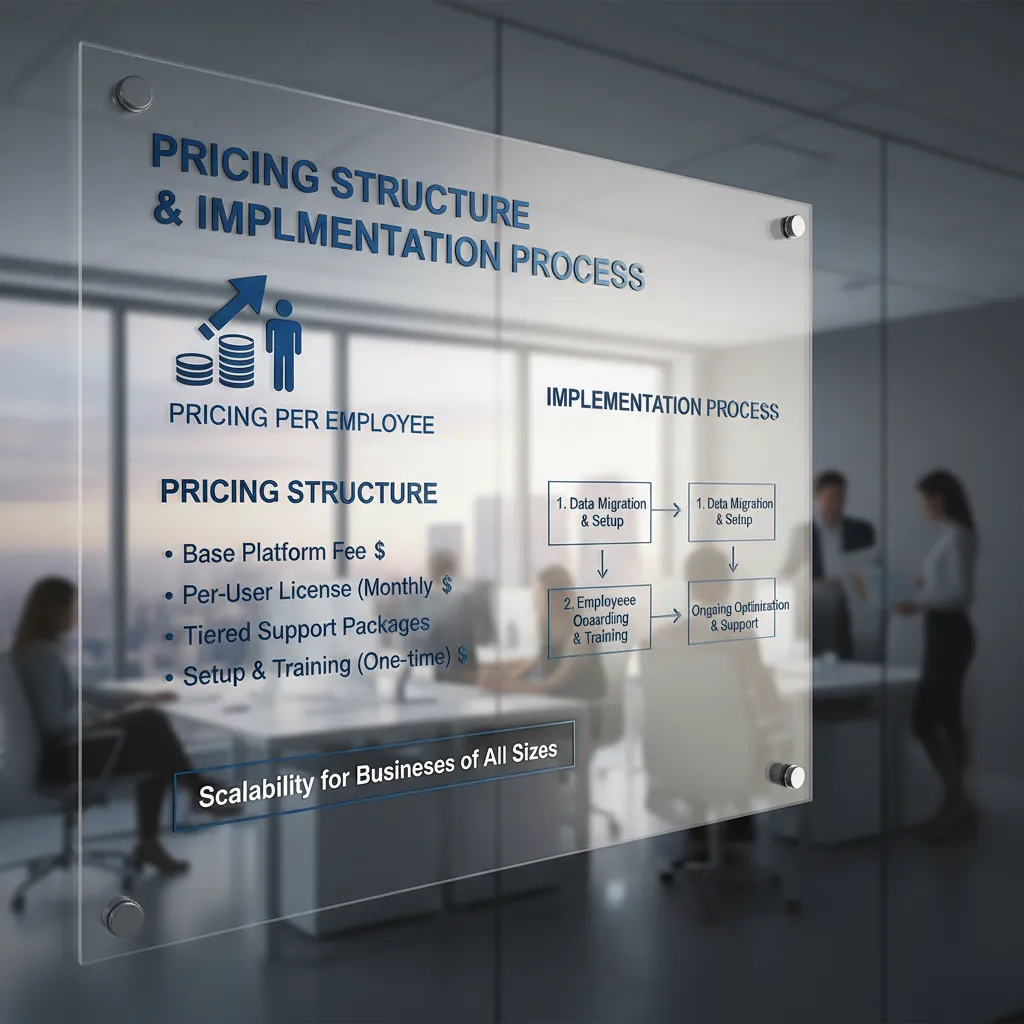
When I compare BambooHR vs Workday vs Rippling, pricing is where the differences feel the most dramatic. These HR platforms don’t just charge “per user”—they often bundle features, add platform fees, or require enterprise contracts.
- BambooHR: Published starting price is often reported as $10 per employee/month, or a $250 flat monthly price for teams of ≤25 employees. In my experience, this is easier to understand because it’s closer to a single HR subscription.
- Rippling: Reported starting price is commonly listed as $8 per employee/month plus a $35 platform fee. The important note is that Rippling pricing can get complex fast because you add modules (like payroll, IT management, and benefits).
- Workday: Workday typically comes with high licensing and implementation costs. It’s usually priced through enterprise agreements, so it’s less “published pricing” and more “quote-based,” which fits large HR teams and bigger budgets.
Pricing in HR software is rarely apples-to-apples. I always look at the base fee, required modules, and implementation costs before I compare totals.
Pricing Per Employee (What It Can Look Like)
| Platform | Published starting price (reported) | What can raise the total |
|---|---|---|
| BambooHR | $10/employee/month or $250 flat (≤25 employees) | Add-ons, higher tiers, extra features |
| Rippling | $8/employee/month + $35 platform fee | More modules (payroll, IT, benefits), platform fee impact on small teams |
| Workday | Enterprise quote | Licensing scale, implementation services, integrations |
Implementation Process (Time-to-Value)
Implementation is the hidden “price” in HR. BambooHR tends to deliver faster time-to-value because it’s designed for simpler setup and standard HR workflows. Rippling often takes longer because you’re configuring multiple systems (HR + payroll + IT), and each module adds decisions. Workday usually has the longest cycle due to deeper configuration, approvals, and enterprise integration needs.
Security, IT Management & Global Payroll (IT Management, Global Payroll, Security Controls)
IT Management: where Rippling stands out
When I compare BambooHR vs Workday vs Rippling for HR teams that also touch IT, Rippling is the clear standout. Rippling connects HR records directly to device and app access, so onboarding and offboarding can happen automatically. That matters when IT needs to ship a laptop, create accounts, and remove access the minute someone leaves.
- Rippling: strong device management and IT provisioning tied to employee profiles.
- Workday: typically relies on integrations and enterprise IT processes rather than “all-in-one” IT tooling.
- BambooHR: focuses on core HR; IT workflows usually require third-party tools.
Security controls and compliance depth
Security is not just a checklist—it’s how well the platform supports access control, audits, and consistent processes across teams. In my view, Workday and Rippling generally offer stronger enterprise-grade security controls, especially for larger orgs with complex roles and approvals. BambooHR covers compliance basics that are often enough for SMBs, but it may feel lighter if you need deep governance across many departments and regions.
My rule: the more systems you connect (HR, payroll, IT), the more you need clear roles, logs, and repeatable access policies.
Global payroll: coverage and practical reach
Global payroll is where differences become very real. If you hire across borders, you want fewer handoffs and fewer vendors. Rippling supports payroll in 100+ countries, which can simplify expansion and reduce the need for separate local payroll providers. BambooHR has a more limited global payroll reach, so international teams may require additional partners or integrations. Workday can support global needs, but it often depends on your configuration and payroll ecosystem.
| Area | BambooHR | Workday | Rippling |
|---|---|---|---|
| IT provisioning | Limited | Integration-driven | Built-in strength |
| Security controls | SMB-focused | Enterprise-grade | Enterprise-grade |
| Global payroll | More limited | Varies by setup | 100+ countries |
Data governance: choosing the “source of truth”
Before I pick a platform, I ask one question: which system will be the source of truth for employee data across HR, payroll, IT, and finance? If HR updates don’t reliably flow to payroll and access controls, you risk errors like wrong pay, delayed deprovisioning, or messy audits. Even a simple policy like terminate_user_access_on_end_date = true
can prevent real security gaps when it’s enforced consistently.
Real-world Use Cases & Buyer Recommendations (Employee Experience, Customer Support)
When I compare BambooHR vs Workday vs Rippling in real HR teams, I look less at feature lists and more at what employees and admins feel every day: how fast tasks get done, how often people need help, and how painful support tickets become.
If you’re a startup under 100 employees
If I’m advising a small team, I usually point to BambooHR first. It’s built for core HR needs like onboarding, time-off tracking, and basic reporting without a long setup. The pricing is typically easier to understand, which matters when you’re watching cash flow and don’t want surprise add-ons.
- Best fit: simple HR processes, fast rollout, clear ownership
- Employee experience: clean, friendly interface that people actually use
- Support reality: fewer moving parts often means fewer “how do I…?” requests
If you’re scaling across countries or need IT automation
When a company is hiring in multiple regions or wants HR and IT to run together, Rippling becomes the operational match. I’ve seen teams reduce manual work by connecting onboarding with device setup, app access, and payroll steps in one workflow. If global payroll and integrations are high on your list, Rippling is usually the most direct path.
- Best fit: multi-country growth, automation, HR + IT workflows
- Employee experience: modern UI and “one place” feel for tasks
- Support reality: more integrations can mean more edge cases—plan admin time
Enterprise buyers with complex reporting needs
For large organizations, Workday still stands out for deep analytics, governance, and scale. If you need advanced reporting across many business units, it can be compelling. The tradeoff I see most often is complexity: implementation takes longer, change management is real, and budgets need to cover both setup and ongoing admin support.
In enterprise HR, the platform is only half the project—the other half is process design and adoption.
Quick buyer checklist (employee experience + customer support)
- BambooHR: best for user-friendly HR basics and quick adoption
- Rippling: best for cross-functional workflows and automation at scale
- Workday: best for enterprise depth, but expect heavier support needs
Pros, Cons, Alternatives & The Final Verdict (BambooHR vs Rippling, Workday Alternatives)
Pros: where each HR platform shines
When I compare these three HR platforms side by side, I see clear strengths that fit different teams. BambooHR is the easiest for me to recommend when a company wants a clean, people-first HR system. It feels simple to run day to day, the pricing is usually more transparent than enterprise tools, and the onboarding experience is a standout for growing teams that need consistency without heavy setup.
Rippling wins when I need automation and connected workflows. Its deep integrations help HR data flow into payroll, apps, and device management, which is why it often feels like more than “just HR.” If your goal is to reduce manual work across HR, IT, and payroll, Rippling’s approach can be a big advantage.
Workday is built for scale. In larger organizations, its enterprise analytics, reporting depth, and ability to support complex structures are hard to ignore. If you need strong governance and advanced insights across the business, Workday is often the benchmark.
Cons: what to watch out for
On the downside, BambooHR can feel limited if I’m trying to manage IT operations or support broad global payroll needs. It’s strong for core HR, but it’s not designed to be an all-in-one operations hub.
Rippling can get complex fast. Pricing can be harder to predict because it’s modular, and the learning curve is real when you start layering automation, app management, and global workflows.
Workday is the most demanding option. Cost is higher, and implementation can take significant time, planning, and internal resources. For many mid-sized teams, that complexity is more than they need.
Alternatives to consider (including Workday alternatives)
If Workday feels too heavy, I often look at HR Cloud as a mid-market Workday alternative, especially for teams that want modern HR features without enterprise overhead. ADP is a common choice when payroll reliability and compliance are the priority, while Paylocity can be a strong fit for mid-sized companies that want a balanced HCM suite. Depending on your hiring focus, smaller ATS or lightweight HCM tools may also be smarter than overbuying.
The final verdict
My final take is simple: choose based on your primary operational need. If you want simplicity and a people-centric HR experience, I’d pick BambooHR. If you want automation across HR, payroll, and IT with room to scale globally, Rippling is the better bet. If you need enterprise analytics and large-scale structure support, Workday is the long-term platform—assuming you’re ready for the cost and rollout effort.
TL;DR: BambooHR is ideal for small to mid-sized teams that want simplicity and transparent pricing; Rippling suits growth-stage firms needing deep IT and payroll automation; Workday remains the enterprise choice but is costly and complex.


Comments
Post a Comment