AI Supply Chain Optimization: Practical Playbook
I still remember the week our “simple” promo blew up demand: sales celebrated, the warehouse panicked, and I spent a late night staring at two spreadsheets that disagreed like they’d never met. That’s when AI stopped feeling like a buzzword and started feeling like a flashlight. In this guide, I’ll walk through the AI Supply Chain moves that actually held up in the real world—predictive demand, real-time visibility, inventory optimization, and the newer wave: multi-agent and agentic systems that don’t just recommend, but coordinate decisions. I’ll keep it practical, slightly opinionated, and honest about where AI helps… and where it absolutely needs adult supervision.
1) Why AI Supply Chain matters (my ‘two spreadsheets’ moment)
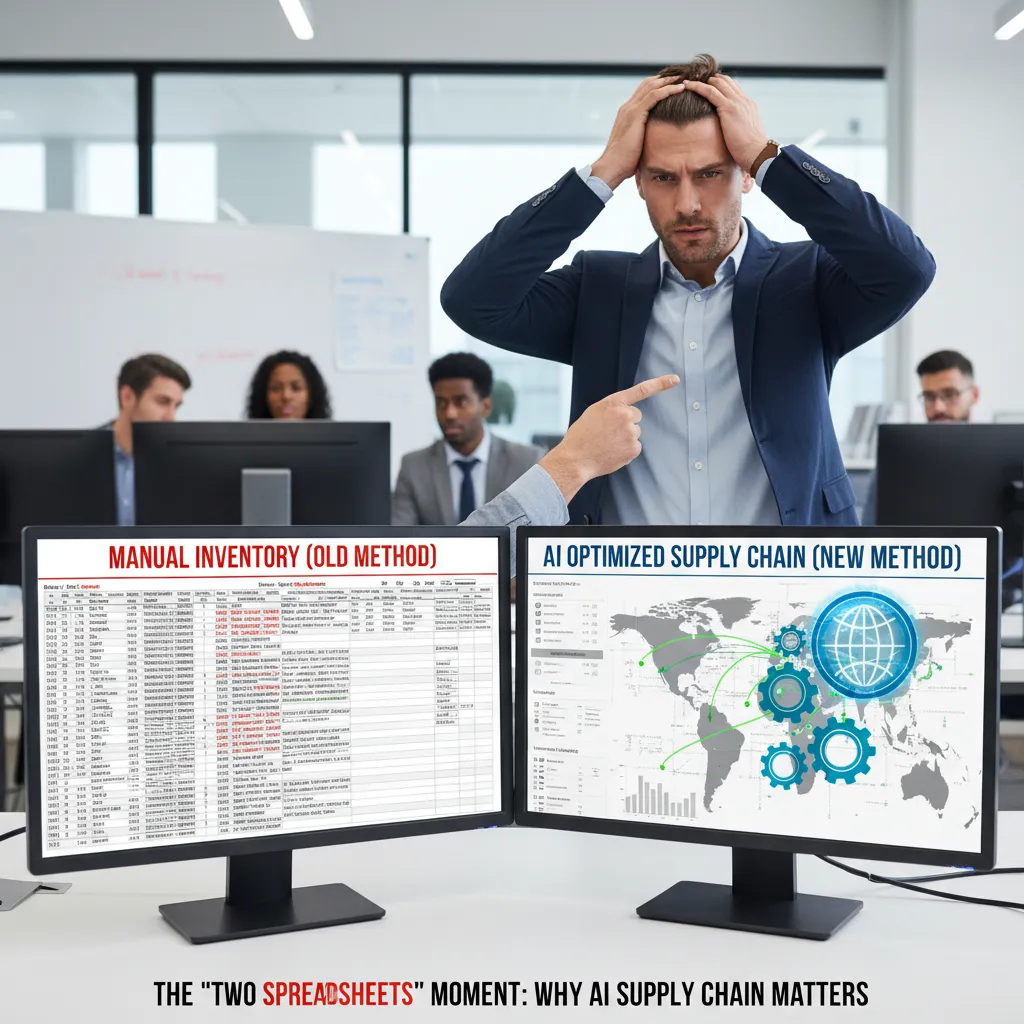
I learned the value of AI in supply chain the hard way—during what I now call my “two spreadsheets” moment. We ran a big promotion, and demand spiked fast. Sales had one forecast. Operations had another. I had two spreadsheets open, trying to “average” the truth while orders piled up. By the time we realized the mismatch, our best-selling SKU was short, customer service was on fire, and we paid for emergency expediting that wiped out most of the promo margin.
That day made Supply Chain Optimization feel very real to me. In plain language, it means setting up your planning and execution so you get:
- Fewer surprises (less stockouts, fewer last-minute changes)
- Faster decisions (signals show up early, not after the damage)
- Less waste (lower excess inventory, fewer rush shipments, less rework)
What’s changing by 2026
When I look at supply chain trends for 2026, the biggest shift is that AI-driven supply chains are moving from pilots to production. Teams are done “testing a model in a corner.” They want AI that runs inside daily workflows—forecasting, replenishment, transport planning, and exception management—so planners spend less time chasing data and more time fixing the right problems.
Connected Intelligence beats siloed decisions
The missing piece in my promo failure wasn’t effort—it was connection. I now think of the goal as Connected Intelligence: linking procurement, finance, and CRM so decisions aren’t made in silos. If CRM sees a promo lift early, procurement can adjust lead-time risk, finance can see cash impact, and operations can plan capacity before expediting becomes the only option.
Running a supply chain without AI is like driving at night with fogged headlights—you can move forward, but you’ll react late and brake hard.
2) Predictive Demand that ops folks will actually trust
I used to push one-number forecasts because they were easy to explain. Then I got burned: the “perfect” number hid the risk, and ops teams paid for it in expediting, stockouts, and awkward meetings. What I changed was simple: I stopped asking AI for a single answer and started asking for a range plus the reasons behind it.
Blend the signals ops already knows are real
In AI-powered supply chain optimization, trust comes from using signals that match how the floor actually runs. My demand forecasting inputs now blend:
- Promotions (start/end dates, discount depth, channel)
- Seasonality (weekly patterns, holidays, weather where relevant)
- Lead times (not just averages—variance by lane and supplier)
- Supplier performance (OTIF, fill rate, late shipment patterns)
- Returns (rate by SKU, reason codes, and return lag)
Explain AI outputs in ops terms
Instead of “Forecast = 1,240 units,” I share:
- Confidence bands: “We’re 80% sure demand lands between 1,050–1,380.”
- Best/worst cases: “If promo lift doubles, worst case is 1,650.”
- Reorder triggers: “Reorder when projected on-hand crosses the risk line (service level + lead time buffer).”
Ops doesn’t need a magic number. They need to know what could happen and what we’ll do if it does.
Mini scenario: the “Tuesday spike” TikTok moment
Say sales jump 4x on Tuesday after a TikTok-style post. The model should react fast only if it sees confirming signals: sustained traffic, repeat orders, low cancel rates, and similar spikes in multiple regions. It shouldn’t overreact if it’s one influencer, one geography, and returns start climbing by Thursday.
Practical checklist (no-blame weekly review)
- Data hygiene: fix SKU mapping, promo calendars, and stockout flags (stockouts are not “zero demand”).
- Granularity: forecast at SKU-location-week, then roll up for planning.
- Weekly review: compare forecast vs. actual, log drivers, and adjust rules—not people.
3) Real-Time Visibility: stop chasing trucks with emails
The before-state: inbox logistics
I’ve lived the “visibility” process that is really just email forwarding. Status updates arrive as screenshots from carrier portals, someone pastes a tracking link into a chat, and then we hold the classic “who owns this?” meeting. By the time we agree on what happened, the shipment is already late, the customer is already asking, and the warehouse is already guessing how to staff the dock.
What real-time visibility actually needs
In AI supply chain optimization, real-time visibility is not a map with dots. It’s a system that turns live data into decisions. The essentials I look for are:
- Shipment tracking across modes and carriers, in one place (for example, project44).
- Exception alerts that trigger when something is off-plan, not when someone remembers to check.
- ETA confidence, not just an ETA—how likely is on-time delivery based on current signals?
- Root-cause tagging so delays become learnings (carrier miss, port congestion, dwell time, paperwork, weather).
Where AI fits (without making it complicated)
AI helps me connect messy operational data and make it usable. Tools like Cognite can add industrial data context so events (like a gate-out scan) match the right shipment and site. For network and scenario modeling, I’ve seen teams use Llamasoft to test “what if we reroute?” before we act.
How visibility feeds decisions
Once I trust the signals, I can act fast:
- Re-routing freight when risk crosses a threshold.
- Customer promises based on confidence, not hope.
- Warehouse labor shifts when ETAs change, so staffing matches arrivals.
Quick win I’d take again
I’d build an exception dashboard that only shows what’s off-plan. No scrolling through “green” shipments. Just the late, stuck, or high-risk loads—each with an owner, a root-cause tag, and the next best action.

4) Inventory Optimization + dynamic inventory: my ‘less safety stock, more sleep’ chapter
Inventory optimization is a constant balancing act between service level (not running out), cash (not overbuying), and warehouse space (not turning aisles into storage). Before I used AI in my planning, I treated safety stock like a blanket: if I felt cold, I added more. It worked—until it didn’t. The business paid for it in slow-moving stock, write-offs, and crowded racks.
Dynamic inventory: buffers that move with reality
Dynamic inventory means I stop using one “set it and forget it” buffer. Instead, I recalculate safety stock based on what is changing right now:
- Demand variance: spikes, seasonality, and promo noise
- Lead time shifts: transit delays, port issues, production swings
- Supplier reliability: fill rate, late shipments, quality holds
In practice, AI-powered supply chain optimization helps me detect these shifts early and adjust reorder points before stockouts or excess happen.
When inventory planning meets constraints
Spreadsheets love clean math. Operations doesn’t. My plans hit real-world limits like:
- MOQ constraints: I may need 5,000 units even if I only need 2,000
- Shelf-life: “extra coverage” becomes waste if it expires
- Slow movers: they look fine until they quietly block cash and space
“The most dangerous inventory is the kind that doesn’t scream—because it sells just enough to hide.”
Warehouse operations: where AI becomes physical
Inventory optimization is not only a planning problem; it’s also a warehouse problem. I use dynamic slotting and prescriptive replenishment so the system recommends what goes where and when to refill.
| Decision | AI-driven input | Outcome |
|---|---|---|
| Slotting | Pick frequency + size | Less travel, faster picks |
| Replenishment | Real-time demand + lead time | Fewer emergencies |
My wildcard metaphor: inventory is like pantry management—until you have 40 pantries across regions. Then “just buy a little extra” becomes a very expensive habit.
5) Production Optimization & Sales Operations Planning: the messy middle
In AI-powered supply chain optimization, this is where things get real: the space between what Sales wants, what Operations can make, and what Finance will fund. I’ve learned that traditional S&OP often turns into one monthly “big meeting” where everyone defends their numbers. With AI, I can shift S&OP from a single event to continuous scenario planning.
AI turns S&OP into “what-if” planning
Instead of debating one forecast, I run multiple scenarios: demand up 10%, a supplier late by two weeks, overtime capped, or a promo pulled forward. The goal is not a perfect plan—it’s faster alignment.
- Baseline plan: what we expect to happen
- Risk plan: what we do if constraints tighten
- Upside plan: what we do if demand spikes
Production scheduling that respects real constraints
Scheduling is where AI can help the most, because it can propose sequences that humans struggle to compute quickly. A good model considers:
- Labor: skills, shifts, and overtime rules
- Changeovers: time, cost, and cleaning requirements
- Materials: shortages, shelf life, and inbound timing
I treat AI schedules as recommendations, then planners adjust for shop-floor reality.
Virtual twins: test before you disrupt
A virtual twin (a lightweight digital copy of the line or plant) lets me test scenarios before I touch the real schedule. I can simulate a new product launch, a line speed change, or a different batch size and see the impact on service, cost, and throughput.
Local-for-local as a resilience move
When global lead times get shaky, local-for-local manufacturing can reduce risk—but it can raise unit cost. AI helps me compare trade-offs across lanes, plants, and service targets, so I know when “local” is worth it.
My candid takeaway: the hardest part is agreeing on one version of constraints across teams.
If Engineering, Quality, and Operations each define capacity differently, AI won’t fix the argument—it will just scale it. The work starts with shared rules.
6) Autonomous logistics, multi-agent systems, and agentic procurement (the ‘new frontier’)
Autonomous logistics: where I’ve seen it shine (and stall)
When people say AI in supply chain, I often start with the physical layer: robotics and automation in picking, yard moves, and delivery. I’ve seen robots shine in repeatable work—case picking in stable aisles, pallet moves, and simple task sequencing. The stall happens when the environment is messy: mixed-SKU totes, damaged labels, last-minute priority changes, or poor master data. In practice, the “AI” win is not magic—it’s tight integration between WMS/TMS, sensors, and clear exception handling.
Multi-agent systems: many small brains, not one monolith
Instead of one big model trying to optimize everything, I’m seeing value in multi-agent systems: separate agents that each own a decision and negotiate with each other. One agent balances inventory across nodes, another plans transportation, another manages dock schedules. They share constraints and trade-offs in near real time, which can be more flexible than a single optimizer.
- Inventory agent: proposes rebalancing moves based on service targets and safety stock.
- Transport agent: prices lanes, consolidates loads, and flags capacity risk.
- Ops agent: checks labor, dock doors, and cut-off times before approving plans.
Agentic procurement: what I’d automate first vs never
For agentic procurement, I’d automate the work that is high-volume and rules-driven first:
- Supplier scorecards (OTIF, quality, lead time drift)
- Risk monitoring (news, sanctions, weather, financial signals)
- Contract review for standard clauses and deviations
What I would never fully automate: final supplier selection for strategic categories, relationship management, and any decision that could create compliance or ethical risk without human sign-off.
Risk mitigation: continuous, not quarterly
The real shift is moving from quarterly reviews to continuous monitoring. I like simple triggers: “lead time +20%,” “defect rate spike,” “port congestion,” then an agent drafts actions (alternate source, expedite, adjust reorder points) for approval.
Job reality check
Automation changes roles. Headlines about Amazon cuts and restructuring pressure are a reminder: the work doesn’t disappear, but it moves toward exception management, vendor governance, and system oversight.
7) AI scaling: from shiny pilot to boring reliability (my checklist)
In AI-powered supply chain optimization, the pilot is the easy part. Scaling is the unglamorous work: stable data pipelines, clear ownership, and constant monitoring. I learned that AI does not fail because the model is “bad.” It fails because the inputs change, the process is unclear, or nobody is accountable when results drift.
The scaling reality: pipelines, owners, drift
To move from a demo to daily operations, I treat data like a product. I define who owns each dataset (orders, inventory, carrier events), how often it refreshes, and what “good” looks like. Then I watch for drift: demand patterns shift, lead times change, and supplier behavior evolves. If I can’t detect drift early, I can’t trust the recommendations.
Where AI should sit in the stack
For real impact, AI must live as an operational layer inside the systems teams already use: TMS for transportation decisions, WMS for warehouse priorities, and procurement tools for supplier and pricing choices. The biggest gains come when I connect these to CRM and finance—what I call Connected Intelligence—so service, cost, and cash decisions align instead of fighting each other.
Guardrails for “autonomous” operations
I never scale automation without guardrails. I set human-in-the-loop approvals for high-impact moves, thresholds for when the model can act, and audit trails so every decision is explainable. If a planner can’t answer “why did we do this?”, trust disappears and adoption stalls.
Vendor and partner selection: what I ask
When evaluating project44/Llamasoft-style platforms, I ask about integration depth (APIs, EDI, event data), model transparency, monitoring tools, and how fast we can move from insight to action inside TMS/WMS. I also ask what happens when data is missing, late, or wrong—because it will be.
If I could restart, I would start smaller, prove value with one workflow, and then expand across functions. Reliability beats novelty. When AI becomes boring, it becomes scalable.
TL;DR: AI-powered supply chain optimization works best when treated as an operational layer across TMS/WMS/procurement: start with predictive demand + real-time visibility, then scale into inventory/production optimization, multi-agent planning, and agentic procurement with tight governance.


Comments
Post a Comment