AI-Powered Product Ops: Real Results, No Hype
Last spring I watched our “simple” product launch checklist turn into a 42-tab spreadsheet—half of it was just chasing approvals. I remember thinking: if AI can write a halfway decent email, why can’t it shepherd a launch through the messy middle? That question sent me down a rabbit hole: agentic AI workflows, orchestration layers, risk governance, and even the weird moment when “product ops” started sounding like factory design. This post isn’t a victory lap for AI; it’s a field note: what’s changing, what’s actually working, and where the sharp edges still are.
1) From “AI helper” to team autopilot (carefully)
My messy-before / clean-after moment
Before, my launch doc was a living mess: notes in Slack, risks in a spreadsheet, approvals in email, and a “final” PRD that was never final. I used an AI chat tool to summarize threads, but I still had to chase people and stitch everything together.
After, I turned that same launch doc into an agent-run workflow. The doc became the source of truth, and agents handled the busywork: collecting inputs, checking gaps, and opening the right tickets. I stayed in control, but I stopped being the human router.
Why agentic workflows change Product Ops more than chat
Chat tools answer questions. Agentic AI workflows move work forward. That difference matters in Product Ops, where the pain is rarely “I can’t find info” and often “I can’t get a clean handoff.” Agents can watch for triggers (new scope, new risk, new date) and then run a repeatable playbook.
- Chat: “Here’s a summary of the launch plan.”
- Agent: “Scope changed. I updated the plan, flagged new risks, and requested approvals.”
The new muscle: cross-functional handoffs that don’t drop
In my best setups, agents collaborate across teams like a lightweight ops layer:
- PM agent validates requirements and updates the PRD.
- Legal agent checks claims, terms, and required disclosures.
- Security agent runs a control checklist and flags missing evidence.
- Sales agent generates enablement notes and updates the pitch doc.
I still approve the final outputs, but the handoffs happen on time, in the same format, every launch.
A wild-card I learned to respect
One time, our “release agent” refused to ship because trust metrics dipped (support tickets rising, error rate trending up). It was annoying. It also forced the right conversation: ship pressure vs. user impact. In a weird way, it was kind of beautiful.
2) Enterprise workflow orchestration systems: the unsexy hero
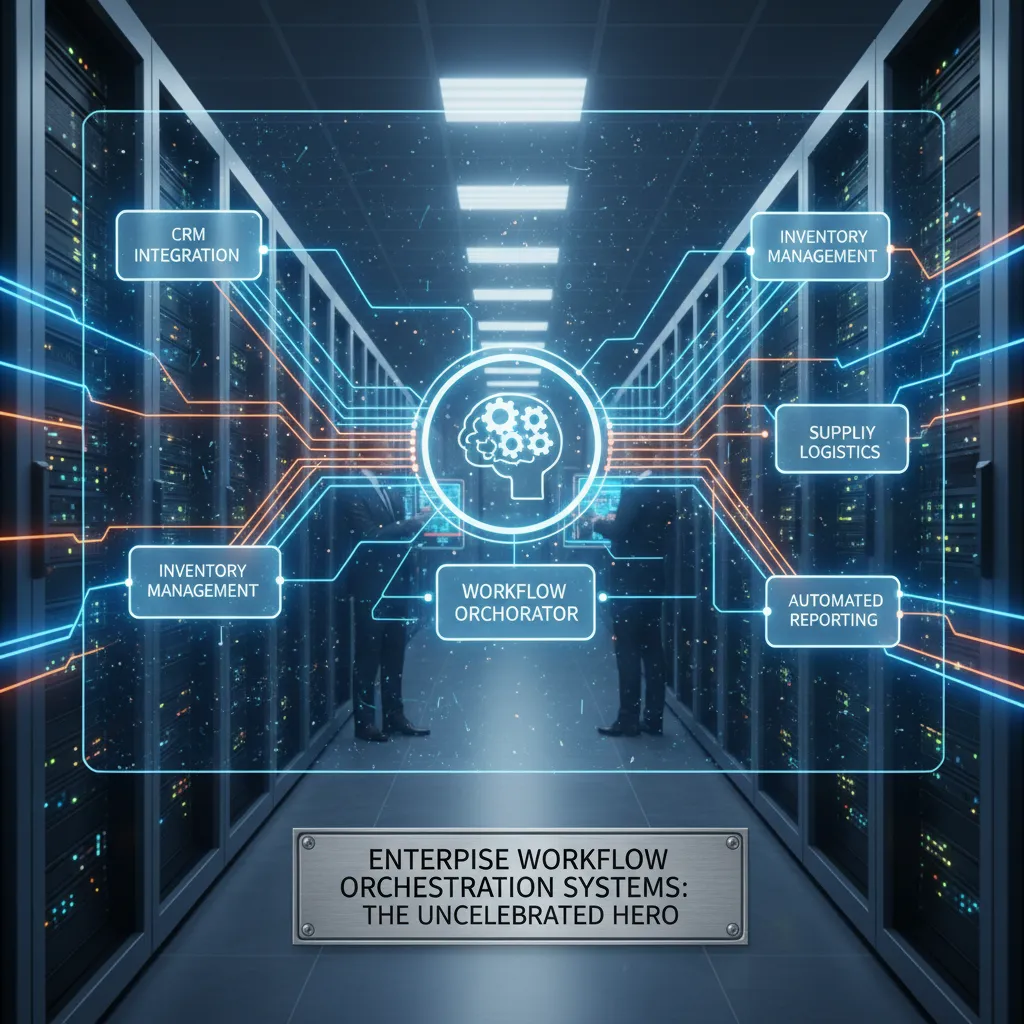
When I say workflow orchestration, I’m not trying to sound fancy. I mean the boring system that makes AI work safely in real product ops: triggers, approvals, context, and receipts. A trigger starts the work (a new support theme, a PR merged, a roadmap change). Approvals decide who can ship what. Context is the “why” and “what changed” that keeps agents from guessing. Receipts are the audit trail: what ran, what it touched, and what it produced.
- Triggers: “When a P0 bug is tagged, start triage.”
- Approvals: “Before updating release notes, get PM sign-off.”
- Context: “Use the current spec, not last quarter’s doc.”
- Receipts: “Link the summary to the ticket and Slack thread.”
Multi-agent orchestration: less magic, more checks
In practice, I get better results with multi-agent orchestration platforms than with one “do-it-all” bot. One agent drafts a customer-facing update, another verifies claims against the spec and analytics, and a third files the Jira ticket with the right labels and owners. That separation reduces hallucinations and keeps work moving even when one step fails.
One agent creates speed. Two agents create safety. Three agents create throughput.
Agentic runtimes: why “runs” and “rollbacks” matter
Product ops is full of “oops.” That’s why I care about agentic runtimes that treat work like a deployment: a run has inputs, steps, and outputs, and a rollback can undo changes. If an agent updates a status page, posts to Slack, and edits a doc, I need a clean way to revert when the incident scope changes.
run_id=8421 → draft → verify → file_ticket → notify
Super agent control planes: the dashboard I didn’t know I needed
Once I had five agents “arguing” (different answers, different sources), I wanted a control plane: a dashboard showing who did what, which tools they used, and where they disagreed. It’s not glamorous, but it’s how AI-powered product operations becomes reliable.
3) AI factories & smarter infrastructure (yes, product ops cares)
Why I started caring about infrastructure
I used to think infrastructure was “someone else’s job.” Then latency killed one of our best automations. We had an AI workflow that triaged support tickets and suggested next steps. In testing it felt instant. In real life, the model call plus data lookups added seconds, agents stopped trusting it, and adoption dropped. That’s when I learned a simple product ops truth: if it’s slow, it’s broken.
AI factories: production lines, not pet projects
From the source material, the shift I now push for is building AI factories: repeatable systems that turn data into reliable outputs. Instead of one-off prompts and “cool demos,” I think in production lines:
- Inputs: clean events, tickets, docs, and permissions
- Processing: model routing, caching, and evaluation
- Outputs: actions in tools people already use
- Quality control: monitoring, drift checks, and human review
In product ops, this mindset matters because it makes AI work repeatable across teams, not fragile in one corner of the org.
Smarter infrastructure: toward AI “superfactories”
Infrastructure is also getting smarter. We’re moving toward distributed AI networks where workloads can run closer to the user, closer to the data, or wherever cost and speed make sense. I see this as “AI superfactories”: shared platforms with standard pipelines, shared guardrails, and fast deployment paths.
Hybrid reality check (cloud + on-prem + edge)
Most teams will live in the in-between. Some data stays on-prem for compliance, some models run in the cloud for scale, and some inference happens at the edge for speed.
Product ops doesn’t need to own infrastructure, but we do need to own the experience it creates: fast, safe, and dependable.
4) Risk governance: the part I wish I’d done earlier
The moment governance got real
Governance became real for me the day a data sovereignty question stopped a rollout mid-sprint. We had an AI assistant ready to summarize support tickets and push insights into our product ops dashboard. Then Legal asked one simple thing: Where does the data get processed, and where is it stored? We couldn’t answer with confidence. The sprint didn’t fail because the model was wrong; it failed because our AI risk governance was missing.
What leaders are actually worried about (and why)
In “AI-Powered Changes in Product Operations: Real Results,” the biggest concerns weren’t sci-fi risks. They were practical, brand-and-budget risks that show up fast in Product Ops:
- Data handling: residency, retention, and vendor access.
- Customer trust: one bad output can become a screenshot.
- Compliance: audits, SOC2/ISO controls, and procurement reviews.
- Decision risk: AI suggestions quietly shaping roadmaps and priorities.
- Operational drift: agents changing behavior after prompts or model updates.
From reactive to continuous
I stopped treating governance like a one-time checklist. Instead, I put it in the loop:
- Trust metrics: hallucination rate, citation coverage, and escalation rate.
- Audits: sampled reviews of outputs, prompts, and data sources.
- Policy-driven schemas: structured inputs/outputs so sensitive fields are blocked by default.
Even simple controls helped, like requiring a schema for any AI-generated “insight” before it could enter our system of record.
My rule of thumb: if an agent can ship, it can also create a paper trail.
So every automated action logs who/what, why, inputs, outputs, and approvals. That paper trail turned governance from a blocker into a safety net.
5) Open source, reasoning models, and the “agentic OS” layer
Open source AI diversification: why teams want options (and leverage)
In Product Ops, I see teams push for open source AI for two simple reasons: choice and leverage. Choice means we can swap models when pricing, latency, or data rules change. Leverage means we can negotiate better terms with vendors because we’re not locked into one stack. It also helps when different workflows need different strengths—fast summarization in one place, deeper analysis in another.
Open source reasoning models: where they fit (and where they absolutely don’t)
Reasoning models are useful when the work is messy: triaging feedback, mapping themes to roadmap bets, or drafting a decision log from scattered notes. I use them as “thinking partners” that produce a first pass I can verify.
- Good fit: structured analysis, hypothesis lists, QA checklists, “why/so what” write-ups.
- Not a fit: anything that must be perfect without review—policy decisions, legal language, or automated customer promises.
Agentic operating system governance: the missing middle
The real gap isn’t models—it’s the agentic OS layer: the rules and controls between tools and enterprise reality. If agents can take actions (create tickets, change fields, message teams), we need governance that’s boring but essential:
- Permissions (what an agent can touch)
- Audit trails (what it did and why)
- Human approvals for high-risk steps
- Fallbacks when systems fail
A candid aside: I love open source—until incident response night makes me wish for a vendor hotline.

6) Physical AI crosses production (and quietly changes ops)
In product ops, the biggest shift I’ve seen is when Physical AI in manufacturing production stops being a slide deck and starts touching real equipment. That’s the moment software ops meets the real world: sensors drift, parts vary, and a “small” model update can change how a line behaves.
Physical AI manufacturing production: software meets the factory floor
Once AI is connected to cameras, conveyors, pick-and-place arms, or QA stations, product ops expands. I’m no longer only managing backlogs and dashboards—I’m coordinating with manufacturing, quality, and safety. The work becomes less about “feature shipped” and more about process stability.
Edge AI hardware acceleration: decisions move closer to the line
In many plants, sending every frame to the cloud is too slow or too risky. That’s why edge AI hardware acceleration matters: some decisions need to happen right next to the machine. Think defect detection, torque checks, or package verification. Lower latency can mean fewer jams and less scrap, but it also means updates must be controlled like any other production change.
GPU accelerators and chip designs: practical constraints
When teams ask for “more AI,” I ask three boring questions that decide everything:
- Budget: accelerators cost money, plus integration and support.
- Power/heat: factory enclosures have limits; cooling is real.
- Lead time: chips and industrial PCs can take months to arrive.
A hypothetical that makes ops real
Imagine an agent optimizes SKU packaging: it finds a new box layout that cuts void fill by 12%. Then a robot actually packs that way. Suddenly product ops needs:
- Safety reviews for new robot motions
- Change control and rollback plans
- Clear acceptance tests on the line
When AI moves atoms, “ops” quietly becomes part product, part plant engineering.
7) A quick peek at 2026: quantum, edge, and the “wait, what?” factor
Quantum breakthroughs in 2026: why I’m paying attention (even if I’m skeptical)
When people say “quantum will change everything,” I usually hear marketing. Still, I’m watching 2026 closely because even small quantum computing breakthroughs can shift what’s possible in optimization and simulation. In product ops, I don’t need a miracle machine. I need a signal that a new tool is moving from lab demos to something teams can test without a PhD.
Quantum computing in drug development: product ops lessons travel
One reason I take quantum seriously is drug development. If quantum methods help model molecules faster, that’s not just a science story; it’s an ops story. It reminds me that product operations patterns repeat across industries: messy data, long feedback loops, and high-cost decisions. The lesson I borrow is simple: tighten the experiment cycle and make results traceable, even when the tech feels “future.”
Edge AI hardware is maturing: “good enough” chips unlock new workflows
The more practical shift I expect is edge AI. “Good enough” chips in devices, kiosks, factories, and vehicles mean models can run near the data, with lower latency and fewer privacy headaches. That changes workflows: faster triage, offline support, and real-time quality checks without waiting on cloud round trips.
- Ops impact: more deployments to manage, but clearer ownership at the edge.
- Data impact: more local signals, less centralized logging by default.
- Process impact: testing needs to include hardware, not just APIs.
My imperfect takeaway: plan for weirdness, don’t budget for magic
In Product Ops, I plan for “wait, what?” moments, but I don’t fund them like guaranteed wins.
I keep a small sandbox for emerging tech, define success metrics early, and avoid roadmaps that assume breakthroughs. If quantum surprises us, great. If not, edge AI alone will still push real, measurable change.
Conclusion: The new job is “ops for thinking machines”
After testing the AI-powered changes in product operations in real teams, I’ve landed on a simple truth: real results come from the mix of orchestration, infrastructure, and governance. Orchestration is how work flows across tools and people. Infrastructure is the data, prompts, and integrations that keep AI Product Ops stable. Governance is the guardrails—privacy, approvals, and audit trails—that stop “fast” from turning into “risky.” When those three pieces work together, AI stops being hype and starts being a reliable part of Product Operations.
On Monday mornings, I keep myself honest with a small checklist. I pick one workflow to automate so the team gets time back right away—like turning messy feedback into tagged themes and a draft summary. I pick one policy to write so we don’t improvise under pressure—like what data is allowed in an agent, who can approve releases, or how we store prompts. And I pick one metric to watch so we measure outcomes, not vibes—cycle time, defect escape rate, support backlog age, or the percentage of insights that make it into roadmap decisions.
My wild-card analogy: I treat agents like interns with superpowers. They’re helpful and fast, and they can surprise you in good ways. But they still need clear instructions, limited access, and review before anything customer-facing ships. In AI Product Ops, my job is less “do the work” and more “run the system that does the work,” with checks at the right points.
If you want to apply this, tell me the most annoying part of your product ops process—handoffs, reporting, triage, release notes, stakeholder updates—and I’ll suggest an agentic workflow sketch you can try this week.
TL;DR: AI in product operations is shifting from personal productivity hacks to team-level workflow orchestration. Expect agentic runtimes, stronger AI risk governance, hybrid infrastructure, and a rise in physical AI—plus a new “agentic operating system” layer to keep it all sane.


Comments
Post a Comment