AI Marketing Tools Compared: My 2026 Must-Haves

I realized my marketing stack had become a junk drawer the day I paid for three “AI writing” tools… and still stared at a blank Google Doc. Since then, I’ve started judging AI marketing tools the way I judge coffee shops: can I get what I need fast, does it taste right (brand voice), and do I leave with more energy than I came in with? In this post, I’m comparing must-have AI-powered solutions across content, SEO optimization, email automation, chatbots, analytics tools, and workflow automation—plus the pricing ranges and the little trade-offs nobody mentions on tool landing pages.
1) My “junk drawer” test for AI Marketing Tools (2026)
I compare AI Marketing Tools the same way I clean a junk drawer: if it doesn’t earn its space fast, it goes. In Marketing tools 2026, the winners aren’t the flashiest—they’re the ones that deliver Marketing Automation, personalization, predictive analytics, and multi-channel integration without turning my stack into a 40-tool circus.
The three questions I ask before trials
- Speed to value: Can I ship a real campaign this week, not “after onboarding”?
- Brand voice consistency: Will the AI Tools Marketing output sound like us across email, ads, and social?
- CRM integration mess: How painful will contacts, fields, and attribution get once data starts flowing?
Quick confession: I’ve over-done Workflow Automation and spent Friday nights untangling Zaps. Never again. Now I treat “automation” as a promise: fewer handoffs, fewer brittle connectors, and fewer silent failures.
Ann Handley: "Good marketing tells a story. Great marketing makes the customer the hero."
Scott Brinker: "Marketing technology isn’t about more tools—it’s about better orchestration."
My scoring rubric (1–5) + stack sprawl benchmark
I score each tool from 1–5, then weight it. Personal benchmark: 6–8 core tools is ideal; beyond 10 tools = “junk drawer” risk.
| Rubric factor | Weight (%) |
|---|---|
| Speed to value | 30 |
| Integration/CRM fit | 25 |
| Content quality | 20 |
| Analytics/attribution | 15 |
| Governance (permissions/roles) | 10 |
Mini scorecard categories I’ll use
- Content Creation
- SEO Optimization
- Marketing Automation
- Analytics Tools
- Governance (permissions/roles)
Radar chart: My AI Marketing Tools Rubric (Weights %)
<svg xmlns="http://www.w3.org/2000/svg" width="640" height="420" viewBox="0 0 640 420">
  <rect width="100%" height="100%" fill="#D1D8DC"/>
  <text x="320" y="34" text-anchor="middle" font-family="Arial" font-size="18" fill="#111">My AI Marketing Tools Rubric (Weights %)</text>

  <g transform="translate(320,230)" font-family="Arial">
    <!-- grid rings (10% ticks) -->
    <g fill="none" stroke="#CCD7E6" stroke-width="1">
      <polygon points="0,-18 17,-6 11,15 -11,15 -17,-6"/>
      <polygon points="0,-36 34,-12 22,30 -22,30 -34,-12"/>
      <polygon points="0,-54 51,-18 33,45 -33,45 -51,-18"/>
      <polygon points="0,-72 68,-24 44,60 -44,60 -68,-24"/>
      <polygon points="0,-90 85,-30 55,75 -55,75 -85,-30"/>
    </g>

    <!-- axes -->
    <g stroke="#A2ACE0" stroke-width="2">
      <line x1="0" y1="0" x2="0" y2="-90"/>
      <line x1="0" y1="0" x2="85" y2="-30"/>
      <line x1="0" y1="0" x2="55" y2="75"/>
      <line x1="0" y1="0" x2="-55" y2="75"/>
      <line x1="0" y1="0" x2="-85" y2="-30"/>
    </g>

    <!-- filled polygon (weights) -->
    <polygon points="0,-54 64,-23 33,45 -17,23 -43,-15"
             fill="#00E2B1" fill-opacity="0.35" stroke="#00E2B1" stroke-width="3"/>

    <!-- labels -->
    <g font-size="12" fill="#111">
      <text x="0" y="-110" text-anchor="middle">Speed to value (30)</text>
      <text x="110" y="-34" text-anchor="start">Integration/CRM fit (25)</text>
      <text x="78" y="98" text-anchor="start">Content quality (20)</text>
      <text x="-78" y="98" text-anchor="end">Analytics/attribution (15)</text>
      <text x="-120" y="-34" text-anchor="end">Governance (10)</text>
    </g>

    <!-- tick labels -->
    <g font-size="11" fill="#333">
      <text x="6" y="-18">10%</text>
      <text x="6" y="-36">20%</text>
      <text x="6" y="-54">30%</text>
      <text x="6" y="-72">40%</text>
      <text x="6" y="-90">50%</text>
    </g>
  </g>

  <!-- accent legend swatch -->
  <rect x="34" y="360" width="14" height="14" fill="#00E2B1" fill-opacity="0.35" stroke="#00E2B1"/>
  <text x="56" y="372" font-family="Arial" font-size="12" fill="#111">Weighted priorities (subjective, but human)</text>
  <rect x="34" y="382" width="14" height="14" fill="#FBD0B9"/>
</svg>

2) Content Optimization + SEO Optimization: Semrush vs Surfer SEO (and where I’ve faceplanted)
When I’m doing Content Creation with AI marketing tools, I bounce between Semrush and Surfer SEO depending on whether I need workflow speed or SERP-level focus. Both can help me ship Best AI Content, but they push my habits in different directions.
Semrush: fast guardrails for multi-channel teams
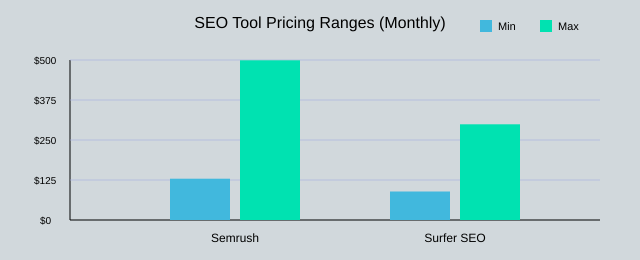
Semrush is my “get me unstuck” stack for Content Optimization across channels. The AI Article Generator helps me draft quickly, Topic Finder gives me angles when my brain is empty, and Content Optimizer keeps my SEO Optimization basics tight. It’s priced for broader marketing needs: $129–$499/month.
Surfer SEO: tight on-page execution (my drift-prevention tool)
Surfer SEO is where I go when I need strict on-page discipline. Its AI-powered editor, content analysis, keyword research, and planner are perfect for Copywriting Tools + SEO workflows. Pricing is usually easier to justify for creators and agencies: $89–$299/month.
Faceplant moment: I once optimized so hard that my post read like a checklist written by a robot. Rankings didn’t save it—read time dropped. Now I treat scores as guardrails, then I back off and write like a human.
Lily Ray: "SEO isn’t about gaming Google—it’s about proving you deserve to rank."
Aleyda Solis: "Technical excellence helps, but relevance and intent are what move the needle."
How I choose (workflow vs SERP precision)
- Semrush when I need ideas + multi-channel structure fast.
- Surfer when I need SERP precision and I don’t trust myself not to drift.
One-week experiment (7 days)
- Pick 1 keyword cluster.
- Publish 2 articles (one guided by each tool).
- Track ranking movement + time saved in a simple log:
minutes_research + minutes_outline + minutes_edit.
| Item | Semrush | Surfer SEO |
|---|---|---|
| Core strengths | AI Article Generator, Topic Finder, Content Optimizer | AI editor, content analysis, keyword research, planner |
| Pricing (monthly) | $129–$499 | $89–$299 |
| Pilot plan | 7 days; publish 2 articles; track 1 keyword cluster | |
3) Email Marketing + Send Time Optimization: Mailchimp vs ‘CRM-first’ stacks
In my 2026 stack, Email Marketing still earns its spot because it’s measurable and personal. As Seth Godin says:
"Email is still the most reliable way to earn attention—if you show up with generosity."
Mailchimp’s sweet spot: small teams that need smart basics
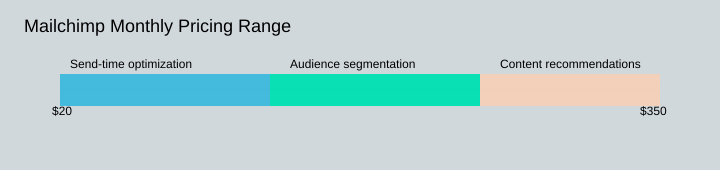
Mailchimp is one of the AI Marketing Tools I recommend when you want fast wins without building a full sales system. For small businesses, it bundles Email Automation, Audience Segmentation, content recommendations, and Send Time Optimization in a clean workflow—typically $20–$350/month depending on list size and features.
The moment email got “too smart” for me
I broke my own system when segmentation rules multiplied and nobody documented them (my fault). Jeanne Jennings nails the risk:
"Relevance is the currency of email. Segmentation is how you mint it."
My rule-of-thumb: start with 3 segments; cap at 7 until reporting is stable.
| Item | My baseline |
|---|---|
| Mailchimp pricing | $20–$350 per month |
| Segmentation hygiene | Start with 3 segments; cap at 7 |
When I’d go CRM-first instead
If lead scoring, pipeline stages, and sales handoffs matter more than newsletter polish, I go “CRM-first” (where email is one channel inside a bigger system). That’s when CRM Integration becomes the real feature, not just a checkbox.
| Use case | Best fit |
|---|---|
| Newsletter-heavy (content + promos) | Mailchimp |
| Lifecycle-heavy (MQL→SQL, handoffs) | CRM-first stack |
Sanity checklist (what I always verify)
- Deliverability basics: SPF/DKIM, clean list, consistent sending
- Segmentation hygiene: one owner, written rules, quarterly cleanup
- One metric I always track: reply rate (signals real engagement)
Example funnel + pricing visual
Example (not a source): 10,000 subscribers → 600 leads → 60 opportunities.

4) Lead Scoring & Predictive Scoring: HubSpot Breeze AI vs Salesforce Einstein AI
When I compare Lead Scoring and Predictive Scoring tools, I’m really asking: “Will my team trust the score, and can we act fast?” In my stack, HubSpot’s Breeze AI feels like the all-in-one that I can actually teach my team: email help, content suggestions, inbound workflows, and scoring that fits mid-market needs (often included at that tier—pricing varies by plan). Salesforce Marketing Cloud with Einstein AI is where I go when an enterprise needs deeper Predictive Lead Scoring, segmentation, and ROI tracking across complex journeys.
Dharmesh Shah: "Inbound marketing is about being helpful, not interruptive."
My real week: the score was right, but the follow-up was late
I watched a lead hit a “hot” score, and the model was correct. But the rep followed up the next day. That’s the lesson: automation supports Campaign Optimization, but it can’t fix slow decisions. Your CRM Integration and routing rules matter as much as the model.
How I compare them (what actually changes outcomes)
- Time-to-implementation: HubSpot is faster for most teams; Salesforce takes more setup.
- Depth of AI Marketing Analytics: Einstein goes further on segmentation and ROI tracking.
- Data cleanliness required: Salesforce rewards clean, consistent data; HubSpot is more forgiving.
Marc Benioff: "The business of business is to improve the state of the world."
Capabilities checklist
| Area | HubSpot Breeze AI | Salesforce + Einstein AI |
|---|---|---|
| Lead Scoring | Yes (easy) | Yes (advanced) |
| Predictive Lead Scoring | Limited/plan-dependent | Strong |
| Segmentation | Good | Excellent |
| ROI tracking | Basic–good | Deep |
| Inbound marketing | Core strength | Supported |
Tool Fit vs Company Maturity (conceptual)
<svg width="640" height="260" viewBox="0 0 640 260" xmlns="http://www.w3.org/2000/svg">
  <rect x="0" y="0" width="640" height="260" fill="#D1D8DC"/>
  <text x="320" y="24" text-anchor="middle" font-family="Arial" font-size="16" fill="#000">Tool Fit vs Company Maturity</text>

  <!-- Axes -->
  <line x1="60" y1="220" x2="600" y2="220" stroke="#000" stroke-width="2"/>
  <line x1="60" y1="220" x2="60" y2="50" stroke="#000" stroke-width="2"/>
  <text x="330" y="248" text-anchor="middle" font-family="Arial" font-size="12">Maturity (1=SMB, 5=Enterprise)</text>

  <!-- X ticks 1-5 -->
  <g font-family="Arial" font-size="12" fill="#000">
    <text x="60" y="238" text-anchor="middle">1</text>
    <text x="195" y="238" text-anchor="middle">2</text>
    <text x="330" y="238" text-anchor="middle">3</text>
    <text x="465" y="238" text-anchor="middle">4</text>
    <text x="600" y="238" text-anchor="middle">5</text>
  </g>

  <!-- Map fit score 1-5 to y (5=60, 1=200) -->
  <!-- HubSpot line: [4,5,5,3,2] -->
  <polyline fill="none" stroke="#00E2B1" stroke-width="3"
    points="60,95 195,60 330,60 465,130 600,165"/>
  <circle cx="60" cy="95" r="4" fill="#00E2B1"/>
  <circle cx="600" cy="165" r="4" fill="#00E2B1"/>
  <text x="70" y="90" font-family="Arial" font-size="12">HubSpot</text>
  <text x="590" y="160" text-anchor="end" font-family="Arial" font-size="12">2</text>

  <!-- Salesforce line: [1,2,3,5,5] -->
  <polyline fill="none" stroke="#FBD0B9" stroke-width="3"
    points="60,200 195,165 330,130 465,60 600,60"/>
  <circle cx="60" cy="200" r="4" fill="#FBD0B9"/>
  <circle cx="600" cy="60" r="4" fill="#FBD0B9"/>
  <text x="70" y="205" font-family="Arial" font-size="12">Salesforce</text>
  <text x="610" y="60" font-family="Arial" font-size="12">5</text>
</svg>
My quick scoring notes (personal, 1–5)
| Scale | Range |
|---|---|
| Maturity | SMB 1–2, Mid-market 3, Enterprise 4–5 |
| HubSpot | Ease-of-use 5, Customization 3 |
| Salesforce | Customization 5, Setup effort 2 |
5) Chatbot Qualification & Conversational Marketing: Drift in the real world
When I think about Conversational Marketing that actually drives pipeline, Drift is the tool I reach for. It’s one of the few AI Marketing Tools where Chatbots can do real work: greet the right visitor, run Chatbot Qualification, and book a meeting without my team playing email tag. For SMBs, Drift typically lands around $50–$1,500/month, which makes it realistic if your site already gets steady traffic.
Chris Messina: "Conversation is the interface."
What Drift does well (especially when my calendar is chaos)
- AI chatbots that route by page, company, or behavior
- Lead qualification that captures the basics fast
- Meeting scheduling that drops qualified leads straight onto my calendar
Where chatbots go wrong (and yes, I’ve done this)
The fastest way to kill conversions is turning the chat into a 12-question tax form. People came for an answer, not an interrogation. If the bot feels like marketing automation in disguise, they bounce.
April Dunford: "Positioning is about making it obvious why you’re the best choice for a specific customer."
My simple playbook: 3 intents, 5 questions max
- Pick 3 intents: pricing, demo/meeting, support/other.
- Ask 5 questions max before routing to a human.
- Use a graceful fallback:
“Want me to connect you with a person?”
| Item | Data |
|---|---|
| Drift pricing | $50–$1,500 per month |
| My chatbot rule | Max 5 qualification questions, then route to human |
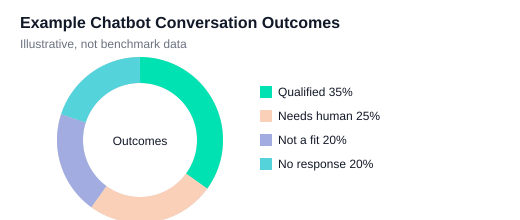
| Example outcome mix | Qualified 35% • Needs human 25% • Not a fit 20% • No response 20% |
Example chatbot flows (intent → question → next step)
| Intent | Question | Next step |
|---|---|---|
| Pricing | “What team size?” | Show range + offer meeting |
| Book a demo | “What’s your role?” | Qualify → schedule |
| Support/other | “What do you need help with?” | Route to human/inbox |
How I measure success (not vanity metrics)
I track qualified meetings and show rate—not “time on chat.” Here’s an example outcome mix:

6) Workflow Automation, Sentiment Analysis, and the ‘glue’ layer: Zapier + Gumloop
In my AI Tools Marketing stack, Zapier is the connective tissue. It handles Workflow Automation by stitching tools together so data keeps moving—especially when I need CRM Integration across email, forms, ads, and spreadsheets. Jason Fried said,
"Work doesn’t happen at work."For me, that’s a reminder to reduce busywork so I can focus on decisions.
Zapier: CRM Integration that keeps data flowing
Zapier connects apps and triggers actions automatically. I use it to push leads into my CRM, tag contacts, and notify my team. It’s not “smart” by itself, but it’s the glue that lets smart tools work together without manual copy-paste.
Gumloop: Sentiment Analysis + Brand Monitoring signals
When I want signals, not just tasks, I reach for Gumloop. It supports Sentiment Analysis, AI workflow automation, and competitor monitoring (often via Web Scraping and Media Monitoring). That makes it useful for Brand Monitoring—not just “did something happen,” but “how do people feel about it?” Pricing runs Free–$999 per month. Paul Graham nailed it:
"A good idea is a new way of seeing an old problem."
My favorite tiny automation (email → sentiment → dashboard)
I auto-label feedback emails by sentiment (positive/neutral/negative), then pipe counts into a weekly dashboard. Example rule:
IF sentiment = "negative" THEN label = "Needs follow-up" AND send to dashboard
Automation recipes (trigger → action → value)
| Trigger | Action | Value |
|---|---|---|
| New form lead | Zapier → create CRM contact + task | Faster follow-up |
| New review mention | Gumloop → Sentiment Analysis + alert | Brand Monitoring |
| Competitor page change | Gumloop → monitor + log | Competitive context |
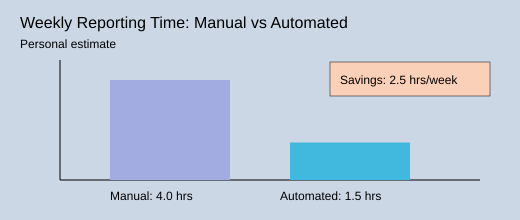
Weekly Reporting Time: Manual vs Automated (personal estimate)
| Metric | Value |
|---|---|
| Gumloop pricing | Free–$999 per month |
| Manual reporting | 4 hrs/week |
| Automated reporting | 1.5 hrs/week |
| Net savings | 2.5 hrs/week |
Cautionary tangent: if you automate a broken process, you just get broken faster—so I map the steps first, then automate the clean version.
7) The comparison wrap-up: building a ‘boring’ stack that wins
After comparing the Best AI Tools across Top AI Marketing use cases, my takeaway is simple: the winning stack in 2026 is “boring.” It leans on automation, personalization, predictive analytics, and multi-channel integration—then repeats the same workflows until results compound.
Stack templates (3) for Content Creation + Campaign Optimization
| Stack template | Tools (combo) | Purpose | Who it’s for |
|---|---|---|---|
| Lean SMB | Mailchimp + Semrush + Zapier | Email + SEO basics + simple automation | Small teams shipping weekly |
| Content-heavy team | Surfer + Mailchimp + HubSpot | Scale Content Creation, capture leads, nurture | Teams publishing daily |
| Enterprise growth | Jasper AI + Salesforce + Gumloop | Brand voice consistency + CRM + advanced workflows | Enterprise teams running many channels |
On enterprise teams, I treat Jasper AI like a campaign manager: it helps keep brand voice consistent across emails, blogs, and ads, which is hard to do when many people touch the same message.
How I avoid tool regret (14-day trial)
| Trial length | 1 KPI | 1 workflow automation | Report cadence |
|---|---|---|---|
| 14 days | Pick one metric | Automate one handoff | Weekly |
Peter Drucker: "What gets measured gets managed."
Katie Delahaye Paine: "Measurement is a dashboard, not a destination."
Choosing AI Marketing Tools (Quick Path)
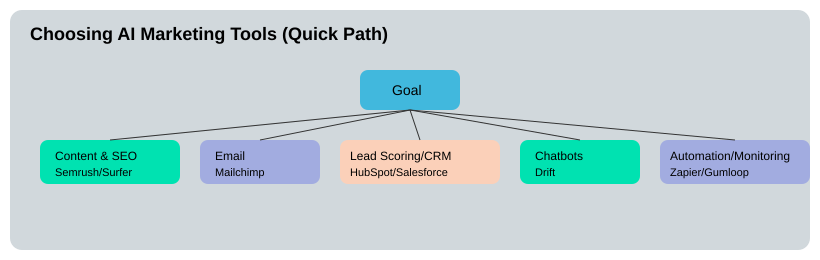
Wild card: if I had to cut my stack in half tomorrow, I’d keep my CRM, one content/SEO tool, and one automation layer—and I’d axe overlapping writers, extra dashboards, and anything that doesn’t connect. The real AI Marketing Analytics win isn’t a prettier report; it’s making better decisions faster, then using that speed for Campaign Optimization and consistent Content Creation.
TL;DR: If you want a sane 2026 stack: use Semrush or Surfer SEO for content optimization and SEO; HubSpot or Salesforce for lead scoring and CRM integration; Mailchimp for email marketing + send time optimization; Drift for conversational marketing; Zapier + Gumloop to glue workflows together; and Jasper AI when brand voice consistency is non-negotiable. Pick based on your team size, data maturity, and how much “automation” you can actually maintain.


Comments
Post a Comment