AI in M&A Due Diligence, Minus the Busywork

The first time I watched a deal team “read” a virtual data room, it looked like speed-reading by flashlight: everyone squinting at PDFs, flagging the same clause twice, and still missing the one indemnity sentence that mattered. That memory is why I care about AI in M&A—not as hype, but as a way to replace frantic sampling with systematic coverage. In this outline, I’ll walk through where due diligence automation actually earns its keep (contracts, cybersecurity posture, compliance checks, valuation models), where it can backfire, and how I’d set up a human-in-the-loop process that doesn’t turn into a black box.
1) My “PDF panic” origin story (and why AI in M&A stuck)
It was 11:48pm in a virtual data room, and my screen looked like a bad magic trick: five tabs open, two spreadsheets half-filled, and a PDF viewer that kept freezing right when I needed it most. Three of us were highlighting the same change-of-control clause in three different agreements, each leaving comments like we were the first person to find it. That was my “PDF panic” moment—the night I realized M&A due diligence isn’t hard only because there’s a lot to read. It’s hard because we read the same things over and over, under time pressure, while trying not to miss the one line that matters.
In theory, due diligence is about coverage. In practice, it often becomes a battle with repetition and fatigue. When you’re on your tenth contract addendum, “good enough” starts to sound reasonable. That’s where the danger lives: not in the big red flags everyone sees, but in the small terms that get skipped because the team is tired or the timeline is tight.
Why due diligence feels heavier than “just volume”
- Repetition: the same clauses appear across dozens (or hundreds) of documents.
- Fatigue: late nights make it easier to miss exceptions, carve-outs, and defined terms.
- Sampling risk: “spot checks” can hide patterns that only show up with full review.
This is why AI in mergers and acquisitions started to stick for me—not as a flashy replacement for experts, but as a way to reduce the busywork. The real promise of due diligence automation is consistent coverage plus faster triage: flag likely change-of-control triggers, surface assignment limits, and group similar indemnities so humans can focus on judgment calls.
AI shouldn’t decide the deal. It should make sure we don’t miss what we meant to check.
I’m especially wary of spot checks now because I once watched a single overlooked indemnity clause turn into a pricing argument. It wasn’t dramatic at first—just one paragraph buried in a schedule. But when it surfaced later, it changed the tone of the negotiation and ate time we didn’t have. That’s the kind of avoidable pain that made AI feel practical, not optional.

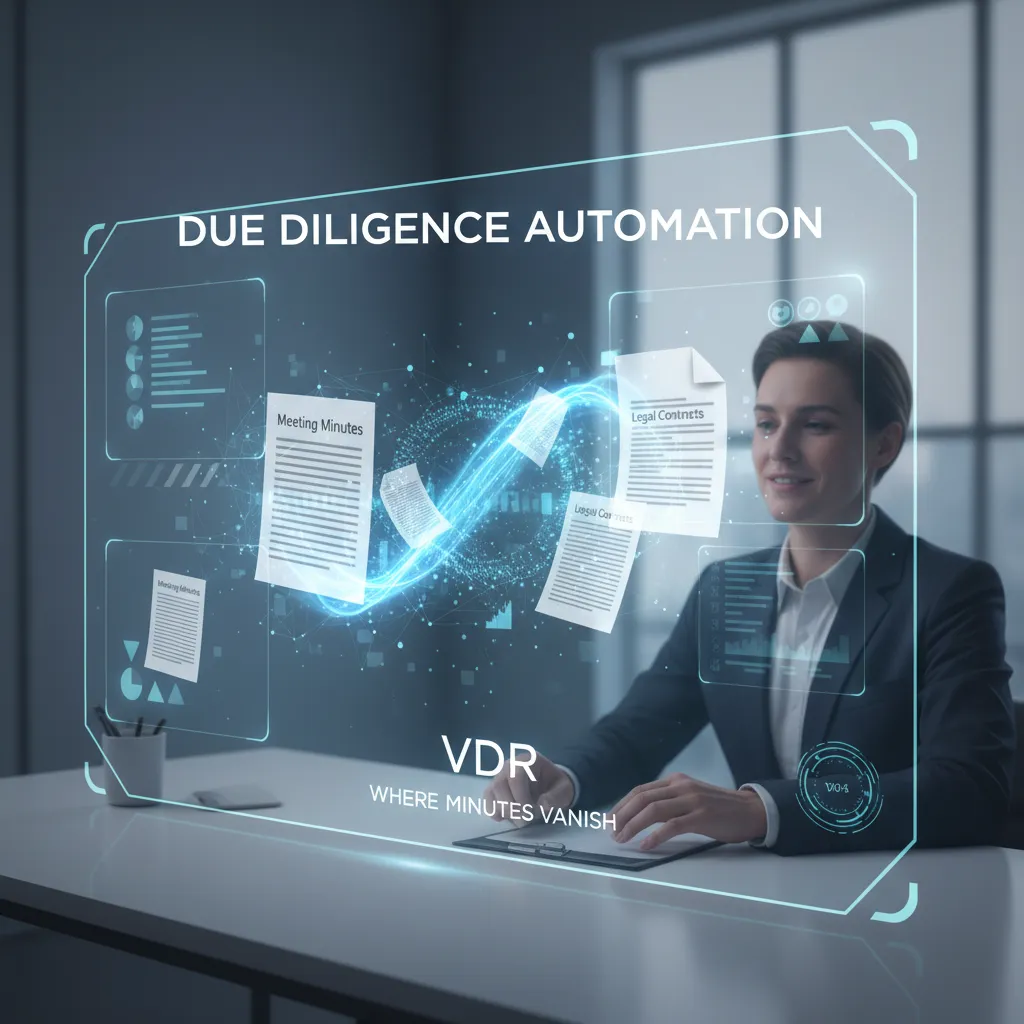
2) Due Diligence Automation in the VDR: where the minutes disappear
In the first 48 hours of a deal, the Virtual Data Room (VDR) can feel like a firehose. This is where AI earns its keep. In an AI-powered VDR, I can drop in a messy batch of uploads and watch the system auto-classify files into logical folders (finance, HR, legal, IP), dedupe near-identical versions, and generate a fast “what’s missing” checklist based on a standard due diligence index. Instead of spending hours renaming PDFs and chasing gaps, I spend minutes validating the structure and asking better questions.
How AI-powered VDRs compress the first 48 hours
- Auto-classification: tags documents by type, entity, and topic (e.g., “customer contract,” “lease,” “board minutes”).
- Deduping: flags duplicates and near-duplicates so reviewers don’t waste time on repeats.
- “What’s missing” checklists: highlights absent items (like tax returns, cap table support, or key policies) and links the request back to the index.
NLP for contract analysis: faster, not mindless
Once the room is organized, Natural Language Processing (NLP) helps me move through contracts at scale. I use it for clause extraction (termination, assignment, exclusivity), change-of-control spotting, and pattern detection—like weird indemnity language that shifts risk in a non-standard way. It’s not “push button, done.” It’s “show me where to look first.”
My rule: AI should point to the paragraph, not replace the judgment.
Risk assessment as a running ledger
The best setups turn findings into a live ledger. Each issue gets a red/yellow/green status, a short note, and provenance—a link back to the exact source document and page. That traceability matters when the deal team asks, “Where did we see that?”
| Status | Meaning | Example |
|---|---|---|
| Red | Deal or value risk | Change-of-control triggers consent |
| Yellow | Needs follow-up | Indemnity cap unclear |
| Green | Standard/acceptable | Market termination language |
What I still do manually
I always do a skeptical reread of the top 20 high-impact contracts—largest customers, key suppliers, credit agreements, leases, and any agreement with unusual remedies. AI speeds the hunt, but I still verify the stakes.
3) Risk Assessment that doesn’t sleep: financial anomalies + cybersecurity posture
My rule: if a risk can hide in plain sight, automate the first scan (then argue about it like adults).
Financial anomaly detection: let AI flag what humans miss at 2 a.m.
In M&A due diligence, I use AI to run a constant first-pass review across ledgers, invoices, contracts, and monthly close files. The goal is not to “replace” finance judgment. It’s to surface patterns that are easy to overlook when timelines are tight.
- Revenue recognition oddities: spikes near quarter-end, unusual credit memo timing, or revenue booked before delivery.
- One-time expenses that keep happening: “non-recurring” items that show up every year, just with a new label.
- Too-smooth margins: when gross margin barely moves despite seasonality, pricing changes, or supply shocks.
I like to turn these into a short list of questions for management, not a long list of accusations. AI helps me get to the right questions faster.
Cybersecurity posture: map risk to deal terms, not a generic score
AI in mergers and acquisitions works best when it connects technical findings to business impact. Instead of a single “security rating,” I map posture to what we’re buying: customer data, IP, uptime, and trust.
| Signal | What it can mean in the deal |
|---|---|
| Unpatched critical systems | Higher breach odds; escrow or price adjustment |
| Weak identity controls | Integration risk; require MFA and access cleanup pre-close |
| Limited logging/monitoring | Hard to prove “no incident”; stronger reps/warranties |
Compliance and privacy: technical gaps become valuation gaps
Privacy rules (like GDPR, CCPA, and sector rules) turn security issues into financial issues. If data retention is messy or consent records are missing, the risk is not abstract—it can affect earnings quality, customer churn, and even closing conditions.
My checklist is simple:
- Where is sensitive data stored and who can access it?
- Can we prove lawful use, retention limits, and deletion?
- Do incident response plans match the reporting deadlines?
4) Deal Sourcing and Target Identification: the part people whisper about
Deal sourcing often feels like fishing. I can spend weeks casting lines—calls, intros, conferences—and still come back with “interesting” leads that don’t fit. AI doesn’t catch the fish for me, but it gives me a better map of the lake: where the activity is, what’s moving, and what’s just noise.
Why AI makes sourcing less random
In AI in M&A due diligence automation, the earliest win is target discovery. Machine learning models can scan and connect signals across:
- Filings (growth hints, risk language changes, new segments)
- Patents (momentum, citations, new assignees, tech adjacency)
- News (product launches, leadership churn, regulatory issues)
- Social chatter (hiring spikes, customer sentiment, partner mentions)
The caveat: social data is messy and easy to misread. I treat it as a weak signal, not proof. And I always check data rights and privacy rules before pulling anything in.
Strategic intelligence: my “thesis scoreboard”
The part people whisper about is how quickly teams fall in love with a target. To stay honest, I like a simple “thesis scoreboard” that forces consistent scoring before we get attached.
| Thesis factor | AI signal | Human check |
|---|---|---|
| Market pull | Search/news velocity | Customer calls |
| Product edge | Patent momentum | Tech review |
| Risk | Language shifts in filings | Contract read |
A quick hypothetical (and why humans still matter)
Say the AI flags a mid-size target because patent filings and citations are rising fast. On paper, it looks like a perfect fit. But when I do a quick human read of revenue notes and key contracts, I spot customer concentration risk: one customer drives 55% of sales and can exit in 90 days. The model found the spark; the human check prevented a costly story.
5) Valuation models, synergy mapping, and the ‘what if we’re wrong?’ machine
Dynamic valuation updates while diligence is still happening
In M&A due diligence, I used to treat valuation like a final exam: gather facts, then update the model at the end. AI changed that workflow. Now I can run dynamic valuation updates as new findings land—customer churn signals, contract clauses, pipeline quality, or a surprise capex need. Instead of waiting, I stress-test the deal in near real time and see how the price moves with each new data point.
My “what if we’re wrong?” machine is basically scenario testing on autopilot. I feed it assumptions, and it keeps recalculating ranges as diligence evolves.
Synergy mapping that’s more than a slide
Synergies are easy to promise and hard to deliver. AI helps me quantify them with more honesty by forcing the inputs to be explicit: timing, owners, and friction. I map each synergy to a driver and a dependency, then I model the drag from integration.
- Cost takeout timing: when savings start, ramp speed, and one-time costs
- Cross-sell assumptions: attach rates, sales cycle length, and channel conflict
- Integration drag: churn risk, system migration delays, and productivity dips
Predictive modeling for bid optimization (with guardrails)
For bid strategy, I’ll let AI suggest valuation ranges based on comparable deals, market signals, and risk flags. But I won’t let it make promises. Predictive modeling is useful for narrowing the “reasonable” zone, not for declaring a single right number. I keep a simple rule: the model can recommend, but I decide.
“If the assumptions aren’t clear, the output is just confidence with better formatting.”
A small confession
I once trusted a synergy model too much. The spreadsheet looked clean, the AI summary sounded certain, and I pushed the numbers into the investment memo. Six months later, the integration team found the real constraint: overlapping tools and a messy data migration that delayed the cost takeout by two quarters. Since then, I require every synergy line to include a downside case and a trigger that tells me early if we’re off track.

6) Post-Merger Integration: where Due Diligence either pays off—or evaporates
I treat post-merger integration (PMI) as the receipt for diligence. In due diligence, we find risks and synergies. In integration, we prove we can act on them. If a risk never gets an owner, a deadline, and a control, it doesn’t count. If a synergy never becomes a workflow change, it’s just a slide.
PMI is the “receipt” for diligence
When I use AI in M&A due diligence automation, I’m not trying to create more reports. I’m trying to create decisions that survive Day 1. The handoff from diligence to integration is where value often evaporates—usually because the findings are not tied to real teams, systems, and calendars.
RPA + AI: integration without the busywork
RPA handles repeatable tasks; AI helps route, classify, and spot exceptions. Together, they reduce avoidable errors during the most chaotic weeks.
- IT consolidation: automate account provisioning, app access reviews, and license cleanup; use AI to flag duplicate tools and risky permissions.
- HR onboarding: auto-create employee records, map titles to job families, and standardize policy acknowledgments; use AI to detect missing forms or mismatched comp bands.
- Finance operations: automate vendor master merges and invoice routing; use AI to catch unusual payment terms or duplicate suppliers.
Performance optimization: the first 90 days
I watch leading indicators, not just lagging results. AI helps summarize signals across systems so I can react early.
- Support tickets: volume, backlog age, and top categories after system changes
- Customer churn risk: renewal slippage, NPS drops, and escalation frequency
- Close process timing: days-to-close, reconciliation breaks, and manual journal spikes
The one-page “risk to owner” map I wish every deal had
My practical tool is a one-page table that turns diligence findings into execution.
| Risk/Synergy | Owner | Day 1–30 Action | Metric |
|---|---|---|---|
| Data access gaps | CISO | Role cleanup + MFA | % privileged accounts |
| Tool overlap | IT Lead | App rationalization | $ licenses removed |
| Churn exposure | CS Lead | Top 20 account plan | Renewal forecast |
Conclusion: The most human part of AI-driven due diligence
When I think about AI in M&A due diligence, I don’t see it as “faster reading.” I see it as better attention allocation across the full deal lifecycle. AI can scan contracts, flag odd clauses, group risks, and summarize patterns in minutes. But the real win is what that speed buys us: time to ask better questions, test the story behind the numbers, and focus on the few issues that can change price, structure, or even whether we should do the deal at all.
My recommended operating model is simple: AI does the first pass, humans do judgment, and governance keeps everyone honest. I want AI to triage documents, highlight inconsistencies, and surface “unknowns” early. Then I want the deal team—legal, finance, ops, and leadership—to decide what matters, what is acceptable, and what needs a hard stop. Governance is the guardrail: clear review steps, version control, and a record of who approved what, so diligence doesn’t become a black box powered by prompts and assumptions.
AI should not replace diligence; it should make diligence harder to fake.
One gentle warning: don’t automate uncertainty away. AI can sound confident even when the data is thin, outdated, or missing context. If a risk is unclear, the goal isn’t to smooth it into a neat summary. The goal is to surface it earlier, quantify it where possible, and price it explicitly—through purchase price adjustments, escrow, reps and warranties, earn-outs, or a tighter integration plan. Uncertainty is not a bug in diligence; it’s the point.
My closing wild card is this: imagine a “diligence black box recorder” that logs every assumption—what the AI flagged, what we ignored, what we accepted, and why. Future me could audit past me, learn from misses, and improve the next deal. In the end, the most human part of AI-driven due diligence is accountability: choosing where to look, how to decide, and owning the outcome.
TL;DR: AI in M&A can cut due diligence time by up to 70% by automating contract analysis, risk assessment, and data analysis in AI-powered VDRs—while improving target identification, valuation scenario testing, and post-merger integration planning (with humans still owning judgment).


Comments
Post a Comment