AI ERP Showdown: SAP, Oracle & Dynamics
The first time I saw “AI” pitched inside an ERP demo, it wasn’t a robot doing my job—it was a quiet little prompt that caught a purchase order anomaly I would’ve missed after a long day. That moment sent me down a rabbit hole: which ERP actually turns AI into fewer headaches—SAP S/4HANA, Oracle Cloud ERP, or Microsoft Dynamics 365? In this post, I’m comparing them the way real teams do: what’s embedded, what’s bolted on, what it costs (in money and patience), and what it feels like to live in the system every day. I’ll keep the marketing fog to a minimum and call out where each platform genuinely shines—and where I’ve seen people get surprised (sometimes pleasantly, sometimes not).
1) My “AI ERP” reality check (before the vendor demo)
Before I sit through any shiny “AI” ERP demo, I force myself to define what counts as AI in ERP. For me, it’s not a chatbot that can summarize a policy. Real AI shows up when the system helps the business run better through predictive analytics (what will happen), recommendations (what I should do), anomaly detection (what looks wrong), and AI-driven processes (what can be automated end-to-end).
A quick personal tangent: when AI beat my gut
Years ago, I was about to place a big inventory order based on “experience” and a few loud sales opinions. A forecasting model flagged a demand dip tied to seasonality and a customer mix shift. I cut the order, and it saved us from sitting on excess stock and discounting later. That was the moment I stopped treating gut feel like a strategy. Since then, I’ve looked for ERP AI features that are measurable, repeatable, and tied to decisions—not just nice dashboards.
My simple scoring rubric
To keep the comparison fair across SAP vs. Oracle vs. Microsoft Dynamics, I’ll score each platform using four buckets:
- AI usefulness: does it improve forecasting, planning, finance, supply chain, or service outcomes?
- Cloud capabilities: how mature is the cloud ERP foundation and how fast can it scale?
- Integration: how easily does it connect to data, apps, and workflows across the business?
- User experience: can normal users act on insights without a data team translating everything?
Wild-card analogy: ERP is a kitchen
Choosing an AI ERP feels like choosing a kitchen: some setups are chef-grade tools with endless options, while others are built for fast weeknight meals that still come out consistent.
The contenders on my list
I’m looking at SAP S/4HANA, Oracle Cloud ERP, and Microsoft Dynamics 365. And yes—Microsoft Dynamics GP still pops up in conversations, usually when teams are balancing legacy comfort with modern AI goals.

2) Feature Comparison: where the AI actually shows up
When I compare AI in ERP, I look for the moments where it changes my daily work—not just a dashboard that looks smarter. In this AI ERP showdown, SAP, Oracle, and Microsoft Dynamics each “place” AI in different parts of the workflow.
SAP S/4HANA + SAP Leonardo
In SAP S/4HANA, AI can feel built in when you run large, connected processes. With SAP Leonardo-style capabilities, I see value in predictive analytics and IoT-like signals that feed operations.
- Predicting delays or shortages before they hit production
- Spotting patterns across plants, warehouses, and logistics
- Surfacing risk signals inside big process landscapes
Oracle Cloud ERP + Oracle AI Cloud
Oracle’s AI shows up as recommendations, especially in finance and procurement. When the data is clean and consistent, these suggestions are genuinely handy.
- Suggested coding for invoices and expenses
- Supplier and spend insights that guide buying decisions
- Anomaly detection that flags unusual transactions
Microsoft Dynamics 365 + Microsoft Copilot
Dynamics 365 with Microsoft Copilot brings AI into the interface through natural language. I can ask for summaries, draft messages, or pull quick insights—though yes, I still double-check it.
- “Explain this variance” style prompts for faster analysis
- Auto-generated notes, follow-ups, and record summaries
- Search and navigation without digging through menus
Power Automate RPA
Power Automate is the sneaky productivity hero: small automations for invoice routing and approvals that add up over time.
Day-in-the-life: month-end close
Instead of exceptions buried in spreadsheets, AI-driven flags can highlight mismatched invoices, unusual journal entries, or late approvals—so I spend less time hunting and more time fixing what matters.
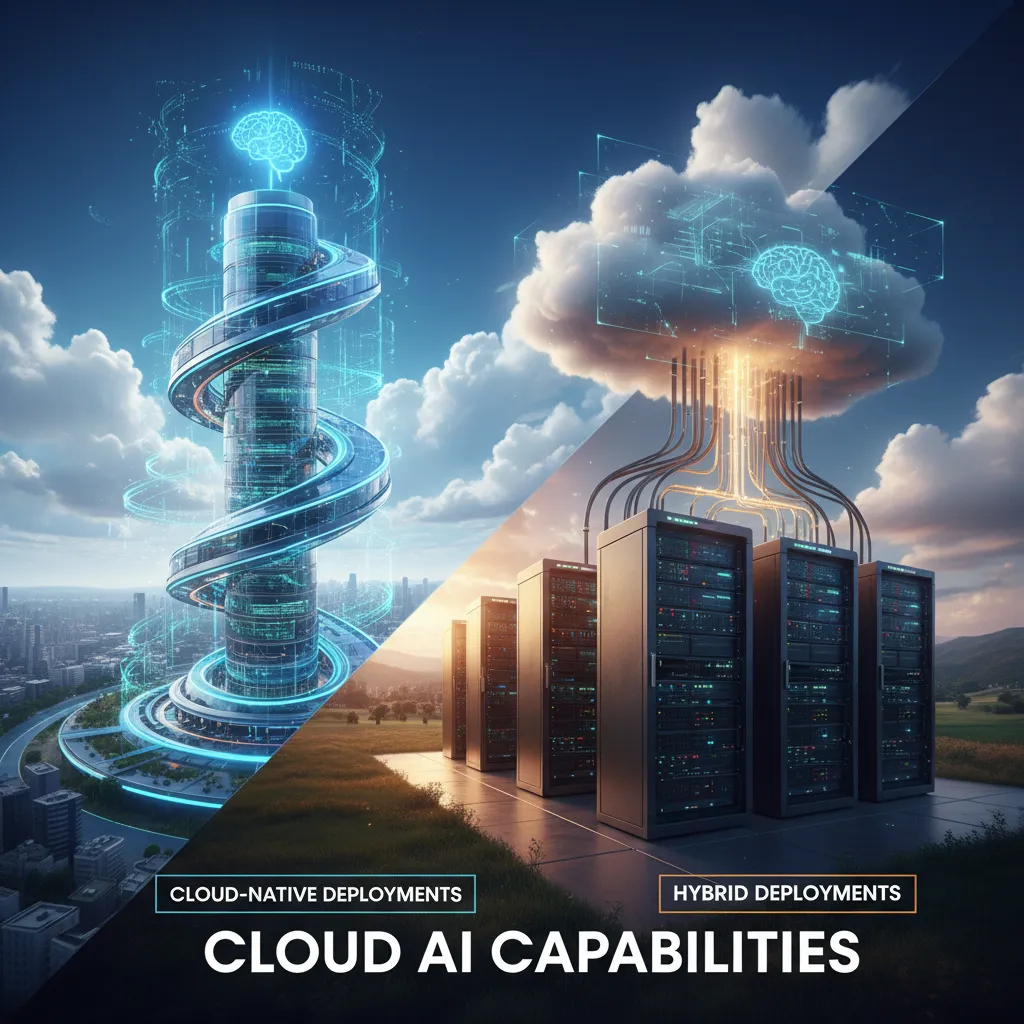
3) Cloud AI Capabilities: cloud-native vs Hybrid Deployments
Cloud-native reality (and why it matters for AI)
When I compare AI features across SAP, Oracle, and Microsoft Dynamics, I start with where the ERP “lives.” Oracle Cloud ERP often feels designed-first for cloud operations: consistent services, centralized controls, and a smoother path to using cloud AI tools at scale. SAP and Dynamics 365 can be very cloud-strong too, but in many real projects they still reflect a hybrid history—especially when older modules, custom code, or on-prem integrations are in the mix.
Hybrid deployments: why teams keep workloads close
I still see hybrid setups for practical reasons, not because teams “fear the cloud.” Common drivers are compliance (data residency rules), latency (fast response needs), and plant connectivity (factories with unstable networks). In these cases, AI can still work, but I plan for where data is processed, cached, and audited.
Azure integration: where Dynamics 365 quietly wins
If a company already runs on Microsoft 365 and Teams, Dynamics 365 can feel like the shortest path to value. Identity, collaboration, and analytics often align well with Azure services, which can reduce friction when rolling out AI assistants, forecasting, or document automation.
Myth-busting “seamless integration”
Integration is easy until you hit identity, data models, and edge cases.
I watch for single sign-on gaps, mismatched master data, and exceptions like returns, partial shipments, or multi-entity reporting.
Mini checklist I use
- Data residency: where data is stored and processed
- API maturity: coverage, limits, and versioning
- Monitoring: logs, alerts, and traceability for AI outputs
- Upgrades vs customizations: what breaks when the platform updates

4) User Experience (and the Learning Curve nobody budgets for)
When people compare AI ERP features, they often skip the daily reality: can normal users get work done without friction? In my experience, user experience is the hidden cost center—because adoption lives or dies in the first few weeks.
Dynamics 365: approachable UX that drives adoption
Microsoft Dynamics 365 often feels more familiar to non-technical teams because it fits the Microsoft ecosystem many already use. That matters because when the screens feel “known,” people try the AI features instead of avoiding them. I’ve seen Power BI and Teams-style patterns reduce training time, especially for finance and operations users who just want clear steps.
SAP S/4HANA: depth as a superpower (or a tax)
SAP S/4HANA has serious depth. If your processes are mature, that depth becomes a superpower: strong controls, detailed workflows, and lots of configuration options. If your processes are messy, the same depth becomes a tax. Users end up learning the system and learning what the business “really means” at the same time.
Oracle Cloud ERP: cleaner UX, but roles decide the flow
Oracle Cloud ERP is much cleaner than older Oracle stacks, but role design still makes or breaks the daily experience. If roles are too tight, users hit access walls. If roles are too broad, approvals and audit trails get confusing. Either way, AI recommendations won’t help if users can’t reach the right page.
My informal test: the requisition moment
Can a new hire create a requisition without asking three people? I’ve watched this happen.
That single task exposes navigation, permissions, and how well AI prompts guide the next step.
Where Business Intelligence lives
- Embedded dashboards: convenient, but sometimes limited to the ERP context.
- Power BI as the “home base”: for Dynamics teams, analytics often lives in Power BI, with ERP data feeding a shared reporting layer.
5) Implementation Time & Implementation Costs: the calendar is part of the price tag
Implementation time: your AI ERP timeline is a cost line
When I compare SAP vs. Oracle vs. Microsoft Dynamics for AI-ready ERP, I always remind teams that the calendar is part of the price tag. In real projects, Dynamics 365 commonly lands in a “moderate” 3–6 month window for a focused scope. SAP can run 6–12+ months for complex rollouts, especially when multiple plants, countries, or legacy systems are involved. Oracle often sits in the middle, but the same forces apply.
What stretches timelines is rarely the software alone:
- Data migration (dirty masters break AI forecasting fast)
- Integrations (CRM, WMS, payroll, eCommerce, EDI)
- Process redesign (standardizing “how we work”)
- Decision latency (yes, meetings and slow approvals)
Implementation costs: scope early or pay later
Implementation costs jump when scoping is vague and customization arrives late—especially when you’re chasing AI ERP features like predictive planning, anomaly detection, or copilots. AI needs clean data, clear ownership, and consistent workflows. If those aren’t defined early, you end up paying for rework, extra integration, and extended consulting.
Week 10 panic: the team realizes approvals were never mapped end-to-end, so purchase requests stall, exceptions pile up, and the “AI automation” demo suddenly looks fake.
Practical mitigation (what I push for)
- Phased modules: finance first, then supply chain, then advanced AI
- Pilot business unit: prove value, fix gaps, then scale
- Integration-first architecture: define APIs and data flows before UI tweaks
6) Total Cost Ownership: pricing, ROI, and the stuff CFOs circle in red
When I compare SAP vs. Oracle vs. Microsoft Dynamics for AI ERP value, I start with Total Cost Ownership (TCO), not the demo. CFOs don’t just pay for software. They pay for everything around it.
What TCO really includes
- Licenses (users, modules, AI add-ons)
- Implementation (partners, data migration, testing)
- Support (vendor + internal team)
- Integrations (CRM, payroll, e-commerce, BI)
- Ongoing change: process updates, training, new compliance needs—the hidden line items
Dynamics 365: pricing that shifts the conversation
Dynamics 365 often anchors pricing around $65–$210 per user, which can be competitive for SMEs. In real projects, that lower entry point changes the AI ERP discussion from “Can we afford it?” to “Can we adopt it fast enough to get value?” But I still budget for integrations and change management, because that’s where costs quietly grow.
ROI claims: how I sanity-check “265%”
Microsoft has reported a 265% ROI after three years for Dynamics 365 in some studies. I don’t accept that number as-is. I map it to your reality:
- Which roles actually save time (finance, purchasing, planners)?
- What manual work disappears (rekeying, reconciliations, spreadsheet reporting)?
- What’s the baseline cost today (hours, errors, delays)?
ROI is believable when it’s tied to specific workflows, not generic “AI productivity.”
Oracle Cloud ERP and SAP S/4HANA: where higher cost can make sense
Oracle Cloud ERP can pay back through strong financial management that reduces manual close work—if governance is real and data standards are enforced. SAP S/4HANA can justify higher cost when global complexity, multi-entity operations, and deep industry specialization are non-negotiable.
7) Customization Flexibility & Integrated Business Applications (where projects get spicy)
Customization flexibility: tailor vs. stay upgrade-friendly
When I compare SAP, Oracle, and Microsoft Dynamics for AI-ready ERP work, customization is where projects get “spicy.” I’ve seen both extremes: teams that over-customize until upgrades become painful, and teams that stay so standard that users build shadow processes in spreadsheets. The real skill is choosing what to tailor and what to keep clean so you can still adopt new AI features and platform updates.
Integrated business apps: where Dynamics often moves fast
Dynamics 365 shines when you want CRM and ERP to feel like one system. In practice, the Power Platform (Power Automate, Power Apps) helps me build the “last mile” workflows—approvals, exception handling, and small UI tweaks—without rewriting the core ERP. That usually means faster iterations and less risk during upgrades, while still letting AI-driven insights flow across sales, service, and finance.
SAP S/4HANA: deep process tailoring for industry needs
SAP S/4HANA is strong when the business truly needs deep process design—think manufacturing planning, complex supply chains, or regulated operations. I’ve seen SAP projects succeed when customization is tied to clear industry requirements, not personal preferences. Done well, it supports specialization while still keeping a path for future AI enhancements.
Oracle Cloud ERP: standardization for finance consistency
Oracle Cloud ERP often wins when finance wants consistency across many entities. Standard processes, shared controls, and common reporting can reduce variation, which makes governance and AI-driven forecasting cleaner.
Mini hypothetical: e-commerce returns workflow
- Dynamics 365: usually cleanest end-to-end because returns touch customer service + inventory + finance with tight CRM-ERP links and Power Platform automation.
- SAP: best if returns require complex warehouse steps, quality checks, or compliance rules.
- Oracle: strongest when the priority is consistent financial treatment and centralized controls across regions.
8) Key Selection Factors: my no-regrets shortlist (plus a tiny gut-check)
If you made it this far in this AI ERP showdown, here’s my practical wrap-up. When people ask me “which is best,” I start with strengths, not hype. SAP S/4HANA is my pick when you need global scale, deep controls, and real industry specialization. Oracle Cloud ERP stands out when the goal is cloud-native finance with strong automation for close, reporting, and controls. Microsoft Dynamics 365 wins when user experience matters most and you want tight integration with the Microsoft ecosystem (Teams, Power Platform, Azure) so AI features can show up in everyday work.
The decision matrix I actually use
I keep it simple: size/complexity, your Microsoft footprint, finance maturity, and your appetite for standardization. If you can standardize processes and move fast, you’ll feel the benefits of AI sooner because clean data and consistent workflows make AI less “magic” and more reliable. If you can’t standardize (yet), choose the platform that best handles your reality without constant workarounds.
Why “best ERP systems” lists mislead
Most lists ignore constraints: timeline, change capacity, regulatory needs, and how many custom processes you truly must keep. Industry fit can beat speed, but speed can beat perfection if you need value this year.
The wild card that changes everything
Two companies can have the same revenue, but if one operates in 12 countries and 9 currencies, the ERP pick changes fast. Complexity, not revenue, drives risk.
My tiny gut-check: if the AI features disappeared tomorrow, would I still like the core workflows?
TL;DR: If you want deep global complexity and industry specialization, SAP S/4HANA is the heavyweight (with SAP Leonardo for embedded AI). If you want cloud-native automation with strong financial management, Oracle Cloud ERP is hard to beat (Oracle AI Cloud). If you want the most user-friendly interface, faster implementation (often 3–6 months), and tight Microsoft ecosystem fit, Microsoft Dynamics 365 stands out (Copilot, Power Automate RPA, Azure integration).


Comments
Post a Comment