AI Customer Segmentation Models That Actually Work
I still remember the first time I tried to “segment customers with AI.” I had a spreadsheet, a strong coffee, and the confidence of someone who hadn’t yet been humbled by missing values. Two hours later, I’d created five “segments” that were basically: people who bought a lot, people who bought a little, and people I accidentally duplicated. That tiny disaster ended up being useful, though—it taught me that AI-powered customer segmentation isn’t magic; it’s a chain of choices. In this post, I’ll walk through the choices that matter (and the ones that quietly wreck results), using Machine Learning tools like K-means Clustering, the Elbow Method, and even a quick detour into PCA when your features get unruly.
1) The day I stopped trusting “gut-feel” segments
I used to think customer segmentation was something you could “feel out” in a meeting room. We’d gather around a whiteboard, list a few customer types, and give them confident names like “VIPs”, “Bargain Hunters”, or “Power Users”. It sounded smart, but it wasn’t reliable. The problem wasn’t effort—it was that we were building segments from opinions, not evidence.
The breaking point came when we launched a campaign for our so-called VIP segment. We assumed these customers were loyal, high-value, and likely to buy again. But when I pulled the data, the “VIPs” were mostly just people who had used a discount code. They weren’t more loyal. They weren’t higher value. They were simply responding to a promotion we ran once. Our “VIP” label was a story we told ourselves, not a real pattern.
That’s when I started taking AI and data-driven segmentation seriously. Not because AI is magic, but because it forces you to define segments based on signals you can measure. If a segment can’t be explained with data, it’s not a segment—it’s a guess.
Why brainstorm-only segmentation fails
- It’s biased: the loudest opinion often wins.
- It’s vague: segments become labels without clear rules.
- It’s unstable: the definition changes every time the team changes.
- It doesn’t scale: you can’t operationalize “we think they care about quality.”
The four lenses I keep returning to
When I build AI-powered customer segmentation models, I still start simple. I return to four classic lenses, then let the data confirm (or reject) the story.
- Demographic Segmentation: age range, role, income band, company size.
- Psychographic Segmentation: values, motivations, preferences (usually from surveys or content signals).
- Behavioral Segmentation: purchases, frequency, product usage, churn risk, support tickets.
- Geographic Segmentation: country, region, climate, local needs, shipping constraints.
My simplest quality check
If I can’t describe a segment without using the word “probably”, it’s not ready.
Now I push myself to write segment definitions like rules: what they did, how often, what they bought, where they are, and what signals prove it. That mindset shift is where segmentation starts working.

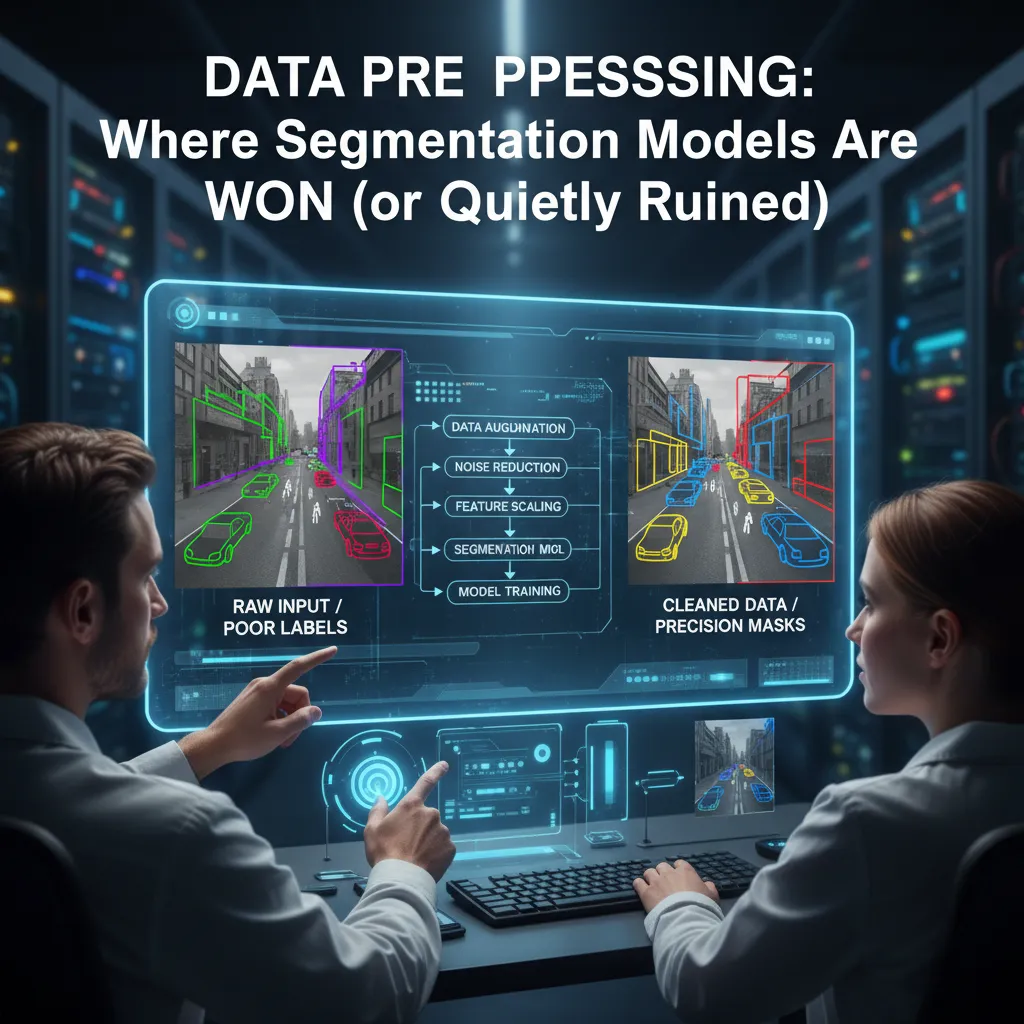
2) Data preprocessing: where segmentation models are won (or quietly ruined)
When I build AI-powered customer segmentation models, I spend more time cleaning data than training models. Not because it’s fun, but because segmentation is fragile: small data issues can create “segments” that are really just tracking errors. Before any Machine Learning, I run a quick messy-data triage so I’m not optimizing noise.
My messy-data triage checklist (before ML)
- Duplicates: I look for repeated customer IDs, repeated orders, and duplicate events from retries. I decide rules like “keep the latest profile row” or “sum orders, dedupe events.”
- Missing values: I separate “unknown” from “not applicable.” For example, missing
ageis different from missingcompany_sizefor a consumer. - Weird currencies: I normalize all revenue to one currency and one time basis. Mixed currencies and tax rules can fake “high-value” segments.
- Bot activity: I filter sessions with impossible speed, zero scroll, or 100+ pageviews in minutes. Bots love to become their own “segment.”
Features that map to behavior (not vanity metrics)
I try to turn raw logs into features that describe what customers do, not what my dashboard likes to show. These are the feature ideas I reuse most:
- Recency, frequency, monetary: days since last purchase, orders per 90 days, spend per 90 days.
- Engagement depth: product views per session, repeat category visits, time between visits.
- Lifecycle signals: first purchase date, time-to-second-purchase, refund rate, support tickets per order.
- Preference signals: top category share, discount share, subscription vs one-time ratio.
Quick tangent: why I sometimes delete “last-click channel” and sleep better
Last-click channel often reflects attribution rules more than customer intent. It can also leak campaign structure into the model, so segments become “Facebook people” vs “Email people” instead of real behaviors. If I need marketing context, I prefer stable summaries like multi-touch share or channel diversity, not a single last touch.
What I want as outputs
Clean rows, consistent scales, and a feature dictionary I can defend.
- Clean rows: one customer = one row (or one account), with clear aggregation rules.
- Consistent scales: log-transform skewed spend, standardize numeric features, cap extreme outliers.
- Feature dictionary: a simple table of each feature, definition, window, and why it matters.
3) K-means Clustering (and the Elbow Method) in plain English
Why I start with K-means for AI customer segmentation
When I build AI-powered customer segmentation models, I usually start with K-means clustering. Not because it’s perfect, but because it’s fast, easy to explain, and gives me a solid first baseline. If I’m working with common inputs like purchase frequency, average order value, time since last purchase, or product categories, K-means can quickly group customers into segments that are “close” to each other based on those numbers.
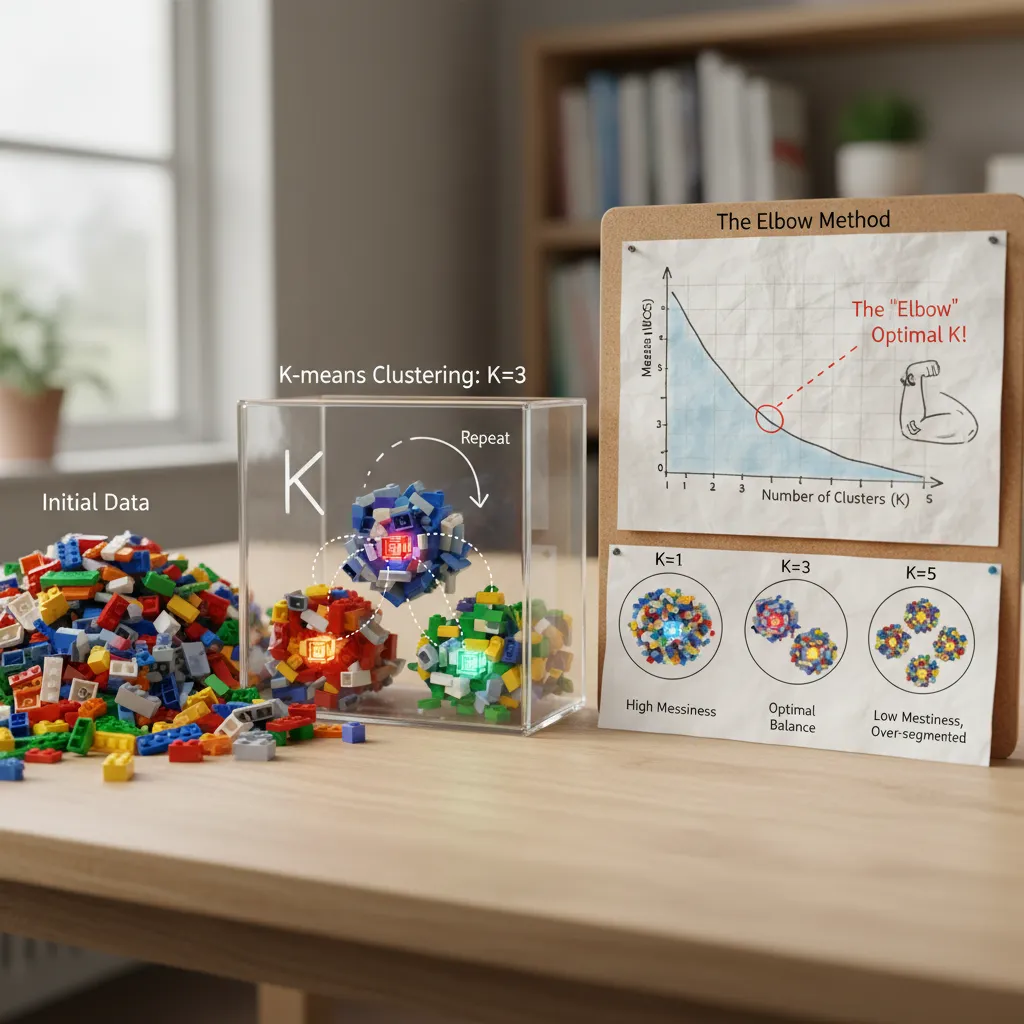
In plain terms: K-means tries to split customers into k groups, where each group has a “center point” (called a centroid). Every customer gets assigned to the nearest centroid, then the centroids move to better represent their groups, and the process repeats.
Centroids can look “too average” (and that’s normal)
One thing that surprises people: the centroid is not a real customer. It’s an average of the customers in that cluster. So when I look at a centroid profile, it can feel bland—like “medium spend, medium frequency, medium everything.” That doesn’t mean the segment is useless. It means I need to interpret it correctly:
- The centroid is a summary, not a persona.
- Clusters can still contain clear patterns even if the center looks average.
- I often pair centroid stats with examples of real customers closest to the centroid.
Using the Elbow Method without pretending it’s magic
The big question is always: how many segments should I use? The Elbow Method helps me choose k without guessing. I run K-means for several values of k (like 2 to 10) and track how much the model improves as I add more clusters. Improvement usually drops off after a point—the “elbow.”
For me, the elbow is a practical hint, not a divine revelation.
If the elbow is unclear, I choose the smallest k that still creates segments my team can act on.
A tiny warning label: outliers will mess with it
K-means doesn’t love outliers. One extreme customer (like a huge one-time buyer) can pull a centroid in a weird direction and distort a segment. When that happens, it’s loud: you’ll see odd centroids and unstable clusters. I usually handle this by capping extreme values, removing obvious anomalies, or trying a different approach if outliers are the norm.
4) When K-means isn’t enough: PCA, DBSCAN, and a quick Decision Trees detour
K-means is a solid start for AI customer segmentation, but I’ve learned it can break down fast when my data is noisy, high-dimensional, or shaped in ways that don’t look like neat circles. When that happens, I switch tools—not because K-means is “bad,” but because real customers rarely behave in clean patterns.
Principal Component Analysis (PCA): when my feature set had “too many opinions”
The first time I used PCA, it felt like admitting my dataset was arguing with itself. I had dozens of features (sessions, categories, discounts, returns, email clicks), and many were basically saying the same thing in different ways. PCA helps me compress that into fewer “summary” dimensions so clustering can focus on the strongest signals.
- Why I use it: reduces noise, speeds up training, and makes clusters more stable.
- Where it helps most: behavioral data with lots of correlated metrics.
PCA(n_components=2 or 3) → then cluster
DBSCAN: for messy shapes and anomaly-ish customer pockets
Some customer groups aren’t round blobs—they’re stretched, curved, or scattered. DBSCAN is my go-to when I suspect there are “pockets” of customers that don’t fit the main crowd, like unusual high-return buyers or sudden bulk purchasers. It can also label points as noise, which is useful when I’m hunting for edge cases.
- Strength: finds clusters of different shapes without choosing K.
- Watch-outs: sensitive to
epsandmin_samples; scaling features is a must.
Hierarchical Clustering: dendrograms make stakeholders oddly calm
When I need to explain segmentation to non-technical teams, hierarchical clustering helps because it tells a story: customers split into sub-groups step by step. A dendrogram turns “black box clustering” into something people can literally point at in a meeting.
“So these two groups are similar until this split?” Yes—and that’s the whole value.
Decision Trees / Random Forests: my “segment explainer” layer
Even if clustering created the segments, I often train a Decision Tree or Random Forest to predict the cluster label. This gives me simple rules like “high repeat rate + low discount use → Segment B”, which makes AI-driven segmentation easier to act on.
- Tree: easy rules for marketing and sales.
- Forest: better accuracy + feature importance for what drives each segment.
5) Turning segments into action: personalization, churn prediction, and LTV
The “so what” test (my rule for AI segments)
I only trust an AI customer segment if it passes the “so what” test: What do we do differently because this person is in this segment? If a segment does not change messaging, offers, onboarding, or pricing, it is just a label.
- Messaging: Which value prop do I lead with—speed, savings, status, or support?
- Offers: Do I push bundles, free trials, loyalty credits, or premium upgrades?
- Onboarding: Do I guide them to one “aha” feature or a full setup checklist?
- Pricing: Do I show annual plans first, usage-based options, or a starter tier?
Behavioral segmentation in practice: purchase history → next-best-action
Demographics rarely tell me what a customer will do next. Behavior does. With AI-powered customer segmentation models, I map purchase history and product usage into a simple “next-best-action” playbook.
| Behavior signal | What it often means | Next-best-action |
|---|---|---|
| Repeat buys every 30 days | Routine, predictable demand | Subscription or auto-reorder offer |
| High browsing, low checkout | Hesitation or price sensitivity | Comparison guide + limited-time incentive |
| Buys only during promos | Deal-driven segment | Promo calendar + bundle discounts |
In my workflows, I keep the action logic readable, even if the model is complex:
if segment == "Routine Replenisher": offer = "Subscribe & Save"
Predictive analytics layer: churn + LTV as a segment multiplier
Segments get more useful when I add predictive analytics. I treat churn risk and lifetime value (LTV) as multipliers on top of the segment. Two customers can be in the same behavioral segment, but one needs retention help while the other deserves premium attention.
Segment tells me what they are like. Churn and LTV tell me how urgent and how valuable the next action is.
Hypothetical scenario: identical demographics, opposite behavior
Imagine two customers: same age, same city, same income band. Customer A buys monthly, uses support docs, and renews early—low churn, high LTV. Customer B buys once, ignores onboarding emails, and stops logging in—high churn, low LTV. Demographically they match, but behavior makes them opposites. That’s why my AI segmentation models focus on actions, not profiles.
6) Shipping the model: monitoring, drift, and the awkward reality of org charts (wild card)
Operationalizing AI segments without starting a turf war
Building AI-powered customer segmentation models is the easy part. Shipping them is where reality shows up—especially the org chart. When I hand segments to marketing, I don’t “drop a model” and walk away. I translate the output into something they can use: clear segment names, a short description, and the top signals that define each group. I also agree upfront on what the segments are for (email targeting, onboarding, upsell, churn prevention) so nobody feels like their team is being replaced by AI.
I’ve learned to position the model as a shared tool, not a verdict. Marketing owns the message and creative. Data owns the logic and monitoring. Product often owns the in-app experience. When those lines are clear, the segments stop being political and start being practical.
Monitoring: when segment sizes suddenly change
Once the model is live, I watch segment sizes like a heartbeat. If a segment that used to be 18% of customers drops to 6% overnight, something happened. The tricky part is figuring out whether it’s data drift (tracking broke, a field changed, a pipeline failed) or a real behavior shift (pricing changed, a competitor launched, seasonality hit).
My rule: first suspect the data, then confirm the business story. I check event volumes, missing values, and any recent releases that touched analytics. If the data looks stable, I ask what changed in the market or in our product. This is where AI needs human context to stay useful.
A lightweight governance habit that actually sticks
I keep governance simple: a monthly segment sanity check meeting. It’s 30 minutes with one person from marketing, product, and data. We review segment size trends, campaign performance by segment, and any “this doesn’t feel right” feedback from the teams using it. If we need to retrain, rename, or merge segments, we decide together. That shared ownership prevents silent distrust.
My favorite analogy: segments are like playlists
I remind everyone that segments are like playlists—great until your taste changes. Customers change, channels change, and the business changes. The goal isn’t a perfect segmentation model forever. The goal is a model we can ship, monitor, and adjust so it keeps driving better decisions. That’s how AI customer segmentation actually works in the real world.
TL;DR: AI-powered Customer Segmentation works when you (1) pick a segmentation lens (behavioral, demographic, psychographic, geographic), (2) prep data with intent, (3) start with K-means Clustering + Elbow Method, (4) validate with real-world outcomes (churn, LTV, conversions), and (5) operationalize segments in campaigns and product decisions.


Comments
Post a Comment