AI Automation Tools Compared: What Actually Works

The first time I “automated” my work, I accidentally created a loop that emailed my coworker every time I changed a spreadsheet cell. He was polite for the first 12 pings. By the 40th, I learned two things: (1) workflow automation is powerful, and (2) the tool you choose matters as much as the idea. In this post, I’m comparing today’s AI automation tools the way I actually shop for them—by stress-testing app integrations, visual builder ergonomics, and the very unsexy reality of pricing plans and governance.
My “automation tools” litmus test (before features)
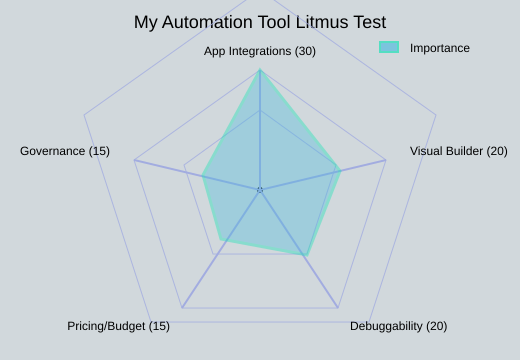
Before I compare key capabilities, I run every AI workflow automation tool through three stress questions: “Does it connect to my apps?” “Can I debug it at 11pm?” and “Will finance freak out?” If a tool fails any one, the fancy AI agents and natural language interfaces don’t matter much in real workflow automation.
The quiet killer is unclear ownership—who fixes the workflow automation when a connector breaks? (Spoiler: it’s always “future me”.) That’s why I look for deep app integrations, clear error messages, and logs I can read when I’m tired and slightly annoyed.
My 30-minute rule (visual builder or templates)
I won’t adopt a tool unless I can build one useful workflow in under 30 minutes using the visual builder or starter templates. Trends in “High-Impact Automation Tools Compared: AI-Powered Solutions” point to visual builders and non-technical-friendly design as the real unlock—especially when AI agents suggest steps, or a natural language interface helps draft the first version.
Scoring rubric (what I weight most)
I use a simple rubric so I don’t get distracted by shiny features:
| Category | Weight | What I’m checking |
|---|---|---|
| App integrations | 30% | My core tools + reliability of connectors |
| Visual builder & scenario building | 20% | Speed to build, templates, clarity |
| Debuggability & logs | 20% | Run history, errors, retries, test mode |
| Pricing plans & budget considerations | 15% | Usage limits, overages, team costs |
| Governance features & audit governance | 15% | Permissions, approvals, audit trail |
“Automation fails most often at the handoff between people and systems—design for ownership, not just for speed.” — Tara VanDerveer
Wild-card analogy (bike test)
Picking automation is like buying a bike—you don’t need a Tour de France rig to commute, but cheap brakes will ruin your week. For me, “brakes” means transparent pricing plans, solid logs, and integrations that don’t randomly snap.

Quick-connect champs: Zapier vs. Make (and my bias)
When I compare AI automation tools and other workflow automation tools, I keep coming back to two no-code automation staples: Zapier and Make (formerly Integromat). My bias is simple: I pick the tool that I’ll still understand when I reopen it months later.
“Tools that win aren’t always the most powerful—they’re the ones people can understand when they revisit a workflow months later.” — April Dunford
Zapier: fast drag-and-drop + huge app integrations
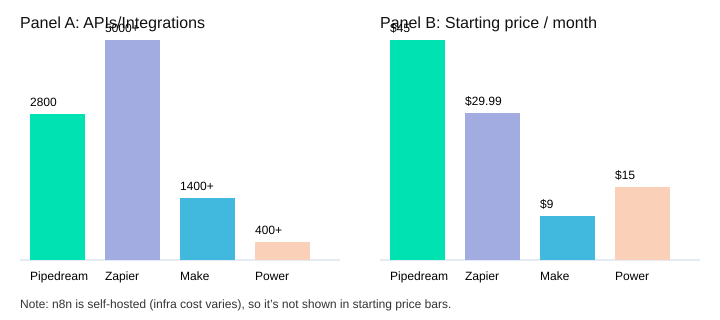
Zapier is my go-to when I just need the thing to talk to the other thing. With 5,000+ app integrations, it’s hard to get stuck. It also has a free tier, and its paid plans start at $29.99/month. The UX feels like clean drag-and-drop rules: trigger → action → done. Conditional logic exists, but I use it mostly for simple “if this, then that” filters.
Make: scenario building for “weird” (good) workflows
Make starts at $9/month, offers a free tier, and supports 1,400+ integrations. Where it wins for me is scenario building: a visual builder that makes branching, routers, and multi-step logic feel organized instead of spaghetti. When conditional logic multiplies, Make gives me more control and clearer debugging.
Mini scenario: content automation
- Auto-publish a draft
- Notify Slack
- Log the URL in Airtable
Zapier is faster to set up for the straight line. Once I add branches (different channels, approvals, retries), Make becomes easier to reason about.
Tiny tangent: I used to think “visual builder” meant “toy.” Then I watched a Make scenario explain itself better than my old Python script.
| Tool | App integrations | Free tier | Starting price | Best fit |
|---|---|---|---|---|
| Zapier | 5,000+ | Yes | $29.99/month | Solo marketer, quick connections |
| Make | 1,400+ | Yes | $9/month | Ops-minded teams, complex workflows |
Microsoft Power Automate: the ‘already paying for it’ move
If my day lives in Outlook, Teams, SharePoint, and Excel, Microsoft Power Automate feels like workflow automation with home-field advantage. In the source material, the big takeaway is simple: Power Automate shines inside Microsoft environments, with 400+ connectors and licensing that’s often included in Office 365 (varies) or $15/month standalone.
“The best automation is the one that matches how your company already works—change management is a bigger cost than software.” — Satya Nadella
Microsoft integrations that matter for enterprise automation
I’ve seen teams underestimate connector depth. Yes, 400+ connectors sounds smaller than Zapier’s 5,000+ or Make’s 1,400+, but Microsoft integrations can be tighter where it matters: identity, permissions, files, and approvals. For enterprise integration (including hybrid automation across on-prem and cloud), that “tight fit” reduces friction when you connect SharePoint libraries, Teams channels, and Excel-based reporting.
Governance features and audit governance (when security asks hard questions)
For enterprise automation, I care less about flashy demos and more about governance features. Power Automate is easier to defend in security reviews because it aligns with Microsoft admin controls, environments, and logging—so audit governance conversations are less painful.
Practical tip: start with one approval flow
- Pick one approval: expense, content review, or access request.
- Automate notifications in Teams + email in Outlook.
- Store the record in SharePoint or Excel.
Common Microsoft-native use cases (and required connectors)
| Use case | Connectors |
|---|---|
| Expense approval | Outlook, Approvals, SharePoint |
| Content review workflow | SharePoint, Teams, Approvals |
| Access request tracking | Microsoft Forms, SharePoint, Outlook |
Connector Ecosystems & Entry Cost (SVG)

Data transformation and predictive modeling: when Alteryx makes sense
I don’t reach for Alteryx when I’m just stitching apps together—I reach for it when data preparation is the job, not the side quest. This is the boundary between workflow automation and analytics automation: tools like Make or Zapier move tasks from A to B, while Alteryx is built for data transformation, repeatable cleaning, and turning messy inputs into analysis-ready tables.
“A lot of ‘automation’ is really data quality work in disguise—treat it like a product, not a script.” — Cassie Kozyrkov
From “Did it run?” to “Did it help?” with predictive analytics
If your automation goal is “make decisions faster,” predictive analytics and predictive modeling change the conversation. Instead of celebrating that a workflow ran on schedule, I can ask whether it improved forecasting, reduced risk, or helped a team act earlier.
Reality check: pricing plans and budget considerations
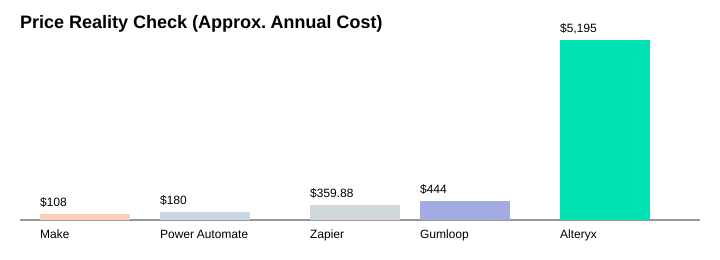
Alteryx is priced at $5,195/year per user. That’s a different universe from budget options like Make at $9/month (~$108/year). So the workflow has to earn its keep—usually in enterprise automation where one model or dataset supports many teams.
| Tool | Pricing plans (approx. annual) |
|---|---|
| Make | $108/year |
| Power Automate (standalone) | $180/year |
| Zapier (paid plans start) | $359.88/year |
| Gumloop (paid plan) | $444/year |
| Alteryx | $5,195/year per user |
Use-case fit: Alteryx vs lighter tools
| Use case | Best fit |
|---|---|
| ETL / data prep pipelines | Alteryx (strong), lighter tools (limited) |
| Forecasting / predictive modeling | Alteryx (strong), lighter tools (usually external) |
Wild-card scenario: retail inventory risk
Imagine a retail ops team that auto-flags inventory risk weekly: POS + supplier feeds go through data transformation, a predictive modeling step scores stockout risk, then results hand off to a dashboard and a task queue. That’s where Alteryx’s enterprise analytics focus makes sense.
Developers & control freaks (affectionate): n8n and Pipedream
When I’m building workflow automation that needs real control, I usually end up with n8n or Pipedream. They’re both “developer-friendly,” but in different ways—and that matters once you move past simple zaps into complex workflows and enterprise integration.
“Developers don’t hate tools—they hate constraints they didn’t choose.” — Kelsey Hightower
n8n: self-hosted options, zero lock-in vibes
n8n is my pick when self-hosted options and flexibility matter—especially if vendor lock-in makes you itch. It’s open-source, so I can run it where I want, wire up custom logic, and shape API integrations around my own data rules. For teams that need internal approvals, private networking, or strict compliance, n8n’s “bring your own infrastructure” model is a feature, not a bug.
Pipedream: AI agents + a workshop for API integrations
Pipedream feels like a workshop for developers: AI agents, an agent-builder vibe, and 2,800+ APIs via MCP server for fast API integrations. Pricing starts at $45/month, which is often worth it when I want managed reliability and quick iteration without babysitting servers.
The blunt question I ask
Do we need a visual builder for everyone, or a programmable platform with guardrails for a few? That answer usually decides whether I lean n8n (shared visual workflows + self-hosting) or Pipedream (code-first speed + agent tooling).
Small cautionary aside: the more power you give yourself, the more you also inherit maintenance (which is… not glamorous).
| Tool | Hosting | Skill level | Typical team fit |
|---|---|---|---|
| n8n | Open-source, self-hosted options (infra cost varies) | Medium–High | Dev + ops teams needing control |
| Pipedream | Cloud | High | Developers shipping fast integrations |

No-code automation goes ‘agentic’: Gumloop and Vellum AI
In my testing, the big shift in no-code automation isn’t just “more blocks.” It’s AI agents that can plan steps, call tools, and adapt. As Ethan Mollick puts it:
“The future of workflows is less ‘if this then that’ and more ‘delegate, verify, and audit’.” — Ethan Mollick
Gumloop: a visual builder with an AI copilot (Gummie)
Gumloop surprised me: it’s no-code automation with a visual builder and an AI copilot called Gummie. I can describe a workflow in natural language, and Gummie nudges me from “idea” to “working flow” faster than I expected. Pricing is simple: free plan, then $37/month.
That said, natural language interfaces are cool, but I still want to see the logic—if I can’t explain it, I can’t trust it. Gumloop works best for quick prototypes and internal automations where speed matters more than strict controls.
Vellum AI: low-code AI for production-grade agentic flows
Vellum AI feels like what happens when low-code AI grows up. It’s built for production-grade agentic flows, with governance features and SDKs so teams can ship without “YOLO deploy.” When a workflow touches customer data, I prioritize governance over novelty—logs, permissions, and review paths matter.
Agentic features checklist
| Tool | AI copilot | Governance features | SDK | Templates |
|---|---|---|---|---|
| Gumloop | Yes (Gummie) | Basic | Limited | Yes |
| Vellum AI | Yes | Strong | Yes | Yes |
Decision weights I use (donut chart)

| Data point | Value |
|---|---|
| Gumloop pricing | Free plan, then $37/month |
| Trend | AI agents + natural language for non-technical users |
| Trend | Visual builders becoming default |
| Suggested decision weights | Speed 35%, Governance 30%, Flexibility/SDK 20%, Cost 15% |
TL;DR: If you want quick wins, start with Zapier’s 5,000+ app integrations and a free tier. If you need complex workflows with visual scenario building, Make starts at $9/month. If you live in Microsoft, Power Automate is the path of least resistance (often included with Office 365 or $15/month). For enterprise data transformation and predictive modeling, Alteryx is pricey ($5,195/year/user) but deep. Developers who hate lock-in should look hard at n8n (self-hosted) or Pipedream (2,800+ APIs, $45/month).


Comments
Post a Comment