AI Analytics That Finally Got Us to Fit

The first time I realized we didn’t have product-market fit, it wasn’t a board meeting or a churn report. It was a support email that read: “Love the idea. I just… don’t think about you during my day.” Ouch. We had sign-ups, we had a slick landing page, and we had a weekly graph that always pointed up and to the right (because we kept spending on ads). What we didn’t have was a habit. So I did what most teams do: added more events, built more dashboards, argued about definitions of “active,” and promised myself we’d talk to users “next sprint.” Then we tried something different: we treated analytics like a product in itself, and we let AI do the boring parts—pattern-finding, segmentation, anomaly sniffing—so we could spend our human hours on decisions. That shift is what finally got us to fit.
1) The week I stopped trusting our dashboards
That week, our dashboard looked like a victory lap. Our activation rate was “healthy,” sign-ups were climbing, and pageviews were steady. I remember thinking, We’re close to product-market fit. Then I joined a customer screen-share.
The screen-share that broke the spell
The user did everything our funnel said “activated” users do: they signed up, clicked through onboarding, and landed on the main page. Our analytics counted it as success. But on the call, I watched them pause, scroll, and whisper, “So… what do I do now?” They tried two buttons, hit a confusing setting, and then opened a new tab to search for a workaround. Five minutes later, they left the product.
In our charts, that session was a green checkmark. In real life, it was a quiet failure.
What we measured vs. what mattered
We were measuring what was easy to count:
- Pageviews (busy does not mean valuable)
- Sign-ups (interest is not commitment)
- Onboarding completion (clicking is not understanding)
But what mattered for AI product analytics and real product-market fit was different. We needed to find repeatable value moments: the actions that made users say, “Yes, this solved my problem,” and then come back to do it again.
- Did they reach the first meaningful outcome?
- Did they repeat it within a week?
- Did they get value without help from us?
The sticky note that changed my questions
After that call, I wrote one uncomfortable question on a sticky note and stuck it to my monitor:
“What job are we hired for?”
Not “What features do we offer?” Not “How many users clicked?” The job. The real reason someone chooses us instead of doing nothing, using a spreadsheet, or picking a competitor. Once I started asking that, our dashboard felt less like truth and more like a guess.
Wild-card aside: dashboards as emotional support objects
Here’s my coffee-fueled theory: dashboards can become emotional support objects. When building is stressful, a clean upward line feels like progress—even if it’s tracking the wrong thing. That week, I realized our metrics weren’t lying; they were just answering questions we shouldn’t have been asking.

2) Fixing the plumbing: structured data before smart AI
From “track everything” to “track the story of value”
Before AI analytics helped us get to product-market fit, we had to admit something: our data was a mess. We were proud of “tracking everything,” but it meant we tracked noise. Every click, every hover, every page view. When we asked AI simple questions like “What actions predict retention?” it gave confident answers built on shaky inputs.
So we rewired tracking around one idea: track the story of value. Not what users touch, but what they try to achieve and whether they succeed.
A practical event taxonomy (and what we deleted)
We created a small event taxonomy that our whole team could understand. It wasn’t fancy, but it was consistent.
- Core actions: the steps users take to get value (e.g., create, import, invite, publish).
- Moments: meaningful checkpoints (e.g., first setup completed, first collaboration, first “aha”).
- Outcomes: proof value happened (e.g., report generated, time saved, task completed).
Then we deleted a lot. We removed “button_clicked,” “page_scrolled,” and other events that sounded useful but never mapped to value. We also merged duplicates across platforms so “created_project” meant the same thing on web and mobile.
| Old habit | New rule |
|---|---|
| Track UI behavior | Track user intent + result |
| Hundreds of events | Few events, strong definitions |
| Loose naming | One schema, enforced |
Privacy/permissions: the day legal saved us (slightly embarrassing)
True story: we almost shipped an event that captured free-text user inputs “for better AI.” Legal reviewed it and asked, “So you’re storing personal data… forever?” That was the moment we realized AI doesn’t excuse sloppy privacy.
We added permission checks, data minimization, and clear retention rules. We also moved sensitive fields to a separate, locked-down store and used anonymized IDs for analytics.
Why smaller, domain-optimized models beat a giant generic model
Once our data was structured, we tested a big generic model versus smaller models tuned to our product language. The smaller, domain-optimized approach won because it understood our event taxonomy, our funnels, and our definitions of “success.” With clean inputs, AI analytics became less about magic and more about reliable answers.
event_name: outcome_report_generated
properties: { plan_tier, team_size, time_to_value_seconds }
3) Letting AI do the boring analysis (so I could do the hard thinking)
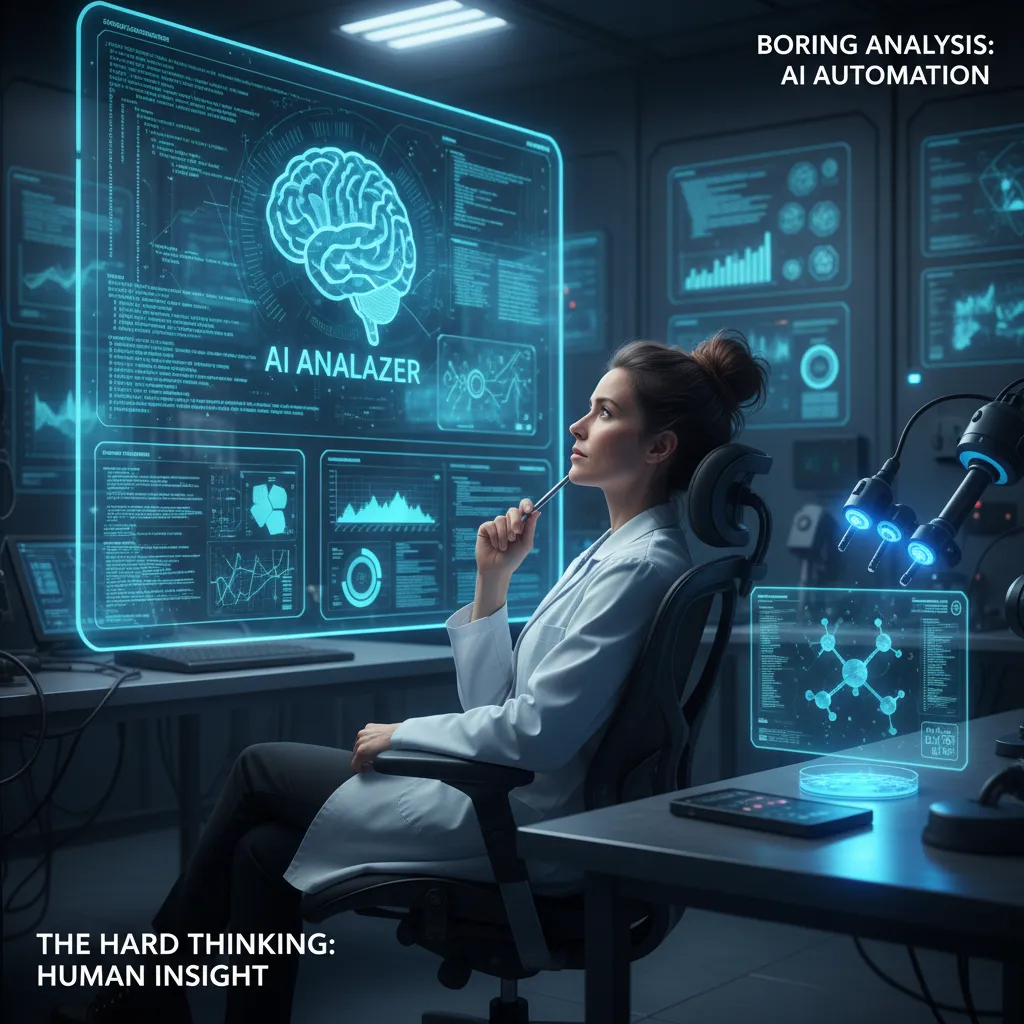
Before we leaned into AI product analytics, my “analysis” was a mix of dashboards, spreadsheets, and gut feel. I could answer basic questions, but I kept missing the real ones: Who is actually getting value? Why do some accounts stick while others fade? AI didn’t replace my thinking—it cleared the noise so I could do the hard thinking.
AI surfaced “hidden segments” we couldn’t see
Our firmographics told a clean story: same company size, same industry, similar team roles. But behavior was messy. We used AI to cluster users by actions instead of labels, and it surfaced hidden segments that looked identical on paper but acted totally different in-product.
- Fast starters: reached value in the first session and kept exploring.
- Busy evaluators: clicked around a lot but never completed the key workflow.
- Single-feature loyalists: used one feature weekly and ignored everything else.
That changed how we talked about “our target user.” It wasn’t a job title—it was a behavior pattern.
The cohort that mattered: “first value moment” beats acquisition channel
We used to slice retention by acquisition channel because it was easy: organic vs. paid vs. partner. AI pushed us toward a better cohort: users grouped by their first value moment—the first time they completed the action that made them say, “Oh, this works.”
When we compared cohorts, the difference was obvious. Channel-based cohorts were noisy. Value-moment cohorts were predictive. If someone hit that first value moment within a short window, retention jumped—even if they came from a “worse” channel.
“Stop optimizing for clicks. Optimize for the moment users feel the product click.”
Anomaly detection caught churn spikes before my gut did
Another win was anomaly detection. Instead of waiting for weekly reports, AI flagged unusual drops in activation and early churn signals. One week it highlighted a spike in cancellations tied to users who hit an error after a specific onboarding step. I wouldn’t have connected those dots fast enough.
The first time AI contradicted my favorite narrative (and it was right)
I had a strong belief that a new feature was driving retention. The AI summary said the opposite: retention improved mainly for users who adopted a boring workflow we’d barely marketed. I didn’t like it. We double-checked with event data and session replays. The AI was right—and my narrative was just louder than the evidence.

4) Experiments that didn’t feel like gambling
Before we used AI product analytics, our “experiments” were mostly guesses with a dashboard screenshot at the end. We shipped changes, waited, and hoped. The turning point was building a simple loop that made every test feel like a decision, not a bet.
Our experiment loop (and the rule that saved us)
We forced ourselves to run every experiment through the same steps:
- Hypothesis: what we believe will happen and why
- Metric: one primary number that proves or disproves it
- Change: the smallest product edit that can test the idea
- Review: a short, scheduled check-in with a clear “keep / revert / iterate” decision
The part that mattered most was the “stop early” rule. If the AI analytics showed the metric moving the wrong way (or not moving at all) after a defined sample size, we stopped. No “let’s give it another week” unless we had a new hypothesis. That discipline kept us from stacking random changes and calling it learning.
Example: shorten time-to-value by removing one onboarding screen
Our AI funnel analysis highlighted a drop-off right before users hit the first “aha” moment. The hypothesis was simple: one extra onboarding screen was delaying value. Our metric was time-to-value (minutes from signup to first successful outcome) plus completion rate for that first outcome.
We removed a screen that asked for “nice-to-have” info and moved it later. The AI helped us segment by acquisition channel, so we didn’t overreact to noisy traffic. The result: faster time-to-value and fewer users stalling in onboarding.
Example: an agentic in-product guide that nudges the next best action
Next, we tested an “agentic” guide: a lightweight in-product helper that suggested the next best step based on what the user had (and hadn’t) done. We didn’t try to build a chatbot. We built nudges.
- If a user imported data but didn’t create a report, we suggested a template.
- If they created a report but didn’t share it, we prompted sharing.
The metric was activation rate within 24 hours. The AI analytics made it clear which nudge sequences helped and which ones annoyed users.
One surprisingly human lesson: one user interview outweighed 10,000 events.
Analytics told us where users struggled. A single interview told us why. That “why” often changed the next hypothesis more than any chart ever did.
5) The ‘fit’ moment: when growth stopped being forced
For a long time, our growth felt like pushing a heavy cart uphill. We could move it, but only with constant effort: more campaigns, more features, more “maybe this will work.” The real change happened when AI product analytics stopped being a reporting tool and became our shared language for decisions.
What changed in our meetings: fewer opinions, more decisions (and yes, fewer slides)
Before, our weekly meeting was a debate club. Everyone had a theory, and we tried to “win” with stories and screenshots. Once we set up AI-driven dashboards and automated insights, the meeting got simpler. We walked in with the same facts.
- One metric owner per question, so we didn’t argue in circles.
- AI summaries of what changed week-over-week, so we didn’t need 20-slide decks.
- Decisions logged next to the data that triggered them, so we could learn faster.
“If we can’t point to the signal, we don’t ship the change.”
Signals of product-market fit we finally trusted
We used to chase vanity numbers. AI helped us focus on patterns that were harder to fake. The “fit” moment wasn’t one big spike—it was a set of steady signals showing up at the same time.
- Retention curves flattening: cohorts stopped dropping off after the first few uses and started leveling out.
- Organic referrals: more new users came from invites and word-of-mouth, not paid clicks.
- Fewer “how do I…?” tickets: support shifted from basic setup questions to edge cases and advanced use.
Our AI analytics also flagged which behaviors predicted long-term retention, so we stopped guessing what “activation” meant and measured it the same way every time.
Why AI infrastructure efficiency mattered as usage grew
Fit created a new problem: volume. Events, sessions, and queries grew fast. We invested in efficient AI infrastructure so analytics costs stayed predictable. We used sampling only where it was safe, automated data quality checks, and kept a tight event taxonomy. That meant we could keep asking questions without fearing the bill.
A forward-looking note: how 2026 AI trends may change product analytics again
By 2026, I expect more agent-like analytics: systems that not only explain what happened, but run controlled experiments, watch for risks, and suggest next actions in plain language. I also expect stronger privacy-by-design analytics, where AI can learn from behavior without exposing raw user data.
Conclusion: Product-market fit as a listening skill
Looking back, I don’t think product-market fit was a miracle moment where everything suddenly clicked. It was a system for listening at scale. The difference was that AI product analytics became our amplifier. Instead of guessing what users wanted, we could hear patterns in behavior, connect them to real outcomes, and then validate them in conversations. In that sense, AI didn’t “find” fit for us—it helped us notice fit faster, with less noise.
If I could rewind to the start, I would do three things earlier. First, I would define our value moments sooner—the few actions that prove a user actually got value. We wasted time measuring activity that looked busy but didn’t predict retention. Second, I would delete more metrics. We had dashboards full of numbers, but only a handful mattered. AI analytics helped us see which signals correlated with long-term use, but we still had to be brave enough to remove the rest. Third, I would talk to users weekly, no matter how “data-driven” we felt. The best loop was always: analytics shows a pattern, I ask users why, then we ship a change and measure again.
I also want to add a small warning label. Agentic analytics can automate confusion if your data is messy. If events are named inconsistently, if identities don’t match across devices, or if “active user” means five different things in five places, AI will still produce answers—but they may be confidently wrong. Before we trusted any model or automated insight, we had to clean our tracking, agree on definitions, and make sure our core events were reliable.
If you take one thing from our story, let it be this: treat product-market fit like a listening skill you can practice. This week, try one change. Pick one value moment—just one—and measure it cleanly. Write a clear event definition, confirm it fires correctly, and watch how it moves for new users over the first week. Then talk to five users who hit it and five who didn’t. That single, focused loop is where AI product analytics becomes truly useful—and where fit starts to feel less like luck and more like learning.
TL;DR: We reached product-market fit by cleaning our structured data, using AI to detect real usage patterns (not vanity metrics), and running fast experiments. Agentic workflows and multi-agent dashboards helped automate analysis; smaller domain models kept it accurate and affordable.


Comments
Post a Comment