2026 AI Strategy Best Practices, Step-by-Step

I used to treat “AI strategy” like a fancy slide deck exercise—until a scrappy pilot I ran on a sleepy Tuesday broke in production because nobody could explain where the “source of truth” data actually lived. That tiny embarrassment turned into my favorite lesson: strategy isn’t the vision statement; it’s the boring checklist that keeps the vision alive. In this step-by-step AI news–style strategy guide, I’ll share the framework I wish I’d had: five pillars, a phased 30-60-90 day plan, and a few opinionated detours (including why prompt engineering is starting to feel like memorizing shortcuts instead of learning to drive).
My “AI strategy” wake-up call (and why AI news matters)
My first AI pilot failed for a boring reason: nobody owned the data definitions. “Customer,” “active,” and even “churn” meant different things in Sales, Support, and Finance. The model did what it was told, then produced results nobody trusted. I blamed the model (classic). Later I realized the real bug was governance: no shared glossary, no data steward, no agreed source of truth.
How I read AI news now: signals, not hype
That experience changed how I follow AI news. I don’t read it to chase the loudest demo. I read it like a strategy radar—looking for signals that affect my plan:
- Tools: what’s becoming standard (agents, evals, RAG, workflow orchestration)
- Regulation: privacy, model risk, audit needs, and data residency shifts
- Vendor roadmaps: what will be bundled, deprecated, or priced differently next quarter
A quick gut-check before we “do AI”
- Are we chasing a shiny demo, or building repeatable AI workers end-to-end?
- Do we have owners for data definitions, prompts, and evaluation metrics?
- Can we monitor quality, cost, and security after launch?
Wild-card analogy: AI as a new hire
I treat AI like a new employee. If you don’t give it a badge (access), a manager (accountability), and a playbook (process + rules), it will wander—sometimes into places it should never go.
Mini-scenario: marketing launches an agent without guardrails
Marketing spins up a “content agent” with a credit card. It connects to a shared drive, pulls old pricing sheets, and drafts emails with outdated claims. Worse, it pastes customer notes into a third-party tool with unclear retention. Security finds out after a complaint.
AI news matters because it tells me what risks are rising—and what controls I need before the next pilot.

Data readiness assessment: the unglamorous 2-week sprint
Before I talk models, I run a 2-week data readiness assessment. It’s not exciting, but it saves months. The trick is to not boil the ocean: I pick one target process (like “support ticket routing” or “invoice matching”) and audit only the data that touches that workflow end to end.
How I assess data without boiling the ocean
I timebox the sprint and keep the scope tight. In week one, I map the process and list every system, file, and handoff. In week two, I validate what’s real with quick pulls and spot checks.
- Choose one process with clear inputs/outputs
- Pull a small sample (last 30–90 days)
- Document gaps, owners, and fixes
Source-of-truth mapping (reality vs belief)
Most teams can tell me where they think the truth lives. My job is to find where it actually lives. I create a simple map: system, table/file, owner, update frequency, and “who trusts it.” This is where hidden spreadsheets show up.
Schema + quality checks: two questions I ask
Before any model discussion, I ask:
- Is the schema stable enough to support automation (fields, IDs, timestamps)?
- Is the data trustworthy enough for decisions (missing values, duplicates, drift)?
If either answer is “no,” the best AI strategy is fixing the pipeline first.
Access gaps + compliance constraints
The fastest way to derail an AI pilot is ignoring access and rules. I check permissions, audit logs, retention, and whether data includes PII, contracts, or regulated content. If legal or security can’t approve access, the pilot can’t ship.
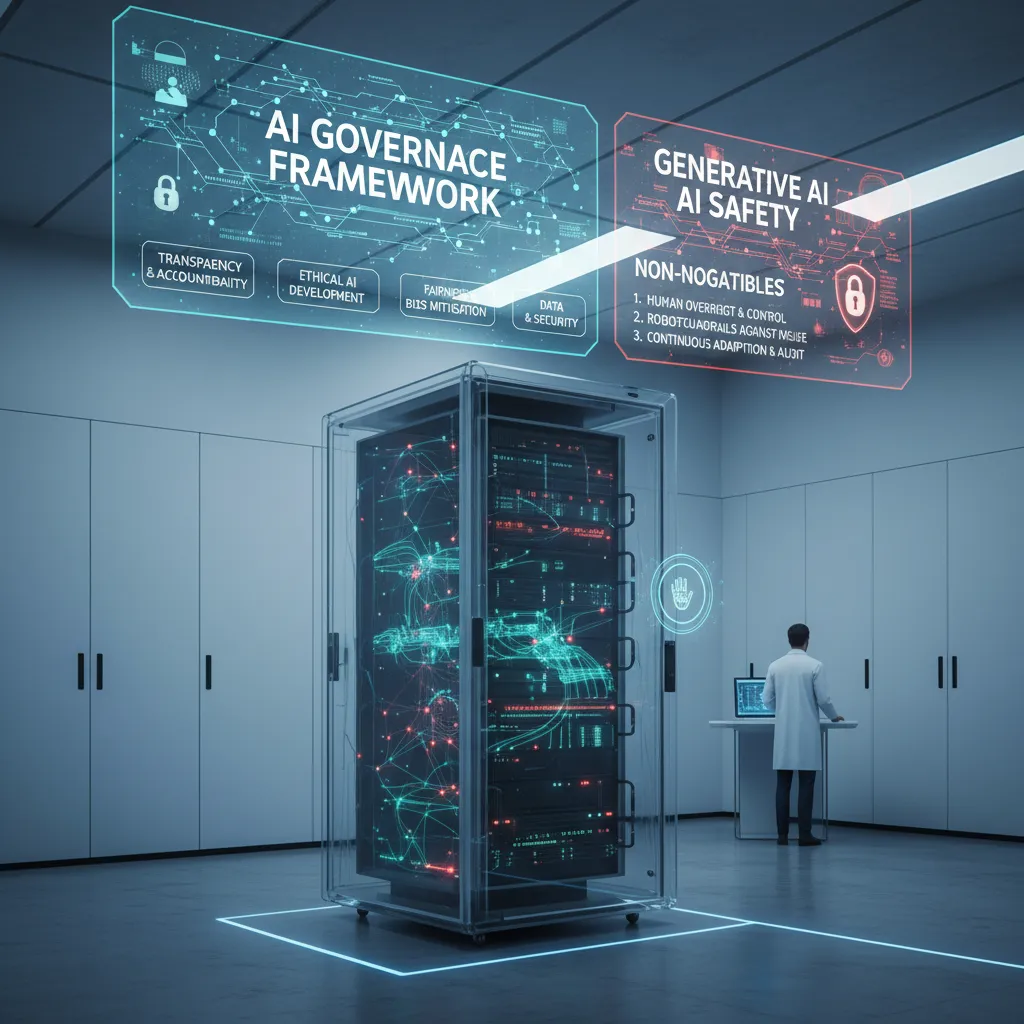
Tiny confession: I once found a final_FINAL.csv powering a dashboard—never again.AI governance framework + generative AI safety (my non-negotiables)
AI governance risk management (what I put in writing)
Before we ship anything customer-facing, I put the rules in writing. Not as a “nice-to-have,” but as a release gate. In my AI strategy guide notes, this is where risk management becomes real: clear owners, clear limits, and clear evidence.
- Use-case scope: what the model can and cannot do
- Data rules: allowed sources, retention, and redaction for PII
- Human accountability: who approves prompts, tools, and outputs
- Monitoring: what we log, how long, and who can access it
Generative AI safety (continuous learning loops)
My non-negotiable is accuracy with feedback loops. I treat every production answer as a test case. We capture user corrections, support tickets, and “thumbs down” signals, then feed them into prompt updates, retrieval tuning, and evaluation sets. If the model can’t cite a trusted source, it should say “I don’t know” and route to a human.
Agent-checking-agent (no single-point failure)
I like independent verification from different vendors. One agent generates; another validates. If they disagree, we slow down and ask for evidence.
- Generator drafts response + citations
- Verifier checks policy, facts, and tool calls
- Fallback triggers human review
Policy-meets-product (approvals that don’t block teams)
I keep approvals lightweight: pre-approved patterns, reusable checklists, and automated tests. The goal is a balancing act—fast shipping with guardrails that are easy to follow.
Side tangent: “Can we audit the agent’s decisions?”
Legal asked, “Can we audit the agent’s decisions?”—and we couldn’t.
That day changed my baseline. Now I require audit-ready logs: prompts, retrieved sources, tool actions, model version, and final output. If we can’t trace it, we don’t ship it.

Implementation roadmap phases: my 30-60-90 day plan (with a few bruises)
In the Step-by-Step AI News AI Strategy Guide, the biggest lesson I learned the hard way is simple: speed matters, but alignment matters more. My bruises came from running “random pilots” that looked smart but had no owner, no data plan, and no clear business metric.
Phase 0 (Days 1–30): assessment + alignment
This is where I stop doing things immediately: no more scattered experiments. I map goals to workflows, audit data access, and name a single decision-maker per use case.
- Pick 3 business outcomes (ex: pipeline, retention, support cost)
- Inventory tools, data sources, and security constraints
- Define “done” with a baseline metric and a target
Phase 1 (Days 31–60): prove value through pilots
I run only 1–2 high-ROI pilots and measure outcomes, not vibes. For AI marketing strategy 2026, my best early wins were content ops (briefs, repurposing) and lead scoring enrichment—because they tie to revenue fast.
- Write a one-page pilot plan (owner, data, metric, risk)
- Track lift weekly (time saved, conversion rate, cost per lead)
- Document what breaks (prompts, data gaps, approvals)
Phase 2 (Days 61–90): ship + scale
If a pilot works, I productionize it with MLOps + security: access controls, logging, evaluation, and a rollback plan. Then I replicate the pattern across similar teams.
Budget allocation strategy (tools/content/automation/analytics)
| Bucket | Split |
|---|---|
| Tools | 35% |
| Content | 25% |
| Automation | 25% |
| Analytics | 15% |
Practical trick: I keep a “kill list” for pilots. If it can’t prove impact in 30 days, it doesn’t earn the right to scale.
From prompt engineering to agentic AI autonomy (the real 2026 shift)
In 2026, I’m treating “prompt engineering” as table stakes. Clever prompts still help, but the real gains come from agent architecture: multi-step workflows that plan, act, check results, and repeat. A single prompt can answer a question; an agent can finish a job.
Why multi-step workflows beat clever prompts
When I design an AI system, I start with the steps a human would take: gather inputs, apply rules, use tools, verify, then hand off. This is more reliable than hoping one perfect prompt covers every edge case.
Choosing model architecture (my rule-of-thumb)
- Foundation models when the task is messy: mixed formats, unclear intent, or high language nuance (sales, support, research).
- Smaller specialized models when the task is narrow and repeatable: classification, routing, extraction, or policy checks.
- Hybrid when cost matters: small model first, foundation model only when confidence is low.
Agent frameworks: tools, memory, decomposition
Agentic AI works best when it can chain tools (CRM, email, calendar, web search), keep long-term memory (account notes, preferences, past outcomes), and do task decomposition (break one goal into smaller actions). I also add guardrails: allowed tools, approval steps, and logging.
“Stop asking for better answers. Start building systems that can take better actions.”
Automate one end-to-end workflow
Instead of building a chatbot that replies once, I pick one process to automate end-to-end—like lead intake to meeting booked—so the AI can move work forward across systems.
Mini hypothetical: an AI SDR worker
- Qualifies inbound leads from forms and CRM history.
- Drafts outreach using firmographic data and past wins.
- Books meetings via calendar rules and time zones.
- Requests human sign-off before sending or scheduling.
Agent identity management (AIAM): giving your AI workers a badge
When I deploy AI agents, I treat them like new hires: they need a badge. That badge is Agent Identity Access Management (AIAM). It’s like human IAM, but it’s different in one key way: agents don’t just “log in” and click around. They call tools, chain actions, and move fast across systems. Without a clear identity, an agent becomes a ghost user with unclear responsibility.
What AIAM is (and why it’s not human IAM)
Human IAM assumes a person behind the keyboard. AIAM assumes an automated worker that can run 24/7, trigger workflows, and touch many apps in seconds. So I assign each agent a unique identity, role, and purpose—no shared service accounts.
Evolving identity management: log every move
In my “Step-by-Step AI News AI Strategy Guide” notes, the biggest shift is visibility. I want logs that show every tool call, the permission scope used, and the data access path (what it read, wrote, and sent out).
- Tool call logs: API name, parameters, response size
- Data lineage: source → agent → destination
- Reason codes: why the agent accessed the data
Practical guardrails that actually work
- Least privilege: only the exact permissions needed
- Time-bound tokens: short-lived access, auto-rotated
- Audit trails: searchable logs tied to the agent identity
Why identity matters for AEO/GEO and AI search optimization
Marketing ops now uses agents to update pages, rewrite snippets, and publish schema for AEO, GEO, and AI search optimization. If an agent can edit content, it can also leak drafts, change canonical tags, or pull keyword data it shouldn’t. Identity controls keep “helpful automation” from becoming “silent damage.”
I once watched an agent pull data it shouldn’t have—because it could.
It had broad CRM access “for convenience.” The fix was simple: a tighter badge, narrower scope, and better logs.
Google's AI roadmap and the weirdly specific grid-management detour
How I read Google’s roadmap: buy, build, or wait
When I scan Google’s AI roadmap, I don’t treat it like a promise. I treat it like a decision tool. I translate each roadmap item into one of three moves: buy (it’s stable and supported), build (it’s core to my advantage), or wait (it’s real, but not ready). This keeps my 2026 AI strategy grounded in what I can run safely, not what sounds exciting in a keynote.
- Buy when the feature is packaged, priced, and has clear docs and support.
- Build when the feature touches my data moat, workflows, or compliance edge.
- Wait when it’s changing fast or depends on missing governance.
The grid-management detour: why a niche example matters
Google’s AI-driven grid management work looks oddly specific, but I use it as a signal. Power grids are high-stakes systems: real-time decisions, messy data, strict safety rules, and human override. If AI can help there, it tells me what patterns are maturing for any org: forecasting, anomaly detection, agent coordination, and audit trails.
“If it can’t be monitored, rolled back, and explained, it won’t survive in critical infrastructure.”
Mid-2026 expectation: Marketplace tools as a maturity signal
By mid-2026, I expect more agent, monitoring, and governance tools to show up on Google Cloud Marketplace. When something becomes a marketplace product, it usually means repeatable deployment, clearer security posture, and a growing buyer base.
My heuristic: Marketplace means my ops must be ready
If a capability is sold as a product, my governance and MLOps need to be ready: access control, logging, model cards, evaluation, and incident response.
Wild card: my org as a city
I picture agents as traffic and AIAM as the traffic law: routing, permissions, and enforcement so automation moves fast without causing pileups.
Conclusion: the strategy isn’t the model—it’s the rhythm
After working through this step-by-step AI strategy guide, I’ve learned the hard truth: the model is never the strategy. The strategy is the rhythm we can repeat. When I tie everything back to the five pillars—clear business outcomes, strong data, practical governance, the right operating model, and real change management—the 30-60-90 day cadence stops feeling like a one-off plan and starts acting like a system I can run again and again.
My personal rule is simple: if we can’t measure business outcomes, we’re not “doing AI,” we’re demoing. Demos are fine, but they don’t earn budget, trust, or adoption. Outcomes do. That’s why I treat every pilot like a business experiment with a scoreboard, not a science project with a slide deck.
On Monday morning, I keep it practical. I pick one process that matters, run the two-week audit to map steps and pain points, define governance so people know what’s allowed and who approves what, choose a pilot that fits our data and risk level, and set AIAM so we can track adoption and impact over time. When I do those five moves in order, I’m not guessing—I’m building a repeatable AI operating rhythm.
If you take one thing from these 2026 AI strategy best practices, let it be this: start smaller than your ambition. Then scale patterns—not chaos. The goal is not to “use AI everywhere.” The goal is to make one workflow better, prove it, and copy what worked.
Write your AI strategy as if your future self has to operate it—because they will.
TL;DR: In 2026, winning AI strategy means: (1) lock governance + risk early, (2) run a 2-week data readiness assessment per process, (3) pick high-ROI use cases, (4) build an AI workforce operating model, and (5) ship via MLOps + security. Use a 30-60-90 day implementation timeline, shift from prompt engineering to agent architecture, and add Agent Identity and Access Management (AIAM) plus “agent-checking-agent” safety for production.


Comments
Post a Comment